
Choosing a Social Media Agency: A UK Buyer’s Guide
Table of Contents
Hiring a social media agency is one of the larger recurring costs a small business will take on, and it is easy to pick the wrong one. The market is crowded, pricing is opaque, and most sales pitches sound identical. This guide gives UK business owners a practical way to judge whether an agency is worth the money, what a fair price looks like in 2026, and which questions separate a genuine partner from a posting service.
Three things to hold onto before you read further:
- A good social media agency is measured by revenue and qualified leads, not by likes or follower counts.
- UK retainers vary widely, so knowing the typical tiers protects you from both overpaying and underbuying.
- Fit matters more than size: the right agency understands your buyers and your sector, not just the platforms.
At ProfileTree, a Belfast-based digital agency, we have watched businesses across Northern Ireland, Ireland, and the UK sign contracts they later regret, usually because nobody asked the hard questions early. The sections below walk through what you are actually buying, what it should cost, and how to test for fit before you commit.
What a Social Media Agency Actually Does
A social media agency runs the strategy, content, and paid campaigns behind your social channels so your team can stay on core work. The label covers a wide range, from a two-person studio handling one platform to a full team running strategy, production, advertising, and reporting across several channels. Knowing which parts you are buying stops you paying enterprise rates for a service you could get from a specialist. A full-service provider connects these channels, from the social media marketing work itself to the wider digital strategy support sitting behind it, so the pieces pull in the same direction.
Strategy and Planning
Strategy is where the money is either well spent or wasted. A capable social media agency starts with your commercial goals, studies your audience and competitors, and builds a plan tied to outcomes you can measure. If the first conversation is about post frequency rather than what you sell and to whom, that is a warning sign. Good planning also sets a testing budget so the agency can try new formats without gambling your whole spend. Expect the plan to name the platforms it will use and, more importantly, the ones it will skip, along with a clear reason for each choice. This kind of strategic planning is what separates a partner from a posting service.
Content Production and Paid Social
Organic reach for most brand pages now sits low enough that content alone rarely moves the needle. That is why production and paid work go together. Short-form video does the heavy lifting on TikTok, Reels, and YouTube Shorts, while paid social builds the funnels that turn a viewer into a buyer. Ask whether the social media agency produces video in-house or relies on you to supply assets, because that single answer changes both the cost and the quality. A team that shoots and edits its own video can move quickly on a trend; one that waits for you to send clips will always be a step behind. Where you place that video should follow the audience: Ofcom’s Online Nation 2025 report found UK adults now spend about four and a half hours a day online, most of it on a smartphone. A strong social media agency pairs this reach with a proper video production service rather than stock clips.
Community Management and Reporting
Replying to comments, handling questions, and spotting a brewing complaint before it spreads is slow, human work. A social media agency that takes community management seriously will tell you who does it, how fast they respond, and what happens out of hours. That last point matters more than people expect, because a public complaint on a Friday evening does not wait for Monday. Some routine replies can be handled with AI chatbots, which frees the team for the conversations that need a human. Reporting should be just as clear. Real-time dashboards have largely replaced the monthly PDF, and any agency still sending a static report weeks after the fact is behind the market.
Social Media Agency or In-House Manager?
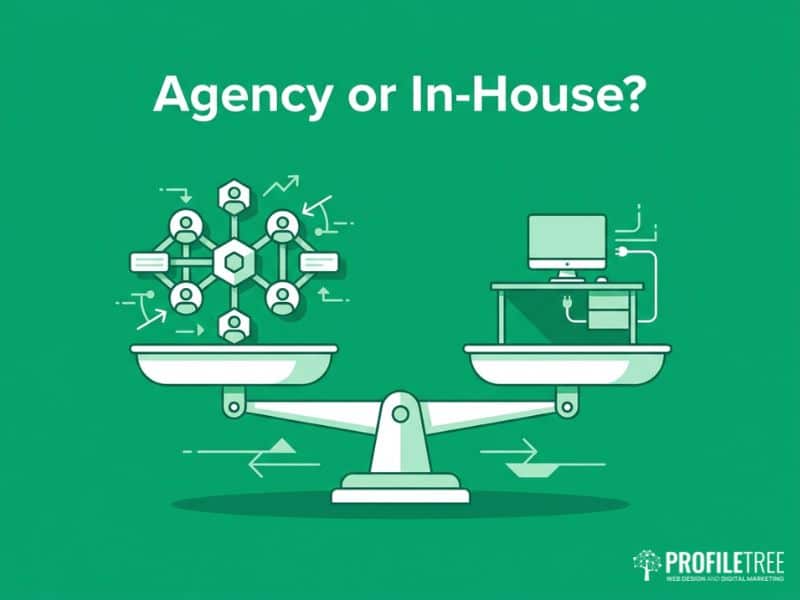
Before you shortlist any social media agency, decide whether an agency is even the right model. The choice between an outside agency and an in-house social media manager comes down to budget, control, and the breadth of skills you need. Neither option wins outright, and plenty of businesses run a hybrid where an internal manager owns the day-to-day and an agency supplies strategy, production, or paid expertise. Getting this decision right first saves you from shopping for the wrong thing.
When an Agency Makes Sense
An agency brings a spread of specialists you could not afford to employ separately: a strategist, a video editor, a paid media buyer, and a designer, all on one retainer. You also get transparency, since a social media agency has reviews, case studies, and contactable clients you can check before you sign. For a business scaling fast or running one-off campaigns, that flexibility usually beats the fixed cost of a full-time hire. The other quiet benefit is continuity: if one person is on leave, the work carries on, whereas a single in-house hire is a single point of failure.
When In-house Wins
An in-house social media manager works only for you, which means deeper knowledge of your brand and faster internal communication. If your social output is steady, your sector is niche, and you want someone embedded in the culture, a good hire can outperform an external team. The trade-off is range: one person cannot be a strong strategist, editor, and ad buyer at once, so gaps appear. One way to close those gaps is to send an existing employee on digital training courses, which suits businesses set on keeping the work in-house. Weigh the salary plus equipment, software, and benefits against an agency retainer before you decide, because the in-house route is not always the cheaper one once the full cost is counted.
What a Social Media Agency Costs in the UK
Pricing is the least transparent part of the market, with most agencies hiding behind bespoke quotes. The ranges below reflect typical UK retainers in 2026 and give you a benchmark, though your figure will move with scope, platform count, and how much paid budget the agency manages. Treat any retainer under £1,000 a month with caution: at that price you are usually buying automated posting with little strategy behind it, often handled by an overstretched junior.
Typical Retainer Tiers
The table sets out what most UK businesses pay and what each tier tends to include. Use it to sense-check a quote rather than as a fixed rulebook, since a strong specialist can deliver more at the mid tier than a generalist does at the top.
| Agency tier | Typical monthly retainer | Best suited to | Usually includes |
|---|---|---|---|
| Freelance or boutique | £1,500 to £3,500 | Startups and small businesses | Posting, community management, light ad management |
| Mid-market specialist | £4,000 to £10,000 | Scaling SMEs and e-commerce | Full strategy, video production, a dedicated account manager, paid social |
| Enterprise | £12,000 and up | Large brands and multi-market firms | Multi-platform strategy, high-end production, always-on monitoring, data science |
Retainer or Project Pricing
Most social media agency work runs on a monthly retainer because social is ongoing rather than a one-off. A retainer buys you consistency and a team that learns your brand over time. Project pricing suits a defined piece of work, such as a product launch campaign or a single video series, where you want a fixed scope and a fixed cost. If an agency pushes you straight into a long retainer for what is clearly a short campaign, ask why. The honest answer is sometimes that a project fee would serve you better. Campaign work often pairs social with other channels, such as email marketing, so ask how a quote handles that crossover.
What Moves the Price
Four factors shift a quote more than anything else: the number of platforms you want covered, whether video production happens in-house, how much paid budget the social media agency manages, and the level of reporting you expect. Adding TikTok video to a plan built for static LinkedIn posts, for example, changes the cost because it changes the production work. Ask for a breakdown by activity rather than a single headline number, so you can see where the money goes and cut anything you do not need. A transparent agency will hand this over without a fuss.
How to Choose the Right Social Media Agency
Choosing well is less about finding the flashiest portfolio and more about testing for fit, honesty, and a model that puts your goals first. Work through the questions and warning signs below with every provider on your shortlist. A social media agency that answers straight, shows real results, and admits what it does not do is worth more than one that promises everything and specialises in nothing.
Questions Worth Asking
Put each agency through the same short stress test and compare the answers side by side. The wording of their replies tells you as much as the content:
- Who owns the content and the ad account data if we leave? Both should stay yours.
- What is your attribution model? “Last click” alone means they are behind on measurement.
- Who actually does the daily work? Ask for the profiles of the people on your account, not the pitch team.
- How do you handle a problem outside office hours? Social does not stop at five o’clock.
- What share of budget goes to testing? Ten to twenty per cent is healthy; zero means no growth.
Red Flags to Walk Away From
Some signals should end the conversation. An agency that recommends every platform at once is guessing rather than strategising. One that reports only likes and reach is selling vanity metrics. Slow replies during the sales stage rarely improve after you sign, and a refusal to name the people who will run your account usually means juniors will do the work while directors take the credit. A credible social media agency will sometimes tell you that you are not a good fit, and that honesty is a mark of quality, not a lost sale.
Check the Track Record
Do the homework before you sign. Look at the social feeds of an agency’s current clients and judge whether the replies and content feel genuine or purely promotional. Read the case studies, ask for measurable outcomes rather than screenshots of high engagement, and speak to a client or two directly if you can. As ProfileTree founder Ciaran Connolly puts it, “Most SMEs know social media matters, but they lack the time and the in-house skill to run it well. The right agency brings the strategy and the measurement, so social becomes a genuine business asset rather than a cost.”
How a Social Media Agency Should Measure Success
Measurement is where a strong social media agency earns its retainer and a weak one hides. The whole point of paying a professional team is to connect social activity to money, so the metrics they report should map to your commercial goals rather than to platform vanity. Agree the measures before the work starts, and revisit them each month.
Attribution and the Halo Effect
With third-party cookies fading, proving the value of social has become harder and more important. A good agency can explain how a view on TikTok or a scroll past a LinkedIn post feeds a later search on Google or a direct visit to your site. That indirect influence, sometimes called the halo effect, is real but easy to miss if the agency only counts last-click sales. Ask how they account for it, and be wary of anyone who claims social has no effect beyond the final click. That crossover is why social and search engine optimisation are best measured together rather than in isolation.
The Metrics That Matter
Reach and engagement have their place, but they are early indicators, not the destination. The measures that should sit at the top of a report are qualified leads, cost per acquisition, and return on ad spend. For a business selling online, revenue attributed to social channels is the number that counts. A social media agency worth its fee will tie its reporting to these outcomes and treat likes as a supporting detail rather than the headline. Using AI in marketing can sharpen this measurement, spotting patterns across campaigns faster than manual analysis.
B2B and B2C Need Different Approaches
One of the more expensive mistakes UK brands make is hiring a generalist when their model demands a specialist. Selling a five-figure software subscription on LinkedIn calls for a different playbook than selling a low-cost skincare product on TikTok. Ask any prospective social media agency which model they know best, because the wrong specialism wastes both time and budget.
B2B: Social as a Trust Engine
In business-to-business, social media builds credibility over months, not moments. A social media agency working on B2B should focus on thought leadership for your senior team, account-based targeting that reaches specific decision makers, and lead quality measured in qualified enquiries rather than raw engagement. LinkedIn tends to carry the weight here, and steady social media management keeps that presence active between campaigns.
B2C: Social as an Impulse Engine
In business-to-consumer, speed and creativity win. The work centres on social commerce through TikTok Shop and Instagram Checkout, moving with cultural trends within hours, and building creator partnerships that feel authentic rather than bolted on. A B2C-focused social media agency lives closer to production and reacts fast, which is a different rhythm to the considered B2B approach. Social commerce also leans on the destination, so your store needs solid website design, reliable website development, and website hosting that holds up when a campaign sends a spike of traffic. If your buyers make quick, low-cost decisions, this is the model you want.
How AI Is Changing the Social Media Agency
Generative AI has reset what a good agency should cost and deliver. A modern social media agency now uses AI to sift social data for content gaps, to version-test ad copy at a scale humans cannot match, and to handle routine community tasks so people can focus on strategy. If an agency cannot explain how it uses these tools, you may be paying premium rates for manual work that should now be faster and cheaper.
The point is not that AI replaces the team. It is that AI should show up as better targeting, faster testing, and lower waste in your reporting. Ask a prospective agency to walk you through one campaign where AI changed the result, and judge the answer on specifics rather than buzz. This same discipline underpins good search work too, which is why our SEO services and social efforts tend to reinforce each other when they are planned together rather than in separate silos. Whichever social media agency you choose, treat AI as a question to probe rather than a badge to admire, and let the quality of the answer guide your decision.
FAQs
How much does a social media agency cost in the UK?
Most SMEs pay between £1,500 and £10,000 a month, depending on platforms, video production, and paid budget managed. Retainers below £1,000 usually mean automated posting with little strategy.
Is a social media agency better than hiring in-house?
An agency gives you a spread of specialists on one retainer, while an in-house manager offers deeper brand knowledge. Fast-scaling or multi-platform businesses often prefer an agency; steady, niche brands may do better in-house.
How soon will I see results?
Paid campaigns can show movement within weeks, but organic growth and lead generation usually take three to six months as content and targeting mature.
What should I ask before signing a retainer?
Confirm who owns the content and ad data, how they measure attribution, who runs the daily work, how they handle out-of-hours issues, and what share of budget goes to testing.
Do I need to be on every platform?
No. A good social media agency recommends only the platforms where your buyers actually are. Being told to join all of them at once is a sign of guesswork rather than strategy.