
Online Marketing Tips for UK and Irish Small Businesses
Table of Contents
Most online marketing advice was written for a search environment that no longer exists. In early 2026, SparkToro’s clickstream research put zero-click Google searches in the US at around 68%, up from roughly 60% two years earlier. Fewer than one in three searches now sends a click to any website at all. For a small business in Belfast, Cork, or Manchester, that changes what good marketing looks like. The job is no longer to chase rankings for broad terms. It is to be visible, trusted, and quotable across search engines, AI answers, social feeds, and inboxes at the same time.
This guide is built for that reality. It covers practical tips you can apply yourself, grouped by discipline, with the regulatory and cultural details that UK and Irish businesses actually need. ProfileTree, a Belfast-based web design and digital marketing agency, has spent years helping SMEs across Northern Ireland, Ireland, and the rest of the UK get found and convert, and the tactics here reflect what tends to work in those markets rather than recycled US playbooks.
If you are starting from scratch, our guide to why small businesses fail is a useful companion: weak demand and poor visibility sit near the top of the list, and most of that is fixable with the steps below.
What online marketing means now (and why the playbook changed)
Online marketing is the set of channels you use to get found and chosen: search, content, social media, email, and paid advertising. The disciplines have not changed. How discovery happens has.
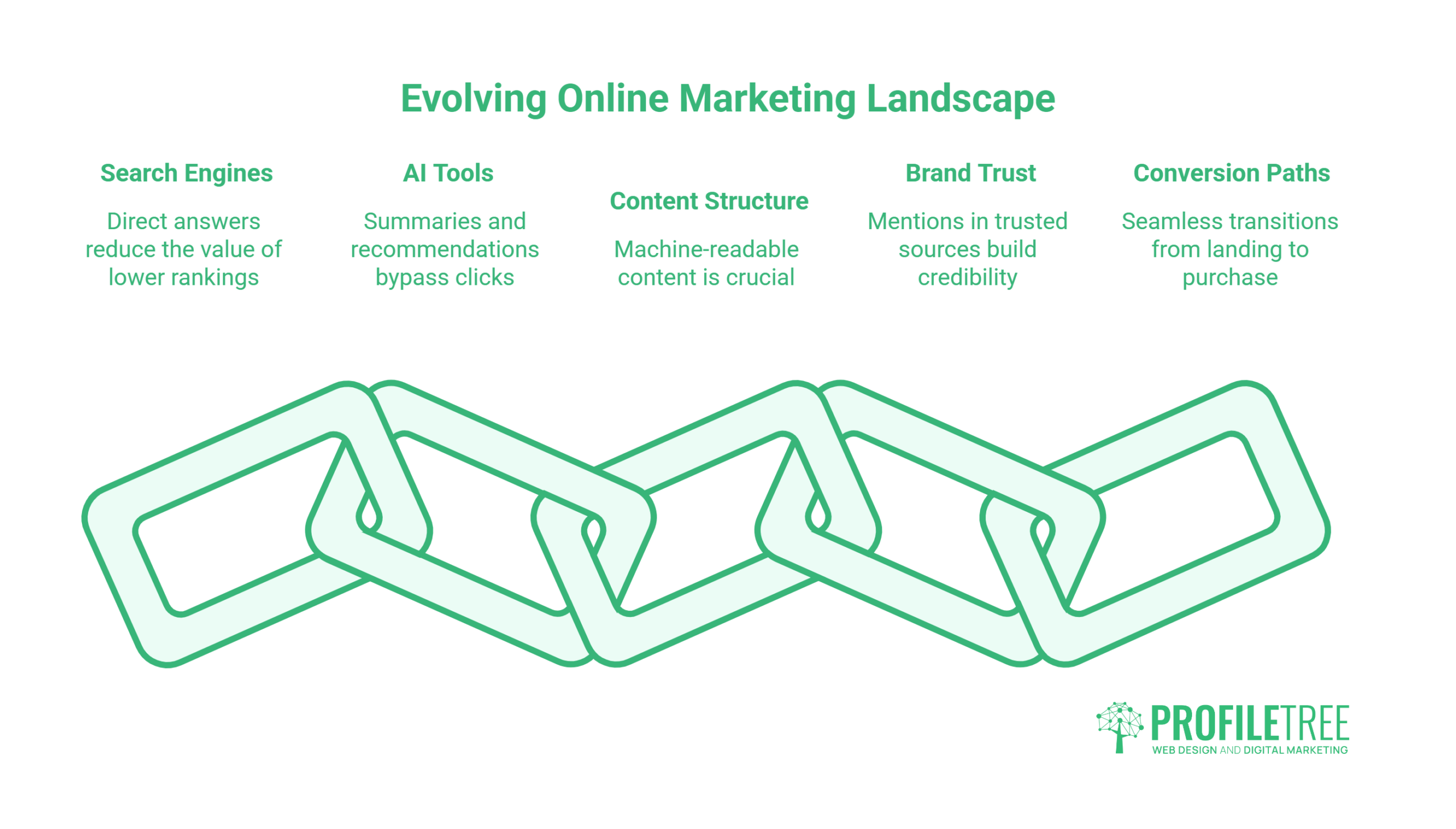
Two shifts matter most. First, search engines answer more questions directly, so ranking at position three is worth far less than it once was. Second, AI tools like ChatGPT, Claude, Gemini, and Google’s AI Overviews now sit between many buyers and the open web, summarising and recommending businesses without a click. The practical upshot: you need content structured so machines can quote it, a brand that gets mentioned in the places your buyers already trust, and conversion paths that work the moment someone does land on your site.
For a fuller picture of how search behaviour is moving, our analysis of the attention span crisis in the digital age covers why short, scannable, answer-first content now outperforms long preambles.
Strategy and measurement: get the foundations right
Start with goals tied to profit, not vanity. Social likes and follower counts feel good and tell you almost nothing. The numbers that matter are customer acquisition cost (what you spend to win one customer) and lifetime value (what that customer is worth over time). If a channel cannot be traced to one of those, treat it as an experiment, not a strategy.
Set up clean conversion tracking before you spend on anything. You want to see lead form submissions, phone calls, and sales, not just traffic. Privacy rules in the UK and Ireland push you toward consent-based, server-aware analytics rather than dropping every cookie you can. Getting this wrong creates both compliance risk and unreliable data, which is a poor base for any decision.
A quick reframe many owners find useful: marketing spend is an investment with a payback period, not a monthly cost to minimise. Once you can see cost per lead and conversion rate, you can move budget toward what works and stop guessing.
Search and AI discovery: SEO and GEO
Search is still where high-intent buyers start, but you now optimise for two audiences: search engines and AI answer engines. The second discipline is sometimes called Generative Engine Optimisation, or GEO.
Write content AI engines can quote
AI systems pull from content that is clearly structured and factually specific. Lead each section with a direct answer in the first sentence or two, then support it. Use plain statements that connect facts: what your business does, where it operates, who it serves. Add tables and specific numbers where you can, because structured data and statistics get cited more often than vague prose.
“Large language models build a picture of a business from how consistently and clearly it is described across the web, not from keyword repetition on a single page. The businesses that get recommended in AI answers are the ones with specific, factual, well-structured information that a model can lift cleanly and trust,” says Ciaran Connolly, founder of ProfileTree.
If you want help building this into your pages properly, our search engine optimisation services cover the technical structure and content work that makes a site both rank and get cited.
Master local SEO for UK and Irish search
For most service businesses, local visibility beats national rankings. When someone searches “web design Belfast” or “accountant near me”, Google leans on your Google Business Profile, consistent name, address, and phone details, and local relevance signals.
Claim and complete your Google Business Profile first; it is free and still one of the strongest local levers. Keep your business details identical everywhere they appear online. Earn reviews steadily rather than in bursts. Then build genuinely local content: write about your area, your local clients’ challenges, and regional conditions rather than swapping a city name into a template. Our piece on AI for local SEO goes deeper on dominating local results as AI search grows.
Target information-gain queries, not the same advice as everyone else
Google’s systems reward content that adds something. If your article repeats the same ten tips as every competitor, your ranking ceiling is low and AI engines have no reason to cite you over an established source. Bring something they cannot: your own project data, a regional angle, a specific worked example, or a clear point of view. This single habit does more for visibility than any technical tweak.
Keep the technical basics clean
Slow, clunky pages lose both rankings and customers. Core Web Vitals, particularly how quickly a page responds to interaction, feed into ranking and directly affect whether visitors stay. Mobile matters most: Google indexes the mobile version of your site first, and most local searches happen on a phone. A site that loads fast and works cleanly on mobile is now a baseline requirement, not a nice-to-have. Solid web development is what makes that reliable rather than occasional.
Trust-first content and community
UK and Irish buyers tend to be sceptical of hype. The aggressive, hard-selling copy common in US marketing often backfires here. Understated, evidence-led, value-first content builds trust faster in these markets, and trust is what converts.
Apply the anti-hype principle to your best content
Write as the helpful expert, not the salesperson. Replace bold claims with specifics: real timelines, honest pricing ranges, actual outcomes, and the trade-offs involved. A page that openly explains where your service is and is not the right fit reads as more credible than one that promises everything. This is largely a content marketing discipline, and it is where the long-term return sits.
Blogging remains one of the better-value channels for this. You do not need to publish weekly; one well-researched, genuinely useful article a month will outperform a stream of thin posts. Many businesses outsource this to an agency or freelance writer, which is often more cost-effective than building the skill in-house. For a sector-specific view of how this plays out, our look at healthcare blogging practices shows how niche depth wins trust.
Secure first-party data with value-first lead magnets
With third-party tracking fading, the email and contact data you collect directly is more valuable than ever. Earn it by offering something genuinely useful first: a practical checklist, a template, or a short assessment. Lead with value before you ask for an address, and you build a list of people who actually want to hear from you.
Build a focused social presence
You do not need to be everywhere. Pick the platforms where your customers actually spend time and engage properly there. LinkedIn suits B2B services and consultants: share useful observations, comment thoughtfully, and treat it as relationship-building rather than broadcasting. Facebook still works for local and consumer businesses, with precise local targeting in its ad tools. Instagram rewards authentic, visual storytelling over polished sales posts. Our overview of social media for small businesses maps which platforms fit which goals, and social media marketing services can take it off your plate if capacity is the constraint.
Use video for discovery, not just polish
Short video now functions as a search and discovery channel in its own right, especially for younger buyers. YouTube doubles as the world’s second-largest search engine, and video embedded on your own pages keeps visitors there longer. You do not need a studio; clear, helpful content beats high production values. The investment pays off across channels, which is why video marketing sits at the centre of so many SME strategies now.
Compliant conversion: email and automation
Email still delivers some of the strongest returns in digital marketing, but in the UK and Ireland it sits under PECR and UK GDPR (and the equivalent EU GDPR in Ireland). Get consent and process right, or you risk both fines and poor deliverability.
For consumer (B2C) marketing emails, you generally need clear prior opt-in consent. For business (B2B) outreach, a legitimate-interest basis can apply, but only under conditions: target named business addresses rather than generic ones, make the offer relevant to the recipient’s role, give a clear opt-out in every message, and document your reasoning. When in doubt, get explicit consent.
Beyond compliance, two habits lift results. Segment your list so people receive messages relevant to where they are in their journey rather than one generic blast. And clean your database regularly: inactive and invalid addresses drag down your sender reputation, and inbox providers increasingly punish poor list hygiene. A welcome sequence that solves problems before it pitches anything will out-earn a hard sell every time. Learning the tooling properly through digital training is often the fastest way to get a team self-sufficient here.
Budget-conscious paid advertising
Paid ads work best when organic foundations are already in place. Start at the bottom of the funnel, where intent is highest: search ads targeting people actively looking for what you sell usually return faster than broad awareness campaigns.
Retargeting your own first-party audiences, built from your customer and subscriber data, tends to outperform broad pixel-based targeting as browser tracking declines. For B2B, small test budgets on LinkedIn can reach specific niches without much risk. The rule across all of it: start small, measure against cost per acquisition, and scale only what proves out. A coherent digital strategy keeps paid spend pointed at the same goals as everything else rather than running as a silo.
Building a marketing system that lasts
Online marketing rewards consistent execution more than the perfect plan. Pick one or two tactics aligned to your main goal, get them working, then add the next. Trying to do everything at once is how most small-business marketing stalls.
Audit your content roughly once a year. Decide for each underperforming page whether to consolidate it with a stronger one, rewrite it with sharper local intent, redirect it, or remove it. This keeps your site focused and your authority concentrated where it counts. And keep the physical and digital connected: local chambers, enterprise offices, and regional networks still generate real relationships and links that strengthen your online presence. Sound web design underneath all of this is what turns the visits you earn into enquiries.
“The biggest mistake I see small businesses make is treating their website like a digital brochure instead of something that earns its keep. Your site should be working every day to turn visitors into enquiries, not just sitting there looking tidy,” says Ciaran Connolly, founder of ProfileTree.
If you would rather not assemble all of this yourself, ProfileTree works with SMEs across Northern Ireland, Ireland, and the UK on exactly these problems, from the website through to strategy, content, and training.
Frequently asked questions
What are the four main types of online marketing?
The four core types are search marketing (organic SEO plus paid search), content and social media marketing, permission-based email marketing, and digital PR or local citations. Each works at a different stage of the buyer’s journey, from first discovery through to conversion and repeat business. Most small businesses get the best results from combining two or three rather than spreading thin across all of them.
How can I market my UK or Irish small business online for free?
Several effective tactics cost time rather than money. Claim and fully complete your Google Business Profile, which is the single strongest free lever for local visibility. Keep your business details consistent across every directory and listing. Answer your customers’ real questions in helpful articles that target specific, long-tail searches. Engage genuinely in relevant communities, such as local Facebook groups or niche forums, without spamming. And build local partnerships and networks that earn mentions and links naturally. None of this needs ad spend; it needs consistency.
Does GDPR mean I cannot send cold marketing emails?
Not entirely, but the rules are strict. Under PECR and UK GDPR, marketing to consumers generally requires clear prior opt-in consent, so cold emailing individuals without it is not permitted. For business-to-business outreach, you can sometimes rely on legitimate interest, provided you target named business addresses, keep the offer relevant to the person’s role, include a clear opt-out in every message, and document your assessment. If you are unsure which applies, the safe route is to get explicit consent.
What is the best way for a complete beginner to start?
Start with a fast, mobile-friendly website and a complete Google Business Profile. Then create helpful content answering your customers’ most common questions to attract organic search traffic. Begin collecting email subscribers early so you own a direct channel to your audience. Only move to paid advertising once those foundations are generating some traction, so you are amplifying something that already works rather than paying to mask gaps.
What is Generative Engine Optimisation (GEO) and why does it matter?
GEO is the practice of structuring your content so AI search platforms like ChatGPT, Claude, and Google’s AI Overviews can read, cite, and recommend your business. As more buyers get answers from AI rather than clicking through to websites, being quotable inside those answers becomes a real source of visibility. In practice it means clear factual statements, answer-first structure, consistent business descriptions across the web, and credible sources, rather than keyword stuffing.
How do I measure marketing ROI without expensive software?
Focus on conversion metrics rather than vanity numbers. Set up basic conversion tracking in your analytics to count lead forms, calls, and sales. Then track two figures: your cost per acquisition (total marketing spend divided by new customers won) and your average customer value. Comparing those two tells you whether a channel is profitable, and you can calculate it with simple arithmetic long before you need any enterprise platform.