
When a Free Website Builder Isn’t Enough for Your Business
Table of Contents
A free website builder for your business stops being enough the moment growth exposes what it was never built to handle: a proper domain, real analytics, GDPR-ready data handling, or payments that settle cleanly into a UK or Irish bank account. Wix, Weebly and WordPress.com all cap storage on their free tiers, block custom domains, and limit e-commerce until you upgrade or move on. For a business testing an idea, that’s a fair trade. For a business chasing new customers or a serious marketing push, it is usually the point where a proper custom website development project starts to look like the cheaper option, not the more expensive one.
This guide sets out where free plans run out of road for businesses across Northern Ireland, Ireland and the wider UK, what staying on one actually costs in 2026, and what to do once a free website builder for your business has done its job.
What Free Website Builders Actually Offer
Wix, Weebly, WordPress.com, and Webnode all offer genuinely usable free website builders for your business at zero upfront cost, and for a brand-new venture testing demand, that is a fair trade. You get a subdomain (yourbusiness.wixsite.com, for example), a handful of templates, basic image galleries and, on most platforms, a simple contact form.
Wix’s free plan caps storage at 500MB and bandwidth at 1GB a month, according to Wix’s own storage documentation, which sounds like plenty until a handful of product photos or a background video eats through most of it. Every page also carries Wix branding. Weebly’s free tier matches that 500MB storage limit and leans towards simple online stores with a visible watermark, though it does not support online payments until you upgrade.
WordPress.com’s free plan gives you the familiar WordPress interface without the plugin flexibility of a self-hosted install, which matters more than it sounds once you need a specific booking form or payment integration. Webnode and WebStarts sit somewhere in between, offering decent templates but similar domain and storage restrictions once you look past the sign-up page.
None of these free tiers includes a custom domain, meaningful analytics or the storage a growing site needs, and that’s by design. The free tier exists to get you comfortable enough to eventually pay for the features that matter. That is a reasonable business model on the platform’s side, but it means a free website builder for your business is really a trial version rather than a long-term home.
For a business testing a concept, holding a placeholder page before a proper launch, or running a simple personal project, this is entirely reasonable. There’s no need to pay for anything more at that stage. The trouble starts when a business built on a free plan starts generating real enquiries, because that’s exactly when the missing domain, the capped storage and the limited SEO controls start costing money rather than saving it.
Where Free Plans Start to Hold UK Businesses Back

The gap between free and fit for a growing UK business shows up most often in three areas: domains, data protection, and payments. Each of these matters matters more once you have UK or Irish customers to answer to, and each one is easy to overlook when you are focused on simply getting a site live. None of them is a dealbreaker on its own, but together they explain why so many businesses outgrow a free website builder within the first year or two of trading.
Custom Domains and the .co.uk and .ie Problem
Most free builders advertise a “free domain,” but read the small print, and it is almost always a subdomain like yourbusiness.wixsite.com or yourbusiness.weebly.com, not a proper .co.uk or .ie address. Connecting your own domain, even one you’ve already bought, typically requires upgrading to a paid plan on Wix, Weebly and WordPress.com alike.
This matters for two reasons. A branded domain looks more credible to a customer comparing three suppliers on Google, and it’s a small but real local SEO signal for businesses targeting Belfast, Dublin or a specific UK region. A .co.uk or .ie extension registered through a standard registrar costs relatively little each year; the cost is in the forced upgrade, not the domain itself.
Some free plans will let you point a domain at their platform using external DNS tricks, but the results tend to be unreliable, and support teams generally won’t help you troubleshoot a workaround they don’t officially support. Choosing .co.uk for a Northern Ireland or GB audience, or .ie for the Republic, signals local trust in a way a generic .com or a builder’s subdomain simply can’t.
GDPR and Data Storage on Free Platforms
Free website builders headquartered in the US do not always make UK GDPR compliance straightforward. Contact forms need clear consent wording, cookie banners need to actually block tracking until a visitor agrees, and you need to know where customer data is stored and for how long. Free tiers often bundle basic, generic versions of these tools with limited customisation, which can leave gaps a UK regulator would flag.
None of this is impossible to fix on a free plan, but the settings are usually more restricted than on a paid tier or a self-hosted WordPress site, where a plugin can give full control over consent, retention and data location. Some free tiers also store customer data on servers outside the UK and EU by default, which adds an extra layer of checking before you can honestly tell a customer their details are handled properly.
The Information Commissioner’s Office runs a self-assessment checklist built specifically for small business owners and sole traders, and it’s a better starting point than assuming your builder has already sorted compliance for you. Worth flagging: the ICO notes this particular checklist is under review following the Data (Use and Access) Act, so it’s worth checking for updates before you lean on it too heavily.
Payment Gateways and UK and Irish Currency Support
If you plan to sell anything, free e-commerce tools on Wix and Weebly are limited by design. Wix’s free tier does not support online payments at all, and Weebly’s free plan blocks them too; you need at least an entry-level paid plan on either platform before you can accept card payments. Where payments are supported on paid tiers, check that pricing displays properly in GBP or EUR rather than defaulting to USD, and that Stripe or PayPal actually settle into a UK or Irish bank account without extra conversion fees.
Local pick-up and delivery options, VAT handling for UK sales, and simple things like displaying prices inclusive of VAT are also more often locked behind paid tiers than free ones. For a retail or hospitality business, these small gaps add up to a checkout experience that feels less trustworthy than it should.
Weebly’s Platform Risk Is the Warning Sign Most Guides Miss
Storage caps and missing domains are the obvious limits. A less obvious one is whether the platform itself is still being invested in, and Weebly is a live example of why that matters.
Square, which owns Weebly, announced in June 2026 that Weebly would stop serving customers in 67 countries, with sites going offline from late September 2026 and accounts closed by the end of the year, as reported by the Khaleej Times. The UK and Ireland are not on that affected list, so a Weebly site built here keeps running for now. What the announcement does show, though, is a platform in wind-down mode: no new features, a smaller engineering team, and every new sign-up steered towards Square’s separate Online Store product instead.
For a free website builder for your business, that is a different kind of risk to a storage cap. A storage cap you can plan around. A platform quietly losing investment from its own owner is harder to see coming, and it is not unique to Weebly; any free or low-cost builder can change its pricing, features, or ownership with little warning. A business with paying customers relying on that platform has no vote in the decision.
Five Signs Your Business Has Outgrown a Free Website
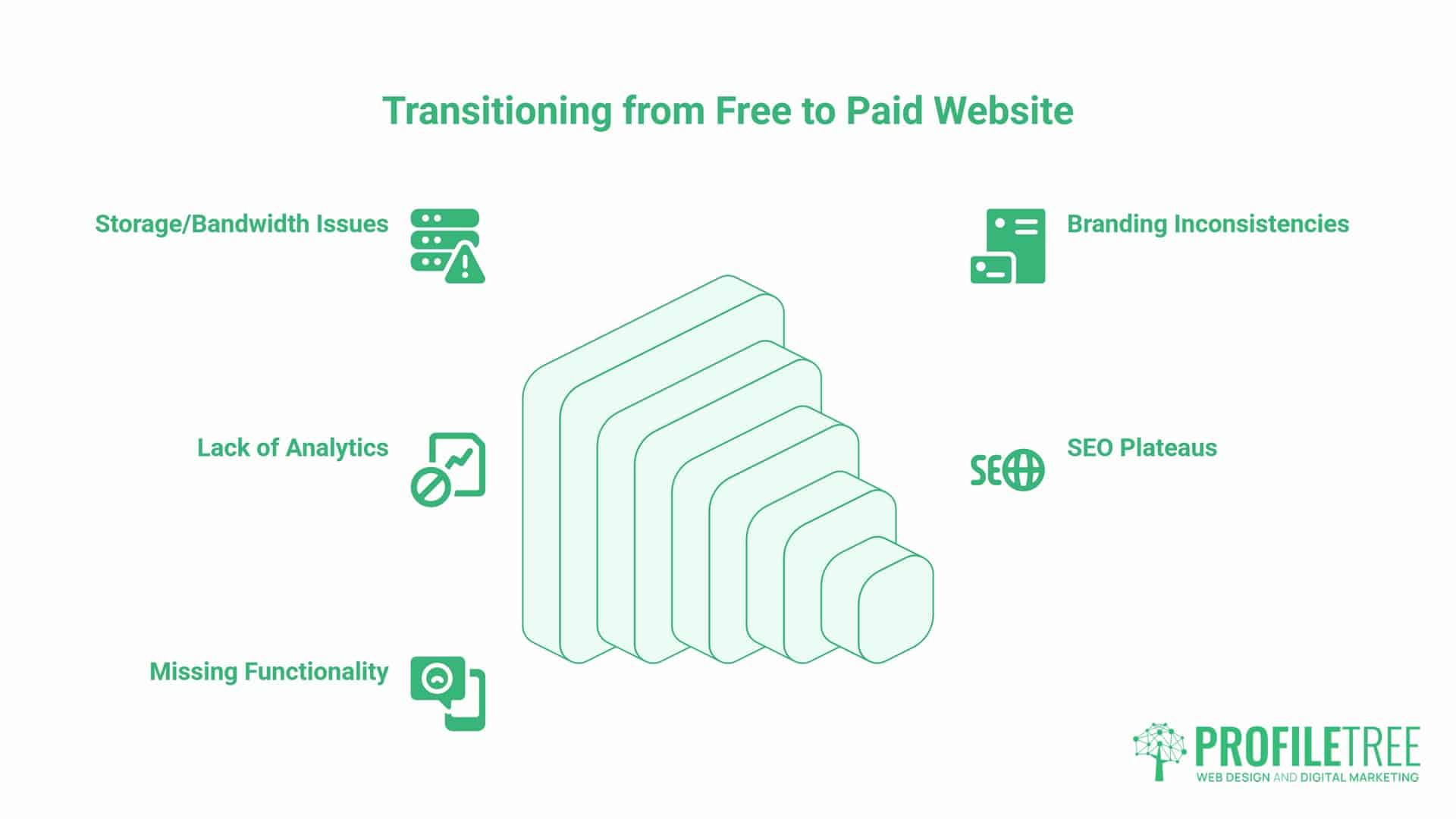
Most businesses don’t wake up one day and decide to migrate; they notice a string of small frustrations that add up. Here are the signs that tend to show up first when a free website builder for your business has reached its limits, gathered from the kinds of enquiries we hear most often from small business owners in Northern Ireland and the UK.
- Storage or bandwidth ceiling: free plans cap image storage and monthly visitors, and a successful marketing campaign, a local press mention or a viral social post can push you past that limit at exactly the moment you most need the site to stay up.
- Branding keeps showing through: a “Made with Wix” banner or a Weebly-hosted subdomain undermines the professional image you are trying to build, particularly for service businesses pitching against established competitors who have already invested in a proper website.
- No proper analytics: free tiers usually give you basic visit counts, not the conversion tracking, heatmaps or search performance data you need to make real marketing decisions.
- SEO plateau: free builders limit control over meta titles, structured data and site speed, all of which matter for ranking in Northern Ireland, Ireland or UK searches.
- Missing functionality: booking systems, membership areas, multi-currency checkout or CRM integration all sit behind paid plans or require a move to self-hosted WordPress.
If two or more of these sound familiar, it’s a reasonably strong sign that whatever got you online in the first place has done its job, and it’s time to look at what comes next.
What Upgrading Actually Costs in 2026
The direct upgrade cost is only part of the picture, but it’s worth knowing the actual numbers before you decide which route to take. Wix’s own UK pricing, reviewed across several independent pricing guides in 2026, puts the entry-level Light plan at roughly £9 a month on annual billing. It removes branding and lets you connect a custom domain, but it still has no online store. Core, the first tier that unlocks payments, runs at roughly £16 a month. Weebly’s paid tiers sit lower on paper, starting from around $10 to $13 a month for its Personal tier, though pricing and plan names have shifted since the Square acquisition and are worth double-checking on the day.
| Route | Typical monthly cost | What it unlocks |
|---|---|---|
| Wix Light (UK, annual) | Around £9 | Custom domain, branding removed, no e-commerce |
| Wix Core (UK, annual) | Around £16 | Online payments, more storage |
| Weebly Personal | Around $10 to $13 | Custom domain, branding removed |
| Self-hosted WordPress | Hosting from roughly £5 to £15, plus a one-off build cost | Full SEO control, any plugin or payment gateway, no storage ceiling |
Businesses that stay on a free plan too long often end up paying twice: once in lost enquiries from a site that does not rank or convert well, and again when they eventually rebuild from scratch rather than migrating in good time, often losing months of accumulated Google rankings in the process. Budgeting for an upgrade within the first six to twelve months, once you know the business has genuine demand, tends to work out cheaper than waiting for a crisis.
What to Do When You Have Outgrown Your Free Website Builder
Once you recognise the signs that a free website builder for your business has run its course, there are broadly two paths: upgrade within your existing platform, or move to a self-hosted WordPress site built around your business rather than a template. Which one makes sense depends on how far your ambitions stretch.
Upgrading within Wix, Weebly, or WordPress.com removes branding and unlocks a custom domain quickly, and it’s the right call if your needs are still fairly simple and your growth plans are modest. It’s usually the fastest fix and the smallest disruption, which makes it a sensible first step for a business that just needs the basics sorted.
Moving to a self-hosted WordPress build makes more sense once you need bespoke functionality, full SEO control, or a site that can grow with bookings, memberships or a proper online shop without hitting another ceiling in a year’s time. It costs more upfront than a paid builder tier, but it removes the ceiling altogether, which matters if you expect the business to keep growing rather than plateau.
“Free website builders solve the immediate problem of getting online quickly, but we regularly work with Belfast businesses who’ve outgrown these platforms within 12-18 months,” notes Ciaran Connolly, founder of ProfileTree. “The transition costs rebuilding content, losing SEO equity, and retraining staff often exceed what custom development would have cost initially.”
A structured migration plan protects the SEO equity you have already built. That typically means auditing which pages and keywords already bring in traffic, mapping old URLs to new ones with redirects, and rebuilding content rather than simply moving it verbatim, so search engines do not see the change as starting from scratch. Skipping this step is the single most common reason a migration ends with lower traffic than the business had before, even on a much better site.
ProfileTree’s team handles exactly this kind of transition for SMEs across Northern Ireland, Ireland and the UK, including ongoing website hosting and management once the new site is live and search engine optimisation support to help it actually rank for the terms the free site never could.
How ProfileTree Helps Belfast and Northern Ireland Businesses Make the Move
ProfileTree is a Belfast-based web design and digital marketing agency that works with SMEs, moving on from a free website builder for your business onto sites built to grow with them. That usually starts with a straightforward conversation about what the business actually needs now and over the next two to three years, rather than a like-for-like copy of the existing free site.
For a service business, that might mean a proper booking system and location-specific pages targeting Belfast, Derry or wherever the business operates. For a retailer, it usually means full-currency e-commerce and stock management that a free plan was never built to handle. For a business that has been running training or mentoring sessions off the back of a simple free site, it often means a site that can showcase case studies, testimonials and service pages properly, rather than cramming everything onto one page, delivered through a full web design and development service rather than a swapped-out template.
Neither hosting nor SEO is a one-off task. A website that stops being maintained tends to slide back towards the same problems a free plan created in the first place, just with a bigger bill attached.
The Right Call for Your Business
A free website builder for your business does exactly what it is designed to do: get you online quickly with no upfront cost. For testing an idea that is genuinely useful, and there is nothing wrong with starting there while you work out whether the business has legs. For a business with real customers, growth plans and a reputation to build in a competitive UK or Irish market, the restrictions around domains, data protection, payments and platform stability tend to catch up sooner than expected, usually just as things start going well.
The businesses that handle this well treat the free-to-paid decision as a planned step rather than an emergency reaction to a lost sale, a GDPR question they cannot answer, or a platform shutdown notice they did not see coming. If you’re weighing up whether your current site can keep pace with where the business is headed, it’s worth having a proper conversation before the free plan makes the decision for you.
FAQs
Is a free website builder ever the right choice for a UK business?
Yes, a free website builder for your business makes sense for testing a new idea, holding a page before a proper launch, or a very small side project with no real growth ambitions. It becomes the wrong choice once paying customers rely on the site working properly.
Can I connect a .co.uk or .ie domain to a free Wix or Weebly site?
Generally not on the free tier. Connecting your own domain almost always requires upgrading to a paid plan, even if you have already bought the domain elsewhere.
Is Weebly shutting down in the UK?
No. Square’s 2026 closure affects 67 other countries, not the UK or Ireland. A UK Weebly site keeps running, but the platform has a smaller team and no new features, so it is worth watching.
How do I know if my business needs a custom WordPress site instead of a free builder?
If you need bookings, memberships, multi-currency payments, or SEO control that the free tier does not offer, a custom build usually pays for itself within the first year through the enquiries it captures.
Will upgrading from a free plan definitely fix my website’s problems?
Not automatically. Upgrading removes some restrictions, but a genuinely custom WordPress build gives full control over speed, SEO and functionality that a template, free or paid, cannot always match.