
Viral Marketing: A Practical Guide for SMEs
Table of Contents
Viral marketing is what happens when content earns its own reach. One person shares it, their network shares it further, and the original post travels beyond any audience you could have bought. For a small or medium-sized business, a single piece of content going viral can do more for brand awareness than months of paid advertising.
But “going viral” is not luck disguised as strategy. It is the result of deliberate decisions: the right emotional trigger, the right format for the platform, and the right production quality to earn the algorithm’s attention in the first place. This guide explains how viral marketing works, why most business attempts fall short, and what UK and Irish SMEs can do differently.
What Is Viral Marketing?
Viral marketing is a strategy that relies on audiences sharing content organically, creating a chain reaction of exposure that multiplies reach without requiring proportional increases in spend. The term comes from the idea of a virus spreading through a population: each infected person infects others, and growth becomes exponential rather than linear.
The mechanics depend on a concept called the viral coefficient. If every person who sees your content shares it with two people, and each of those two shares it with two more, the reach doubles with every cycle. A viral coefficient above 1.0 means the content is self-sustaining. Below 1.0, it fades. Most content sits well below 1.0. The goal is not to guarantee viral spread but to maximise the probability that the coefficient reaches or exceeds that threshold.
What distinguishes viral marketing from paid reach is the role of the audience. In paid advertising, distribution stops when the budget stops. In viral marketing, the audience does the distributing. That shift in economics is why a small business with a well-made video can reach more people in a week than a large competitor spending heavily on display advertising.
The Psychology of Sharing: Why People Hit Send
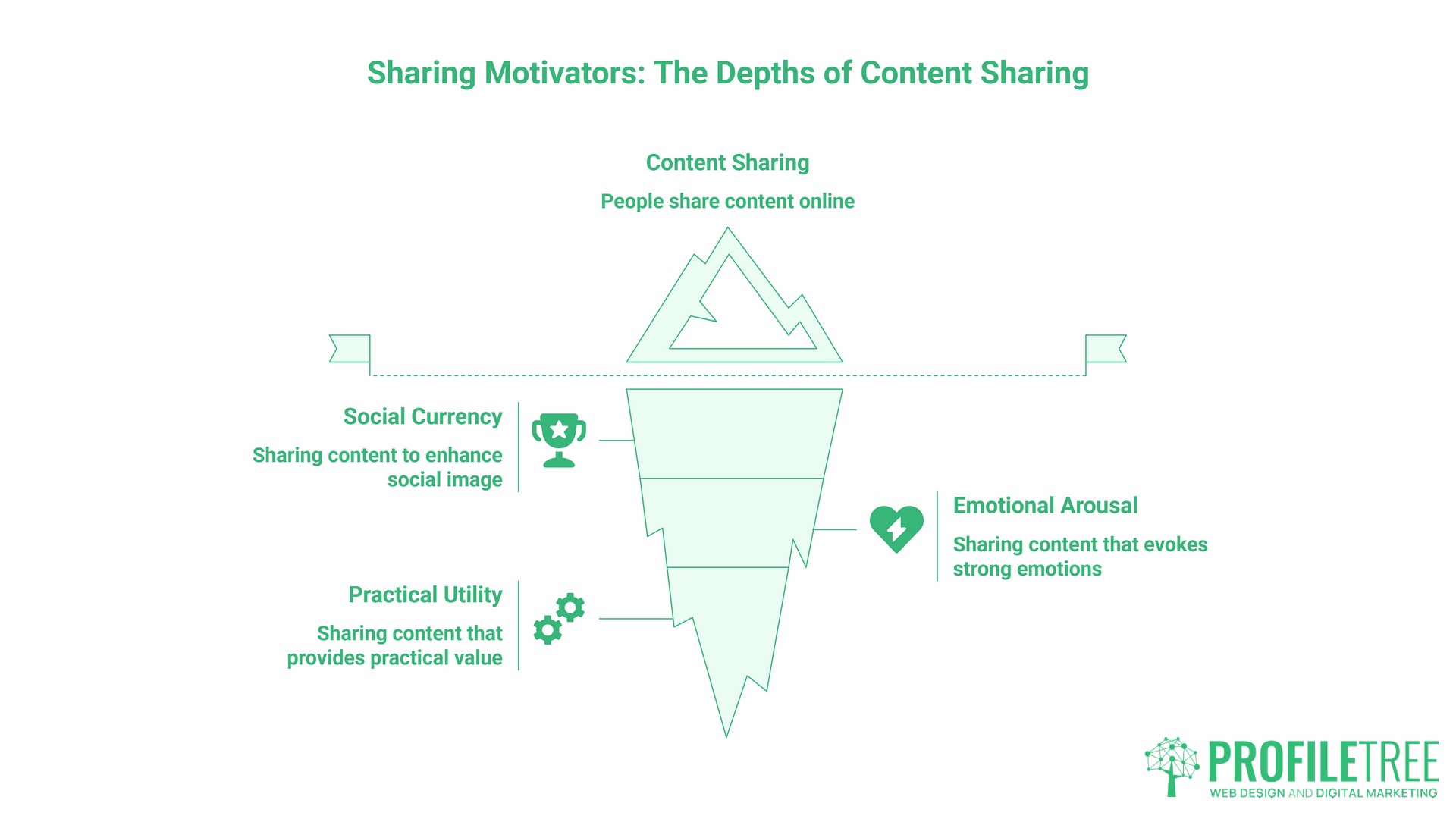
Understanding why people share content is the foundation of any viral marketing strategy. Jonah Berger, Professor of Marketing at the Wharton School of the University of Pennsylvania, identified six sharing motivators in his 2013 book Contagious: Why Things Catch On. Three of those motivators are most relevant for SMEs.
- Social currency drives a significant proportion of sharing behaviour. People share content that makes them look informed, funny, or socially aware. A local restaurant posting an unexpected take on a food trend, or a Belfast accountancy firm sharing a counterintuitive insight about tax planning, gets shared because the person sharing it benefits from the association. The content reflects well on them.
- Emotional arousal triggers sharing more reliably than useful information alone. Berger’s research distinguishes between high-arousal emotions, including awe, amusement, and even mild anger or surprise, which push people to act immediately, and low-arousal emotions, such as contentment or mild sadness, which do not. This is why content that provokes a strong reaction (“I can’t believe that’s true” or “this is genuinely funny”) outperforms content that is merely pleasant or informative.
- Practical utility is particularly powerful in B2B and professional contexts. When content helps someone do their job, save money, or avoid a common mistake, they share it with colleagues and peers who face the same problems. A short video explaining one specific thing that most small business owners get wrong, without padding or preamble, can travel through professional networks because every person who shares it is adding value to someone they know.
The implication for viral marketing strategy is that you are not trying to create content that is broadly appealing. You are trying to create content that triggers one of these responses strongly enough to motivate an immediate action.
The Infrastructure of Virality: Why Production Quality Matters
There is a widespread belief that rough, lo-fi content performs better because it feels authentic. This is partly true for individual creators, and almost never true for businesses. When a brand publishes poorly lit, hard-to-hear video content, audiences interpret it as a signal that the business does not care about quality. Platforms read low completion rates as a signal that the content is not worth distributing.
Professional production for viral content does not mean a film crew and a full day on location. It means:
- Clean, consistent audio (a £40 lapel microphone eliminates most audio problems)
- Adequate lighting that does not require viewers to squint
- Editing that removes dead time and cuts at the right moments
- Thumbnails and opening frames designed to earn the click or the watch
These are not luxuries. They are the baseline the algorithm requires before it will distribute content beyond your existing followers. TikTok’s For You Page, Instagram’s Reels feed, and YouTube Shorts all use watch time and completion rate as primary distribution signals. If viewers click away in the first three seconds, the content stops spreading regardless of how good the idea behind it is.
The hook is everything. Whether it is a surprising opening line, an unexpected visual, or a question the target audience immediately wants answered, the first three seconds of a video determine whether the content earns the attention required for viral distribution.
ProfileTree’s video marketing work for UK and Irish SMEs is built on this principle: the idea matters, but execution determines reach. You can learn more about how professional video marketing supports organic distribution, or explore the broader shift toward short-form video content and what it means for brands investing in this format.
Viral Marketing Examples: UK and Ireland Case Studies
Most guides on viral marketing cite US examples: the ALS Ice Bucket Challenge, Dollar Shave Club, Old Spice. These are relevant to understanding the mechanics, but they are poor models for UK and Irish SMEs. The following examples are more instructive.
- Greggs and the Vegan Sausage Roll (2019) remains one of the most studied examples of reactive viral marketing in British retail. Greggs announced the product with a parody video mimicking Apple’s iPhone launch style, complete with dramatic music and sleek visuals. The absurdity was the point: a high-street bakery delivering a product reveal with the sincerity of a tech giant. The launch video was watched 8 million times, with 82.5% of those views unpaid. Organic Twitter reach hit 24 million.
- PR coverage reached 69% of UK adults over eleven times, and like-for-like sales grew 9.6% in the first seven weeks of 2019. The campaign was later named Marketing Week’s Brand of the Year. The lesson: a strong creative idea matched to the right format can outperform any budget.
- Aldi vs. Marks & Spencer (Cuthbert the Caterpillar, 2021) demonstrated how a legal dispute could become a viral marketing asset. When M&S took legal action over a caterpillar cake design, Aldi’s social media team turned the story into a running campaign with the hashtag #FreeCuthbert. The campaign started with a single tweet parodying M&S’s own tagline.
- Within a few hours, #FreeCuthbert was trending at number one on Twitter. User-generated videos accumulated over 30 million views across social media. The campaign generated 1,400 pieces of written media coverage and won the 2021 Marketing Week Masters Award for Social Media. The lesson: speed and brand voice matter as much as production quality in reactive content.
- Specsavers’ reactive social media is worth studying for any business that doubts whether smaller brands can participate in viral moments. Specsavers has built a consistent practice of responding to news events and social media moments with simple, well-timed posts that reference their “Should’ve gone to Specsavers” slogan. The production cost is negligible. The timing and the wit do the work. The lesson: Virality does not always require video or significant spend.
For B2B businesses, “niche virality” on LinkedIn is worth understanding separately. A manufacturing firm sharing a genuine insight about a common process problem, delivered by someone with visible credibility in that industry, can reach thousands of relevant decision-makers through shares and comments. The audience is smaller than a consumer campaign, but the commercial value per view is significantly higher.
Choosing Your Platform: Where Viral Momentum Actually Happens
The platform determines the format. Choosing the wrong one wastes production effort and budget. Here is a practical breakdown for SMEs.
| Platform | Best content type | Primary signal | Ideal for |
|---|---|---|---|
| TikTok | Short-form video (15-60 sec) | Shares/saves | Consumer brands, hospitality, retail |
| Instagram Reels | Short-form video (30-90 sec) | Comments/dwell time | Visual products, lifestyle, food |
| YouTube Shorts | Short-form video (under 60 sec) | Click-through + watch time | Education, how-to, professional services |
| Text posts, short video | Retweets/replies | B2B, professional services, recruitment | |
| X (Twitter) | Text, short video, image | Retweets / replies | Reactive content, news-adjacent topics |
TikTok’s algorithm is the most powerful distribution engine available to businesses right now for consumer audiences. It surfaces content to people who have no prior connection to your account, which means a well-made video from a brand with zero followers can reach hundreds of thousands of relevant viewers. Our TikTok statistics for the UK shows why this platform has become a priority for brands targeting under-45 audiences. Before investing in TikTok content, it is worth understanding the common TikTok marketing mistakes that cause otherwise good content to underperform.
LinkedIn virality works differently. The platform prioritises content that generates comments and extended reading time. A post that poses a genuine question, challenges a widely held assumption, or shares a specific insight from real-world experience can travel rapidly through professional networks, particularly if early engagement from well-connected individuals triggers further distribution.
The practical recommendation for most UK and Irish SMEs is to pick one platform and do it properly before attempting to be present everywhere. Consistent, well-produced content on one platform will outperform thin, inconsistent content spread across five.
How to Launch a Viral Marketing Campaign: A Step-by-Step Approach
Viral success cannot be guaranteed. What can be engineered is a higher probability of success through deliberate planning.
- Step 1: Define the emotional target. Before scripting or designing anything, decide which emotion the content is intended to trigger. Amusement, surprise, admiration, and mild outrage all work. “Informative” is not an emotion. If the best description of the content’s effect is “people will find it useful,” that is a good start, but it needs a sharper emotional edge to motivate active sharing rather than passive consumption.
- Step 2: Build the hook first. Write the first three seconds before anything else. The opening line, image, or question is the only part that matters for initial distribution. Everything else follows from whether this hook earns the continued watch.
- Step 3: Match format to platform. A 90-second YouTube-formatted video will not work on TikTok. A TikTok designed for the For You Page may not translate to LinkedIn. Decide the primary platform before production begins, and design for that platform’s specific format requirements.
- Step 4: Seed strategically. Viral content rarely starts spreading from zero. Identify ten to twenty people, whether industry contacts, local communities, or existing customers, who are likely to engage with the content early. Early engagement in the first hours after posting is disproportionately weighted by most platform algorithms. Getting genuine shares and comments from real people in that window improves organic distribution.
- Step 5: Plan for the traffic. This is where most SMEs are underprepared. If a campaign does achieve significant reach, the resulting traffic spike will hit your website. A site that loads slowly, is not optimised for mobile, or has no clear path from landing to conversion wastes the opportunity. ProfileTree’s website development work with SMEs consistently shows that the gap between viral traffic and actual business results comes down to site performance and conversion design, not the campaign itself. An otherwise successful campaign generates no revenue if the website cannot handle the volume or turn visitors into leads.
- Step 6: Follow up immediately. The 48 to 72 hours after a piece of content achieves meaningful reach are the highest-value window for follow-up content. A second video that responds to the reaction, a behind-the-scenes post, or a piece of content that serves the new audience you have just reached can extend the momentum and convert temporary attention into lasting audience growth.
The Risk Factor: When Viral Goes Wrong
Every guide on viral marketing discusses how to achieve viral reach. Very few address what happens when a campaign goes viral for the wrong reasons.
Negative virality occurs when content attracts mass sharing driven by criticism, mockery, or outrage rather than admiration. It can happen to any business, but certain triggers are predictable: campaigns that appear culturally tone-deaf, that trivialise serious issues, or that make claims quickly contradicted by the audience’s direct experience.
The risk is not only reputational. A campaign that generates viral criticism can create a lasting association between your brand and the specific failure. This is more damaging than simply producing content that does not spread.
Practical risk management for SME viral campaigns:
- Get genuinely critical feedback on the content before publishing, not just from people who want to support you
- Avoid any campaign mechanic that could be easily subverted, such as open voting, user submissions without moderation, or hashtag campaigns that can be hijacked
- Prepare a response plan before launching: if the campaign attracts negative attention, know who will respond, what the tone will be, and how quickly
“If you would be embarrassed for the campaign to appear in a national newspaper under a critical headline, do not publish it” is a reasonable test. Most content that fails this test still gets published because the team creating it has lost the ability to see it from the outside.
Measuring Success: Beyond the Vanity of Views
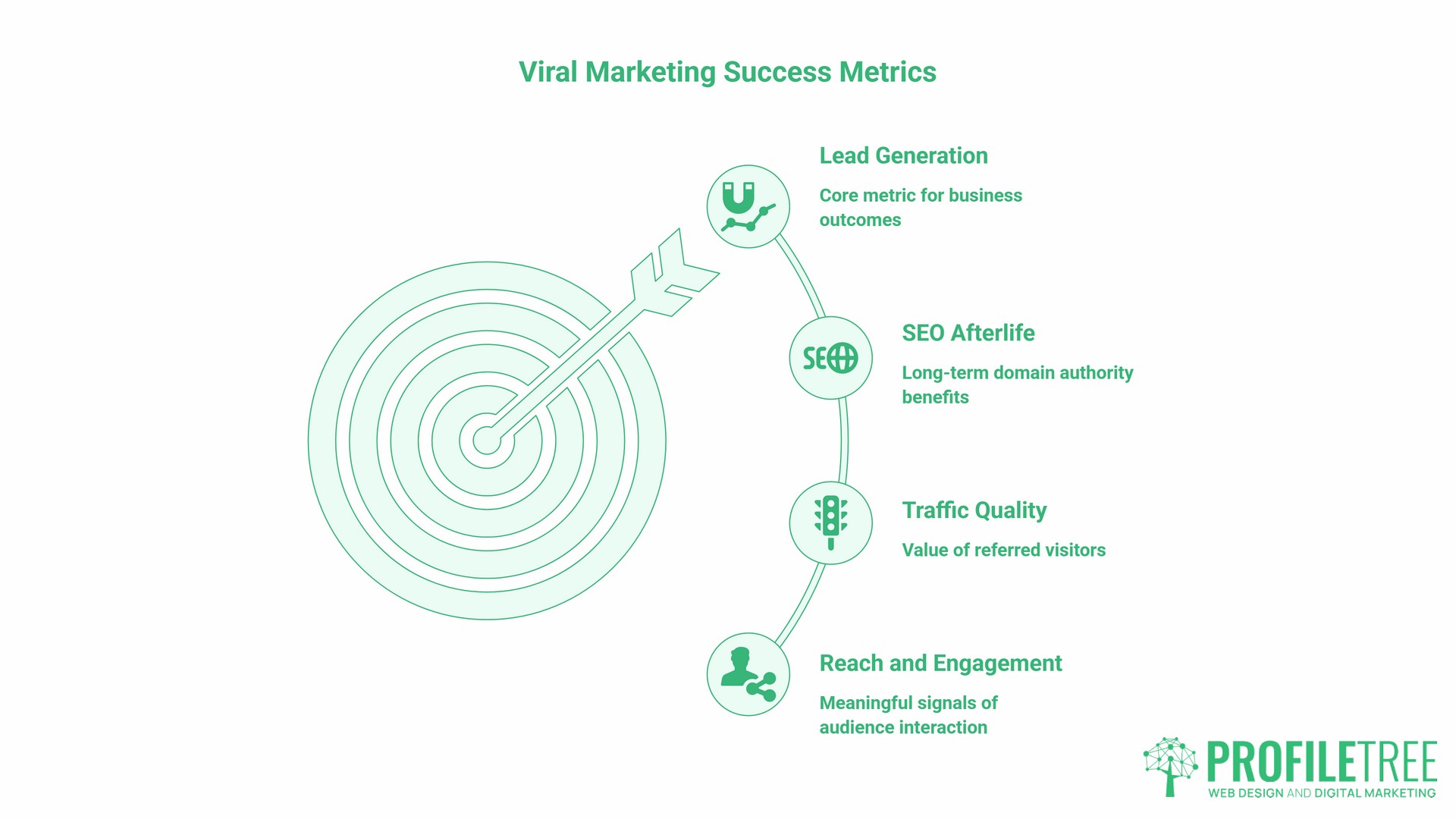
View counts and share counts are metrics that feel significant but rarely translate into business outcomes. The measurement framework for viral marketing needs to connect activity to commercial results.
Reach and engagement: Track unique reach (how many different people saw the content), not just impressions (how many times it was seen). Engagement rate, the proportion of people reached who took an action, is a more meaningful signal than absolute engagement numbers.
Traffic quality: How much referral traffic did the campaign generate, and what did those visitors do on your site? A campaign that drives 50,000 people to your homepage, none of whom convert, is less valuable than one that drives 2,000 people to a service page with a 3% conversion rate.
SEO afterlife: Viral content that earns backlinks from other websites creates long-term domain authority benefits that outlast the campaign itself. When journalists, bloggers, or industry publications reference your content, they create inbound links that improve your organic search visibility for months or years. Understanding how to build on this authority through a structured SEO strategy is how businesses turn a one-time viral moment into a sustained improvement in search performance.
Lead generation: How many email addresses, enquiries, or direct messages did the campaign generate? For most SMEs, this is the most important metric, and it requires having a clear conversion mechanism built into or adjacent to the viral content itself.
Building a Viral Marketing Strategy That Fits Your Business
Viral marketing works best as part of a broader digital marketing strategy, not as a standalone tactic pursued in isolation. The businesses that achieve repeatable viral success tend to share a few characteristics: they publish consistently enough that the algorithm learns their audience, they have a clear brand voice that makes their content recognisable, and they treat each piece of content as a test rather than a guaranteed win.
A social media content strategy that incorporates regular attempts at virality, with realistic expectations about success rates, is more sustainable than chasing viral results on an ad hoc basis. Most content will not go viral. The goal is to create the conditions in which viral success becomes possible, and to be positioned to capitalise when it happens.
For businesses that want to build these capabilities in-house, ProfileTree’s digital training covers content strategy, video production fundamentals, and platform-specific distribution. The aim is to give marketing teams the skills to execute consistently rather than being dependent on external support for every campaign.
As Ciaran Connolly, founder of ProfileTree, puts it: “The SMEs we work with who build genuine content capability tend to see viral moments as a byproduct of doing the basics well, rather than something they can plan for in isolation. Get the production quality right, understand your platform, and publish consistently. The viral results follow from that, not the other way round.”
FAQs
What is viral marketing?
Viral marketing is a strategy that relies on audiences sharing content organically, creating exponential reach without a proportional increase in advertising spend. Unlike paid campaigns that stop when the budget runs out, viral content continues spreading as long as people find it worth sharing.
Can you guarantee a post will go viral?
No. Viral spread depends on a combination of content quality, emotional resonance, platform timing, and audience behaviour, all of which cannot be fully controlled. What can be engineered is a higher probability: the right emotional trigger, the right format, strong production quality, and strategic seeding in the first hours after publishing all increase the likelihood without guaranteeing the outcome.
What are the four types of viral marketing?
The most widely cited categories are emotional viral marketing (content that triggers strong feelings), incentivised viral marketing (sharing driven by a reward or entry requirement), social viral marketing (content that spreads through communities or networks of shared interest), and informational viral marketing (content that spreads because it teaches something genuinely useful). In practice, the most effective campaigns combine elements of more than one type.
Is viral marketing better for B2B or B2C?
B2C campaigns have higher potential reach because consumer audiences are larger, but B2B viral content can deliver higher commercial value per view. On LinkedIn, a post that reaches 10,000 relevant decision-makers in a specific industry can generate more pipeline than a consumer campaign reaching millions of people with low purchase intent. The goals and measurement framework differ significantly between the two.
What is the viral coefficient?
The viral coefficient is the average number of new people each existing viewer brings to the content through sharing. A coefficient of 1.0 means the content is self-sustaining: every viewer generates one additional viewer. Above 1.0, growth is exponential. In practice, most content sits well below 1.0, which is why initial seeding and platform algorithm support matter so much in the early hours after publishing.
How much does a viral marketing campaign cost?
Production costs vary widely, but the relationship between budget and viral success is not linear. Some of the most widely shared business content has been produced with minimal spend; some expensive productions have generated no organic reach at all. The more useful question is whether the production quality is high enough to earn the platform’s distribution. For most UK SMEs, that threshold is achievable without large budgets, provided the fundamentals of audio, lighting, and editing are handled properly.
Does viral marketing help SEO?
Yes, in two ways. Content that achieves significant reach often earns backlinks from other websites, journalists, and bloggers who reference it, which builds domain authority over time. The traffic spike from a viral campaign can also generate positive user behaviour signals, including longer dwell time and reduced bounce rate on landing pages, that contribute to search ranking improvements for related pages.