
What Is a Blog? 12 Types and What to Blog About
Table of Contents
A blog is a regularly updated section of a website where articles appear in reverse chronological order, newest post first. The word is a contraction of “weblog”, and the format exists to share knowledge, build authority and keep readers returning in a way a single static page never manages.
For a business owner in the UK or Ireland, a second question follows straight away: what should yours actually cover? Estimates put the global blog count above 600 million, producing somewhere around 7.5 million posts a day, though a large share of those sit dormant. Standing out depends far less on volume than on picking the questions nobody else is answering properly.
This guide covers both. You’ll get a working definition of what a blog is, a tour of the main types of blogging and where each one fits, and a practical framework for choosing what to blog about, whether you’re starting from scratch or reviving a content plan that stopped pulling its weight
What Is a Blog?
A blog is a section of a website that publishes articles, or posts, on a regular schedule. Unlike a static page, such as a homepage or a contact page, a blog changes constantly, which is exactly what search engines and readers want when they’re after current information on a topic. It’s this constant movement that separates a blog from every other section of your site.
Blogs vs Websites: What Is the Difference?
A website covers everything from product pages to booking forms. A blog is one part of that website, built specifically for informative or conversational writing that addresses a reader’s question or interest. Most business websites, including ProfileTree’s, combine both: static service pages that describe what the business does, and a blog section that shows how the business thinks. If you’ve only ever built the static pages, you’re missing half of the site that actually earns organic traffic month after month.
What Is a Blog Used For in Business?
Businesses use blogs to attract search traffic, answer common customer questions before a sales call ever happens, and build a track record of expertise that Google and AI tools can cite. A well-run blog also feeds a wider content marketing strategy by giving you material to repurpose into email, social posts and video, so a single piece of research can work five different ways instead of one.
As Ciaran Connolly, founder of ProfileTree, puts it: “Blogs have evolved from simple online journals into sophisticated business assets. When run strategically, they become lead generation tools that attract the right prospects while building long-term brand authority.”
This distinction matters because plenty of business owners ask what a blog is used for and assume it means writing about the business itself. It doesn’t. The strongest business blogs solve a reader’s problem first and let the brand authority follow naturally, which is also why an informative blog tends to outperform a purely promotional one in search results. If you wouldn’t read a post yourself, don’t expect a customer to either.
12 Types of Blogs Explained
Once you’re clear on what a blog is in principle, it helps to see the very different shapes that idea can take. Blogging covers far more than personal diaries, and knowing the main types of blogs helps you see where your own content fits and which formats other successful blogs use to build an audience.
| Type | What It Covers | Best For |
|---|---|---|
| Personal blogs | Individual experiences and perspectives | Founders and personal brands |
| News and politics blogs | Timely analysis of current events | Thought leaders on regulation or market shifts |
| Creative blogs | Poetry, art, music, short fiction | Artists and designers building a portfolio |
| Celebrity and personality blogs | Fan updates and behind-the-scenes content | Building community around a public figure |
| Sports blogs | Team coverage, analysis, and training guidance | Niche sports commentary |
| Comedy and entertainment blogs | Humour, satire, and entertainment writing | Brands wanting a lighter tone |
| Quiz and interactive blogs | Quizzes, assessments, games | Lead generation through email signups |
| Educational blogs | Tutorials, guides, explainers | Businesses proving expertise, like this one |
| Professional service blogs | Accounting, legal, and insurance advice | Firms building trust before a consultation |
| Lifestyle blogs | Food, home, hobbies | Product brands with a lifestyle angle |
| Travel and language blogs | Destinations, culture, and learning progress | Niche travel and education audiences |
| Advocacy and cause blogs | Awareness and campaigning | Organisations building values-led communities |
Not every business needs all twelve. Most SMEs get the best return from educational and professional service formats, since they’re the two types that turn a curious reader into an enquiry without feeling like an advert. A tech supplier probably doesn’t need a comedy blog, and a law firm probably shouldn’t attempt one either; matching the format to the audience matters more than covering every type on this list.
Fresh, regularly updated blogs also matter more than they used to. AI-powered search tools increasingly favour content that’s been reviewed or updated recently, so revisiting an older post with new examples often does more for visibility than publishing something brand new.
Personal Blogs and What “Personal Blog” Actually Means
A personal blog is exactly what it sounds like: one person’s writing about their own experiences, opinions or projects, published without a corporate filter. The format works because first-hand storytelling builds trust that polished corporate copy rarely matches. For businesses, a personal blog from a founder or team member humanises the brand and shows real expertise rather than theory, which is why several ProfileTree client blogs lead with a founder’s voice rather than a generic company byline. It doesn’t need to be daily or dramatic; even a monthly note from a founder on what they’ve learned that month tends to outperform a purely corporate update.
What to Blog About: The Sweet Spot Framework
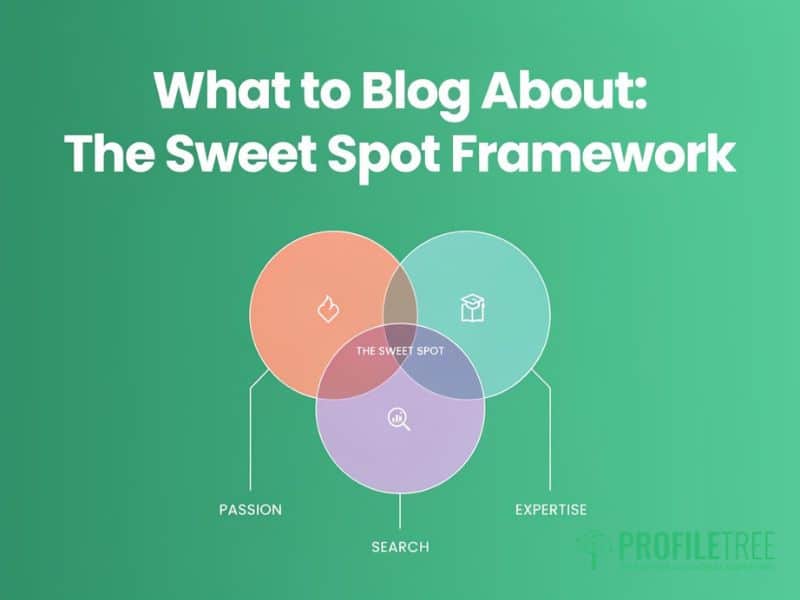
Deciding what to blog about is where most new bloggers get stuck. The fix is a simple framework: look for the overlap between what you know, what you enjoy writing about and what people are actually searching for. Once you’ve settled what a blog is for in your specific case, whether that’s education, trust-building or lead generation, the topic list gets much easier to narrow down.
Passion, Expertise and Audience Demand
Start with subjects where you have genuine first-hand experience. If you’ve run a business for ten years, you already have more things to blog about than any generic list can offer. Cross-reference that expertise against real audience questions using Search Console data, a digital strategy review, or simply the questions your sales team hears every week. Don’t dismiss those recurring questions as too basic; if your sales team hears them weekly, your readers are searching for them too.
The Quick Google Search Test
Before committing to a topic, search the exact phrase in Google. If the results are dominated by large, well-resourced publishers, you’ll struggle to compete without a genuinely new angle. If the results are thin, outdated or generic, that’s a gap worth filling. This one test answers “what should I blog about” more reliably than any brainstorm session, and it takes about two minutes per idea.
Things to Blog About: Topic Ideas by Category
If you’re still short on things to blog about, working through categories rather than starting from a blank page usually breaks the block. Revisiting what a blog is meant to do here helps too: a category only earns a place on this list if it genuinely serves a reader, not just a keyword.
Personal and lifestyle: career changes, home renovation projects, minimalist living, parenting in a digital age, and managing wellbeing alongside a busy job.
Money and business: managing cash flow as an SME, side hustles alongside a day job, the real cost of hiring your first employee, and UK grant or funding schemes for small businesses. These topics work well precisely because they’re specific; “small business tips” is too broad to rank, but “cash flow gaps for seasonal NI retailers” isn’t.
Tech and hobbies: practical AI tools for small teams, gardening for beginners, home coffee setups, and gaming as a side income.
Professional and B2B: case studies from client work, leadership lessons from a specific project, industry regulation changes, and “how to choose” guides that compare approaches rather than naming a single winner. These formats consistently earn more trust than a straightforward sales page ever could, because they’re written for the reader’s decision, not your pitch.
UK and Northern Ireland Topic Angles Worth Trying
Local relevance beats generic advice almost every time. Staycation and short-break travel content, sustainable living tips suited to UK housing stock, and practical guides to ISAs, business rates or NI-specific grant schemes all perform well because most large US guides ignore them completely. A Belfast bakery blogging about NI food festivals will consistently out-compete a generic “ideas” listicle for local searches, simply because it’s speaking to searchers who live five miles away rather than a global average.
More things to blog about, fast:
- A behind-the-scenes look at how you deliver a project
- A beginner’s glossary for jargon in your industry
- A comparison piece, such as one platform against another, for small businesses
- Seasonal or calendar-led content tied to your industry
- A myth-busting piece correcting a common misconception in your field
- An honest account of a project that didn’t go to plan and what you’d do differently
Using AI to Find Blog Ideas Faster

AI tools such as ChatGPT and Claude are genuinely useful for brainstorming, provided you treat the output as a starting point rather than a finished plan. It’s worth keeping what a blog is for in mind here: a tool for building authority and answering real reader questions, not a machine for churning out filler nobody asked for.
“Dogs” becomes “the best dog-friendly cafes in Belfast.” “Marketing” becomes “why NI manufacturers underuse LinkedIn compared to their GB competitors.” Ask the tool to take one broad topic and turn it into ten specific angles for your industry and location. The more specific the prompt, the more usable the ideas, and the less editing you’ll need to do afterwards.
AI is weaker at knowing what will actually rank or convert, which is where real search data still earns its keep. Teams that pair AI brainstorming with genuine search intent data consistently produce better content faster than either approach alone. It’s a starting point, not a shortcut past the research. If you want a whole content team working this way rather than relying on one person’s prompts, that’s exactly what a structured AI training programme is built to fix, turning scattered individual habits into a repeatable process everyone on the team can follow.
How to Start a Business Blog: Setup Essentials
Once you know what to blog about, the technical setup determines whether anyone finds the content at all. This is also where what a blog is for your business becomes a practical decision rather than a philosophical one: platform, schedule and setup all flow from that answer.
Choosing a Publishing Platform
WordPress powers 41.2% of all websites, and 59.1% of those running a recognised CMS, according to W3Techs. That share has eased back from its 2025 peak as hosted builders picked up ground, but it remains the strongest choice for businesses that want full control over SEO, plugins and long-term scalability.
Wix and Squarespace suit simpler blogs with no technical requirements, while Shopify works well when blogging sits alongside an existing store. There isn’t a single right answer here; it depends on how much control you’ll need as the blog grows.
Essential Setup Before Your First Post
Before publishing, get the basics right: an SEO plugin such as Yoast or Rank Math, Google Analytics and Search Console connected from day one, a security plugin if you’re on WordPress, and a caching setup that keeps load times fast on mobile, which StatCounter has recorded as the majority source of global web traffic every year since 2017. Skipping any of these won’t stop you from publishing, but it will make the results much harder to measure later.
Realistic scheduling matters more than ambition. A weekly post sustained for two years will always outperform a daily post that stops after six weeks. Build a simple editorial calendar listing topics, target dates and who’s writing each piece; it alone prevents the last-minute scramble that derails most business blogs within the first year. If you don’t have the resource in-house, a digital strategy review can help you set a realistic cadence from the outset rather than an ambitious one you’ll abandon by March.
Don’t skip the author bio either. A short, real credential under each post, a name, a role and genuine experience, does more for reader trust and search visibility than another paragraph of generic advice ever will.
Building Blog Traffic: SEO and Distribution
Publishing is only the first half of the job. Without proper search engine optimisation and distribution, even a strong article can sit unread. None of this works if you’ve lost sight of what is a blog meant to achieve for your business in the first place: sustained search visibility built over months, not a single viral spike.
Keyword research shows you the exact phrases your audience searches for, so target terms sit naturally in titles, headers and body text rather than being forced in afterwards. Technical basics, clean site structure, fast loading, mobile responsiveness, let search engines crawl and understand the content properly. Backlinks from other reputable sites remain one of the strongest ranking signals available, and guest posts, digital PR and genuine relationship-building all help earn them. None of this happens by accident; it’s the result of a deliberate SEO strategy, not a lucky post that happened to go viral.
Publishing isn’t the finish line either. Share new posts through email, repost across social media marketing channels, and consider turning a strong article into a short video that reaches people who’d never click a text link. The clip below shows how ProfileTree approaches content and SEO work for clients across Northern Ireland, Ireland and the UK:
Track what’s working through Google Analytics and Search Console. Impressions, clicks and average position tell you which posts are close to ranking and which topics deserve a follow-up piece. For businesses without an in-house content team, this cycle, research, writing, optimisation, and distribution is exactly what a content marketing services partner handles end-to-end, freeing your team to focus on running the business rather than chasing algorithm updates you don’t have time to track.
Where to Take Your Blog Next
Blogging works best as a habit rather than a project with an end date. Once you’re clear on what a blog is and have a working list of things to blog about, the businesses that see real results are the ones that keep publishing, keep checking their Search Console data and keep refining the topics that bring in the right readers. None of that requires a huge team, just a realistic schedule and a willingness to look at what’s actually working rather than what you assumed would work.
If building and maintaining that habit isn’t realistic in-house, ProfileTree’s content marketing services team can take on the research, writing and optimisation, leaving you with a blog that keeps working long after the first post goes live. It’s a slower route to results than paid advertising, but it doesn’t stop delivering the moment you stop paying for it, which is exactly why it’s worth the patience.
FAQs
1. What is a blog, and how is it different from a website?
A blog is a regularly updated section of a website, not a separate site. Most business websites combine static pages, like services or contact details, with a blog section built for ongoing articles.
2. What should I blog about if I don’t know where to start?
Look for the overlap between what you know, what you enjoy writing about and what your audience actually searches for. A quick Google search test for your ideas usually reveals whether the gap is worth filling.
3. What are good things to blog about for a small business?
Client case studies, practical how-to guides, comparison pieces and local, UK-specific angles on your industry all perform consistently well. Avoid writing only about your own products; solve a reader’s problem first, and the enquiry usually follows on its own.
4. What is a good first blog post to publish?
An in-depth guide that answers a genuine question tends to outperform a “why I’m here” introduction post for search visibility. Save the personal introduction for your About page instead, and let the first post prove your expertise from the very start.
5. How often should a business publish blog content?
Consistency matters more than frequency. A realistic weekly or fortnightly schedule maintained for years will outperform a burst of daily posts that stops after a few months.
great article
Interesting read! I in no way realized there have been so many matters to blog about. Thanks for the ideas!