
Small Business Digital Marketing Statistics: What the Data Shows
Table of Contents
Small business digital marketing statistics tell a clear story: the businesses that grow online are not necessarily those with the biggest budgets, but those that put their money in the right places. Search, social, video, and email each offer a different return, depending on the business type, the audience, and how well the channel is actually managed. Getting that picture right starts with understanding what the data shows.
This guide pulls together verified statistics on how small businesses approach digital marketing in the UK and Ireland, what judgments produce results, and where the common gaps appear. For each area, there are practical observations on what the numbers mean for a business, making real decisions about where to spend time and money.
The figures below are drawn from named primary sources and industry reports. Where data is UK or Ireland-specific, that is noted. Where figures are global or US-weighted, that context is included so you can apply them with appropriate judgment. The small business digital marketing statistics covered span SEO, social media, video, email, and paid advertising, with a consistent focus on what the numbers actually mean for day-to-day decisions.
The State of Digital Marketing for Small Businesses
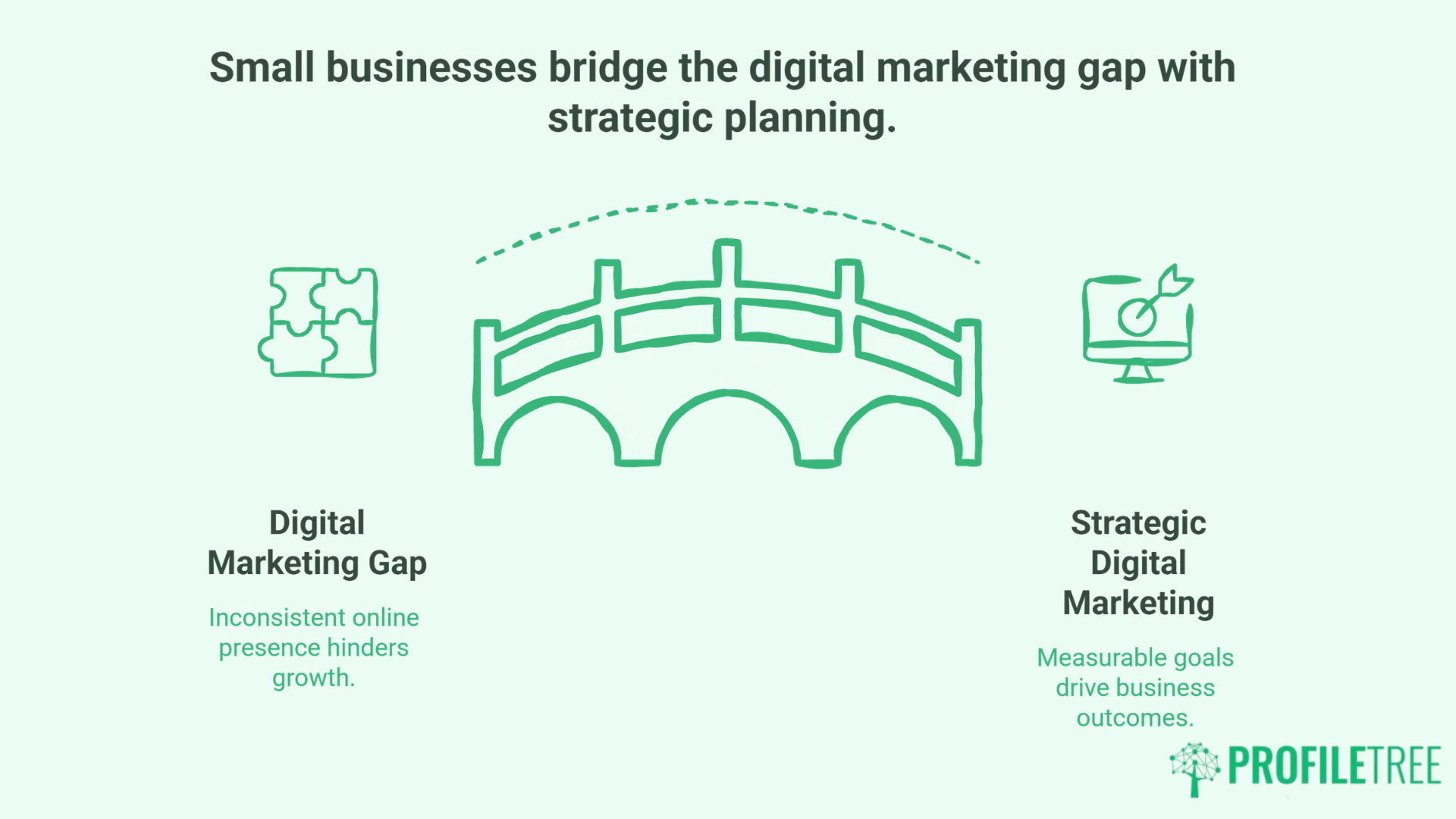
Understanding the overall picture helps before diving into individual channels. The gap between small businesses that have a structured digital marketing strategy and those operating without one has widened considerably over the past three years.
How many small businesses invest in digital marketing?
According to the Federation of Small Businesses, the majority of UK small businesses now have some form of online presence, but active, strategic digital marketing remains far less common. Having a website or social media profile is not the same as running a channel with a measurable goal. Many small business owners set up accounts during the pandemic and then continued posting inconsistently with no clear objective tied to the activity.
The distinction between presence and strategy is where most digital marketing consultancies, including ProfileTree, find the biggest opportunity when working with new clients. The business has the assets; what is missing is the plan connecting those assets to commercial outcomes.
What share of marketing budgets goes to digital?
Statista data from 2025 indicates that digital channels now account for over 60% of total advertising spend in the UK. For small businesses specifically, the proportion varies widely by sector, but the direction of travel is consistent: budgets that were previously split between print, outdoor, and digital have shifted heavily toward digital over the past five years.
The more relevant question for most small business owners is not the industry average but whether the mix within digital spend is proportionate to the return each channel delivers. Many businesses over-invest in paid social and under-invest in SEO, despite organic search typically delivering a lower cost per lead over time.
What does the data say about ROI from digital marketing?
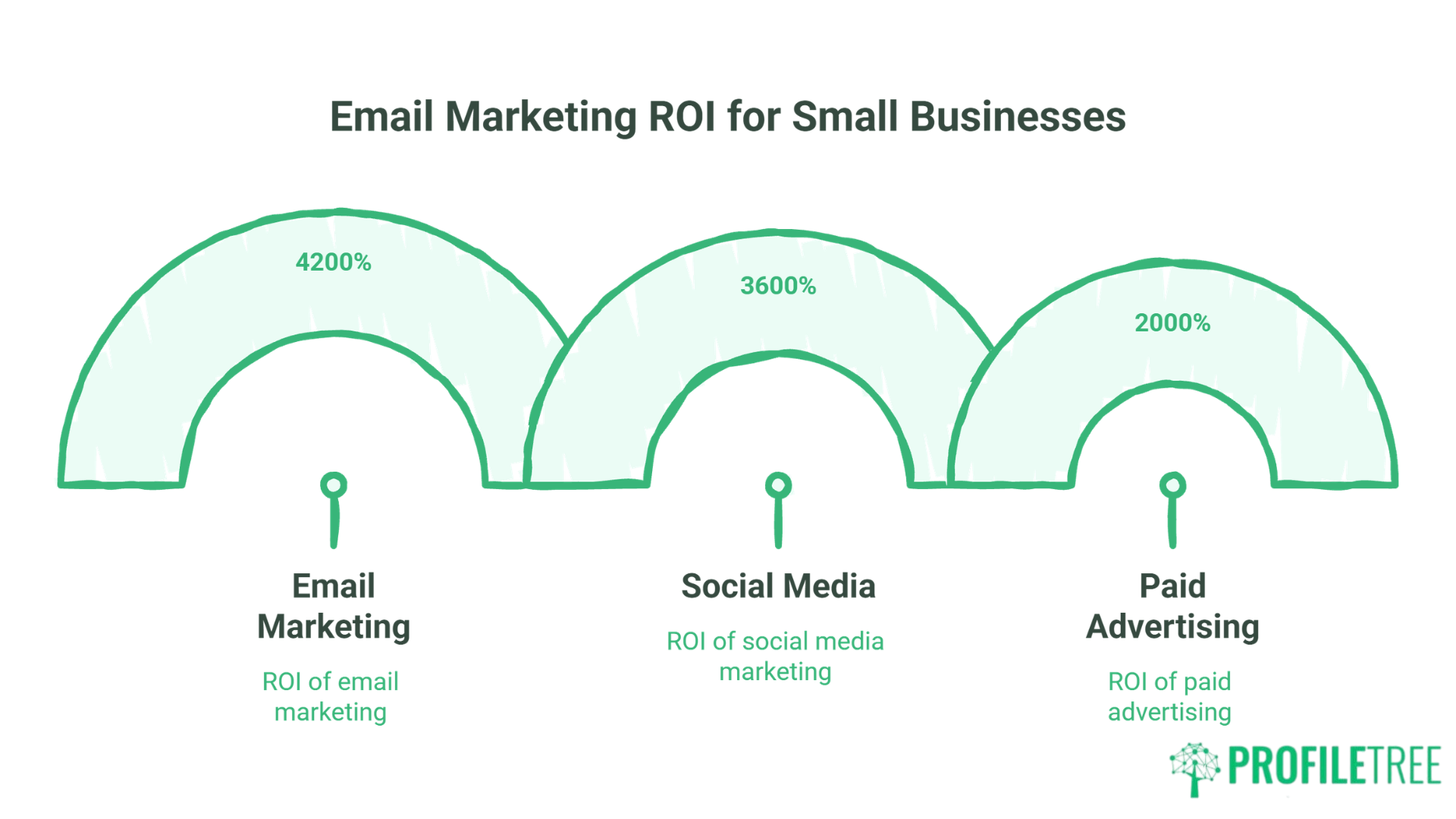
Digital marketing ROI statistics are notoriously difficult to compare across studies because measurement methodologies differ and attribution models vary. That said, email marketing consistently appears at the top of ROI league tables. The Data and Marketing Association (DMA) reports that email delivers an average return of £35.41 for every £1 spent in the UK market, based on their email benchmarking research. Organic search follows as a high-ROI channel for businesses that invest consistently over 12 to 18 months. Paid search and paid social sit behind both in long-run ROI, though they offer the advantage of immediate traffic while organic authority is being built.
For a more detailed breakdown of how to calculate and interpret these figures, the digital marketing ROI statistics guide covers the methodology in more depth.
Small Business SEO Statistics
Search engine optimisation remains one of the highest-return digital marketing investments for small businesses, but it is also one of the most misunderstood. The small business digital marketing statistics in this section help to set realistic expectations around timelines, effort, and outcomes.
How many small businesses use SEO?
BrightLocal’s 2024 Local Consumer Review Survey found that 98% of consumers used the internet to find information about local businesses in the past year. Despite this, a significant proportion of small businesses have never conducted a formal SEO audit or implemented structured on-page optimisation. The practical gap between what consumers do (search online) and what small businesses do (optimise for search) represents the clearest opportunity in small business digital marketing statistics.
Local SEO is the most accessible entry point for small businesses because it targets geographic intent that larger national competitors cannot always serve as relevantly. A Belfast café competing for “coffee Belfast city centre” is not going up against global brands; it is competing with a manageable set of local businesses. ProfileTree’s SEO services for SMEs typically begin with exactly this kind of local intent mapping before broadening the scope.
How long does SEO take to produce results?
This is one of the most common questions small business owners ask before committing to an SEO investment. The honest answer is that meaningful organic ranking improvements typically take between three and six months for low-competition local terms and six to twelve months or more for broader competitive keywords. Ahrefs’ analysis of their own index data found that only 5.7% of pages rank in the top 10 within a year of being published; most high-ranking pages are two or more years old.
This timeline reality is why SEO works best when treated as an ongoing programme rather than a one-off project. Businesses that stop after three months rarely see the full return on what they invested in the first place.
What do the statistics say about local search behaviour?
Google data indicates that “near me” searches have grown significantly year on year, with mobile driving the majority of local search queries. For small businesses with a physical location or a defined service area, appearing in the local pack (the map results that appear above organic listings) can deliver a meaningful share of new enquiries without any paid spend.
Google Business Profile optimisation is the most direct lever for local pack visibility and requires no technical knowledge to get started. It does, however, require consistent attention: profile completeness, review responses, and regular posts all influence position.
ProfileTree’s SEO work with SMEs across Northern Ireland regularly begins with local search fundamentals before moving to broader content strategy, because local intent is where the immediate commercial return sits for most small businesses in the region.
Social Media Marketing Statistics for Small Businesses
Social media statistics for small businesses are among the most widely cited figures in digital marketing, and also among the most misleading. Platform-level metrics (reach, impressions, follower counts) are easy to measure and easy to report, but they do not always connect to commercial outcomes. The statistics below focus on what the data actually shows about channel effectiveness rather than vanity metrics.
Which social platforms do small businesses use most?
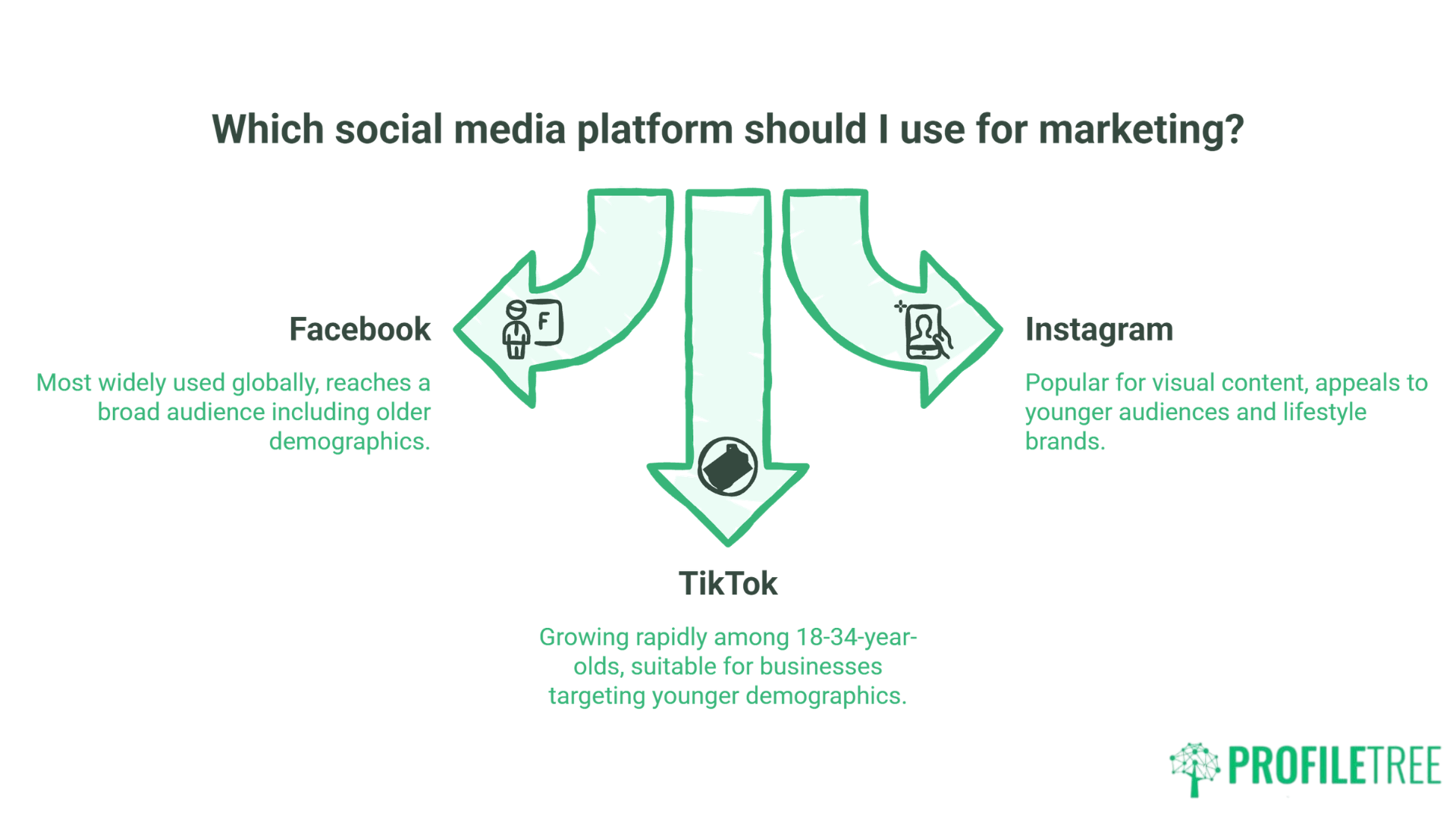
According to Statista’s 2024 social media marketing statistics, Facebook remains the most widely used platform by small businesses globally, followed by Instagram. For UK-specific data, Ofcom’s 2024 Online Nation report shows that Facebook and Instagram together reach the majority of UK adults regularly. TikTok’s reach among 18 to 34-year-olds has grown to the point where it is now relevant for small businesses targeting younger demographics, though the content production demands are higher.
The platform choice should follow the audience. A trade business targeting homeowners in their 40s and 50s is unlikely to generate meaningful commercial returns from TikTok regardless of content quality. A food business targeting younger city-dwellers is in a different position. Choosing platforms based on where the target customer actually spends time beats following trends. ProfileTree’s social media marketing work with SMEs is built around this audience-first approach rather than recommending the same platform mix to every business.
Detailed platform-by-platform data is available in the TikTok statistics UK breakdown.
What does the data say about organic social media reach?
Organic reach on Facebook has declined significantly since 2012. Hootsuite’s annual social media benchmarks report that average organic reach for Facebook pages sits below 5% of followers for most business accounts. Instagram organic reach varies more widely but is similarly constrained by the algorithm for accounts that do not produce content the platform wants to promote (typically Reels, which receive preferential distribution).
This decline in organic reach is the primary reason why many small businesses find social media disappointing: they post regularly, the posts reach only a fraction of their followers, and the commercial return is hard to trace. The response is not necessarily to abandon organic social, but to align expectations with the data and supplement with either paid social or a stronger emphasis on platforms such as LinkedIn for B2B or YouTube for long-form content, where organic reach holds up better.
How does social media marketing affect sales for small businesses?
The relationship between social media activity and direct sales is difficult to measure cleanly for small businesses because most do not have attribution tracking in place. What the data does show is that social media plays a significant role in the consideration phase: consumers research businesses on social before making contact, check review counts and recency, and form an impression of the business’s professionalism from content quality.
A deeper look at how social platforms influence purchasing decisions is available in the social media marketing and sales analysis.
Video Marketing Statistics for Small Businesses
Video has become the dominant content format across every major digital platform. The statistics for small businesses are particularly interesting because video was previously perceived as expensive and technically demanding, and that barrier has lowered substantially.
How effective is video marketing for small businesses?
Wyzowl’s State of Video Marketing Survey 2024 found that 91% of businesses use video as a marketing tool, up from 61% in 2016. Of those, 87% reported that video has directly increased traffic to their website, and 82% said video content has directly increased sales. These are self-reported figures from businesses that have already committed to video, so they represent the outcomes of businesses actively using the channel rather than an average across all small businesses including those who have not tried it.
The more relevant question for a small business owner is what type of video is worth producing. Short-form video (under 60 seconds) is the dominant format for organic social distribution. Long-form video (five minutes or more) performs better on YouTube and supports SEO through watch time and session signals. Product demonstration videos consistently outperform brand awareness content on conversion rate metrics.
What platforms should small businesses use for video?
YouTube is the second-largest search engine in the world by query volume, according to Semrush data. For small businesses producing educational or instructional content, YouTube offers something that Instagram and TikTok do not: long-term discoverability. A YouTube video optimised for search can continue generating views and enquiries years after it is published. Instagram Reels and TikTok videos have a much shorter active lifespan in the algorithm.
The practical implication for small businesses is that YouTube and short-form platforms serve different purposes. Short-form is better for reach and brand awareness; YouTube is better for building trust with people who are actively researching a service category before making a purchase decision.
What does video marketing cost for a small business?
Production costs vary enormously depending on the format, quality level, and whether the business produces content in-house or commissions it professionally. Smartphone-shot social content can cost almost nothing in production but requires time and consistent creative direction. Professionally produced videos for service pages, case studies, or YouTube channels typically carry a higher upfront cost but have a longer commercial lifespan. ProfileTree’s video marketing services for SMEs cover both ends of this spectrum, from strategy and scripting through to full production.
Ciaran Connolly, founder of ProfileTree, notes that the businesses getting the best return from video are usually those that plan a series rather than one-off productions: “When you build a library of video content around your service area and your customers’ most common questions, you start to own that search space over time. One video rarely changes anything; twenty well-targeted videos often do.”
Email Marketing Statistics for Small Businesses
Email is one of the most underused channels by small businesses relative to the return it can deliver. It is also one of the few digital channels where the small business owns the audience outright, without platform algorithms controlling who sees the content. Small business digital marketing statistics on email consistently show it punching above its weight against better-known channels.
What do the statistics say about email marketing ROI?
As noted above, the DMA’s UK benchmarking data consistently places email at the top of digital marketing ROI tables. The mechanism is straightforward: the list is an owned asset, the cost per send is low, and the audience has already opted in (which means intent is higher than cold advertising audiences). The businesses that see the strongest returns from email are those that segment their lists and send relevant content rather than broadcasting the same message to everyone.
Mailchimp’s annual email marketing benchmarks show that UK small business email open rates average between 20% and 25% across most sectors, with click-through rates typically between 2% and 5%. These figures vary significantly by industry and list quality, so treating them as targets without benchmarking against your own historical data is of limited value.
How should small businesses approach email marketing?
The most common mistake small businesses make with email is treating it as a broadcast channel rather than a relationship channel. A monthly newsletter sent to an unsegmented list with no clear call to action will produce very different results from a targeted sequence sent to people who have recently visited a specific service page or downloaded a piece of content.
Segmentation does not require sophisticated technology at a small business scale. Even basic segmentation by customer type (existing clients vs. prospects) or by interest (which service category someone enquired about) can materially improve relevance and therefore results.
For businesses using social media alongside a broader digital marketing channels strategy, email works best when it is connected to what is happening elsewhere: following up on social content, re-engaging website visitors, or nurturing leads from paid campaigns.
Paid Digital Advertising Statistics for Small Businesses
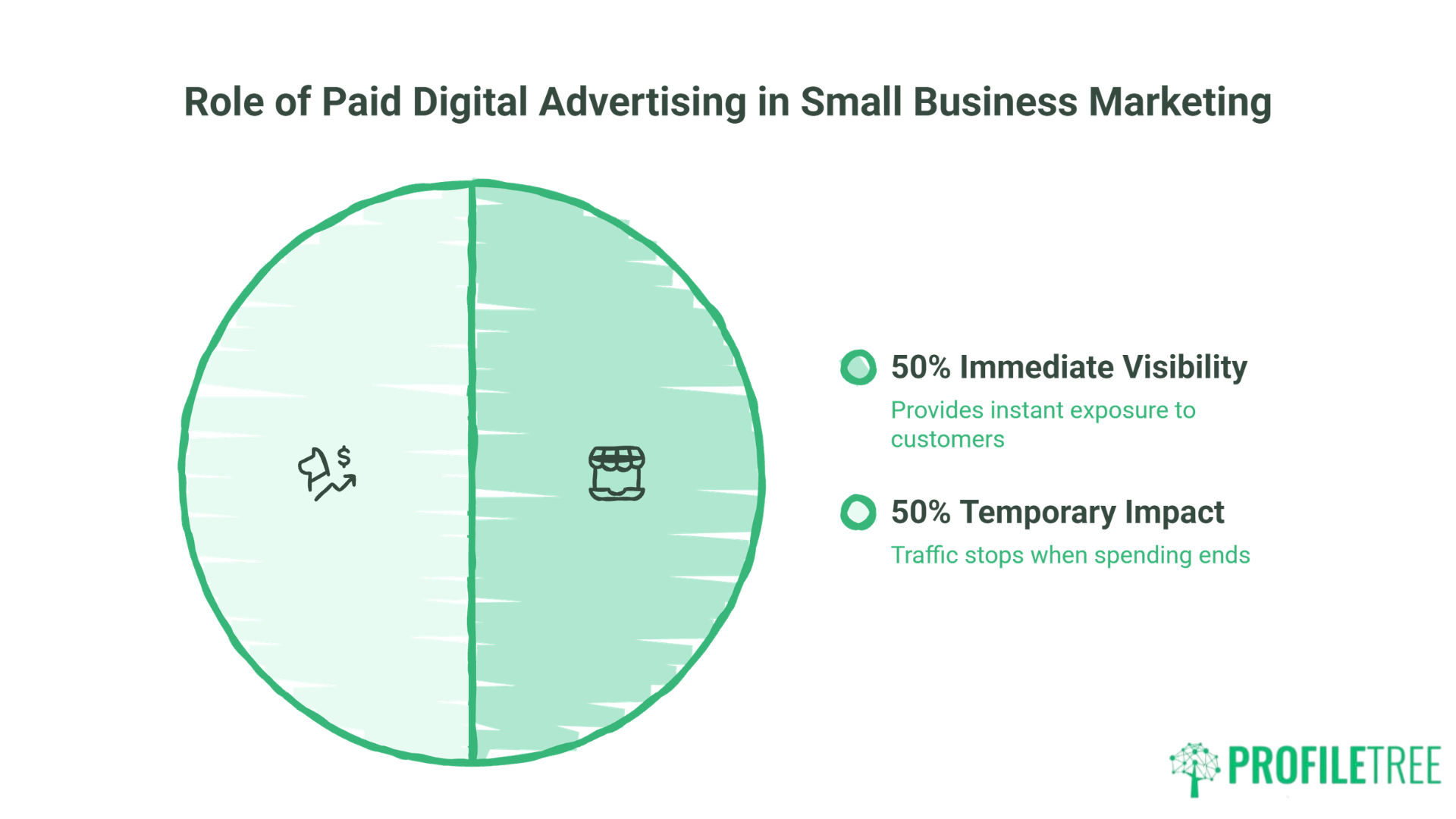
Paid advertising gives small businesses something that organic channels cannot: immediate visibility. The trade-off is that the traffic stops when the spend stops. The statistics in this section are focused on helping small businesses understand where paid media fits relative to other channels rather than treating it as the default answer.
What do small businesses spend on paid digital advertising?
WordStream’s analysis of Google Ads data shows that small businesses across most sectors pay between £1 and £5 per click for competitive keywords, with service businesses in legal, financial, and medical categories paying considerably more. The practical implication is that paid search can become expensive quickly in competitive categories, and the economics only work if the conversion rate from landing page to enquiry is well managed.
Many small businesses run well-defined audiences without a clear landing page strategy, sending paid traffic to a generic homepage instead of a page built around the specific query the user searched for. This is one of the most common reasons paid search underperforms for small businesses relative to what the channel is capable of delivering.
Is paid social advertising worth it for small businesses?
Meta’s own advertising data shows that small business advertisers with audiences well-defined by location and interest can achieve cost-effective results, particularly for local awareness campaigns and event promotion. The challenge is that paid social requires creative quality to perform: a poorly designed ad with a weak offer will not produce meaningful results regardless of how well the targeting is set up.
The honest assessment is that paid social is a channel worth testing for most small businesses, but it should not be the primary growth channel unless the creative and targeting infrastructure is in place to manage it properly. Many small businesses find that a modest paid social budget used to amplify organic content (boosting posts to existing followers and their lookalike audiences) produces a better return than running standalone conversion campaigns.
How do businesses measure paid advertising performance?
The statistics on paid advertising ROI are heavily dependent on what is being measured. Click-through rate and cost per click are easy metrics but poor proxies for business outcome. Cost per lead and cost per acquisition are more meaningful but require conversion tracking to be set up correctly in Google Analytics or Meta’s tracking pixel.
For small businesses running paid campaigns, the most important number is the cost per qualified lead relative to the average lifetime value of a customer. A £50 cost per lead is expensive for a business where the average transaction is £100 and cheap for a business where the average contract is £5,000.
The maximising ROI from digital marketing campaigns guide covers attribution and measurement in more detail.
Digital Training and Capability Statistics for Small Businesses
One of the most consistent findings across small business digital marketing research is that capability gaps, not budget gaps, are the primary constraint on digital marketing performance. Small businesses often have sufficient budget to invest in digital channels but lack the internal knowledge to deploy that budget effectively.
What skills gaps do small businesses report?
DCMS’s UK Digital Strategy research has consistently identified digital skills as one of the primary barriers to small business growth. The skills gaps most commonly reported include SEO and content strategy, data analysis and reporting, paid advertising management, and video production and editing. These are not specialist technical roles; they are practical skills that any marketing function needs to operate digital channels at a basic level of competence.
The gap between knowing a channel exists and knowing how to run it effectively is where digital training adds direct commercial value. A business owner who understands what good SEO looks like is better positioned to brief and evaluate an agency than one who does not, even if they never implement SEO themselves.
What is the return on digital training investment?
ProfileTree’s digital training programmes for SMEs are built around practical skills rather than theoretical frameworks. The businesses that see the clearest return are typically those where training is tied to a specific live project: learning to manage a Google Ads campaign while actually running one, or learning content strategy while building out an existing blog.
The data on training ROI for small businesses is harder to aggregate than channel-level statistics because the return depends heavily on what the business does with the skills. What the research does show consistently is that businesses with higher digital capability grow digital revenue faster than those without it.
How does AI fit into small business digital marketing?
AI tools are now embedded in every major digital marketing platform. Google’s ad targeting, Meta’s lookalike audiences, and content performance prediction tools all use machine learning. For small businesses, the practical AI adoption question is usually not whether to use AI but which AI-assisted tools are worth learning and where the real efficiency gains sit.
The businesses getting the most value from AI in their digital marketing tend to use it for research and first-draft production, saving time at the top of the content production process, while maintaining human editorial judgement over what is published. The risk of delegating content entirely to AI tools is that the output reflects average quality rather than the specific expertise and voice that differentiates one small business from another. ProfileTree’s guidance on AI in marketing for SMEs covers the practical adoption decisions in more depth.
Building a Digital Marketing Strategy from the Statistics
Statistics are useful for calibrating expectations and informing decisions, but they cannot substitute for a strategy built around a specific business’s goals, audience, and resources. The small business digital marketing statistics across every channel above point in the same direction: the small businesses that get the most from digital marketing are not those that chase every trend the statistics highlight; they are those that choose two or three channels, run them well, and measure the outcomes consistently.
Where should a small business start?
The data consistently points to the same starting point: a well-built, fast-loading website that converts the traffic it receives. Every other digital marketing channel, whether paid or organic, sends traffic somewhere. If that destination is a poorly structured website with no clear call to action and slow load speed, the return from every channel above it in the funnel is diminished. ProfileTree’s web design for small businesses is built around this conversion-first principle: the site must be capable of handling the traffic before investing heavily in channels to generate it.
Website quality is the multiplier on everything else. A strong SEO campaign driving 1,000 visitors to a 5% converting website produces 50 leads. The same campaign driving to a 1% converting website produces 10. The conversion rate is a lever that many small businesses leave untouched while continuing to invest in traffic channels.
How should small businesses prioritise digital marketing channels?
A useful framework is to prioritise channels in order of intent. Search captures people who are actively looking for what the business offers; social media reaches people who are not necessarily looking but can be moved along the consideration journey. Email communicates with people who already have a relationship with the business. Paid advertising can accelerate any of these, but it works best when the organic foundations are in place.
For most small businesses in Northern Ireland and the UK, the priority order looks like this: fix the website, build local SEO, develop an email list, add content marketing to support search rankings, and then layer paid media on top when the conversion infrastructure can handle the traffic efficiently. A structured digital strategy makes this sequencing explicit rather than leaving each channel decision to be made in isolation.
What role does content marketing play for small businesses?
Content marketing and SEO are closely connected for small businesses: most of the pages that rank for relevant search queries are content pages, not service pages. A plumber who publishes genuinely useful guides on common household plumbing problems builds search authority that supports the ranking of their service pages over time.
The small businesses that produce content most effectively treat it as a systematic process rather than a creative exercise. They identify the questions their customers ask most frequently, answer those questions more thoroughly than anyone else currently ranking for them, and publish consistently over a long enough period for the authority to compound.
ProfileTree supports SMEs across the UK and Ireland with digital marketing in Northern Ireland and beyond, from initial strategy through to content production and campaign management. The starting point is always the data: what does the business’s audience actually search for, and what is the gap between where the business currently appears and where it needs to be?
If you want to understand where your business sits against the benchmarks in this guide and what the highest-priority actions are for your situation, get in touch with the ProfileTree team.
Frequently Asked Questions
What percentage of small businesses use digital marketing?
The precise figure varies by source and definition. Ofcom’s 2024 Online Nation report shows that the vast majority of UK small businesses have some form of digital presence, but active, strategic digital marketing (with defined goals, channel selection, and measurement) is less common. The gap between having a social profile and running a strategy is significant, and most small business digital marketing statistics conflate the two.
What is the most effective digital marketing channel for small businesses?
There is no single answer because effectiveness depends on the business type, target audience, and what is being measured. Email consistently shows the highest ROI in benchmarking data. SEO delivers the strongest long-term return per pound spent for businesses in categories where search intent exists. For businesses with shorter sales cycles and visual products, paid social can deliver faster results. Most small businesses benefit from a combination of two or three channels run well rather than spreading effort across every available platform.
How much should a small business spend on digital marketing?
A common rule of thumb is 7% to 12% of revenue, with newer businesses toward the higher end to build visibility faster. For UK SMEs with turnover under £1 million, this translates to budgets that need to be focused on channels with the clearest return rather than spread thinly. A more useful approach than a percentage rule is to calculate what a new customer is worth and work backwards from there to determine what a sustainable cost per acquisition looks like.
Is SEO worth it for a small business in 2026?
Yes, for most small businesses with a local or regional market. The investment timeline is longer than paid advertising, but the returns compound over time and are not dependent on ongoing ad spend. Businesses that invest consistently in SEO over 12 to 24 months typically develop an organic search presence that continues generating enquiries at a lower cost per lead than any paid channel. The caveat is that SEO requires patience and consistency; businesses that stop after two or three months rarely reach the point where the investment pays back.
What digital marketing statistics should small businesses track?
The most important metrics depend on the channel, but at a minimum, small businesses should track: organic search sessions (from Google Search Console), lead or enquiry source (which channel sent the contact), email open rate and click rate, and cost per lead for any paid advertising. Tracking these four consistently over time gives a clear picture of which channels are working and where attention should be directed. Platform-level vanity metrics (likes, followers, impressions) are useful as secondary indicators but should not drive strategy decisions.
How does AI affect digital marketing for small businesses?
AI tools have lowered the barrier to entry for several digital marketing tasks: first-draft content production, image creation, ad copy testing, and keyword research are all faster with AI assistance. The risk for small businesses is producing generic content that does not differentiate the business from competitors using the same tools. AI works best as a production accelerator combined with human editorial judgement, not as a replacement for strategy or expertise. Google’s search quality guidelines continue to reward content that demonstrates genuine expertise and first-hand experience, which AI alone cannot credibly produce.