
Small Business Consultation: How to Hire Right and Grow Fast
Table of Contents
Every growing business hits a ceiling it cannot break through alone. Whether the problem is stalled revenue, a marketing strategy that stopped working, or a digital presence that no longer converts, the right consultant can cut through the noise and provide the external clarity that in-house teams often cannot.
Small business consultation has evolved well beyond generic advice and slide decks. The best consultants now combine sector knowledge with real data tools, giving SMEs faster, more targeted insights than were available even five years ago. For business owners across Northern Ireland, Ireland, and the wider UK, there are also funded routes into consultancy that many overlook entirely.
This guide covers what small business consultation actually involves, what it costs, how to find a credible consultant, and how to measure whether the engagement has worked.
What Is Small Business Consultation?
At its core, small business consultation means bringing an external expert into your business to solve a specific, defined problem. That problem might be strategic (how to grow into a new market), operational (how to reduce fulfilment costs), or digital (how to generate more qualified leads online). The consultant analyses the situation, draws on their expertise across similar businesses, and delivers recommendations designed to produce a measurable outcome.
This is distinct from a general business advisory relationship. Consultation is typically project-based, with a clear scope, defined deliverables, and an agreed timeline. Understanding that difference upfront saves both time and money.
The Difference Between a Consultant and a Business Coach
The terms are often used interchangeably, but they describe different engagements. A business coach works with the owner or leadership team over time, helping them develop their own thinking, decision-making, and capabilities. The emphasis is on the person.
A consultant is brought in to solve the business problem directly. They conduct their own research, analyse your data, and present specific recommendations. The emphasis is on the outcome, not the personal development of the individual. For SMEs facing a concrete challenge with a defined deadline, consultancy is usually the right fit.
Types of Small Business Consultants
The type of consultant you need depends entirely on the nature of the problem. Common categories include:
- Strategy consultants who help define direction, prioritise growth opportunities, and build business plans
- Marketing and digital consultants who address brand positioning, lead generation, and digital marketing performance
- SEO and content consultants who audit and improve organic search visibility
- IT and systems consultants who address technology infrastructure, software selection, and integration
- AI and digital transformation consultants who help businesses understand where AI implementation will generate real efficiency gains
- Financial consultants who tackle cash flow, pricing models, and funding strategy
Many SMEs benefit from a consultant who bridges two of these areas, for example,e a digital strategist who understands both web design fundamentals and commercial growth levers.
What Does a Business Consultation Actually Look Like?
A typical engagement begins with a discovery session. The consultant asks structured questions to understand the business model, the current challenges, and the desired outcome. This is followed by a period of audit, research, or data analysis. The consultant then presents findings and recommendations, either as a written report, a strategy document, or a structured presentation to the leadership team.
Some consultants will also support the implementation phase, providing ongoing guidance as recommendations are put into practice. Others hand over the strategy and leave execution to the internal team. Clarifying which model is on offer before signing anything is important.
Why SMEs Need External Advice Now
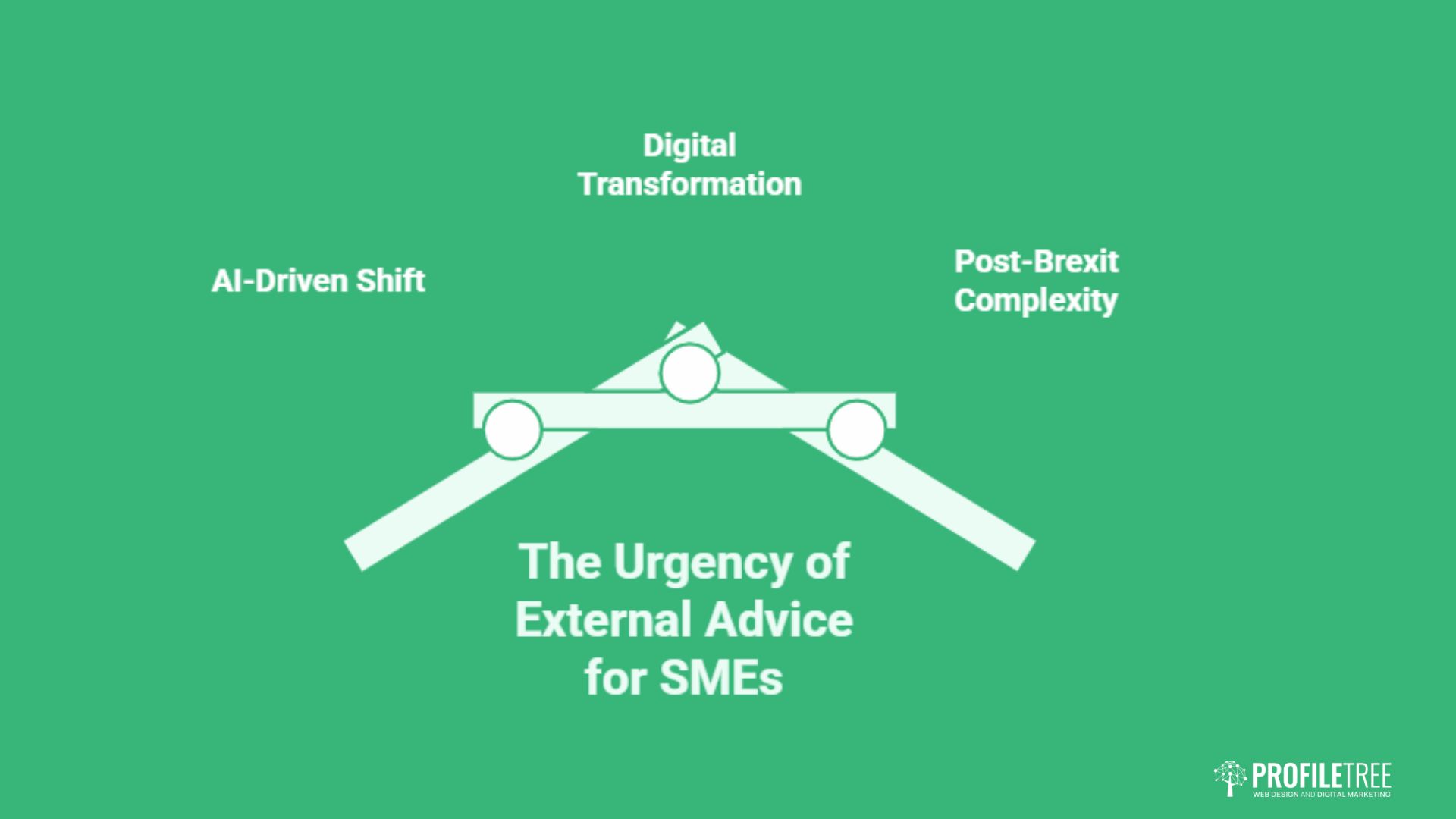
The pace of change across digital, regulatory, and competitive environments has accelerated sharply. For small businesses without dedicated research functions, staying current across all of these areas simultaneously is not realistic. External consultancy provides a concentrated dose of current expertise without the cost of a full-time senior hire.
There are also structural reasons why internal teams struggle to solve certain problems. When everyone inside a business has been working on the same challenge for months, perspective narrows. A consultant brings a fresh set of eyes, informed by similar problems solved across a range of other businesses.
The AI-Driven Shift in Business Consultancy
One of the most significant changes in how consultants work is the adoption of AI-powered analysis tools. Where a business health check once took weeks of manual data gathering, a skilled consultant can now generate a detailed audit of a company’s digital footprint, competitive position, and operational data within days. This speed advantage is particularly valuable for small businesses, where time lost in a prolonged diagnostic phase has real commercial cost.
AI tools also allow consultants to model multiple scenarios quickly, helping business owners see the likely outcomes of different strategic choices before committing resources. For SMEs considering AI training and adoption, a consultant experienced in this area can separate the tools that genuinely suit the business from those that would add complexity without proportionate return.
Digital Transformation and the SME Gap
Many small businesses in Northern Ireland, Ireland, and across the UK are still operating with disconnected digital systems, underperforming websites, and marketing activity that generates impressions without generating leads. The gap between what these businesses could achieve with a coherent digital strategy and what they currently achieve is often significant.
Consultation provides a structured assessment and prioritised action plan that allows businesses to close that gap without wasting budget on the wrong interventions first. Given the breadth of digital options available, from social media marketing to technical SEO to video marketing, having an experienced outside view to direct the investment is often the difference between results and noise.
Post-Brexit Complexity for UK and Irish SMEs
For businesses trading across the UK and Ireland, the regulatory and logistical environment has shifted considerably since 2020. From customs documentation to VAT treatment and supply chain adaptation, many SMEs are navigating complexity that was not part of their operational planning five years ago. Consultants with specific expertise in cross-border trading have become meaningfully more valuable in this context, particularly for businesses in Northern Ireland operating under the Windsor Framework.
Funding Your Consultation: UK and Ireland Grants
One of the most overlooked aspects of small business consultation is that a significant portion of the cost is often fundable through government and regional support schemes. For SMEs on constrained budgets, this changes the calculus entirely. The schemes vary by region, but the principle is consistent: governments across the UK and Ireland recognise that expert external advice accelerates business performance, and they subsidise access to it.
All prices and figures in this guide are indicative UK examples and correct at the time of writing; use them as a benchmark rather than fixed quotations.
Support in Northern Ireland
Invest NI offers several funded advisory programmes for eligible Northern Ireland businesses, covering areas from management development to digital transformation. The Accelerate programme and various sector-specific support schemes have historically covered between 25% and 50% of consultancy costs for qualifying SMEs. Businesses in Northern Ireland’s cities and towns should check directly with Invest NI for current availability, as programmes open and close on a rolling basis. The NI Business Info portal is the most reliable starting point for up-to-date eligibility criteria.
For businesses specifically looking at digital capability, the Department for the Economy has also run voucher-based schemes that fund consultancy focused on digital adoption and e-commerce development.
Support in the Republic of Ireland
Local Enterprise Offices (LEOs) across Ireland offer mentoring and consultancy support to businesses with fewer than ten employees. The LEO Mentoring scheme provides subsidised one-to-one sessions with experienced business advisors, often at minimal cost to the applicant. For more established SMEs, Enterprise Ireland’s Management Development programmes provide funding for more substantial consultancy engagements, particularly where the focus is on export growth or innovation.
Microfinance Ireland also runs support programmes that can be used alongside consultancy to fund the implementation of recommendations once the strategic work is complete.
Support in England, Scotland, and Wales
The British Business Bank coordinates access to several advisory and funding programmes across Great Britain. The Business Growth Hub in Greater Manchester, the Growth Hub Network across England, and Business Gateway in Scotland all provide funded business advisory services that range from light-touch mentoring to structured consultancy engagements.
The UK Shared Prosperity Fund has also channelled resources into business support programmes across English regions, with specific allocations to local authorities for SME development activity. Checking with your regional Growth Hub is the most direct route to understanding what is currently available in your area.
What to Expect to Pay: 2026 UK Fee Guide
Outside of funded schemes, consultancy fees in the UK and Ireland follow a fairly consistent structure. Day rates for independent consultants typically range from £500 to £900, depending on specialism and experience. Senior consultants from established firms charge from £1,000 per day upwards. Project-based fees for a defined engagement, such as a digital audit and strategy plan for an SME, commonly range from £2,000 to £8,000 depending on scope.
Retained consultancy, where a consultant provides ongoing support for a fixed monthly fee, is increasingly popular with growing SMEs. Monthly retainers typically sit between £800 and £2,500 for ten to fifteen hours of access per month. Hourly rates for shorter, advisory-only engagements range from £100 to £250 for most specialisms. All prices and figures in this guide are indicative UK examples and correct at the time of writing; use them as a benchmark rather than fixed quotations.
How to Find the Right Consultant for Your SME
Choosing poorly here is an expensive mistake. The market for business consultancy contains a wide range of quality, from deeply experienced practitioners with a track record in your sector to generalists who repackage generic frameworks as bespoke advice. Knowing how to separate the two protects your time and budget.
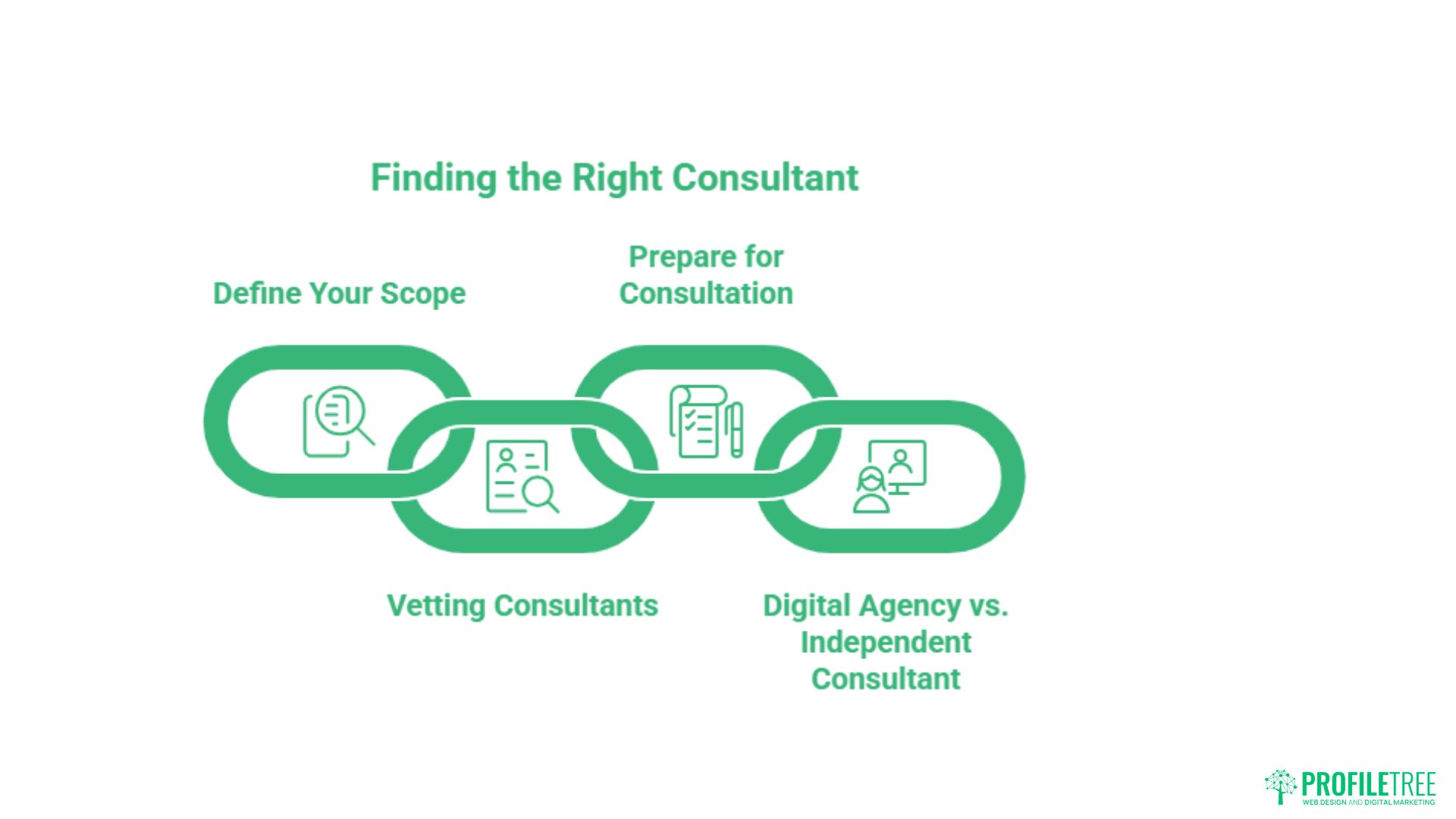
Define Your Scope Before You Start Looking
The most common mistake small business owners make when hiring a consultant is beginning the search before the problem is clearly defined. A vague brief produces vague proposals, which makes it almost impossible to compare candidates fairly or hold them accountable for outcomes.
Before approaching any consultant, write a short problem statement that covers: what is not working, what you have already tried, what a successful outcome looks like, what data or access you can provide, and what your budget and timeline are. This document alone will filter out most unsuitable candidates and allow genuine specialists to respond with meaningful proposals.
Vetting the Consultant: Red Flags to Watch For
Once you have a shortlist, the vetting process is where you earn or waste the investment. Ask each candidate for examples of similar projects they have completed, including the specific outcomes achieved. Be sceptical of any consultant who cannot point to measurable results from past work. Strategy without execution accountability is rarely worth the fee.
Red flags include consultants who arrive at the first meeting with a prepared solution before completing a diagnostic, those who cannot name the specific tools or methods they would use for your type of problem, and those who refuse to offer any form of outcome commitment or success metric. An experienced consultant who has solved your type of problem before will ask detailed questions before forming any view.
References from businesses of a similar size and sector to yours carry far more weight than general testimonials. Ask for two or three and follow up on them. Reviewing how businesses use data in decision-making can also help you frame better questions when evaluating a consultant’s analytical approach.
Preparing for Your First Consultation Session
A productive first session depends almost entirely on the quality of information you bring to it. The more prepared you are, the faster a good consultant can get to useful insight rather than spending the first hour gathering basics they could have reviewed in advance.
Bring the following as a minimum: your most recent profit and loss statement, current website analytics data, an overview of your existing marketing activity and spend, and a brief account of the three to five decisions that are currently creating the most uncertainty for the business. If you have customer feedback, complaint data, or sales conversion rates, bring those too. Consultants work faster and better when the data is already on the table.
Working with a Digital Agency vs an Independent Consultant
For SMEs whose primary challenges are digital, a digital agency with a consultancy function often provides better value than a solo consultant. Agencies bring a team across design, development, SEO, content, and paid media, which means that once the strategic recommendations are agreed upon, the implementation capacity is immediately available without a separate procurement process.
“For most small businesses, the gap between having a digital strategy and executing it is where value is lost,” says Ciaran Connolly, founder of ProfileTree. “When the consulting and the doing sit with the same team, you eliminate that gap and the time it takes to get from insight to result.”
Independent consultants are typically more cost-effective for strategic or financial challenges that do not require ongoing execution support. For anything requiring website development, content production, or sustained digital delivery, an agency model usually produces faster outcomes.
Measuring ROI: How to Tell If the Consultation Worked
Most guides on business consultancy stop at the point of hiring. The question of whether the engagement actually delivered value is at least as important, yet it is rarely addressed in detail. Establishing measurement criteria before the engagement begins is the only way to answer it objectively.
Setting Success Metrics at the Outset
When you commission a consultation, agree on three to five specific, measurable outcomes at the start. These should be tied to the original problem statement. If the brief was to improve lead generation, the metric is the number of qualified leads per month before and after. If the brief was to reduce operational costs, the metric is cost per unit or cost as a percentage of revenue before and after.
Consultants who resist agreeing to measurable outcomes upfront are worth questioning. Vague deliverables, such as “a strategic roadmap” or “a brand positioning framework”, are not outcomes. They are documents. The outcome is what changes in the business as a result of using them.
The 90-Day Review
Most consultancy engagements have a natural endpoint when the report or recommendations are delivered. Build in a 90-day review at commissioning, at which point you assess what has been implemented, what results have been recorded, and what gaps between recommendation and reality have emerged.
This review is valuable regardless of the outcome. If results are strong, it provides documented evidence of ROI that justifies future investment in consultancy. If results are mixed, it identifies whether the shortfall was in the quality of recommendations, the speed of implementation, or the underlying assumptions about the business environment. Understanding the impact of business planning on long-term outcomes reinforces why this review step matters.
Calculating Break-Even on Consultancy Investment
A straightforward break-even calculation helps SMEs decide whether a consultation is financially justified before committing. Take the fee, divide it by your average gross margin percentage, and the result is the additional revenue the consultation needs to generate for you to recover the cost. A £3,000 consultancy fee for a business with a 40% gross margin requires £7,500 in additional revenue to break even. Any outcome beyond that is a net positive return.
This framing shifts the conversation from “can we afford a consultant?” to “what does this engagement need to deliver to be worth it?” That is a more useful question, and one that most credible consultants are happy to engage with directly.
Ongoing Digital Support and Implementation
For many SMEs, the most durable return on a consultation comes from the ongoing support that follows the initial engagement. A digital audit, for example, produces a prioritised list of improvements, but those improvements require skilled execution. Working with a team that provides ongoing website management, content development, and SEO services alongside the strategic input creates compounding value over time, as each phase of improvement builds on the last.
Businesses that treat consultation as a one-off event rather than the starting point of a structured improvement programme typically achieve less than those that integrate external expertise into their regular business rhythm.
Conclusion
Small business consultation, done well, is one of the highest-return investments available to an SME. The key is clarity: a defined problem, a credible consultant with a track record in your sector, agreed success metrics, and a plan for implementing what the engagement produces. For businesses across Northern Ireland, Ireland, and the wider UK, the combination of available funding and experienced local consultancy makes this a more accessible option than many assume.
To explore how ProfileTree supports SMEs with digital consultancy, strategy, and hands-on implementation, visit our digital strategy services page or get in touch directly.
FAQs
How much does a small business consultation cost per hour in the UK?
Hourly rates for independent small business consultants in the UK typically range from £100 to £250 in 2026, depending on specialism and experience. Senior consultants from established firms charge significantly more. Project-based fees for a defined SME engagement commonly range from £2,000 to £8,000. All figures are indicative benchmarks; actual costs vary by scope and provider.
Can I get a free business consultation?
Yes, in many cases. Growth Hubs across England, Local Enterprise Offices in Ireland, and Invest NI in Northern Ireland all offer subsidised or free initial advisory sessions for eligible businesses. These are typically introductory in nature, but they can provide enough direction to clarify whether a more substantial paid engagement is warranted.
What is the difference between a business coach and a consultant?
A business coach works with the individual owner or leader to develop their thinking and decision-making capacity over time. A consultant is engaged to solve a specific business problem directly, providing analysis and recommendations rather than personal development. For defined, time-sensitive challenges, consultancy is usually the more appropriate choice.
What should I prepare for my first consultation?
Bring a recent profit and loss statement, current website and marketing analytics, a summary of existing marketing activity and spend, and a clear written description of the problem you are trying to solve. The more structured your preparation, the faster a good consultant can move beyond information-gathering to useful insight.
Do consultants work with startups or only established businesses?
Both. The type of consultancy useful at the startup stage, typically focused on product-market fit, early-stage marketing, and business model validation, differs from the consultancy needed by an established SME looking to scale or solve a specific operational problem. Be specific about your stage and what you need when approaching potential consultants.
Very good written information. It will be helpful to everyone who utilizes it, as well as yours truly :). Keep up the good work – looking forward to more posts.