
Blog vs Vlog: Choosing the Right Format for Your Business
Table of Contents
A blog is written text hosted on your own website and indexed by Google. A vlog is video content, usually hosted on YouTube, discovered through platform search and recommendation rather than a search engine crawl. For most SMEs weighing up blog vs vlog, the practical answer is that neither replaces the other: a blog builds long-term organic search authority on a domain you own, and a vlog builds an audience relationship on a platform you don’t own. Businesses with a sustained content strategy tend to run both, feeding one into the other rather than picking a side permanently.
This guide walks through the core blog vs vlog difference, a head-to-head comparison across the factors that matter for SMEs, UK and Irish regulatory compliance, and a hybrid approach that keeps both formats running without doubling the workload. If video is the direction you’re leaning towards, ProfileTree’s video production services can handle the filming and editing side while you focus on strategy and message.
The formats look different on the surface, one written, one video, but the underlying question is the same: where will your audience find you, and what will persuade them to trust you? For businesses building out both blogging and vlogging, this guide draws on work with businesses across Northern Ireland, Ireland, and the UK, where the blog vs vlog decision comes up regularly in digital strategy consultations.
What Is the Difference Between a Blog and a Vlog?
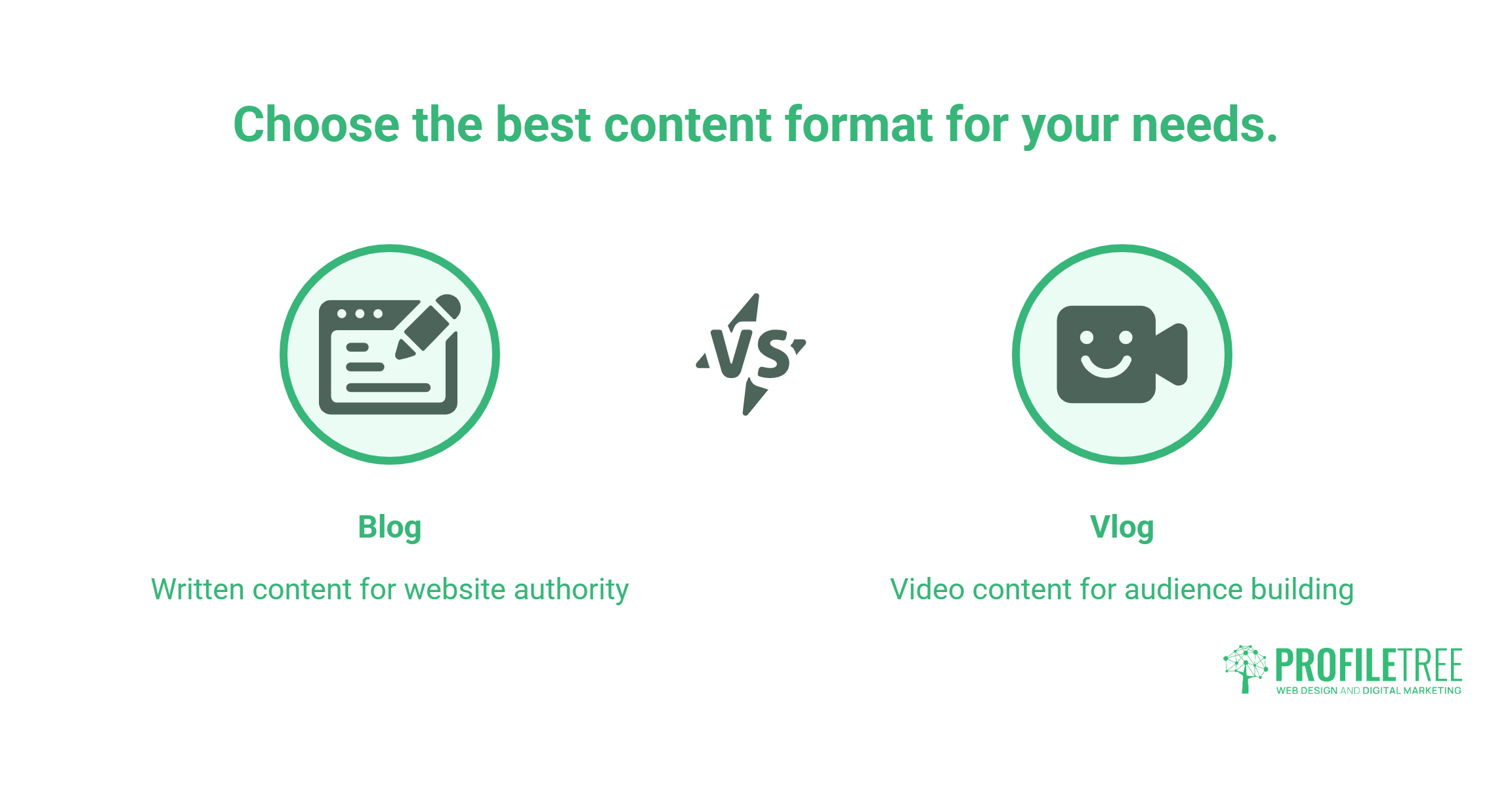
The blog vs vlog difference comes down to format, not personal preference. A blog is a written article published on a website, usually structured with headings, images and internal links, and built to rank in search engines such as Google. A vlog is a video, typically published on a platform like YouTube, discovered through that platform’s own search and recommendation systems rather than a text index.
That distinction matters more than it sounds. A blog lives on your domain: it builds your website’s authority, drives organic search traffic, and compounds in value as more pages get indexed. A vlog lives on a third-party platform: it builds an audience there, earns views through an algorithm you don’t control, and is harder to redirect towards a specific action on your own site.
Both formats can cover the same subject. It’s really about how people find that content, and what they do with it next.
The Core Differences Explained
The table below sets out the blog vs vlog comparison across the practical factors that shape an SME’s budget and time, before the head-to-head discussion that follows.
| Parameter | Blog | Vlog |
|---|---|---|
| Format | Written text, images, tables | Video, usually with voiceover |
| Primary platform | Your own website | YouTube, Instagram, TikTok |
| Search engine | Google (text indexing) | YouTube search plus Google video |
| Setup cost (GBP) | £0 to £500 (hosting, CMS) | £200 to £2,000+ (camera, audio, editing) |
| Time to edit per asset | 2 to 5 hours | 4 to 12 hours |
| Content shelf life | 3 to 5+ years (evergreen) | 6 to 18 months average |
| Skill requirement | Writing, SEO basics | On-camera presentation, video editing |
Head-to-Head Comparison: Blog vs Vlog
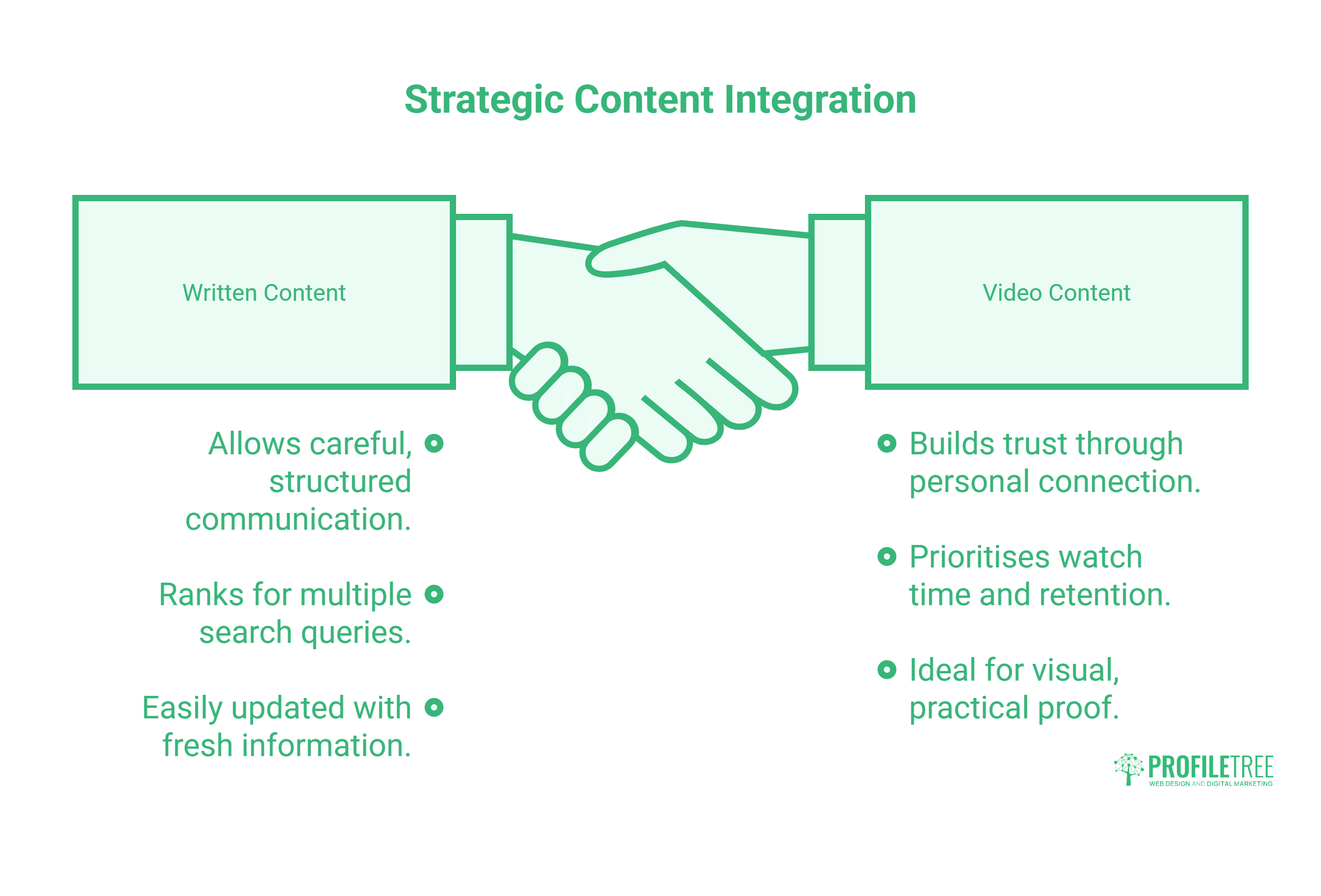
Working through the key parameters in the blog vs vlog comparison gives a clearer picture of where each format earns its place in a strategy.
Formats and Communication Styles
Blogs communicate through precision. You can draft, revise, and structure a written argument carefully before it reaches a reader, which suits nuanced topics (legal considerations, technical processes, strategic decisions) where phrasing matters. Readers also control the pace; they can skim headings, re-read a section, or jump straight to the FAQ.
Vlogs communicate through presence: viewers watch a person think, react, and explain in near real time, which builds a different kind of trust and suits topics where personality or visual evidence carries the point (cooking, fitness, product reviews). For most SMEs, the written format handles commercial intent searches while video handles the credibility-building work.
Required Skills and Time Commitments
The skills gap between blogging and vlogging is real but often overstated. A competent writer can produce a 1,500-word blog post in three to five hours. A comparable vlog, writing a script, filming, editing, adding captions and a thumbnail, typically takes two to three times longer, depending on the production standard you’re working towards, though that gap narrows with practice and a consistent production template.
Platform Options and Hosting Costs
For blogging, WordPress remains the standard for SMEs that want control over their SEO, design, and data. It requires a hosting plan (typically £5 to £25 per month) and a domain name (£10 to £15 per year); the content lives on your site, and the equity builds there.
For vlogging, YouTube is the dominant platform, with more than 2.7 billion monthly active users as of 2026, per platform-usage data compiled by Global Media Insight, and its own search engine, second only to Google. Instagram and TikTok work for short-form content, but have shorter shelf lives for business-intent queries. A phone, decent camera, and a lapel microphone (£20 to £50) is enough to get started; a polished setup sits in the £500 to £2,000 range.
Search Engine Optimisation (SEO): Blog vs Vlog
Blogs and vlogs are optimised differently, but the logic is the same: match what you publish to what people search for. For blogs, that means keyword research, heading structure, internal links, and content depth. For vlogs, it happens through titles, descriptions, tags, and closed captions; YouTube weighs watch time heavily, so a video holding attention from start to finish outperforms a longer one that loses viewers early.
One advantage of blogging: a well-optimised article can rank for dozens of related queries and be updated later. A vlog typically targets one topic, and once published, it’s largely static; you can update the description, but the footage stays as filmed.
Monetisation and Revenue Streams
Understanding how each format earns matters, whichever side of the blog vs vlog decision you’re leaning towards, whether you’re a solo creator or a business owner investing in content as a marketing channel.
Advertising Revenue
Display advertising on blogs typically generates £2 to £9 per thousand page views (RPM) through AdSense in the UK market, according to 2026 ad-network benchmarking published by ToolSignal, with finance and legal niches earning several times that through Mediavine or Raptive. Affiliate links tend to convert better on written content, since readers can return and act on them later.
YouTube’s AdSense RPM for UK creators typically sits between £1.50 and £8.00 per thousand views in 2026, according to earnings data published by Fluxnote, with technology and business channels earning towards the upper end. Sponsorships can generate far more: UK micro-influencers (10,000 to 50,000 subscribers) typically charge £200 to £2,000 per video, depending on niche.
For businesses that use content mainly as a lead-generation tool rather than an ad-revenue channel, blogs drive organic traffic that converts into enquiries, while vlogs build the familiarity that supports trust at the point of enquiry.
Other Revenue Streams
Beyond advertising, both formats support affiliate marketing, sponsored content, digital products, and online courses. The same principles apply regardless of format: only promote products you genuinely use, disclose commercial relationships clearly, and let the quality of the advice do the selling. Building a joined-up content strategy across formats, rather than treating each post as a one-off asset, is where ProfileTree’s content marketing services typically add the most value for SMEs working out where to focus first.
UK and Irish Regulatory Compliance
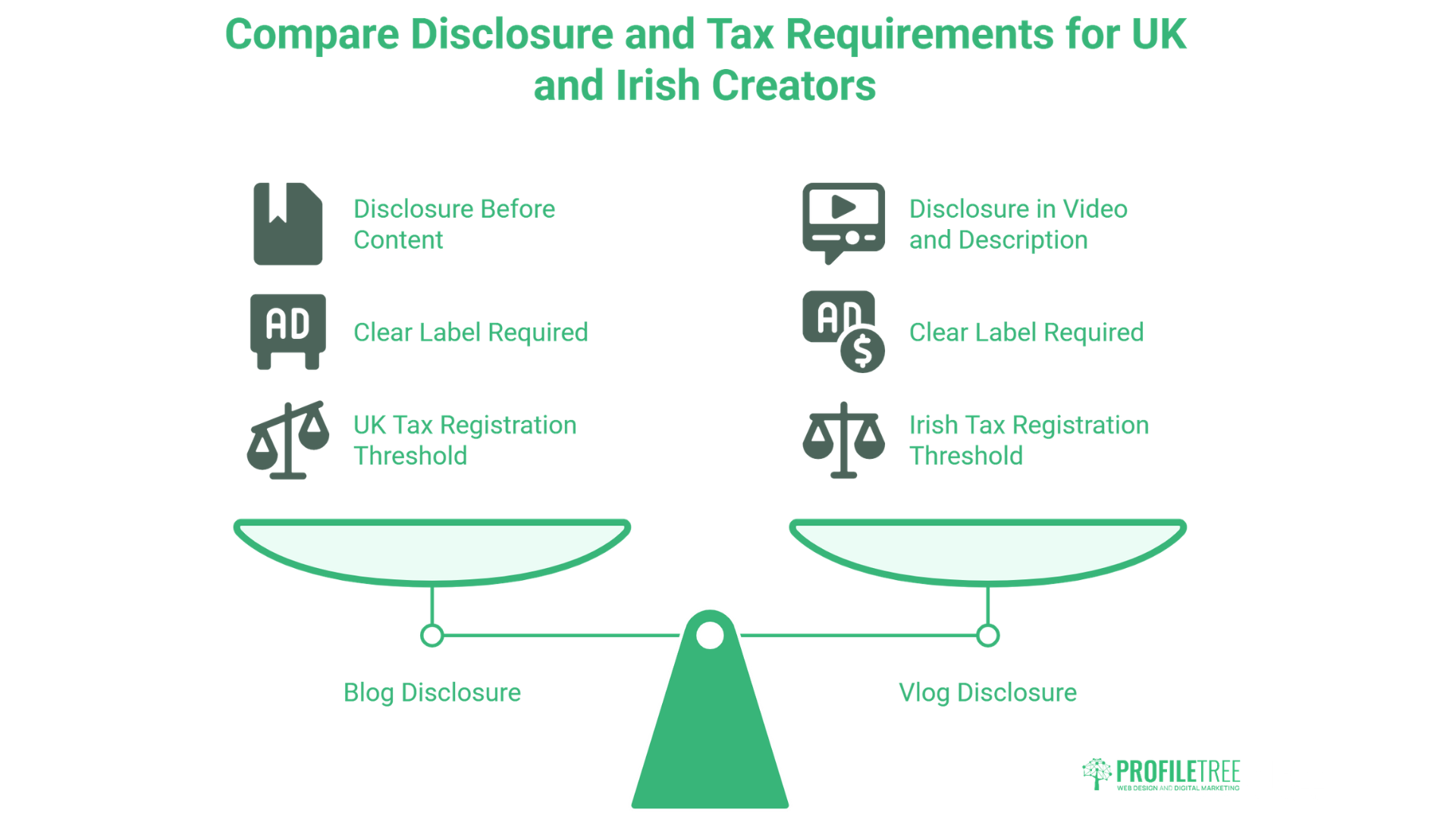
This is an area most blog vs vlog guides skip entirely, and it matters for anyone earning from blogging and vlogging in Northern Ireland, Ireland, and Great Britain.
ASA Disclosure Requirements
The Advertising Standards Authority (ASA) requires that any content that includes a commercial incentive, such as affiliate links, sponsored mentions, or gifted products, be clearly labelled under the CAP Code, which governs UK advertising.
- On a blog post, the disclosure must appear before the content, not at the end.
- On a YouTube video, the disclosure must appear in both the video itself (verbally or on-screen) and in the description.
- The label must be clear: “Ad”, “Sponsored”, or “Paid Partnership” are acceptable; “in association with” or “thanks to” are not.
Tax Registration
For UK creators, earning income from blogging or vlogging requires registration as a sole trader with HMRC once annual trading income exceeds £1,000, the trading allowance threshold confirmed for the 2026/27 tax year. HMRC has also confirmed that the Self Assessment reporting threshold for this kind of income will rise to £3,000 from the 2027/28 tax year, though the £1,000 tax-free allowance itself stays the same in the meantime.
In Ireland, registration with Revenue as self-employed is required once non-PAYE self-employment earnings exceed €5,000 in a tax year. Both HMRC and Revenue allow deductions for genuine business expenses, including equipment, hosting, and editing software.
The Hybrid Strategy: How to Combine Blogging and Vlogging
The most effective long-term content strategy for most businesses isn’t a straight blog vs vlog choice: it’s a structure that uses both, with one feeding the other.
“The most effective content strategies from SMEs aren’t choosing between written and video: they’re using each format where it performs best and connecting them so the audience moves naturally between the two,” says Ciaran Connolly, founder of ProfileTree, a Belfast-based digital marketing agency.
The Repurposing Workflow
The practical challenge of running both formats is time. Most content teams in 2026 use a single research process that produces both a blog post and a video script from the same material: write a structured post optimised for the keywords your audience searches, strip it back to five or seven key arguments, then adapt those into a spoken script. Film using the script as a guide rather than a verbatim read, publish the post with the finished video embedded, and upload the video with a description linking back.
This reciprocal structure means both assets reinforce each other: the post ranks in Google and sends readers to the video, and the video sends viewers back to the website.
Dual-Search Domination (Google and YouTube SEO)
Publishing on both platforms means appearing in two separate search ecosystems for one topic: a well-optimised post can rank in Google’s organic results, and a well-optimised video can rank in YouTube search and Google’s video carousel. That’s especially useful where a competitor ranks strongly in text search but has no video presence, or the other way round, since it creates an opening to build a presence across both channels while they cover only one.
Which Platform Should You Choose?
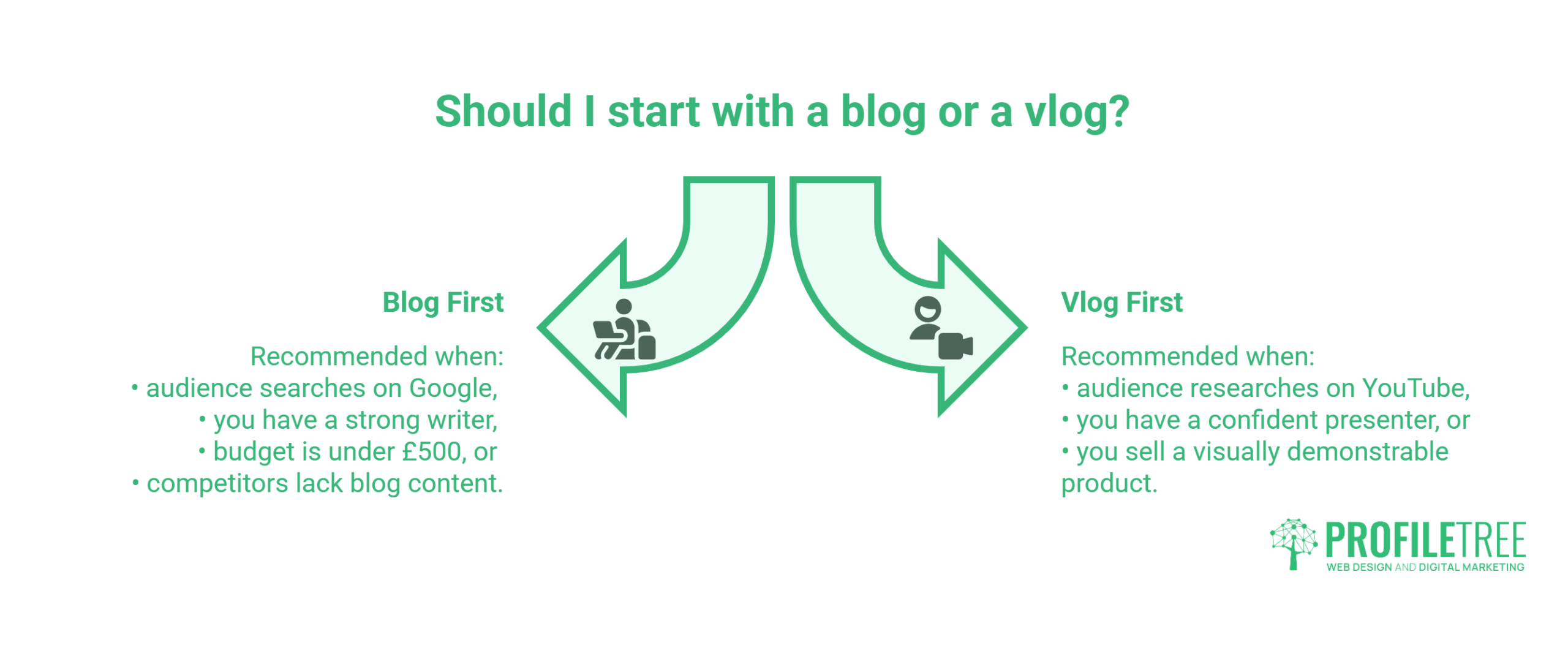
The answer to the blog vs vlog question depends on your audience, your resources, and your immediate goal. Most businesses don’t need to commit exclusively to one format at the start; picking a primary format for the first six to twelve months makes the execution more manageable.
The SME Business Decision Matrix
| Situation | Recommended starting point |
|---|---|
| Audience searches for your service on Google | Blog first |
| Audience researches on YouTube before buying | Vlog first |
| You have a strong writer on the team | Blog first |
| You have a confident on-camera presenter | Vlog first |
| Budget under £500 | Blog first |
| You sell a visually demonstrable product or service | Vlog first |
| Your competitors have no blog content | Blog: clear opportunity |
| Your competitors have no YouTube presence | Vlog: clear opportunity |
Choosing Your Niche and Audience
Before committing to a format, it’s worth thinking through where your audience already spends time. A younger audience gravitating towards YouTube and short-form video is more reachable through vlogging; a B2B audience researching suppliers on Google is more reachable through well-optimised blog content. A restaurant owner reaching local diners might prioritise short-form video on Instagram, while a consultancy targeting “business strategy Northern Ireland” will find blog content more useful.
For solo creators and freelancers building a personal brand, the decision often comes down to how you naturally communicate: a confident writer will find blogging faster to start, and someone comfortable on camera will reach publishable quality faster with a vlog. Starting with one format and adding the second once it runs without friction beats launching both from scratch.
How SEO Works Differently for Blogs and Vlogs
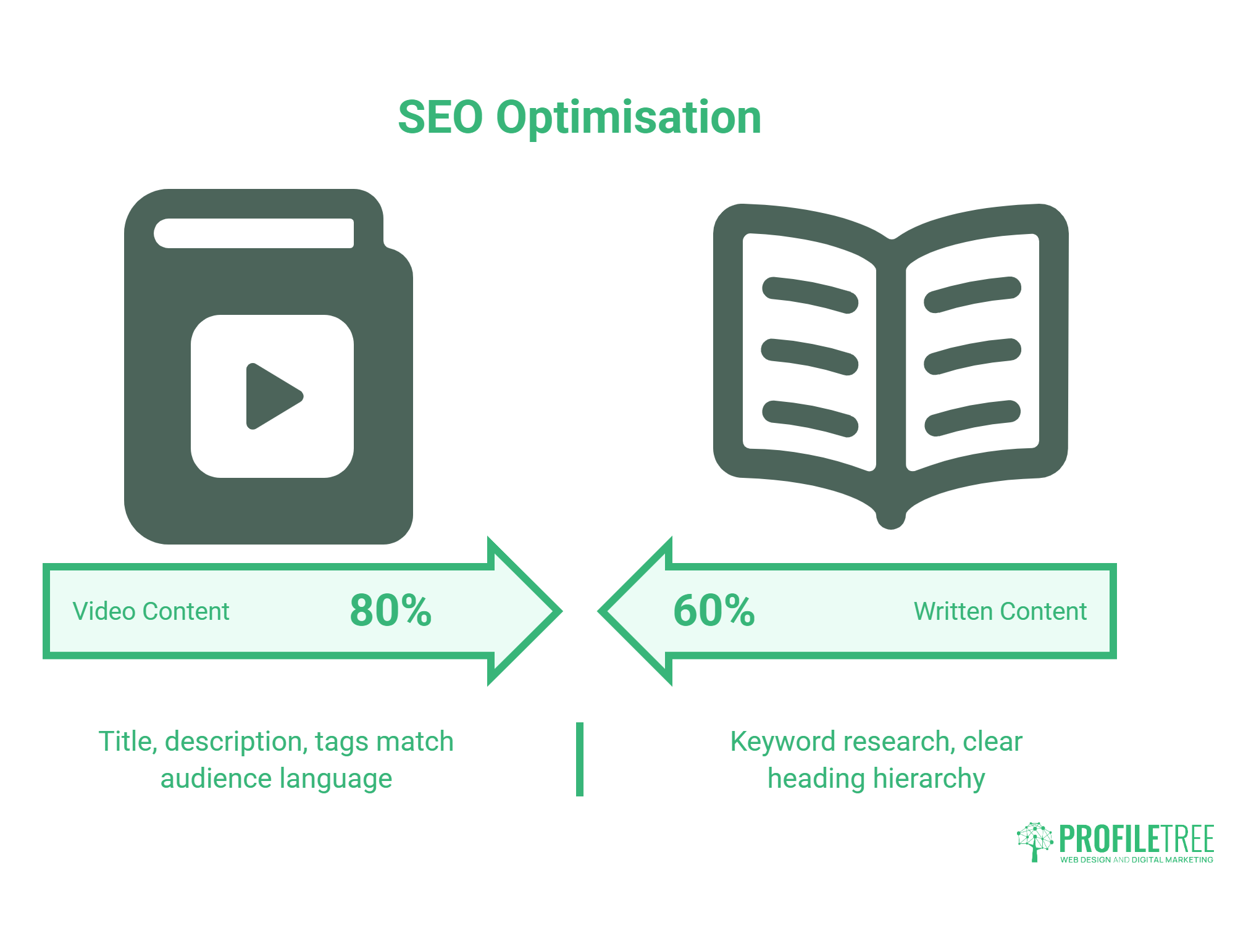
SEO shapes whether either side of the blog vs vlog decision actually reaches an audience. For written content, the fundamentals are keyword research, a clear heading hierarchy, internal linking between related pages, and a word count that matches the depth of the topic; shallow content with the right keywords but insufficient depth tends to underperform compared to longer, more thorough competitors. It’s depth, not keyword count, that decides the outcome.
For video content, the title, description, and tags need to match the language your audience uses when searching on YouTube. Closed captions, either auto-generated and edited or manually uploaded, improve discoverability noticeably, and thumbnails affect click-through rate, which feeds back into the platform’s decisions about whom to show your video to next.
ProfileTree’s SEO services for Northern Ireland businesses cover keyword mapping across both channels as part of a connected strategy.
Technical Setup for Blogging and Vlogging
The technical foundation shapes whether your blog vs vlog content actually reaches its intended audience. Load speed, mobile experience, search visibility, and conversion rates all depend on getting the basics right from the start. The requirements differ between the two formats, so they’re worth treating separately.
Blogging Platforms
WordPress dominates the content management space; its flexibility, plugin library, and SEO capabilities make it the preferred choice for serious content marketing. Self-hosted WordPress gives complete control and removes platform restrictions, though it requires hosting and a domain name. SEO plugins like Yoast or Rank Math simplify technical setup (XML sitemaps, title tag optimisation, structured data markup), and Google Analytics plus Google Search Console together provide the performance data you need to improve over time.
Vlogging Technical Setup
YouTube provides the largest potential audience and functions as a search engine for video content, with free hosting and built-in monetisation options. Proper channel setup, a professional banner and profile image, a clear “about” description, playlist organisation, and a channel trailer affect discoverability and credibility before a single video performs. Audio quality matters more than video quality: viewers tolerate lower-resolution footage but abandon content with poor sound, so a decent microphone is worth buying before a better camera.
The AI Search Shift: How Blogs and Vlogs Get Cited in 2026
AI answer engines have changed the blog vs vlog calculation for informational queries. Google’s AI Overviews, Bing’s Copilot answers, and tools like Perplexity draw their citations overwhelmingly from structured written content, because text is far easier for these systems to parse, quote, and attribute than video.
Ahrefs research has found that pages that cover multiple sub-questions within a single topic are 161% more likely to be cited in AI Overviews than pages that answer only one question. That favours the blog side of the blog vs vlog equation for topics like this one, where several related questions sit under one umbrella.
Video isn’t locked out of AI citation altogether: a YouTube video with an accurate, keyword-rich transcript can still surface in a video carousel, or get referenced indirectly through the accompanying blog post. For most SMEs, the practical move is to keep the written version as the primary asset for AI and traditional search, and treat the video as a companion.
Short-Form Videos’ Growing Role in Discovery
Short-form video, under 60 seconds and published on YouTube Shorts, Instagram Reels, or TikTok, has become a genuine discovery layer alongside full-length blogs and vlogs. YouTube Shorts alone generated over 200 billion daily views in 2026, according to platform data reported by SQ Magazine and Global Media Insight.
That growth doesn’t replace the blog-vs-vlog decision for commercial-intent searches, where written content and full-length video still do the heavy lifting. What it adds is a top-of-funnel layer: a short clip introduces a topic, and part of that audience goes on to read the blog or watch the full vlog for details. ProfileTree’s guide to the rise of short-form video looks at how Shorts, Reels and TikTok fit alongside long-form blogs and vlogs.
Future Trends in Online Content Creation
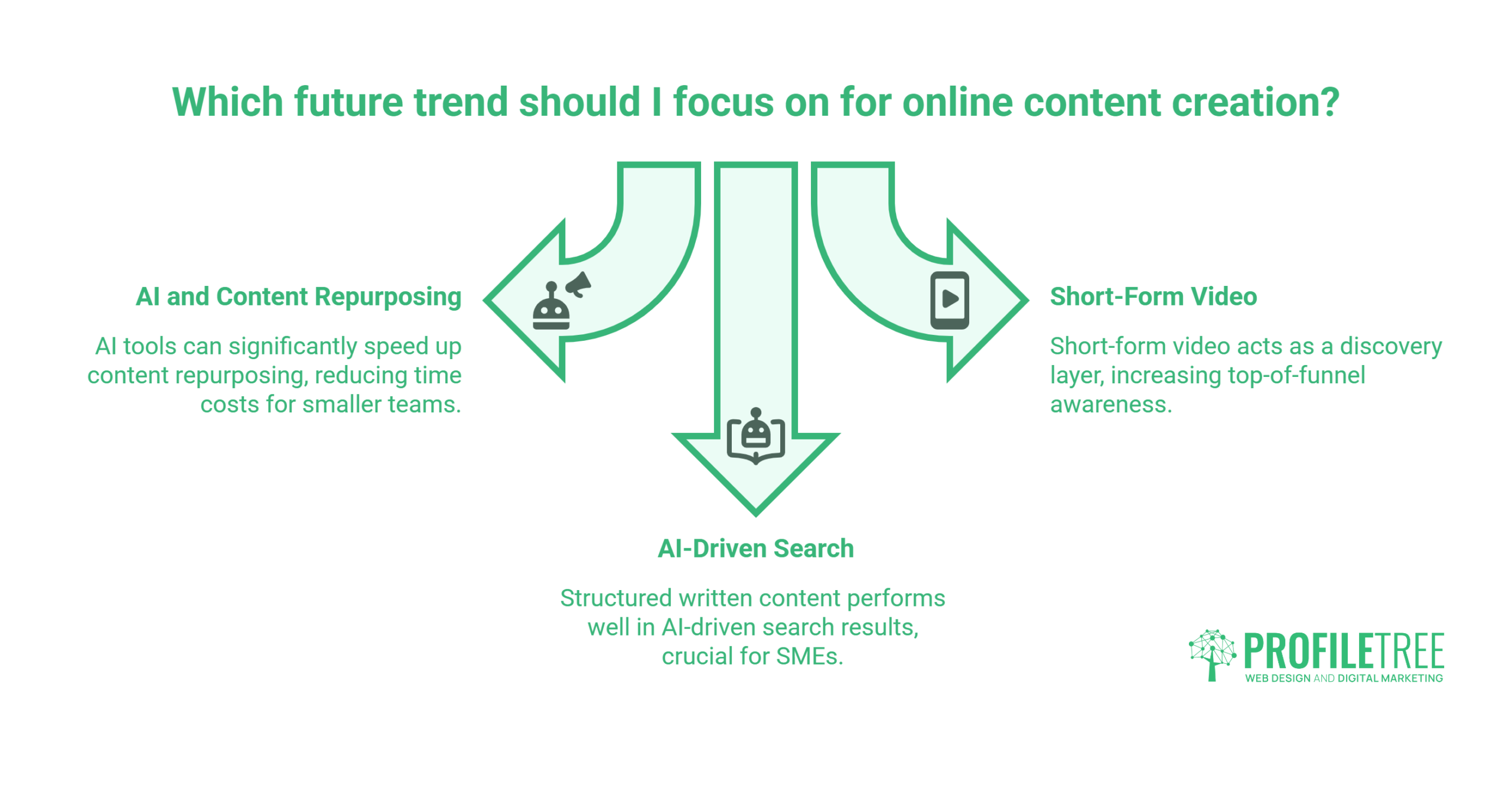
The content formats available to businesses keep shifting across blogging and vlogging alike, driven by AI tools, platform changes, and evolving search behaviour. One development worth watching closely is how quickly repurposing has sped up: AI tools can now generate a video script from a written article in minutes, auto-generate captions, and produce social clips from a longer video with minimal manual input. That cuts the time cost of running both formats in parallel, which was historically the main barrier for smaller teams weighing up a blog vs vlog approach.
Businesses looking to get more from their existing content can explore ProfileTree’s digital training programmes for practical frameworks on content strategy, repurposing, and distribution.
Thinking about how blogging or vlogging fits into your business’s content strategy? ProfileTree works with SMEs across Northern Ireland, Ireland, and the UK to build content plans that integrate organic search, video, and digital marketing into a single practical system. Get in touch to talk through your options.
FAQs: Blog vs Vlog
Quick, direct answers to the questions people ask most often about the blog vs vlog decision.
What is the main difference between a blog and a vlog?
The core difference is format and platform. A blog is written text on your own website, indexed by Google. A vlog is video content, usually on YouTube, discovered through the platform’s own search and recommendation system.
Which is better for SEO: a blog or a YouTube channel?
For long-tail informational traffic, a well-optimised blog consistently outperforms a YouTube channel. For visual or personality-driven queries, YouTube has the advantage. Most SMEs get the strongest result from combining both.
Do bloggers or vloggers make more money?
Neither format is categorically more lucrative. UK bloggers in high-value niches such as finance typically earn higher RPM from display advertising than equivalent YouTube channels, while vloggers often close the gap through sponsorships. Creators who run both formats tend to generate more total revenue than those using either alone.
Is blogging still profitable in the UK and Ireland?
Yes, for content targeted at genuine commercial intent. General lifestyle blogging with no clear monetisation model has become harder to sustain on advertising revenue alone. Niche blogs in B2B, professional services, and specialist consumer topics continue to perform well for organic traffic and lead generation.
Can I start a blog and a vlog at the same time?
It’s possible, and the repurposing workflow above makes it more practical than starting both from scratch. The risk is spreading effort too thin in the first few months, so a reasonable approach is to launch the blog first and add video once that workflow runs smoothly.