
What Is YouTube? A Complete Guide for Businesses and Creators
Table of Contents
What is YouTube? It’s a Google-owned platform where anyone can upload, watch, and search for videos, and it doubles as the world’s second-largest search engine. For a business in Belfast, Dublin or Manchester, that makes it two things at once: somewhere customers already go to research before they buy, and a channel you can build without paying for reach.
So what is YouTube in practical terms for a company trying to win work? This guide covers how the platform works, the figures that hold up to scrutiny, the monetisation rules that change on 1 February 2027, and five ways UK and Irish businesses turn a channel into enquiries. Whether that work sits in-house or with our Belfast video production team, the fundamentals don’t change.
Three things to know before the detail:
- YouTube behaves like a search engine as much as a social feed. Video metadata competes for the same intent as your website pages.
- Alphabet broke out YouTube revenue for the first time in February 2026: more than $60 billion across advertising and subscriptions for 2025.
- The Partner Programme entry bar doubles on 1 February 2027, so anyone planning to monetise has one window left under the current rules.
What Is YouTube? The Platform in Plain Terms
YouTube is a video-sharing and search platform where anyone can upload, watch, and comment on video, from thirty-second clips through to hour-long documentaries. It pairs the reach of a search engine with the community features of social media, and that pairing is what makes it useful for reaching people who have never heard of you.
Three former PayPal employees, Chad Hurley, Steve Chen and Jawed Karim, launched the site in 2005. Google bought it in 2006 for $1.65 billion, and that backing turned a small video-sharing site into the infrastructure behind modern video search, online learning and digital commerce.
Unlike platforms built around posts that vanish from a feed within days, YouTube behaves like a permanent library. A video uploaded today can still pull in viewers years later through search and recommendations, which is why tutorials, product demonstrations and case studies hold their value better here than almost anywhere else. Viewers arrive by several routes at once: Google search, YouTube’s own search bar, recommendations, subscriptions and social sharing.
How YouTube Works
YouTube’s recommendation system is built around watch time, engagement, and viewer satisfaction. It wants people to stay on the platform, so it promotes videos that keep them watching. A handful of signals carry most of the weight.
Watch time and session duration measure how long someone watches and whether they carry on watching afterwards. Click-through rate reflects how often people click a video when it appears in search or as a recommendation, which is where the thumbnail and title do the heavy lifting. Likes, comments, shares and subscriptions all signal quality, though a few thoughtful comments count for more than a wall of emoji. Titles, descriptions, tags and captions tell the platform what a video is actually about. And channels that publish to a schedule hold audience attention better than channels that upload in bursts.
The scale is worth sitting with. YouTube’s own press materials put daily uploads at more than 20 million videos, across localised versions in over 100 countries and 80 languages. Your video isn’t competing with all of that, but it is competing with everything on the platform about your topic. That’s the case for depth over frequency, and it’s the same argument that applies to setting up a channel properly from the start.
Watching YouTube Across Devices in the UK and Ireland
Most people asking what YouTube is today are setting up a television or a streaming stick, not opening a desktop browser for the first time. The platform runs natively on smart TVs, games consoles and streaming devices, and the interface adapts to whatever screen it lands on.
Ofcom’s Media Nations 2026 report, published in July, found that YouTube viewing on UK television sets has doubled since 2022, rising from 9 minutes per person per day to 19 minutes in 2025. Across all connected devices, daily viewing went from 33 minutes to 41 minutes per person. Older audiences drove much of that shift: weekly reach among people aged 75 and over climbed from 28% in 2022 to 33% in 2025, while viewing among 16- to 24-year-olds fell for a second year running.
There’s a licensing wrinkle worth knowing, and it’s narrower than most people assume. TV Licensing guidance is that you don’t need a TV Licence to watch videos or clips on demand on YouTube, but you do need one to watch TV programmes live on the platform, such as a news channel’s live simulcast. A business’s own livestream, webinar or product launch isn’t part of a TV channel and doesn’t carry that requirement.
The living-room shift changes production decisions. A tutorial that works on a phone, with large on-screen text and a fast opening, doesn’t always translate to a sixty-inch screen where viewers expect a calmer pace and more room to read. Channels that plan for both contexts, rather than defaulting to whichever device the video was filmed on, hold attention across a wider range of viewing situations.
YouTube by the Numbers
Ask what YouTube is today and the honest answer starts with scale. Most statistics circulating about the platform come from aggregators reworking each other’s figures. The table below sticks to numbers that trace back to a named primary source, with the date attached, because an undated figure is close to useless on a platform that moves this fast.
| Metric | Figure | Source and date |
|---|---|---|
| Videos uploaded daily | More than 20 million | YouTube press materials, 2026 |
| Shorts views per day | More than 200 billion | YouTube, Cannes Lions keynote, June 2025 |
| Hours watched on TV screens daily | More than 1 billion | YouTube, June 2025 |
| YouTube total revenue, 2025 | More than $60 billion | Alphabet Q4 2025 results, February 2026 |
| YouTube ad revenue, Q2 2026 | $11.06 billion, up 13% | Alphabet Q2 2026 results, July 2026 |
| Alphabet paid consumer subscriptions | More than 325 million | Alphabet Q4 2025 results, February 2026 |
| UK viewing on TV sets | 19 minutes per person per day | Ofcom Media Nations 2026 |
| Localised versions | 100+ countries, 80 languages | YouTube press materials, 2026 |
Table 1: YouTube platform figures and their primary sources
Two things stand out. The first is that Alphabet broke out YouTube’s total revenue for the first time in its Q4 2025 results, confirming more than $60 billion across advertising and subscription income, such as YouTube Premium. That puts YouTube ahead of Netflix on annual revenue.
The second is the living room. On Alphabet’s Q2 2026 earnings call, the company said more than 1.7 billion unique viewers watched World Cup-related video on YouTube, with over 550 million of them watching on a television set. Whatever you make of the platform as a marketing channel, it stopped being a phone-first product some time ago.
YouTube for Businesses and Marketers
Video on YouTube does several jobs at once. It ranks in Google results, which gives you a second route to the same searcher. It can be repurposed across social media, embedded in blog posts and dropped into email campaigns as part of a wider content marketing programme, which stretches the value of a single production day. And because the platform rewards consistency over volume, even a modest publishing schedule builds momentum if you keep it up.
The platform also lets you demonstrate things text can’t. A web design agency can walk through a portfolio project and explain the decisions behind it. A consultant can break down a strategy in real time. A manufacturer can show a machine running rather than describing it in a spec sheet. That kind of demonstration builds credibility faster than written claims do.
“The businesses that get results from YouTube treat it like a second website rather than a social account. They decide what each video is meant to answer, they publish to a schedule they can actually keep, and they measure enquiries rather than views. That’s a slower start than chasing one viral clip, but it’s the version that still pays off two years later.”
Ciaran Connolly, Founder, ProfileTree
Content Strategy and Pillars
Channels that work align content with one goal, whether that’s brand awareness, lead generation, or customer education. A practical starting point is three to five content pillars. For a web design agency that might be website strategy, design decisions, technical development, and client case studies. Pillars give a channel consistent themes while leaving room to vary format within each one.
Before filming anything, check what competitors’ most-watched videos cover, what people type into YouTube’s own search bar, and which questions come up most often in sales conversations. That last source is the one most businesses skip, and it’s usually the richest.
A short list of formats covers most business needs: educational tutorials that solve one specific problem, commentary on industry changes, product or service demonstrations, behind-the-scenes footage, client case studies, and FAQ videos. Rotating through these keeps a channel from feeling repetitive to the people who subscribe.
Production Essentials
You don’t need a broadcast budget, but a few basics change how a channel is perceived. A modern smartphone shoots genuinely good video, and an entry-level mirrorless camera is a worthwhile upgrade where the budget allows. Audio deserves the first spend, though. A decent USB or lavalier microphone does more for perceived quality than any camera upgrade, because bad sound is the fastest way to lose a viewer.
Lighting matters almost as much. A window with good natural light, or an inexpensive three-point kit, prevents the flat, grainy look that makes video feel amateur. For editing, DaVinci Resolve is free and capable, while Adobe Premiere Pro and Final Cut Pro suit teams who need more control.
Measuring Business Return
Views and subscriber counts are easy to track and easy to overvalue. What matters is whether YouTube moves enquiries, bookings or sales.
Google Analytics shows referral traffic from the platform, which tells you which videos bring qualified visitors rather than passing browsers. Tracking form submissions, consultation bookings or downloads that start from a video gives a clearer read on lead generation than watch time does. It’s also worth comparing acquisition cost across channels: divide total investment in the channel, including filming time, editing and any paid promotion, by the customers it brings in, then set that against your other marketing. A rise in branded search volume, meaning people searching for your business by name rather than a generic term, often tracks alongside a growing channel, and it’s a useful secondary signal even when direct attribution is hard.
| Video type | Best for | Typical length |
|---|---|---|
| Explainer or how-to | Answering one specific customer question | 5 to 10 minutes |
| Case study | Showing results with a real client | 6 to 12 minutes |
| Product or service demo | Showing a capability in action | 3 to 8 minutes |
| FAQ video | Covering several common questions at once | 5 to 10 minutes |
| Behind the scenes | Humanising the team and the process | 2 to 6 minutes |
| Short | Pulling new viewers towards longer content | Under 60 seconds |
Table 2: Business video formats, purpose and typical run time
YouTube SEO, Growth and Engagement
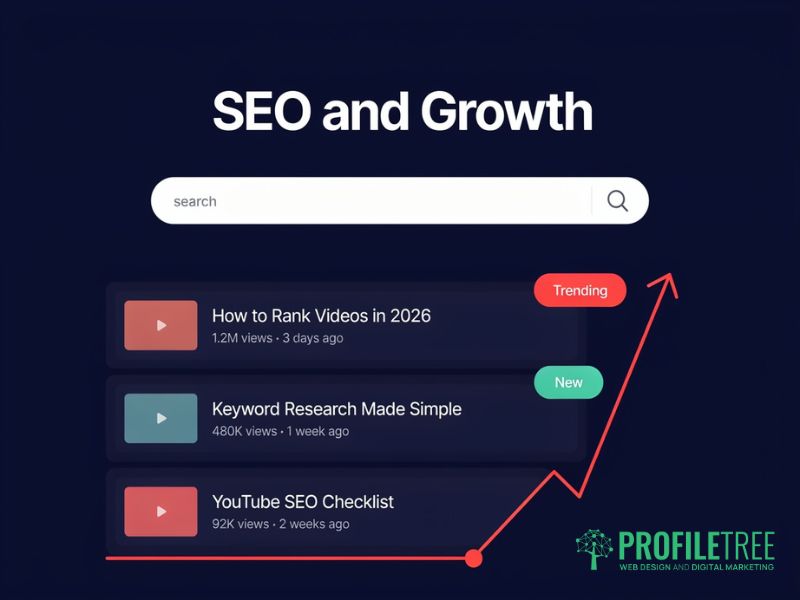
YouTube is a search engine in its own right, so metadata and viewer behaviour both decide whether a video gets found. The discipline sits close to website search engine optimisation, and the same team can usually run both.
Keyword Research and Metadata
Good YouTube SEO starts in the search bar. Type a relevant term and note the autocomplete suggestions, because those reflect what people actually search for. Then look at which videos already rank for those terms to find the gaps. Our fuller guide to YouTube SEO works through the ranking factors in more detail.
Separate informational searches from commercial ones early. Someone typing “how to optimise a YouTube video” wants a tutorial. Someone typing “video production agency Belfast” is closer to a decision. The two call for different videos, not the same video with a different title.
Titles should put the main keyword near the start while staying readable, ideally under seventy characters so they don’t get cut off. Thumbnails with clear faces, high contrast, and no more than a few words consistently beat auto-generated stills. Descriptions matter more than most creators realise: the first one or two sentences appear before the “show more” button, so front-load them with the video’s key point. Tags carry less weight than they once did, but five to ten relevant ones still help categorisation, and accurate captions improve both accessibility and search.
Growing Your Audience
Consistency does more for growth than raw upload volume. Channels that publish to a schedule, even a fortnightly one, outgrow channels that post in bursts and then go quiet. Batching, which means filming several videos in one session, makes that rhythm far easier to hold.
Promotion outside YouTube speeds things up. Embedding video on relevant website pages drives traffic in both directions and can increase time on page. Sharing uploads with an email list reaches people who already know you. Cross-posting to LinkedIn and Instagram works best when the message is adapted to each platform rather than copied across.
Playlists and Shorts do different jobs. A playlist keeps someone watching after the first video ends, which extends session length in a way a single upload can’t. Shorts get wider initial reach and introduce new viewers to longer content, and at more than 200 billion daily views, they’re hard to ignore for any channel chasing discovery. We cover that trade-off in more depth in our piece on short-form versus long-form video. A business channel doesn’t need both from day one, but it’s worth deciding which role each will play before publishing becomes routine.
Monetisation and the Partner Programme
Once a channel is established, the obvious question is how it earns. YouTube runs a two-tier Partner Programme, and the bar for the top tier doubles on 1 February 2027.
| Requirement | Early access tier | Full tier to 31 Jan 2027 | Full tier from 1 Feb 2027 |
|---|---|---|---|
| Subscribers | 500 | 1,000 | 1,000 (unchanged) |
| Recent uploads | 3 public in 90 days | Not separately required | Not separately required |
| Watch hours | 3,000 in 12 months | 4,000 in 12 months | 8,000 in 365 days |
| Or Shorts views | 3 million in 90 days | 10 million in 90 days | 20 million in 90 days |
| What it gives you | Memberships, Super Thanks, Shopping | Plus ad and Premium revenue | Plus ad and Premium revenue |
Table 3: YouTube Partner Programme thresholds before and after 1 February 2027
What Changes on 1 February 2027
YouTube announced the change on 10 August 2026, describing it as the first major adjustment to Partner Programme entry since 2018. New applicants from that date need 8,000 qualified public watch hours in the last 365 days, or 20 million qualified Shorts views in the last 90 days, alongside the unchanged 1,000-subscriber minimum. Channels already in the programme keep their status, according to YouTube’s own documentation. They do need to accept YouTube’s updated terms in YouTube Studio by 31 January 2027, or their earnings will pause until they do. From 1 February, a channel needs 10 million qualified Shorts views in 90 days to keep earning from Shorts.
The fan-funding tier doesn’t change. You can still join at 500 subscribers with three public uploads in 90 days and either 3,000 watch hours or 3 million Shorts views, which opens channel memberships, Super Thanks and Shopping.
For a business channel, the practical read is simple. If monetisation is part of the plan and you’re anywhere near 4,000 hours, applying before 1 February 2027 is worth the effort, because review alone takes weeks. If it isn’t part of the plan, the change doesn’t affect you, and most service businesses earn far more from the enquiries a video generates than from the advertising placed against it.
One requirement still catches people out. YouTube asks creators to disclose realistic AI-generated or altered content through a toggle in YouTube Studio, and channels that skip it risk a warning followed by restrictions. It doesn’t apply to obvious animation or clearly stylised work, only to material that could be mistaken for real footage. Any business experimenting with AI-assisted production should build that step into its workflow now rather than retrofitting it later.
Alternative Revenue Streams
Advertising is rarely the most predictable income, which is why established creators diversify and why a business shouldn’t plan a YouTube strategy around ad revenue at all. Ad income is paid per thousand views, and the rate swings widely by audience location, sector, and time of year, so treat it as a bonus rather than a forecast.
Sponsored content pays brands to feature a product or service, though rates vary enormously by audience size and sector. Affiliate marketing, which means promoting products through a tracked link for commission, works well alongside tutorials and reviews. Digital products such as courses, templates or guides carry the highest margin, since there’s no split with a sponsor or the platform. And for service businesses, YouTube most often works as a lead source in its own right: a well-made explainer or case study can bring in enquiries long after upload.
Five Ways YouTube Supports Business Growth
Scale and mechanics only matter if they turn into commercial outcomes. Five patterns come up repeatedly among businesses that treat YouTube as a working channel rather than a side project.
- Dual visibility. A video that ranks on YouTube can also surface in Google’s results for the same query, so one piece of production work earns two routes to the same searcher.
- Longevity. Unlike a social post that disappears from feeds within days, a well-optimised video keeps earning views and enquiries for years, which changes the economics of the time spent making it.
- Trust through demonstration. Watching someone work through a real process on camera persuades a hesitant buyer faster than a page of written claims.
- Content reuse. One filming session can be cut into a long-form video, several Shorts, social clips and blog embeds, which multiplies the return on an afternoon’s work.
- A measurable path to leads. Form fills, consultation bookings and branded search upticks give you something more concrete to report than view counts.
None of these depends on chasing viral reach. A modest, consistent channel that ticks each box usually outperforms a sporadic one with a single high-view outlier.
“Chris from Profile Tree recently produced some video content and head shot images for our business, Cartmill Stewart Chartered Accountants. Chris was amazing from start to finish and the finished product exceeded our expectations.”
Claire Stewart, Cartmill Stewart Chartered Accountants, Google review
Building a YouTube Strategy That Lasts
YouTube gives businesses a real route to an audience, authority, and measurable growth, but it rewards planning and consistency rather than effort delivered in bursts. Most channels that stall do so because publishing stopped after a handful of videos, before either the recommendation system or the audience had a chance to respond.
At ProfileTree, we help clients across Northern Ireland, Ireland and the wider UK build video strategies that combine content planning, production, SEO and cross-channel promotion, so each video earns more than a view count. If YouTube has felt like an intimidating unknown rather than a working part of the marketing mix, that’s usually a sign it needs structure, not more effort.
FAQs
1. What is YouTube used for?
YouTube is used for watching, uploading, and sharing video, from entertainment and education through to product research and business marketing. It also works as a search engine, so many people use it to find how-to content and reviews before buying.
2. What is a YouTube channel?
A YouTube channel is a creator’s or business’s dedicated space on the platform, where uploaded videos, playlists, and the subscriber community all sit. Channels can run on a personal account or a Brand Account, which lets several team members manage the same channel.
3. How does YouTube work?
YouTube combines creator uploads with a recommendation system that prioritises watch time, engagement and viewer satisfaction. Videos surface through search, recommendations, subscriptions and social sharing, so well-optimised content can be found by several routes at once.
4. Do I need to pay to use YouTube?
Basic access is free and funded by advertising. YouTube Premium removes ads and adds background play and offline downloads for a monthly fee, but it isn’t required to watch, upload or grow a channel.
5. Do I need a TV Licence to watch YouTube in the UK?
Not for on-demand videos and clips. You do need one to watch TV programmes live on YouTube, such as a news channel’s live simulcast, because that counts as live TV under TV Licensing rules. A business’s own livestream or webinar isn’t part of a TV channel and doesn’t trigger the requirement.