
Skills Needed for Marketing: A Leader’s Guide
Table of Contents
Understanding the skills needed for marketing has never been more important for business owners and managers. The role has shifted. What marketing teams must deliver today (measurable growth, search visibility, content at scale, AI-assisted campaigns) looks very different from what was expected five years ago. Yet most guidance on this topic is written for students building a CV, not for the people who have to hire, train, and retain the people doing the work.
This guide takes a different approach. It covers the core technical and strategic skills needed for marketing in a way that is directly useful to SME owners, marketing managers, and business leaders across Northern Ireland, Ireland, and the UK.
Quick reference: The skills covered below fall into four categories: technical skills for marketing (SEO, data, paid media, content), AI and automation, commercial and strategic thinking, and the soft skills that determine whether a capable individual becomes a capable team player.
How Marketing Skills Have Changed
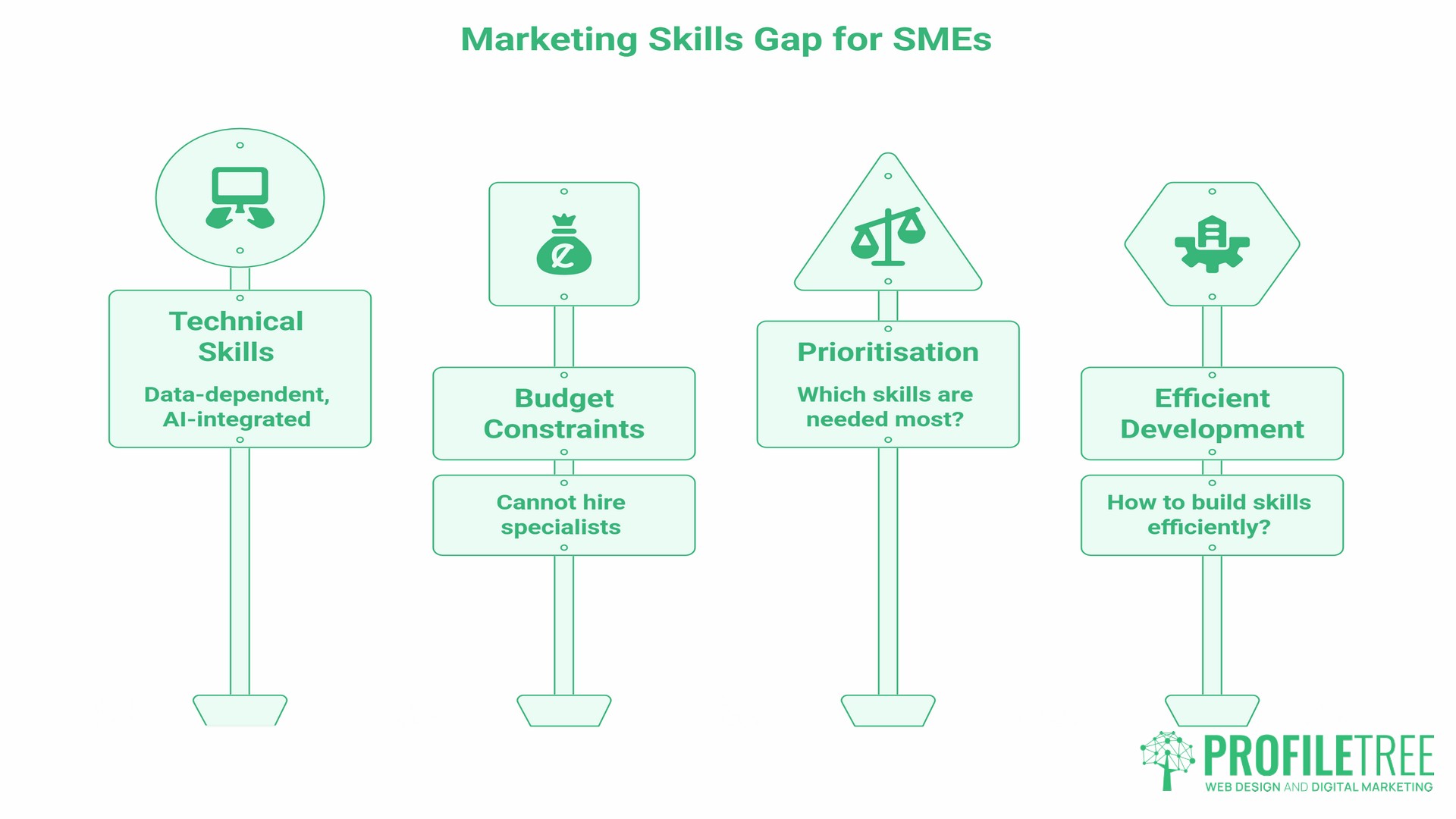
The marketing generalist of ten years ago (someone who could write, design, and manage social media) is still valuable. But the gap between a generalist and a specialist has widened considerably, and the skills that generate measurable commercial results are now more technical, more data-dependent, and more AI-integrated than most job descriptions acknowledge.
For SMEs in particular, this creates a real challenge. You rarely have the budget to hire one person per specialism. The question most business owners face is not “what are all the skills needed for marketing?” but “which skills does my team need most right now, and how do I build them efficiently?”
The answer depends on your growth stage, your channels, and your current gaps. The framework below is designed to help you work that out.
Technical Skills for Marketing: The Hard Skills That Drive Results
Technical marketing skills are the ones most directly connected to measurable outcomes. They are also the category where the skills needed for marketing jobs have evolved most rapidly.
Data Literacy and Performance Analytics
The ability to read, interpret, and act on data is now a baseline requirement for any marketing hire. This does not mean advanced statistics. It means understanding what GA4 tracks and what it misses, knowing the difference between sessions and users, and being able to connect traffic data to revenue without relying on a developer to run reports.
For SMEs, the practical priority is attribution clarity: understanding which channels and campaigns are generating leads, at what cost, and with what conversion rate. Marketers who can answer those questions from a live dashboard are worth considerably more than those who cannot.
If your team currently produces marketing reports that list what happened without explaining why, or recommends budget increases without evidence, that is a data literacy gap worth addressing directly. ProfileTree’s digital training programmes include analytics and reporting modules designed specifically for SME marketing teams.
Search Engine Optimisation and Modern Search Behaviour
SEO remains one of the most valuable technical skills needed for marketing, particularly for businesses that rely on organic traffic from local and regional searches. The discipline has grown more complex over the past two years. Google’s AI Overviews now appear above traditional results for many informational queries, and the signals that influence ranking include page experience, content depth, and entity clarity alongside the traditional factors of links and keyword use.
For a marketing professional working in the UK and Ireland, core SEO competencies should include keyword research, on-page optimisation, technical basics (site speed, crawlability, structured data), and content strategy. Local SEO (Google Business Profile management, local citations, and location-specific page content) is particularly relevant for service businesses targeting specific geographic areas.
The practical gap most SME marketers have is not awareness of SEO but the ability to connect SEO activity to business outcomes. A marketer who understands SEO well enough to report on it in commercial terms (impressions, clicks, leads generated, cost per acquisition compared with paid channels) is genuinely rare.
Content Strategy and Multichannel Storytelling
Content marketing extends well beyond writing blog posts. The technical marketing skills required here include editorial planning, audience research, keyword-to-content mapping, and understanding which formats (written, video, short-form social) suit different stages of the buyer journey.
Video has become a significant part of the content skills picture for UK and Irish businesses. Short-form video performs across social platforms, while longer educational videos work well for SEO and for building the kind of trust that service businesses need before a prospect makes contact. ProfileTree’s video production work with SMEs consistently shows that businesses which integrate video into their content strategy see stronger engagement rates than those relying solely on written content.
The specific technical skill here is the ability to plan and execute content across formats without siloing them. A blog post, a short video, and a social caption covering the same topic should reinforce each other. Marketers who can work across those formats, or who understand each well enough to brief specialists effectively, are increasingly in demand.
Paid Media Management
Paid media requires a distinct technical skill set separate from organic marketing. The core competencies include campaign structure, audience segmentation, creative testing, bid strategy, and performance analysis. Google Ads and LinkedIn are the most commercially relevant platforms for B2B SMEs in the UK and Ireland. Meta advertising remains useful for B2C businesses with sufficient audience scale.
The skills needed for marketing jobs in paid media are becoming more data-intensive as automated bidding and AI-driven audience expansion reduce the need for manual bid management. What matters more now is the ability to set clear objectives, interpret performance signals, and make sound decisions about budget allocation based on the data.
The AI-Augmented Marketer
Artificial intelligence is no longer a “trend to watch.” It is a set of tools that marketing teams are using right now to reduce the time spent on routine tasks and to improve the quality and consistency of their output. The technical skills needed for marketing in this area are practical rather than theoretical.
AI Workflow Automation and Efficiency
The most immediate AI skills needed by marketing teams are not advanced prompt engineering. They have the ability to use AI tools to accelerate research, draft and iterate content, generate structured briefs, summarise competitor content, and build basic automated workflows.
A marketing manager who can use AI tools to cut the time spent on first-draft content, briefing, and reporting gives their business a meaningful productivity advantage. One who cannot is spending a disproportionate amount of time on tasks that competitors are automating.
This is the area where upskilling an existing team member is often more cost-effective than hiring. The tools change regularly, but the underlying skill, knowing how to give an AI system a clear enough task and evaluate the output critically, is transferable. ProfileTree’s AI implementation service for SMEs includes practical training on integrating AI tools into existing marketing workflows.
Generative AI for Content and Personalisation
Beyond efficiency, AI unlocks capabilities that were previously out of reach for smaller marketing teams. AI-driven content personalisation, automated A/B testing at scale, and AI-assisted image and video creation are now accessible to SMEs. The skill is not in using any single tool but in knowing which tools suit which tasks and how to evaluate quality before anything goes out.
“The businesses we work with across Northern Ireland and the UK that are seeing real gains from AI are not the ones that have handed marketing to a chatbot,” says Ciaran Connolly, founder of ProfileTree. “They are the ones who have trained their people to use AI as a multiplier on skills they already have. That distinction matters a great deal when you are working with limited resources.”
Commercial Awareness: The Marketing Skill Most Teams Lack
Commercial awareness is rarely listed in job advertisements but consistently cited by hiring managers as the quality that separates average marketers from excellent ones. It is the ability to connect marketing activity to business outcomes in concrete, financial terms.
Budget Management and ROI Thinking
A marketer with commercial awareness understands the cost of customer acquisition, can calculate return on advertising spend, and knows how to make a case for budget allocation based on evidence rather than instinct. They understand that spending £2,000 on a campaign that generates £6,000 in revenue is better than spending £500 on one that generates £800 in revenue, even though the second looks cheaper.
This skill is particularly important for SMEs where marketing budgets are constrained, and every pound needs to work hard. The ability to build a basic marketing P&L (showing investment, output, conversion rates, and revenue generated) is a practical commercial skill that relatively few marketing professionals have developed.
Customer Journey Mapping and Conversion Rate Optimisation
Understanding the customer journey from first contact to purchase is both a strategic skill and a technical one. The practical competency involves mapping the stages a prospective customer moves through, identifying where people drop off, and making changes to content, design, or messaging that improve conversion at each stage.
This connects directly to web design and website performance. A marketing team that drives strong traffic to a poorly structured website with slow load times and unclear calls to action is wasting its effort. The technical skills needed for marketing in this area include a working understanding of landing page design, user experience principles, and basic conversion rate optimisation techniques. ProfileTree’s web design services work closely with marketing teams on this exact problem: ensuring that the website converts the traffic that marketing activity generates.
Skill Comparison: Entry-Level vs Senior Marketing Roles
The skills needed for marketing jobs vary significantly depending on seniority. This table provides managers with a practical reference point for assessing team capabilities and identifying development priorities.
| Skill Area | Entry Level | Mid Level | Senior Level |
|---|---|---|---|
| SEO | Keyword basics, on-page optimisation | Technical SEO, content strategy | Search strategy, team oversight, ROI reporting |
| Data analytics | GA4 navigation, basic reporting | Attribution modelling, funnel analysis | Commercial data storytelling, budget decisions |
| Content | Writing, basic briefing | Multichannel planning, video briefing | Editorial strategy, brand voice, team direction |
| Paid media | Campaign setup and monitoring | Audience segmentation, creative testing | Full-funnel strategy, budget allocation |
| AI tools | Prompt basics, content drafting | Workflow automation, AI briefing | AI integration strategy, team upskilling |
| Commercial awareness | Reporting on activity | Connecting activity to leads | Connecting leads to revenue, budget P&L |
Essential Soft Skills for Marketing Teams
Technical and commercial skills are necessary but not sufficient. The soft skills that determine whether a marketing team functions well are often harder to hire for and harder to develop than the technical ones.
Adaptability in a Fast-Moving Landscape
Marketing platforms, tools, and best practices change faster than almost any other business function. A team member who resists learning new tools, dismisses new channels before testing them, or treats their existing knowledge as fixed is a liability in a discipline that rewards continuous learning.
Adaptability in practice means a willingness to test, learn, and change approach based on evidence. It also means recognising when a previous approach is no longer working before the data makes it undeniable.
Strategic Critical Thinking
Critical thinking is the ability to evaluate a problem, consider multiple approaches, and make a reasoned decision rather than defaulting to habit or received wisdom. In marketing, this shows up in decisions like “Should we invest in SEO or paid media for this campaign?” Is the underperformance on this channel a targeting issue or a creative one? Is this external agency’s report telling us what we need to know?
Marketers who think critically are also better at briefing agencies and suppliers, because they know what questions to ask and what good work looks like.
Communication Across Audiences
Marketing professionals communicate constantly: with clients, suppliers, technical teams, and senior leadership. The specific skill here is the ability to adjust communication style and level of detail for different audiences. Reporting campaign performance to a CEO requires a different framing than briefing a web developer on a landing page change.
Written communication remains a core marketing skill. Clear, well-structured writing is the foundation of good content, good briefing documents, and good reporting.
Training vs Hiring: Building Your Internal Marketing Capability
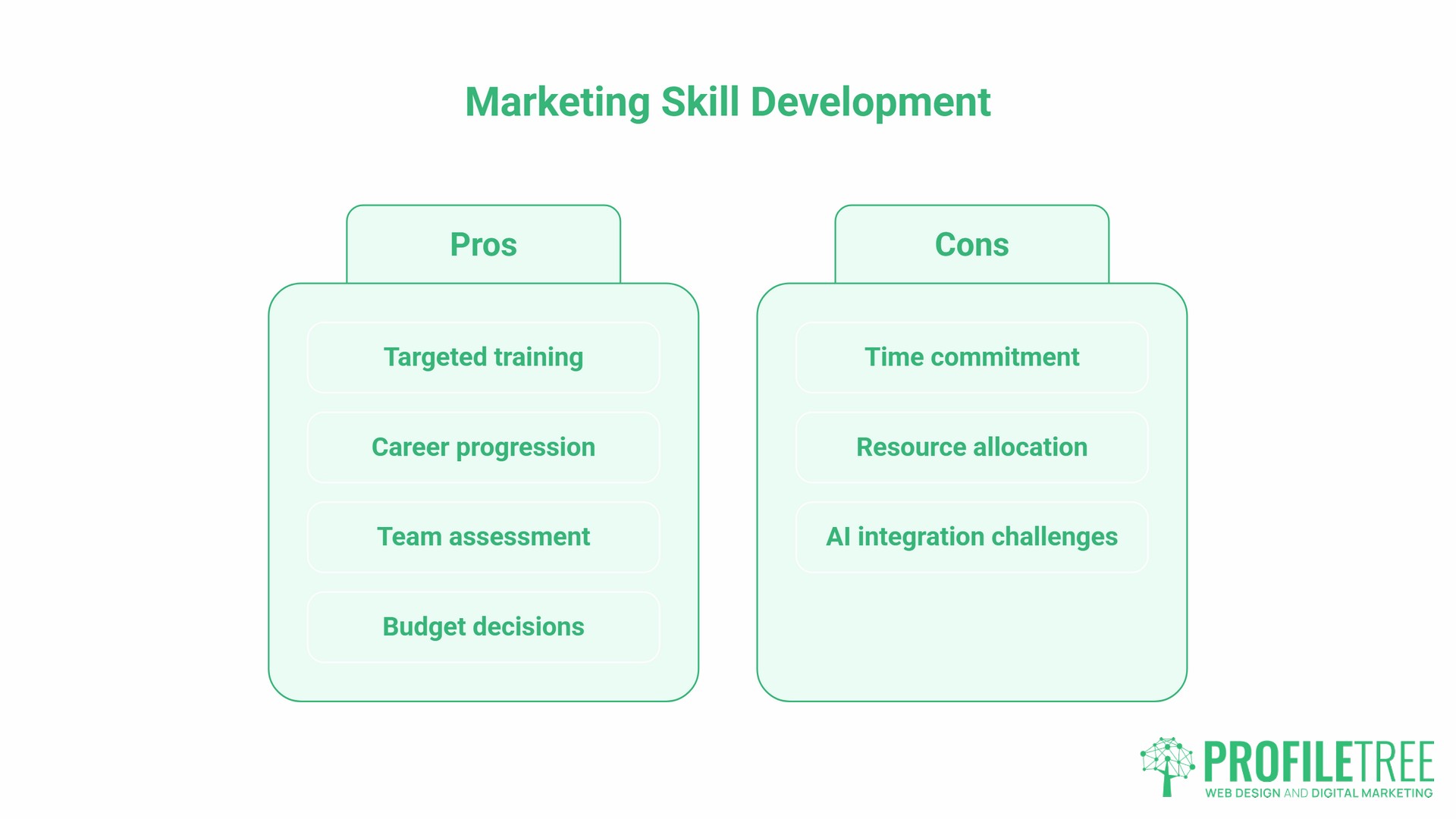
For most SMEs, the practical question about the skills needed for marketing is not what they are but how to acquire them efficiently. There are three routes: hire someone who already has the skills, develop the skills in someone who already works for you, or bring in external support for the most specialist skills.
The Cost-Benefit Case for Upskilling
Upskilling an existing team member in digital marketing, SEO, or AI tools is almost always cheaper than hiring a specialist, and often faster than it appears. A marketing coordinator with two years of experience who receives structured training in analytics and content strategy over six months will outperform a junior hire with the same time investment, because they already understand the business, the brand, and the existing marketing activity.
The key is choosing training that is practical and applied rather than theoretical. Certifications have their place as credential signals, but the training that produces the most measurable change is the kind that is tied to real tasks in the actual business context. ProfileTree’s digital marketing training programmes are built around this model: skills developed through real projects, not case studies.
When to Bring in External Support
There are skills where the specialist-versus-develop question tips clearly toward specialist: technical SEO auditing, high-volume paid media management, video production, and AI implementation strategy are all areas where the time cost of developing in-house capability from scratch is difficult to justify for most SMEs.
The more productive approach is often a hybrid: bring in external support for tasks that require deep specialist expertise while building in-house competency in adjacent skills that enable your team to brief, manage, and evaluate that external work intelligently.
ProfileTree’s digital marketing team works with SMEs across both models: delivering specialist services while training internal teams to manage and build on the work over time.
FAQs
Do my marketing staff really need to know AI tools?
Yes, as a practical productivity tool rather than a theoretical concept. AI tools are now widely used for content drafting, research summarisation, brief writing, and basic automation of reporting tasks. A marketing team that is not using them spends more time on lower-value tasks than competitors that are. The specific tools matter less than the underlying skill of giving an AI system a clear task and evaluating the output critically before it goes anywhere near a customer.
What is the most in-demand technical skill for marketing in the UK right now?
Data analysis and AI-integrated content strategy are consistently cited by UK hiring managers as the hardest skills to find and the most valuable when present. The ability to connect marketing activity to commercial outcomes in clear, financial terms runs through both. SEO remains a high-demand skill, particularly for businesses targeting regional and local search in the UK and Ireland.
Should I hire a specialist or a generalist for a small business?
For most SMEs, a generalist with one area of genuine depth is more practical than either a pure generalist or a narrow specialist. The T-shaped model works well at the team level: someone with broad competency across channels who has deep expertise in the area most relevant to your growth stage. A retail business entering SEO seriously for the first time needs someone with genuine depth in search, not someone who knows a little about everything.
How do I assess whether a marketing candidate has commercial awareness?
Ask them to explain a campaign result in terms of return on investment. Ask them what they would do if a campaign’s cost per acquisition doubled. Ask them to walk through how they would build a basic case for a budget increase. Candidates with genuine commercial awareness will answer these questions in financial terms with specific figures. Candidates without it will describe what they did without connecting it to its outcomes.
Do I need a marketing degree to hire in this field?
Not necessarily. Practical experience combined with platform certifications from Google, HubSpot, or Meta, along with a demonstrable portfolio, often outweighs a degree for digital marketing roles. The CIM (Chartered Institute of Marketing) qualification is worth considering for more senior hires in the UK and Ireland as a benchmark for professional standards and strategic depth.
Does marketing require strong maths skills?
Comfort with percentages, ratios, and basic financial calculations is required. Advanced maths is not. The practical requirement is the ability to read a performance report, calculate cost per lead, compare return on spend across channels, and make budget recommendations with supporting evidence.