
What Is a Content Plan? Build a Strategy That Drives Results
Table of Contents
Creating content without a clear plan is like setting off on a road trip without a map. You might eventually reach your destination, but the journey will be more protracted, more expensive, and frustrating. Many business owners ask, “What is a content plan, and why does my company need one?” The answer lies in understanding that a content plan is a documented strategy outlining what content your business will create, when it will be published, where it will appear, and who it’s designed to reach. It transforms content marketing from random posts into a structured approach that drives measurable business outcomes.
The benefits of content marketing are well-documented, particularly in terms of ROI. However, this doesn’t mean you can simply publish any content and hope for the best. Success requires publishing the right content at the right time, striking the proper balance between sales and informational material, and determining the publishing frequency and timing that works best for your audience. A content plan provides the structure and direction needed to turn your marketing efforts into measurable business results—whether that’s increased website traffic, qualified leads, or actual sales.
For business owners and marketing managers, understanding what a content plan is—and how to create one effectively—can mean the difference between content that merely exists and content that actively generates leads and sales. This guide walks through everything you need to know about content planning, from fundamental concepts to practical implementation strategies that work for businesses across Northern Ireland, Ireland, and the UK.
Content Planning Fundamentals
Before building your content plan, it’s essential to understand what sets it apart from ad-hoc content creation and why structured planning yields better results for your business.
Defining Content Planning in Marketing
A content plan is a documented strategy that outlines what content you’ll create, when you’ll publish it, where it will appear, and who it’s designed to reach. Unlike spontaneous posting, content planning involves deliberate decisions about topics, formats, publishing schedules, and distribution channels.
The planning process forces you to think strategically about your content marketing rather than reacting to whatever seems urgent on any given day. This structured approach helps businesses maintain consistency, build audience trust, and achieve specific marketing objectives—whether that’s increasing website traffic, generating leads, or supporting sales conversations.
For digital agencies like ProfileTree, content planning extends beyond our own marketing to encompass the strategies we develop for clients across different industries. A properly structured content plan takes into account business goals, audience needs, competitive positioning, and available resources.
Three Core Components of Content Strategy
Every effective content plan rests on three foundational elements that work together to create marketing that delivers results.
Understanding Your Audience
Your content exists to serve specific people with specific needs. Before planning what to create, identify who you’re making it for. This extends beyond basic demographics, such as age and location. Consider the problems your audience faces, the questions they’re asking, the information they need to make decisions, and the stage of awareness they’re at when they encounter your content.
Use analytics tools to examine your existing audience data. Review customer service enquiries to understand common questions. Speak with your sales team about the objections they encounter. This research informs content decisions that actually connect with the people you want to reach.
Aligning Content With Brand Values
Your content should reflect what your business stands for and how you want to be perceived in your market. A law firm and a craft brewery might both use content marketing, but their tone, topics, and presentation will differ substantially based on their brand positioning.
Consider what makes your business different from competitors. ProfileTree’s focus on AI implementation, accessible web design, and digital training for SMEs informs the content we create—it demonstrates expertise in areas that matter to our clients, rather than offering generic marketing advice.
**Selecting Distribution Channels Strategically
Not every platform suits every business. Rather than trying to maintain a presence everywhere, focus on channels where your audience actually spends time and where your content format naturally fits.
A B2B software company might prioritise LinkedIn and industry-specific forums. A local restaurant benefits more from Instagram and Google Business Profile. An e-commerce retailer might focus on Pinterest and YouTube. Choose channels based on where you can effectively reach your audience, not where you think you “should” be.
Strategic Content Development
Moving from planning foundations to actual strategy requires a deeper understanding of your audience and setting clear objectives that guide your content decisions.
Researching Your Target Audience
Effective content planning starts with a genuine understanding of the people you want to reach. This research phase informs every subsequent decision about topics, formats, and messaging.
Start by analysing your current customer base. What characteristics do your best clients share? What challenges led them to seek your services? What information did they need before making a purchase decision? These insights reveal patterns that can guide your content strategy.
Use website analytics to understand visitor behaviour. Which pages attract the most traffic? Where do people spend the most time? At what point do they leave your site? This data shows what’s working and where gaps exist in your current content.
Look at search console data to see what queries bring people to your site. These actual search terms reveal the language your audience uses and the specific information they’re seeking. Building content around these queries helps you capture existing search demand.
Social media analytics reveal which content formats and topics generate the most engagement. Pay attention to comments and questions—these represent real audience interests and concerns that your content should address.
“Understanding your audience isn’t a one-time exercise,” notes Ciaran Connolly, Director of ProfileTree. “It’s an ongoing process of listening, learning, and adapting your content to serve their evolving needs. The businesses that invest time in audience research create content that actually resonates.”
Setting Clear Content Objectives
Content without clear objectives is difficult to measure and improve. Define specific goals that tie your content efforts to business outcomes.
Common content marketing objectives include:
- Brand awareness: Reaching new audiences and establishing your business as a credible voice in your industry
- Lead generation: Attracting potential customers and capturing their contact information
- Customer education: Helping prospects understand your products or services and how they solve problems
- Search visibility: Ranking for keywords that bring qualified traffic to your website
- Customer retention: Keeping existing clients engaged and reducing churn
- Sales support: Providing resources that help your sales team close deals
Choose 2-3 primary objectives for your content plan. Trying to achieve everything simultaneously dilutes focus and makes measurement difficult. Your objectives should align with broader business goals and be measurable through specific metrics.
For example, if lead generation is a primary objective, you’ll focus on creating content that attracts your ideal customers and includes clear calls-to-action to capture contact information. You’ll measure success through metrics such as form submissions, email sign-ups, or consultation requests, rather than vanity metrics like page views.
Mapping Content to Business Goals
Once you’ve established objectives, map specific content types and topics to these goals. Different content serves different purposes in the customer journey.
Top-of-funnel content attracts new audiences who may not yet know about your business. This includes informational blog posts that answer common questions, social media content addressing industry topics, and resources that provide value without requiring a commitment.
Middle-of-funnel content engages people who are aware of their problem and actively researching solutions. This might include comparison guides, case studies, detailed how-to content, and resources that demonstrate your expertise and approach.
Bottom-of-funnel content supports purchase decisions for individuals who are ready to choose a solution. This includes service pages with clear value propositions, customer testimonials, pricing information, and content that addresses common objections.
Create a content mix that supports customers at each stage. Many businesses focus too heavily on top-of-funnel content, attracting traffic but failing to convert visitors into customers. A balanced plan includes content that moves people through the entire decision-making process.
Content Execution Tactics
With strategy established, the focus shifts to practical implementation—selecting platforms, researching topics, and organising your content production process.
Choosing the Right Platforms
Platform selection should be driven by where your audience is active and what content formats suit your message, not by what’s currently trendy or where you feel you “should” have a presence.
Website and Blog
Your website serves as the foundation of content marketing efforts. Unlike social platforms where you’re building on rented land, your website gives you complete control over content, design, and user experience. Blog content improves search visibility, establishes expertise, and provides resources you can share across other channels.
Focus on creating comprehensive, well-researched articles that thoroughly address topics your audience cares about. Optimise content for search engines while prioritising readability and usefulness for human readers. ProfileTree’s approach to web design centres on creating sites built for ranking, traffic, leads, and sales—not just aesthetic appeal.
For B2B businesses and professional services, LinkedIn provides direct access to decision-makers. The platform is ideal for publishing thought leadership articles, industry insights, company updates, and facilitating professional networking. The content here should be more polished and business-focused than on casual social platforms.
Facebook and Instagram
These platforms are well-suited for businesses with visual products or services, as well as those targeting consumer audiences. Instagram is particularly well-suited for visual storytelling, behind-the-scenes content, and building community. Facebook remains effective for local businesses and community engagement.
YouTube
Video content continues to grow in importance. YouTube serves as the second-largest search engine, making it a valuable platform for how-to content, product demonstrations, and educational materials. ProfileTree’s video production services enable businesses to create professional content that engages their audiences and supports marketing objectives.
Email Marketing
Despite being one of the oldest digital channels, email remains highly effective for nurturing relationships and driving conversions. Build an email list through website signups and use it to share your best content, company updates, and targeted offers with people who’ve already shown interest in your business.
Researching and Selecting Content Topics
Topic selection determines whether your content attracts the right audience and achieves your objectives. Effective research combines audience insight, search data, and competitive analysis.
Keyword Research
Use tools like Google Keyword Planner, Ahrefs, or SEMrush to identify terms your audience searches for. Look for keywords with sufficient search volume to drive traffic but reasonable competition levels that give you a realistic chance of ranking.
Pay particular attention to long-tail keywords—longer, more specific phrases that indicate stronger intent. Someone searching “web design” could mean anything, but “web design for small businesses Northern Ireland” shows clear intent and location relevance.
Competitor Analysis
Review what content performs well for competitors. Which of their blog posts attract the most engagement? What topics do they cover repeatedly? This reveals what resonates with your shared audience and where content gaps exist that you can fill.
Don’t simply copy competitor topics. Look for angles they’ve missed, questions they haven’t answered thoroughly, or ways to provide more value through deeper analysis or better presentation.
Customer Questions and Pain Points
Your customers are your best source of content ideas. What questions do they ask during sales calls? What concerns do they raise? What misconceptions do they have about your industry? Create content that addresses these real-world issues.
Review customer service enquiries, sales call notes, and feedback forms. These interactions reveal the information people actually need, not what you assume they want to know.
Industry Trends and Developments
Stay current with the latest developments in your industry. New regulations, emerging technologies, shifting best practices, and market developments all provide content opportunities. Being among the first to address new topics establishes thought leadership and captures search traffic before competition intensifies.
Building an Effective Content Calendar
A content calendar transforms your plan from abstract strategy into an actionable schedule. It provides visibility into what’s being created, when it will publish, and who’s responsible for each piece.
Your calendar should include:
- Publication dates: When each piece of content will go live
- Content titles and topics: What each piece covers
- Content format: Blog post, video, social update, email, etc.
- Target keywords: Primary search terms for SEO-focused content
- Author or creator: Who’s responsible for producing the content
- Status: Planning, in progress, review, scheduled, published
- Promotion channels: Where the content will be distributed
Start with a manageable publishing frequency. Publishing one high-quality blog post per week is better than committing to daily posts and failing to maintain the schedule. Consistency matters more than volume.
Plan content in monthly or quarterly blocks. This allows you to develop content themes, create complementary pieces that support each other, and maintain a cohesive narrative rather than publishing disconnected individual posts.
Build flexibility into your calendar. Leave room for timely content that responds to industry developments, trending topics, or business needs. A calendar provides structure, not rigid constraints that prevent you from seizing opportunities.
Creating Varied Content Formats
Different formats serve different purposes and appeal to different audience preferences. A robust content plan includes variety rather than relying on a single format.
Written Content
Blog posts, articles, and written guides remain fundamental to content marketing. They support SEO, provide in-depth information, and offer audiences a resource they can reference repeatedly. Long-form content (1,500+ words) often performs better in search results and offers more value to readers than short posts.
Video Content
Video engages audiences in ways text cannot. It’s particularly effective for demonstrations, tutorials, interviews, and storytelling. Many people prefer watching videos over reading, making this format crucial for reaching specific audience segments.
ProfileTree’s video production and animation services enable businesses to create professional content without requiring in-house expertise or specialised equipment. From explainer videos to testimonials to educational content, video adds depth to your content marketing.
Infographics and Visual Content
Complex information often communicates more effectively through visuals. Infographics, charts, diagrams, and illustrations help audiences quickly grasp concepts and data. Visual content also performs well on social platforms and earns backlinks from other sites.
Podcasts and Audio Content
Audio content suits audiences who consume media while commuting, exercising, or engaging in other activities where video or text is impractical. Podcasts foster deeper connections through voice and enable long-form conversations that would be tedious in text.
Interactive Content
Quizzes, calculators, assessments, and interactive tools engage audiences actively rather than passively. This content generates higher engagement and provides personalised value based on user input.
Maintaining Consistent Brand Voice
Your content voice—the personality and tone that comes through in your writing and communication—should remain consistent across all content and channels. This consistency builds recognition and trust.
Define your brand voice by considering:
- Tone: Are you formal or casual? Authoritative or friendly? Professional or conversational?
- Language complexity: Do you use industry jargon or plain language? Technical terms or simple explanations?
- Perspective: First person (“we”), second person (“you”), or third person (“businesses”)?
- Personality traits: What characteristics describe your brand? Helpful? Innovative? Reliable? Straightforward?
Document these voice guidelines so everyone creating content for your business maintains consistency. Include examples of what your brand voice sounds like and what it doesn’t.
For ProfileTree, our voice is expert but approachable. We provide authoritative guidance on digital marketing, web design, and AI implementation without using unnecessary jargon or talking down to readers. We focus on practical advice and clear explanations that help businesses make informed decisions.
Building Audience Engagement
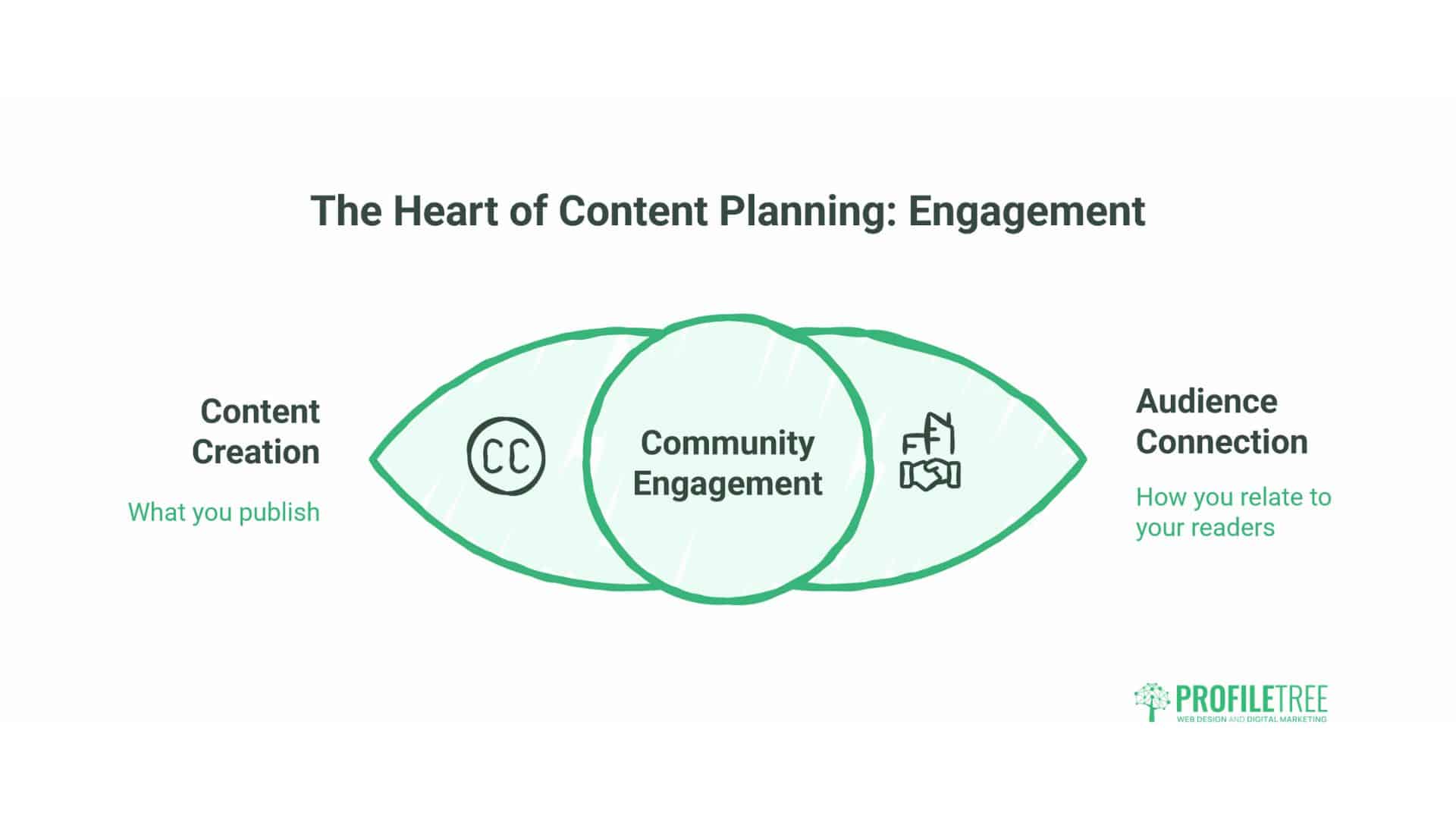
Content planning isn’t just about what you publish—it’s about how you connect with the people who consume it. Building engagement turns passive readers into active participants in your brand community.
Encouraging Participation and Interaction
Create opportunities for your audience to engage with your content and with each other. This might include:
- Comments sections: Ask questions at the end of blog posts to spark discussion
- Social media engagement: Respond to comments, ask for opinions, create polls
- User-generated content: Encourage customers to share their experiences
- Community spaces: Build forums, Facebook groups, or other spaces where your audience can connect
Active engagement provides several benefits. It provides you with direct feedback on what resonates with your audience. It helps you understand their concerns and interests more deeply. It builds relationships that turn casual readers into loyal customers. It signals to search engines that your content is valuable, which can potentially improve your rankings.
Make engagement easy by being responsive. Reply to comments thoughtfully. Answer questions promptly. Thank people for sharing your content or contributing their perspectives. This attention makes people feel valued and encourages continued interaction.
Building Trust Through Transparency
Modern audiences value authenticity. Rather than projecting a facade of perfection, successful brands share their processes, acknowledge challenges, and communicate openly about their values and practices.
Consider sharing:
- Behind-the-scenes content: Show how your products are made or services delivered
- Team introductions: Put faces to your business and share the people behind it
- Learning experiences: Discuss what you’ve learned from mistakes or challenges
- Values and positions: Be clear about what your business stands for
This transparency builds trust because it shows you’re a real business with real people, not a faceless corporate entity. It helps audiences understand what working with you would be like and whether your values align with theirs.
ProfileTree regularly shares insights about our approach to AI implementation, accessible web design, and digital training. By explaining our methodology and reasoning, we help prospective clients understand how we work and what makes our approach different from competitors.
Measuring Content Performance
Creating and publishing content is only part of the equation. Measuring performance reveals what’s working, what isn’t, and how to refine your strategy over time.
Key Metrics That Matter
Focus on metrics that align with your business objectives, rather than vanity numbers that may look impressive but don’t drive meaningful results.
Traffic Metrics
- Page views: How many times your content has been viewed
- Unique visitors: How many individual people have visited
- Traffic sources: Where visitors come from (search, social, direct, referral)
- New vs returning visitors: Balance between attracting new audiences and building loyalty
- Time on page: How long people spend reading your content
- Bounce rate: Percentage of visitors who leave after viewing only one page
- Scroll depth: How far down the page people read
- Social shares: How often content is shared on social platforms
- Comments: Volume and quality of discussion your content generates
Conversion Metrics
- Lead generation: Form submissions, email signups, content downloads
- Click-through rate: Percentage of people who click your calls-to-action
- Conversion rate: Percentage of visitors who take desired actions
- Revenue attribution: Sales that can be traced back to content touchpoints
SEO Metrics
- Keyword rankings: Where your content appears in search results
- Organic traffic growth: Increase in visitors from search engines
- Backlinks: Other websites linking to your content
- Domain authority: Overall strength of your website in search engines
Analysing and Improving Content
Regular analysis helps you understand what’s working and guides strategic adjustments.
Review performance on a monthly or quarterly basis, depending on your publishing frequency. Look for patterns rather than obsessing over individual post-performance. Which topics consistently perform well? Which formats generate the most engagement? Which distribution channels drive the most qualified traffic?
Use this data to inform future content decisions. If how-to guides consistently outperform opinion pieces, create more instructional content. If video content generates more engagement than text, increase video production. If specific topics attract traffic but don’t convert, either improve the content to address buyer needs better or shift focus to more profitable issues.
A/B testing helps optimise individual content elements. Test different headlines to determine which one drives the most clicks. Try various calls-to-action to determine which converts better. Experiment with content length, format, or structure to find what resonates most with your audience.
Don’t be afraid to update and improve existing content. Refresh old posts with new information, better formatting, or additional depth. Add new sections addressing questions you’ve received. Update statistics and examples. This breathes new life into content that’s already ranking and often delivers better ROI than creating entirely new pieces.
Developing Your Website Content Approach
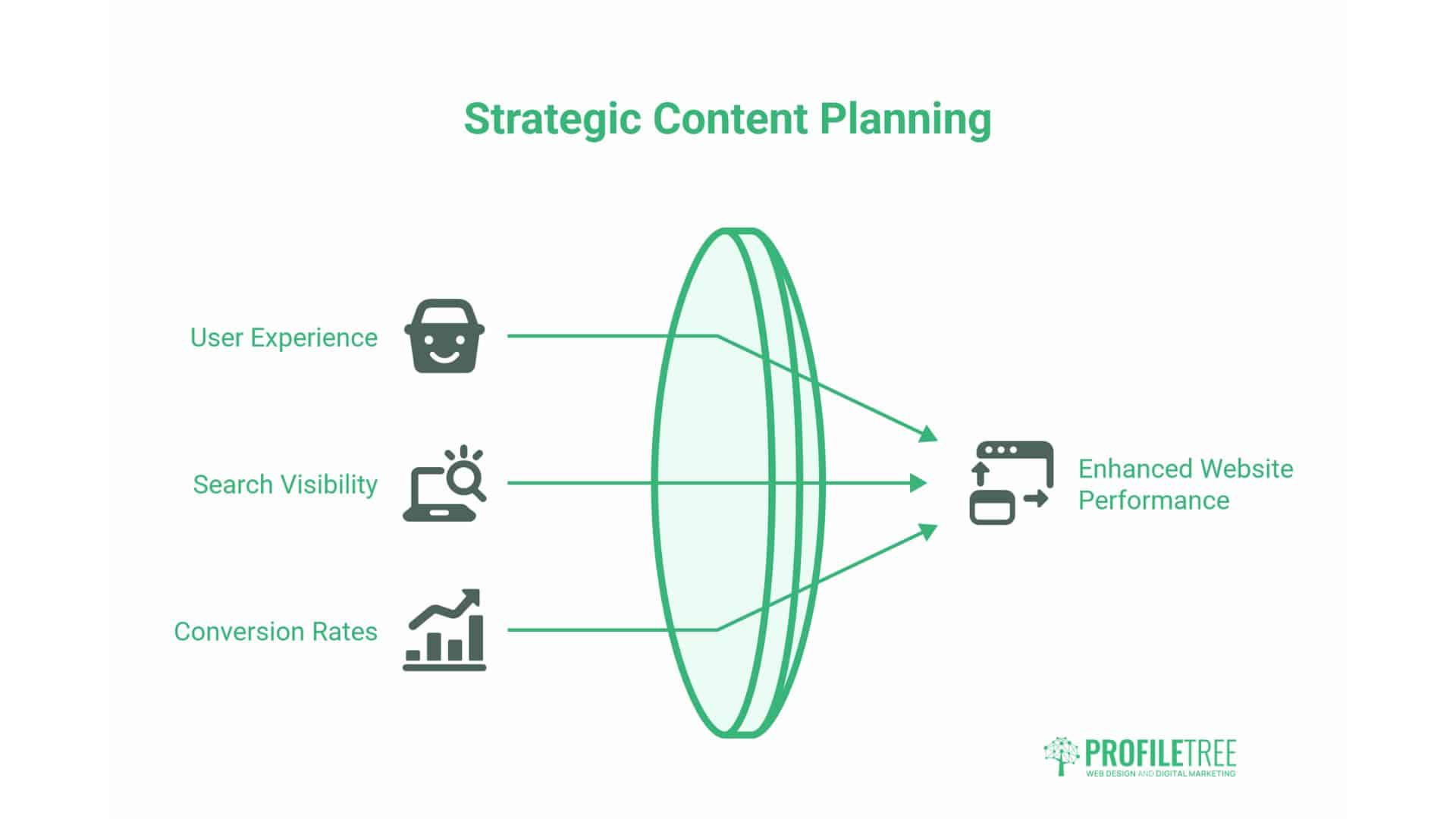
Your website serves as the hub of all content marketing activity. A strategic approach to website content planning affects everything from user experience to search visibility to conversion rates.
Structuring Content for User Experience
The website content structure should guide visitors logically through the information and toward conversion actions.
Start by mapping user journeys. What path do different audience segments take through your site? What questions do they need answered at each stage? What information helps them move from awareness to consideration to decision?
Create content that serves each stage. The homepage and pillar pages introduce your business and its primary services. Service pages provide detailed information about specific offerings. Blog posts address questions and establish expertise. Case studies and testimonials provide social proof. Contact and consultation pages make it easy to take the next step.
Implement straightforward navigation that enables visitors to find what they need quickly. Use descriptive labels rather than creative terms that confuse people. Include search functionality for content-rich sites. Add related content links to keep people engaged.
For ProfileTree, our web design process focuses on creating sites that prioritise user experience alongside search visibility. A beautiful design means nothing if visitors can’t find the information they need or struggle to understand how you can help them.
Optimising Content for Search Visibility
Search engine optimisation remains critical for driving qualified organic traffic to your website. Proper optimisation starts during content planning, not as an afterthought once content is created.
Keyword Integration
Identify target keywords during the planning phase. Integrate primary keywords naturally into headlines, subheadings, opening paragraphs, and throughout body content. Include related terms and variations rather than repeating exact phrases unnaturally.
Technical SEO Elements
Optimise title tags and meta descriptions for each page. Use descriptive URLs that include keywords. Add alt text to images. Implement proper heading hierarchy (H1, H2, H3). Create internal links between related content.
Content Depth and Quality
Search engines increasingly prioritise comprehensive content that thoroughly addresses topics. Shallow posts rarely rank well for competitive keywords. Aim for depth that matches or exceeds what currently ranks for your target terms.
ProfileTree’s SEO services help businesses improve search visibility through both technical optimisation and strategic content development. We focus on long-term results through quality content and sustainable practices rather than quick-fix tactics that risk penalties.
Creating Content That Converts
Attracting traffic means nothing if visitors don’t take desired actions. Content should naturally guide people toward conversion points.
Clear Calls-to-Action
Every page should include clear next steps appropriate to its purpose and the visitor’s stage in the buying journey. Blog posts might invite email signups or related content. Service pages should make it easy to request consultations or quotes. Make calls-to-action stand out visually and use action-oriented language.
Addressing Objections
Content should proactively address concerns that prevent conversion. If price is a common objection, explain your value proposition clearly. If trust is a concern, showcase testimonials and credentials. If people need more information before making a decision, provide comprehensive resources.
Social Proof and Credibility
Include elements that build trust, such as customer testimonials, case studies, certifications, awards, client logos, and media mentions. These signals help overcome scepticism and reassure visitors they’re making a safe choice.
The Role of AI in Content Planning
Artificial intelligence is transforming how businesses approach content planning and creation. Understanding how to utilise AI effectively provides significant advantages in terms of efficiency and capability.
AI for Content Research and Ideation
AI tools can accelerate the research phase of content planning. Use them to:
- Generate initial topic ideas based on keywords or themes
- Analyse competitor content to identify gaps and opportunities
- Summarise research sources to extract key points quickly
- Identify trending topics and questions in your industry
ProfileTree offers AI training and implementation services tailored specifically for SMEs. We help businesses understand how AI can improve their marketing operations without requiring deep technical expertise.
AI-Assisted Content Creation
AI writing tools can handle various content creation tasks, from drafting initial content to creating specific elements. Use AI to:
- Create initial outlines for articles or guides
- Generate multiple headline options for testing
- Draft social media posts and variations
- Write meta descriptions and alt text
- Summarise long-form content for different formats
However, AI should augment human creativity, not replace it. AI-generated content requires editing, fact-checking, and refinement to meet quality standards. The best results come from combining AI efficiency with human expertise and judgement.
AI for Content Optimisation
Beyond creation, AI helps optimise existing content. Tools can:
- Analyse readability and suggest improvements
- Recommend keywords and related terms to include
- Identify content gaps where additional information would help
- Predict content performance based on various factors
Creating a Content Plan: Practical Implementation
Understanding content planning principles is valuable, but implementation determines success. Here’s how to build and execute your content plan effectively.
Getting Started With Limited Resources
Many businesses delay content planning because they feel they lack resources. Start small rather than waiting for perfect conditions.
Begin with one primary channel—likely your website blog. Commit to a manageable publishing frequency, such as bi-weekly posts. Focus on quality over quantity. One excellent article every two weeks is better than several mediocre posts weekly.
Repurpose content across channels to maximise the value of each piece. Turn blog posts into social media content, email newsletters, and video scripts. This approach multiplies your output without proportionally increasing effort.
Consider outsourcing strategically. If writing isn’t your strength, work with content writers. If video seems daunting, consider using ProfileTree’s video production services to create professional content without investing in in-house capabilities. Focus your time on strategy and your core expertise.
Building Internal Buy-In
Successful content planning requires support from across your organisation. Get leadership buy-in by connecting content marketing to business objectives and demonstrating potential ROI.
Show examples of competitors using content effectively. Share case studies from similar businesses. Create projections showing how content marketing could impact lead generation or customer acquisition costs.
Involve team members in content creation. Salespeople can share customer insights and objections. Technical staff can explain complex topics in a clear and accessible way. Customer service can identify common questions. This involvement distributes workload and brings diverse perspectives to your content.
Maintaining Consistency Long-Term
The biggest challenge in content marketing isn’t starting—it’s maintaining momentum over months and years. Build systems that support consistency.
Create content production workflows that clearly define who is responsible for what and when—Utilise project management tools to track content throughout the planning, creation, review, and publication stages.
Batch content creation when possible. Spend one day outlining multiple pieces. Dedicate blocks of time to writing, recording, or filming. This focused approach is more efficient than constantly switching between tasks.
Build a content library of evergreen pieces that remain relevant over time. These assets continue to deliver value long after publication, without requiring the constant creation of new content.
Schedule regular content audits to review what’s working and what isn’t. Adjust your plan based on performance data rather than assumptions or hunches.
Taking Action on Your Content Plan: What Is A Content Plan?
Content planning transforms marketing from reactive scrambling into strategic asset development. By understanding your audience, setting clear objectives, selecting suitable platforms, and maintaining consistency, you can create content that actively contributes to business growth.
Start by auditing your current content efforts. What’s working? What gaps exist? Use these insights to develop a focused plan that addresses your most important business needs.
Remember that perfection is the enemy of good. Begin publishing, measure performance, learn from the data, and improve continuously.
ProfileTree helps businesses across Northern Ireland, Ireland, and the UK develop and execute content strategies that drive measurable results. From web design built for conversions to video production to AI implementation that improves marketing efficiency, we provide the expertise SMEs need to compete effectively in digital channels.
Your content plan should evolve as your business grows and your audience changes. Regular review and adjustment keep your strategy aligned with business objectives. The companies that succeed with content marketing commit to the process, learn from results, and persistently provide value to their audiences.
FAQs
What’s the difference between a content plan and a content strategy?
A content strategy is the overarching approach that defines what content you’ll create and why. It includes audience definition, business objectives, brand positioning, and success metrics. A content plan is the tactical execution of that strategy—the specific topics, formats, publishing schedule, and distribution channels you’ll use to achieve strategic goals.
How often should businesses publish new content?
Publishing frequency depends on your resources, audience expectations, and content goals. Quality matters more than quantity. One comprehensive, valuable piece per week is better than daily superficial posts. Start with a manageable schedule you can maintain consistently, then increase frequency as you build processes and resources.
Should small businesses invest in content marketing?
Content marketing benefits businesses of all sizes. For small companies, it offers a cost-effective way to compete with larger competitors by demonstrating expertise and building trust. The key is focusing on quality and relevance rather than trying to outspend competitors on paid advertising.
How long before content marketing shows results?
Content marketing is a long-term strategy. Initial results, such as traffic increases, may be observed within 3-6 months. Significant outcomes, such as improved search rankings and consistent lead generation, typically take 6-12 months. The timeline varies based on competition, publishing frequency, and content quality.