
Website Copywriter: The Strategic Guide to Hiring for ROI
Table of Contents
Most business owners approach their website in the wrong order. They spend weeks choosing fonts and colours, then scramble to fill the pages with text at the end. The copy, the actual words that sell, becomes an afterthought. That’s a costly mistake, because your website copywriter is the person who makes everything else on the page work.
Your site is always open, always in front of potential customers, and always either winning or losing business on your behalf. Design gets people to stop. Web copywriting makes them stay, and more importantly, makes them act. A beautifully designed site built on weak copy will consistently underperform a simpler site where every sentence has a job to do.
This guide covers what a professional website copywriter actually does, what you should expect to pay in the UK and Ireland, how to brief one properly, and how to measure whether the investment is delivering results. Whether you’re launching a new site or overhauling pages that aren’t converting, the principles here apply directly.
Your Website Copy Is Your 24/7 Salesperson
Your sales team goes home. Your receptionist finishes at five. But your website is always open, always presenting your business to potential customers, and always either winning or losing that audience. That’s why the quality of your website copywriting matters more than almost any other marketing investment.
When a visitor lands on your homepage, they make a decision about your business within seconds. That decision isn’t based on your logo or your colour scheme. It’s based on whether the words on the page answer the question they came with. A professional website copywriter makes sure the answer is yes, consistently, across every page.
The difference between copy that converts and copy that rarely comes down to vocabulary or grammar. It comes down to whether the writing is built around what the customer actually needs to hear, in the order they need to hear it. Most businesses write about themselves. High-converting website copywriting puts the customer’s problem first, then introduces the business as the solution.
A useful test: read your current homepage without the company name. Does it describe a real, specific business? Or does it sound like it could belong to any organisation in your sector? If it is the latter, a good web copywriter can fix that. A fresh set of eyes, grounded in how your customers actually think, almost always reveals copy problems that are invisible from the inside.
The Human Edge: Why AI Cannot Replace a Website, Copywriter
It is tempting to use a generative AI tool to handle your website copywriting. The output looks plausible at a glance, and the speed is hard to argue with. The problem is that plausible copy and persuasive copy are very different things, and the gap between them has a direct impact on your enquiry rate.
AI tools are trained on published text. They can remix what already exists, but they cannot do the discovery work that makes copywriting for websites genuinely effective. They haven’t interviewed your best customers. They don’t know what objection almost stopped your last three clients from signing. They can’t identify the one phrase your sales team uses that always seems to land, or translate the way you describe your work down the phone into web copy that feels honest rather than corporate.
The deeper issue is commoditisation. When every business in your sector uses the same AI tools with similar prompts, the output begins to converge. Your homepage ends up saying more or less the same things as your competitors, in more or less the same order. That is not a copy problem; it is a strategy problem. A skilled website copywriter starts from your actual customers and your actual business, which is where real differentiation comes from.
Nuance, Tone, and Local Cultural Context (UK, Northern Ireland, and Ireland)
There is a geographic dimension that AI tools handle badly. Writing for a Belfast manufacturing firm is not the same as writing for a London fintech startup, even if the brief looks similar on paper. The trust signals that resonate with Northern Irish business owners, the vocabulary that feels natural to an Irish SME audience, the level of formality that builds credibility in a particular sector: these are things a good web copywriter picks up through research and cultural familiarity.
UK and Irish audiences tend to be more sceptical of direct American-style sales language. They’re more persuaded by specifics than by superlatives. ‘We have completed over 400 projects for businesses in Belfast and Dublin’ lands better than ‘We are the region’s leading digital partner’. A skilled website copywriter knows the difference and writes accordingly.
This is also where UK English matters. Not just the spelling conventions that American web copywriting patterns get wrong, but sentence rhythm, idiom, and the way authority sounds to a British or Irish reader. Those patterns read as slightly off to UK audiences, even when they cannot articulate why. A website copywriter who works primarily in the UK market will get this right automatically.
What Does a Professional Website Copywriter Actually Do?
The job is wider than most clients expect. Writing is the final stage, not the whole of it. Before a professional website copywriter produces a single sentence, they will typically spend considerable time on research, strategy, and structure. Clients who treat this investment as paying someone to write usually get weaker results than those who see it as paying someone to understand their business and communicate it effectively.
Discovery and Research
A good website copywriter starts by understanding your customers, not your services. They’ll look at your reviews, your sales conversations, your support emails, and any customer research you have. They’re mining for the language your customers use to describe the problem your business solves, because that language is what belongs on your homepage.
They’ll also audit your existing web copywriting to identify what’s working, what’s confusing visitors, and what’s missing entirely. This stage often surfaces the single insight that drives the whole project: the thing your customers care about most that has been buried halfway down the page, or the objection that has never been directly addressed.
The Difference Between Content Writing and Conversion Copywriting
These two disciplines are often confused, and the distinction matters when you are hiring. Content writing produces articles, guides, and educational material. Its primary job is to attract search traffic and build authority over time.
Conversion copywriting is written to move a specific reader towards a specific action: book a call, request a quote, or sign up for a trial. Website copy sits firmly in the conversion category. It needs to earn attention, build trust, and create a reason to act, all within the time it takes someone to decide whether to keep reading or close the tab.
A skilled website copywriter understands both sides of this. They’ll produce web copywriting that attracts organic search traffic through well-integrated keywords and clear structure, while also being sharp enough to convert the visitors who arrive. When you hire a copywriter for website work, you’re investing in both traffic and conversion, not just words on a page.
| Capability | Generative AI Tool | Professional Website Copywriter |
|---|---|---|
| Customer research and message mining | Cannot do | Core part of the process |
| Brand voice consistency across pages | Inconsistent without heavy prompting | Built in from the discovery stage |
| Regional nuance (UK/IE) | Defaults to US/global tone | Applied through local knowledge |
| SEO keyword integration | Surface-level only | Integrated with search intent |
| Persuasive and emotional intelligence | Pattern matching only | Genuine reader psychology |
| Conversion-focused structure | Generic templates | Page-specific architecture |
Website Copywriter Rates in the UK: What Should You Expect to Pay?
Copywriter pricing varies widely, and the range can feel bewildering if you have not hired one before. The figures below reflect UK market rates as reported in the ProCopywriters annual survey and are broadly consistent with what we see when businesses approach us about professional website copywriting across the Northern Ireland and Irish markets. Whether you are comparing freelance website copywriters or agency rates, the table below gives you a reliable starting point.
| Level | Day Rate (UK) | Typical Output | Best For |
|---|---|---|---|
| Junior (0-2 years) | £250-£400/day | 1-2 pages per day | Simple pages, tight briefs |
| Mid-weight (2-5 years) | £400-£650/day | 1 researched page per day | Service pages, landing pages |
| Senior/Specialist (5+ years) | £650-£950/day | Strategy plus copy | Full site projects, complex briefs |
| Agency (copy + SEO + strategy) | £800-£1,500+/day | Integrated delivery | End-to-end website builds |
A five-page website typically takes two to four weeks from briefing to approved copy. That timeline includes a discovery session, a round of structural review before web copywriting begins, and two rounds of revisions. Rushing this process is one of the most common reasons website launches go over budget: the copy comes back misaligned, the design needs to change around it, and everything stalls.
When comparing quotes for website copywriters, check what’s actually included. Some copywriters price per word, some per page, some per day. A per-word rate sounds competitive until you realise it doesn’t include the discovery session or revisions. Ask for a project fee with a defined scope, and make sure revision rounds are specified upfront.
It is also worth distinguishing between a freelance web copywriter and an agency that provides copywriting as part of a wider service. Freelancers offer flexibility and often specialise deeply in particular sectors. Agencies bring integrated expertise in SEO, design, and strategy alongside the writing itself, which typically delivers faster results and fewer coordination headaches on full website builds.
How to Brief a Copywriter for Website Projects
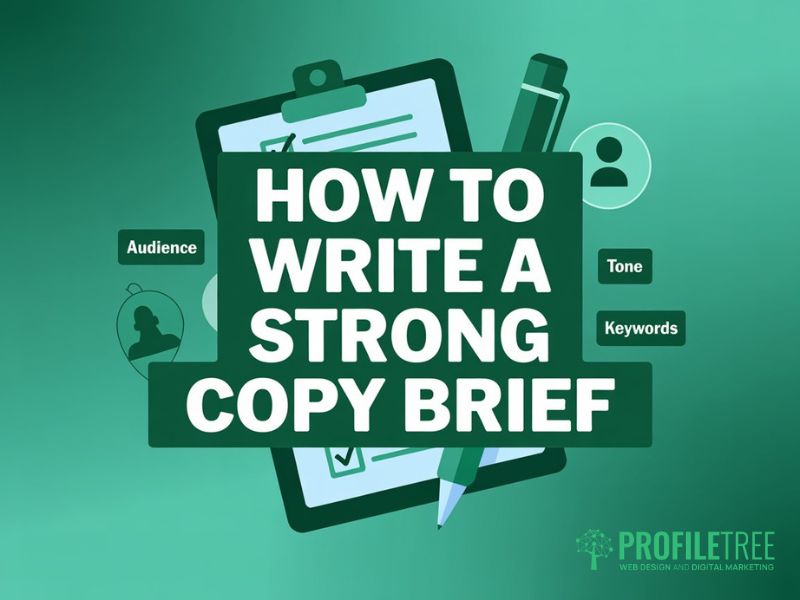
The quality of the brief almost always determines the quality of the web copywriting. A vague brief produces generic copy. A well-structured brief gives the website copywriter what they need to write something that sounds like your business, speaks to your customers, and does a clear job on every page. Whether you are hiring website copywriters for a full site rebuild or bringing in a copywriter for website updates and individual page rewrites, the same briefing principles apply.
Your brief should cover:
- The purpose of each page and the one action you want the visitor to take
- Who your ideal customer is, what they already know, and what they are worried about
- Your key differentiators in specific terms, not ‘we put customers first’, but what you actually do differently
- The tone you are aiming for: formal, conversational, technical, reassuring
- Any sites whose copywriting for websites you admire, including outside your sector
- The primary search keyword for each page, if you have them
- Examples of your own writing or customer reviews that capture your voice
You don’t need to hand over a full content strategy. You do need to give the web copywriter enough context to make real decisions about what goes on each page. The strongest projects happen when the client treats the discovery phase as a genuine collaboration, not just a transfer of information.
One area that’s often underestimated: customer reviews. Your Google reviews and testimonials are some of the most valuable briefing material a website copywriter can receive, because they show exactly how satisfied customers describe the value you provide, in their own words. If you’ve done the work to earn a strong review record, make sure your copywriter for website work sees it early.
ProfileTree’s content marketing services include a structured briefing and discovery stage that helps businesses prepare this groundwork before website copywriting begins, which is particularly useful for companies that have never worked with a professional web copywriter before.
Measuring the ROI of Professional Website Copywriting
Good website copywriting should be measurable. If you can’t track whether it’s working, you can’t make informed decisions about where to invest next. Here are the signals worth monitoring after any website copywriter completes a project.
The most direct metric is your enquiry rate: the percentage of visitors who take your desired action, whether that’s completing a contact form, booking a call, or requesting a quote. Before any web copywriting project, pull your current conversion baseline from Google Analytics or your CRM. After the new copy goes live, give it six to eight weeks and compare.
Bounce rate provides a useful secondary signal. If visitors arrive and leave immediately, the copywriting for website pages usually fails to confirm that they’ve found what they were looking for. Lower bounce on key landing pages tends to follow well-written, clearly structured website copy that quickly answers the visitor’s primary question.
Search performance is the longer-term indicator. A professional website copywriter who understands SEO will integrate target keywords naturally into headings, opening paragraphs, and page structure. Pages built this way tend to improve in rankings over three to six months as search engines assess their relevance and depth.
Time on page is another metric worth tracking. If visitors are spending more time reading a page after a web copywriting refresh, that’s a strong signal that the new copy is more relevant and engaging than what it replaced. Pair this with scroll depth data if you have it.
Our search engine optimisation services work directly alongside website copywriting because the two disciplines reinforce each other. Copy that genuinely answers search intent tends to rank better, attract more qualified traffic, and convert at a higher rate than copy written without that strategic layer.
FAQs
1. What is the average cost of a website copywriter in the UK?
Day rates for UK website copywriters typically run from £250 at the junior end to £950 or above for senior specialists. For a five-page business website, budget roughly £2,000 to £6,000 depending on the complexity of the brief, the level of research required, and whether the web copywriter is also providing SEO strategy. Agency pricing that bundles copywriting for websites with web design and search optimisation sits above these figures, but brings integrated delivery rather than requiring you to coordinate multiple freelancers.
2. How long does it take to write a five-page website?
From initial briefing to approved, publish-ready website copy, most five-page projects take two to four weeks. This assumes a structured discovery session at the start, a structural review before website copywriting begins, and two rounds of revisions. Most website copywriters will confirm that the brief and research phase is where good copy is made or lost, so projects that rush past this stage almost always take longer overall.
3. Can I just use ChatGPT or another AI tool to write my website?
AI tools produce copy that is technically coherent but rarely rooted in your specific customers, your brand voice, or your actual market position. They cannot do the discovery work that makes web copywriting genuinely persuasive. A more specific risk is that AI-generated copywriting for websites tends to converge across competitors in the same sector, so everyone’s homepage begins to sound the same.
4. Do I provide the SEO keywords, or does the website copywriter?
Ideally, both parties contribute. You or your SEO strategist should provide the primary keyword for each page and any secondary terms you are targeting. The website copywriter’s job is to integrate those terms naturally into headings, opening paragraphs, and body copy, and a good web copywriter can also guide you towards the right terms if keyword research is not yet in place.
5. Does a website copywriter also design the website?
No, these are separate disciplines. A web copywriter produces the words, and a web designer or developer builds the visual layout and technical structure. Website copywriters often produce wireframes alongside the text, which prevents the common problem of fitting copywriting for websites into a layout that was not built around the words.