
User-Generated Content: A Strategy Guide for UK Brands
Table of Contents
Engaging user-generated content is one of the most cost-effective ways to build trust online, yet most SMEs have no clear strategy for generating it. Customers are already sharing reviews, posting photos, and creating videos about brands they love. The gap is in how businesses capture, manage, and use that content.
This guide covers everything you need: what UGC actually is, how to encourage it consistently, the UK legal requirements you must follow before repurposing customer content, and how it fits into a wider content marketing and SEO strategy.
What Is User-Generated Content?
User-generated content is any content created by customers, followers, or members of the public rather than by a brand’s own team. It includes written reviews on Google or Trustpilot, photos customers post on Instagram, video testimonials shared on TikTok or YouTube, LinkedIn recommendations, comments on Facebook posts, and forum threads where people discuss a product or service.
The Three Types of UGC
Understanding the different categories helps you target your strategy correctly.
Organic customer content is created spontaneously, without prompting or payment. A guest photographs their hotel room and posts it on Instagram. A homeowner leaves a five-star Google review for a tradesperson. This is the most trusted form because there is no incentive behind it.
Encouraged UGC is content that customers create in response to a brand prompt, a hashtag campaign, a competition, or a post-purchase email asking for a review or photo. The content is still genuine, but the brand has created the conditions for it.
Paid UGC creators are individuals hired specifically to produce content that appears to be organic customer-generated content. They are not traditional influencers with large audiences; they are content creators who produce raw footage or photography for the brand to use in its own marketing. This is a growing industry, but it differs from authentic customer content and carries distinct legal obligations.
The confusion between these three categories is one of the most common UGC mistakes brands make. Paid UGC creator content must be disclosed as advertising under UK Advertising Standards Authority (ASA) rules, even if the creator has a small following or no audience at all.
Why UGC Outperforms Branded Content
When a customer shares content about a brand, it carries an implicit endorsement that a polished advertising campaign cannot replicate. People are reading reviews before making purchase decisions at every price point, from a £15 product on Amazon to a five-figure website build. The psychological mechanism is straightforward: we weigh the opinion of a stranger with no financial stake in the product more heavily than we weigh the company’s opinion.
For SMEs, this matters practically. A Belfast restaurant with 200 customer photos on Google Maps and consistent four and five-star reviews is likely to outperform a competitor with a better website but fewer visible customer signals. The content customers create becomes part of the brand’s digital presence in a way that neither paid advertising nor SEO alone can replicate quickly.
UGC and SEO: What Business Owners Need to Know
UGC has a direct impact on organic search performance, though not always in the ways businesses expect.
How Customer Reviews Feed Search Visibility
Google treats review content on your own website, product reviews, testimonials, and Q&A sections as indexable content. When customers write detailed reviews that include the service name, location, and specific details about their experience, they are effectively contributing keyword-rich content that supplements what your team has written. A hospitality business in Belfast accumulating detailed Google reviews over several years is building a body of localised, naturally written content that search engines can process alongside the structured content on the website.
Google Business Profile reviews also directly influence local pack rankings. Volume and recency of reviews are documented ranking factors for businesses targeting local search terms.
UGC and Dwell Time
Content that includes genuine customer photos, embedded social posts, and video testimonials tends to hold visitors on a page longer than text alone. Dwell time, or how long a user stays on a page before returning to the search results, is a signal Google uses to evaluate whether a page satisfies search intent. A service page that integrates real customer video content will typically retain visitors more effectively than one that does not. If you want to understand how UGC fits into a wider content plan for your business, the customer feedback for the content strategy guide covers the relationship between customer input and content planning in more detail.
The Connection to Social Media Marketing
UGC is most consistently generated on social platforms, which means the strength of a brand’s social media presence directly affects how much organic content customers produce. Brands with active, well-managed Instagram or Facebook presences give customers something to respond to and share. A social media marketing strategy that focuses solely on broadcasting brand content, without creating conditions for customer participation, will generate less UGC than one that invites engagement directly.
The UK Legal Framework: What You Must Know Before Using Customer Content
This is the section UGC guides most often skip, and it is the one that causes the most problems for UK and Irish brands. Using a customer’s photo or video without proper consent is not a grey area; it is a legal risk.
Getting Permission Correctly
If a customer posts a photo featuring your product on Instagram and you want to use it in an advertisement, a paid social campaign, a website banner, or a printed poster, you need explicit permission from the person who created it. A like or a comment from your brand account does not constitute consent.
The standard approach is to send a direct message requesting permission and clearly stating how you intend to use the content. Keep a record of the response. A screenshot of a DM exchange where the person says “yes, feel free to use it” provides documented consent. For commercial advertising use, a formal written agreement is advisable.
ASA Disclosure Rules
The UK Advertising Standards Authority requires that any content used in paid advertising is clearly labelled as such, regardless of whether it was created by a paid influencer or a genuine customer. If you take an organic customer review and run it as a paid Facebook ad, that ad must carry an appropriate disclosure label. The same applies to UGC creator content, which must always be disclosed even when the creator has no significant following.
The Competition and Markets Authority (CMA) has also published clear guidance on fake reviews and incentivised reviews that are not disclosed. Offering a discount or gift in exchange for a positive review, without requiring the reviewer to disclose that incentive, breaches CMA guidelines and ASA rules.
GDPR Considerations
Under UK GDPR, images of identifiable individuals are personal data. Before repurposing a customer’s photo in any context beyond acknowledging it on the platform where it was originally posted, you need a lawful basis for processing. Explicit consent is the clearest basis. This applies particularly to content shared in a professional context, such as testimonial videos or case study photography.
For a broader look at the legal and ethical dimensions of digital marketing for UK businesses, the article on the ethics and legalities of digital marketing provides a more detailed overview of the regulatory landscape.
Organic UGC vs. Paid UGC Creators: Understanding the Difference
The term “UGC creator” has become widespread in marketing circles, but it describes something fundamentally different from a customer spontaneously posting about a brand.
| Organic Customer UGC | Paid UGC Creator | Influencer Marketing | |
|---|---|---|---|
| Cost | Free | Fee to the creator | Negotiated in a contract |
| Authenticity | High (genuine customer) | Moderate (produced to brief) | Variable |
| ASA disclosure required | No (organic) | Yes, always | Yes, always |
| Rights ownership | Creator, by default | Negotiated in a contract | Negotiated in contract |
| Primary use case | Reviews, social proof | Ad creative, website content | Audience reach, awareness |
Paid UGC creators produce content that looks raw and unpolished, filmed on a phone, casual in tone, but is made to a brand’s specification. The format is designed to perform in social feeds where overly produced content gets scrolled past. It can be effective, but it is not the same as a real customer choosing to share their experience.
For most SMEs, the priority should be building the conditions for organic UGC before investing in paid creators. A business that cannot generate any spontaneous customer content yet has not developed the brand presence or product satisfaction needed to sustain a creator-heavy strategy.
How to Encourage User-Generated Content: Seven Practical Strategies
Getting customers to create content on your behalf takes more than hoping they will. The strategies below work for businesses at every stage, whether you are starting from zero reviews or looking to build on an existing base of customer content.
Ask at the Right Moment
The most effective UGC prompt is a well-timed request. A post-purchase email sent 48 to 72 hours after a product is delivered or a service is completed, when the experience is fresh, will generate a significantly higher response rate than a generic request sent weeks later. The email should make the action simple: a direct link to the Google review page, or a specific prompt asking customers to share a photo on Instagram with a named hashtag.
Create a Branded Hashtag With a Clear Purpose
A hashtag works best when it is tied to a specific action or identity rather than a generic brand name. A Northern Ireland food producer asking customers to share recipes using their products with a specific hashtag gives people a creative brief. The resulting content is more varied and genuinely useful to other potential customers than a simple product photo.
Monitor the hashtag consistently. Responding to posts, resharing content (with permission), and featuring customer posts on your own channels signals to other customers that participation is noticed and valued.
Make the Product or Experience Shareable
Some products and experiences generate UGC naturally because they are visually distinctive or surprising. Others need to be designed with shareability in mind. Product packaging that includes a prompt to share, a service environment that creates a memorable moment, or a delivery experience that goes beyond expectations all create the conditions for customers to want to document and share what they received.
Run Competitions With a Clear Entry Mechanism
Photo or video competitions linked to a hashtag can generate substantial UGC in a short period. The entry mechanism should be simple, and the prize should be relevant. A competition that asks customers to share how they use a product, with a prize that appeals directly to the brand’s audience, tends to produce more genuine, varied content than a generic prize draw.
Ensure competition mechanics comply with ASA rules on promotions, and that terms and conditions are clearly stated.
Use Post-Purchase Automation
For businesses with an e-commerce component or a CRM system, automating review requests and follow-up prompts removes the reliance on manual outreach. A sequence that sends a review request email, then a softer “share your experience” prompt on social media, and finally a request to tag the brand in any photos they post, can maintain a steady flow of UGC without ongoing manual effort.
Feature Customer Content Prominently
Customers are more likely to create content when they see that other customers’ content is being used. If your website, social channels, and email newsletters regularly feature genuine customer photos and testimonials, it signals that the brand values and amplifies customer voices. This creates a positive feedback loop.
Respond to Negative UGC Constructively
A well-handled negative review can be more persuasive to potential customers than a string of five-star reviews, because it demonstrates that the brand takes complaints seriously and resolves them. Respond to every negative review promptly and professionally. Never argue or offer incentives for the reviewer to change or remove the review; this breaches ASA guidelines.
Platform-Specific UGC Tactics
Different platforms produce different types of UGC, and the mechanics that work on Instagram will not translate directly to LinkedIn or TikTok. Choose the platforms where your customers are most active and focus your efforts there, rather than spreading yourself too thin across every channel.
Instagram remains the primary platform for visual UGC for most consumer-facing businesses. Stories and Reels currently generate more engagement than static posts. The most effective approach is to create a hashtag campaign tied to a specific prompt, respond consistently to tagged content, and use the “Add to Story” feature to reshare customer content with credit clearly attributed.
For businesses actively using Instagram, the guide to Instagram content creation strategies covers the platform mechanics in more detail.
TikTok
TikTok’s algorithm gives organic content from small or zero-follower accounts the ability to reach large audiences if the content itself performs well. This makes it one of the more democratised UGC platforms. For brands targeting younger demographics or product categories with strong visual appeal, such as food, fashion, fitness, and hospitality, encouraging customers to create short videos demonstrating or reviewing products can generate meaningful reach at no cost.
The content style that performs on TikTok is informal, quick-cutting, and often sound-led. Brands that try to impose polished production values on UGC from this platform tend to underperform against those that let the raw format stand.
For B2B brands, professional services, and SaaS businesses, LinkedIn is the primary UGC platform. Customer recommendations on LinkedIn profiles, case study posts shared by clients, and reposts of company content by team members all function as UGC in a B2B context. Encouraging satisfied clients to share a post about a project outcome or write a recommendation is the B2B equivalent of asking a retail customer for a Google review.
Video production businesses, digital agencies, and training providers can benefit significantly from client-generated LinkedIn content. A client sharing the results of a website project or a digital training programme, in their own words, carries more weight with their network than any advertisement the agency could run.
UGC and Video Marketing: The Highest-Performing Format
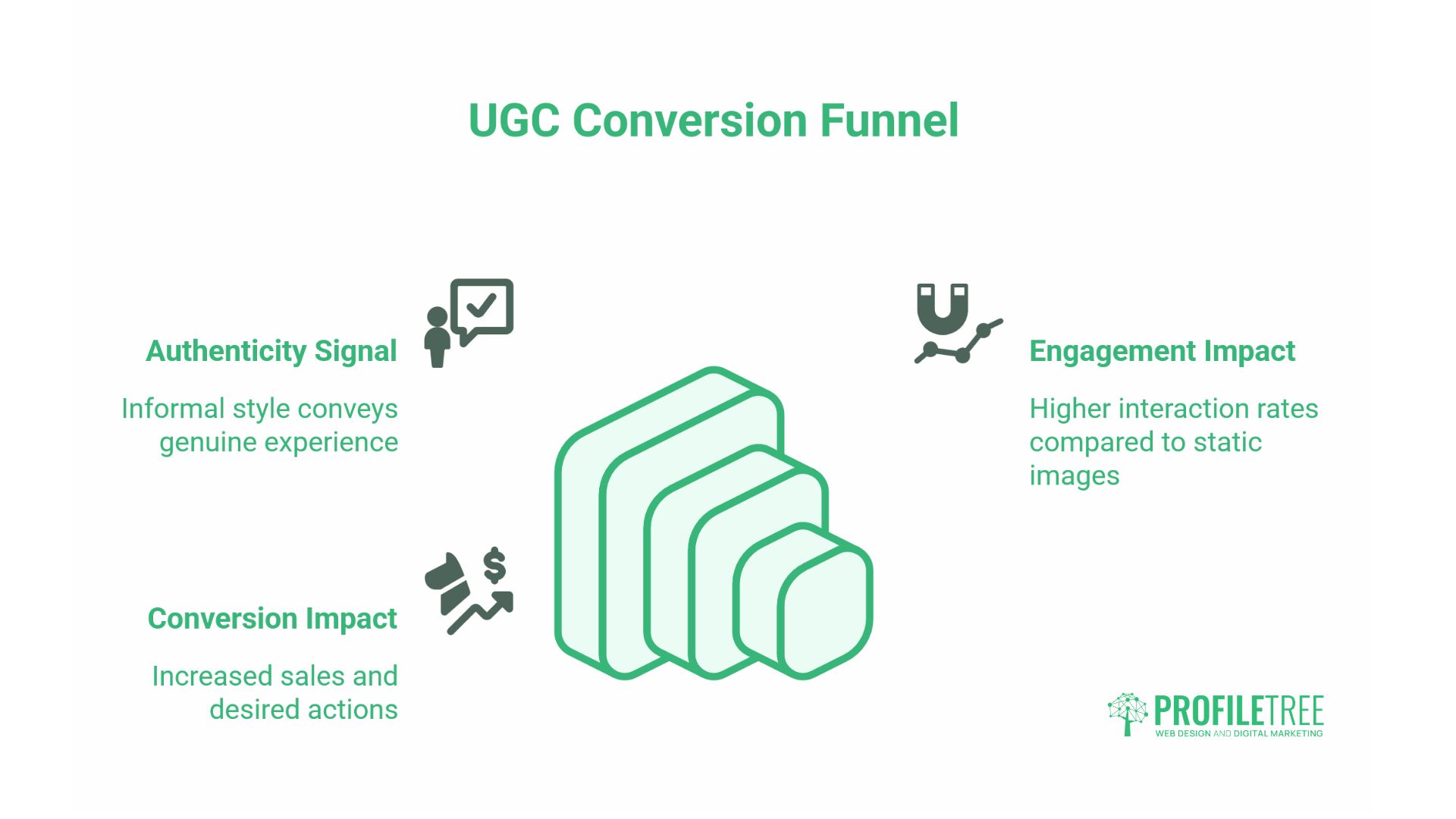
Video UGC consistently outperforms static image UGC in terms of engagement and conversion impact. A customer-shot video review of a product, even filmed on a phone in imperfect lighting, will often convert better than a professionally produced product video because the informality signals authenticity.
For businesses investing in video content, UGC video and professional video production serve different functions. A professionally produced brand film from a Belfast-based video production team sets the benchmark quality and tells the brand story with control and precision. Customer-generated video content provides the authentic peer-to-peer signal that complements it. The most effective video strategies use both.
ProfileTree’s video production service works with businesses across Northern Ireland and the UK to produce branded video content that gives audiences the quality foundation alongside which organic UGC can sit. The social media marketing guide on how social media drives sales increases covers the relationship between video content and conversion.
Measuring UGC Performance
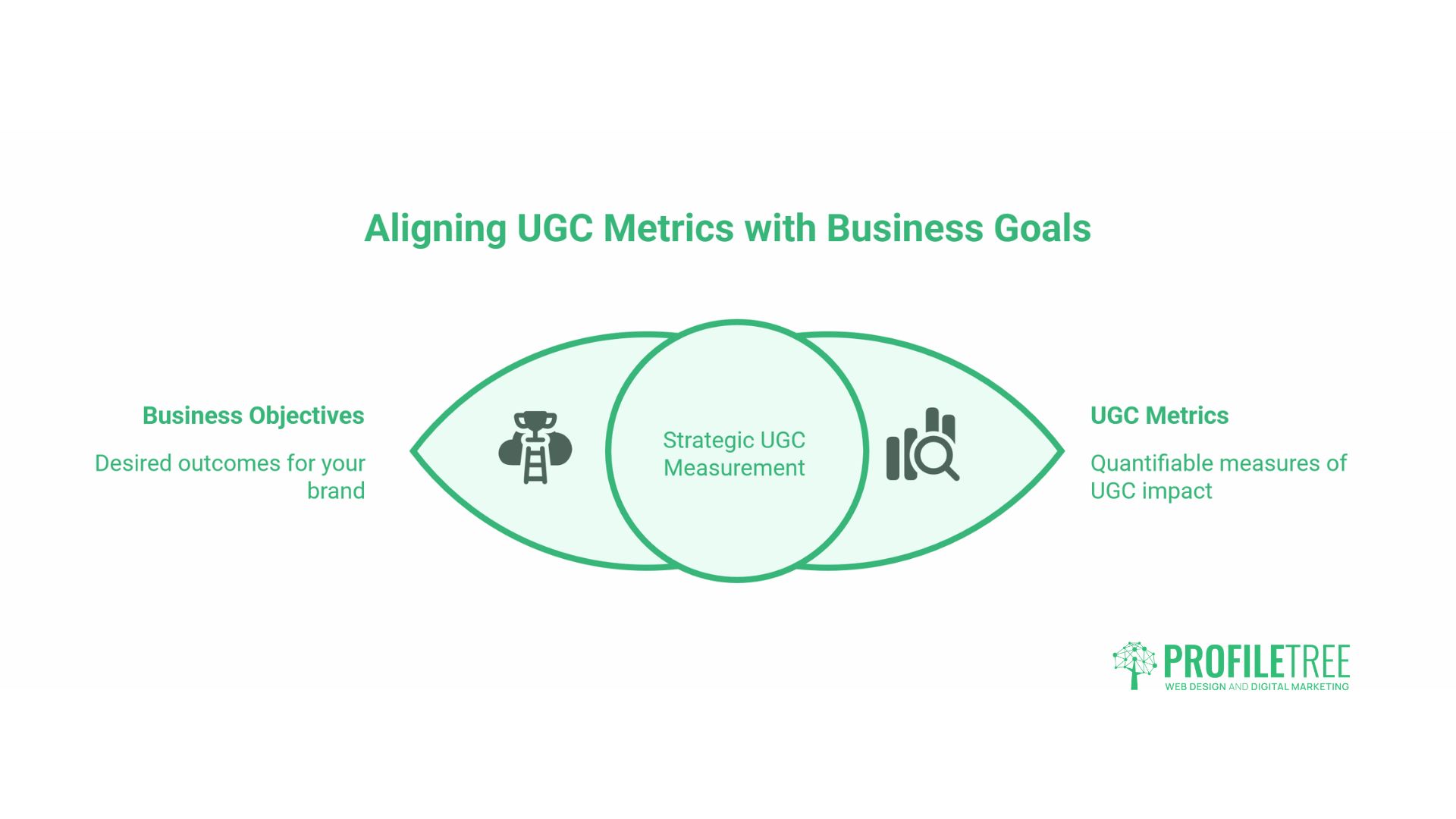
Tracking UGC effectively requires deciding upfront what outcome you are trying to influence. The metrics that matter will vary by objective.
For brand awareness: track reach and impressions from posts that tag or mention the brand. Monitor hashtag volume over time.
For SEO impact: track review volume on Google Business Profile and any structured review content on your website. Monitor changes in monitor position for local search terms during periods of increased review volume.
For conversion: track whether pages that include UGC (testimonials, customer photos, embedded reviews) convert at a higher rate than equivalent pages without it. Most analytics platforms allow page-level conversion comparison.
For social engagement, monitor engagement rates for posts featuring customer content versus brand-produced content. This comparison is consistently revealing: organic customer content typically outperforms in engagement, even when reach is lower.
Conclusion: Engaging user-generated content
A UGC strategy does not replace professional content; it works alongside it. Businesses that build the conditions for customers to share their experiences, handle permissions correctly, and integrate that content across their website, social channels, and marketing campaigns get a compounding benefit over time: more social proof, stronger SEO signals, and a more credible brand presence than advertising alone can build. If you want to understand how UGC fits into a content marketing plan for your business, the ProfileTree team works with SMEs across Northern Ireland, Ireland, and the UK to develop strategies that connect content, search, and social. Get in touch to discuss your content marketing.
FAQs
What is user-generated content?
User-generated content is any content created by customers or members of the public rather than by the brand itself. It includes Google reviews, customer photos on social media, video testimonials, LinkedIn recommendations, and forum discussions about a product or service.
Is UGC free to use?
Organic UGC belongs to the person who created it by default. You can acknowledge it, like it, or comment on it without permission. To repurpose it in your own marketing on your website, in a paid advertisement, or in an email campaign, you need explicit consent from the creator. Paid UGC creator content is produced under a fee and rights agreement.
Do I need to disclose UGC in advertising?
Yes. Under UK ASA rules, any customer content used in a paid advertisement must be clearly disclosed as advertising, regardless of whether the creator was paid. The same applies to UGC creator content, even when the creator has no significant following.
What is the difference between a UGC creator and an influencer?
An influencer is typically paid to reach their own audience. A UGC creator is paid to produce content for the brand to use in its own channels, without necessarily publishing it to their own audience. Both require disclosure if the content is used in paid advertising.