
How to Build a Future-Proof Content Strategy for UK SMEs
Table of Contents
Most content strategies don’t fail because of bad writing. They fail because they’re built as a collection of individual posts rather than a system. A blog goes up, a video gets made, a social post gets scheduled, but none of it connects, nothing compounds, and the business has no clearer picture of what’s working six months later.
A future-proof content strategy changes that. It treats content as a business asset with a defined architecture, a clear role for every format, and a way to measure whether it’s actually generating leads or just filling a content calendar.
This guide is written for SME owners, marketing managers, and in-house teams across Northern Ireland, Ireland, and the UK who want to build a future-proof content strategy that survives algorithm updates, AI disruption, and shifting audience behaviour, without starting from scratch every year.
Why Traditional Content Approaches Are Breaking Down
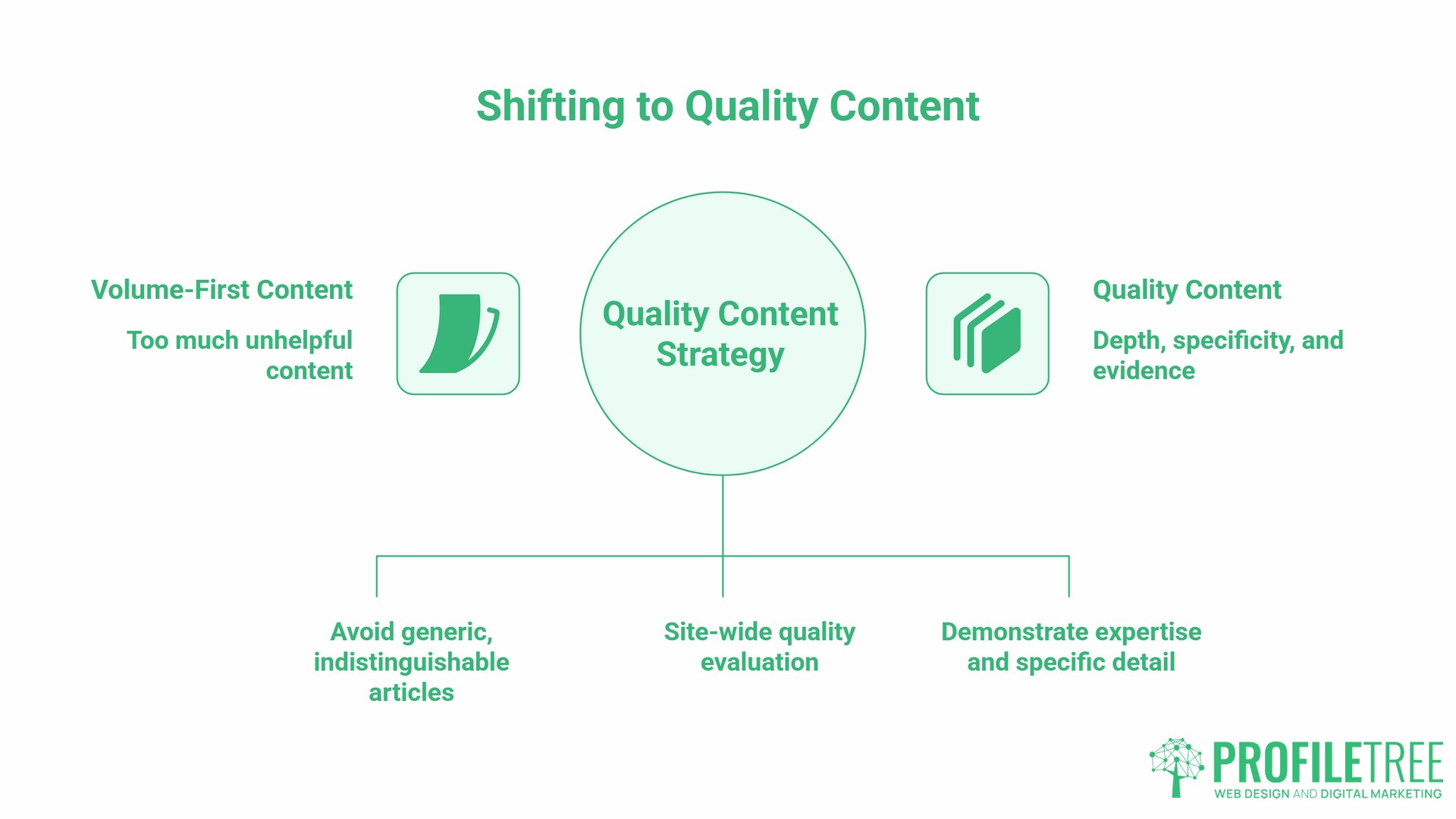
The volume-first content model had a good run. Publish frequently, target every keyword variation, build up a library of posts and wait for traffic to accumulate. For years, that worked well enough.
It doesn’t work now, for two reasons.
The first is AI-generated content. Every niche is flooded with articles that are technically correct, structurally competent, and genuinely indistinguishable from each other. Publishing more of the same thing no longer builds authority; it just adds to the noise.
The second is how search has changed. Google’s helpful content system operates as a site-wide ranking signal, meaning it evaluates the overall quality of content across an entire domain rather than assessing individual pages in isolation. A site with a high proportion of unhelpful content risks pulling down the performance of even its strongest pages. Search engines and AI platforms like Perplexity and Google’s AI Overviews are increasingly filtering for content that demonstrates first-hand experience, genuine expertise, and specific detail that couldn’t have been generated from a generic brief.
The result is that cheap, fast, high-volume content is now a liability. The businesses holding ground in search, and increasingly in AI citations, are those producing fewer pieces with more depth, more specificity, and more evidence of real experience.
Building a future-proof content strategy starts with accepting that reality and building accordingly.
The Four Pillars of a Resilient Content System
1. Technical SEO and AI Readiness
The foundation of any future-proof content strategy isn’t the content itself; it’s whether search engines can find, read, and understand it correctly.
Technical SEO covers the infrastructure: page speed, crawlability, internal link architecture, schema markup, and mobile performance. These aren’t glamorous, but they’re the reason a well-written article either ranks or disappears. A technically broken site will underperform regardless of content quality.
The newer layer is AI readiness. As AI-powered search becomes the default for more users, content needs to be structured so AI systems can extract and cite it accurately. That means clear, self-contained sections with a direct answer at the start of each one, explicit semantic connections between related pages, and schema markup that tells Google exactly what type of content is on each page.
According to an Ahrefs analysis of 17 million citations across AI platforms, including ChatGPT, Perplexity, Gemini, and Google AI Overviews, AI-cited content is on average 25.7% fresher than content that ranks in traditional organic search, which means regular, substantive updates to your key pages are part of any genuine future-proof content strategy, not an optional extra.
For most SMEs, the technical audit is the most neglected part of the process. ProfileTree’s SEO services include a full technical review as the starting point for any content programme, because there’s no point building content on a foundation that’s already working against you.
2. The Human-Only Content Moat: Video and Original Insight
The content formats that AI cannot replicate are the ones built on genuine human experience: a video interview with a real person making a specific argument, an original opinion grounded in actual client work, a case study with real numbers from a real project.
Video is the clearest example. An AI tool can write a script, but it cannot appear on camera, demonstrate a product, explain a local market with credibility, or build the personal familiarity that makes a prospect decide to get in touch. That’s exactly why video has become the most defensible content format for businesses that want long-term authority.
Short-form video for social platforms and long-form video for YouTube and your website serve different purposes within the same system. Short clips build reach and brand recognition. Longer pieces, interviews, walkthroughs, and explanations build the depth of trust that converts a viewer into a buyer. Both have a role in a resilient, future-proof content mix.
ProfileTree’s video production team works with SMEs across Northern Ireland and Ireland to produce video content that fits both formats. You can see how this works in practice below.
Original insight works the same way. A post that draws on your actual experience, a pattern you’ve noticed across client projects, a specific process that produced a measurable result, or an opinion grounded in real-world work is content that cannot be replicated from a generic brief. This is what the SEO community calls a content moat: a body of work that competitors and AI tools cannot easily reproduce.
3. Intent-Based Planning Over Keyword Volume
Keyword research still matters, but optimising for search volume alone produces articles that answer questions nobody was really asking. The more useful question is: what is the person actually trying to do when they search this term?
Someone searching for “content strategy for small business” might be trying to understand what a content strategy is, evaluate whether they need professional help, or build a plan themselves right now. Each of those intents requires a different article. Writing one piece that tries to serve all three usually serves none of them well.
Intent-based planning starts with the customer journey. What does someone need to know before they’re ready to buy? What questions come up in sales conversations? What do existing clients ask most often? The answers to those questions produce a content map built around real commercial value rather than keyword volume, and that map is central to any future-proof content strategy that’s meant to last.
The practical output is a topic cluster structure: one pillar page per major topic area, supported by a set of more specific articles that each answer a distinct question within that topic. Every piece links to the pillar, every piece links to related articles, and the whole cluster builds topical authority in that area over time.
4. Data Privacy and UK GDPR in Content Personalisation
Personalising content for different audience segments is standard practice, but it raises compliance questions that most guides written for a US audience don’t address.
Under UK GDPR, electronic marketing activities must also comply with the Privacy and Electronic Communications Regulations (PECR). Where PECR requires consent, for example, for email marketing to individuals, legitimate interests cannot be used as an alternative lawful basis. Where PECR does not require consent, legitimate interests may be available, but the ICO requires organisations to carry out a three-part test covering purpose, necessity, and balancing against the individual’s rights. The ICO’s guidance on this was updated in March 2026 following changes introduced by the Data (Use and Access) Act, and it is worth reviewing if your content personalisation relies on electronic communications.
The practical implication is that your personalisation approach needs to be built on data you have legitimate access to. First-party data gathered through direct subscription, enquiry forms, and declared preferences is the cleanest foundation. Third-party behavioural data is increasingly restricted.
This isn’t a reason to avoid personalisation, it’s a reason to build it properly from the start. If your future-proof content strategy includes email sequences, retargeting, or audience segmentation, a UK GDPR and PECR review of how that data is collected and used is worth completing before you scale.
Building Your Content Operation: In-House, Agency, or AI?
The most common mistake SMEs make with content is treating it as a binary choice: either hire a full in-house team, or outsource everything. The businesses that do this well tend to use a three-way split.
The table below outlines how that typically works:
| Task | In-House Role | AI Tool Role | Professional Agency Role |
|---|---|---|---|
| Content strategy and planning | Owns the brief and priorities | Research support, topic clustering | Audit, keyword strategy, cluster architecture |
| Blog and article writing | Subject matter input, review | First-draft generation, research | Editorial quality control, optimisation |
| Video production | On-camera presence, briefing | Script drafting support | Filming, editing, YouTube strategy |
| SEO and technical | Basic on-page updates | None, requires human judgement | Technical audit, link building, schema |
| Social media content | Brand voice, scheduling | Caption and hook generation | Strategy, paid amplification |
| AI tool governance | Prompt writing, output review | N/A | Training, workflow design |
The key insight from this model is that AI tools are most useful in the middle of workflows, not at the start, where strategy and judgement are required, and not at the end, where quality control and brand voice matter most. Treating AI as a way to skip strategy is the most common mistake businesses make, and it’s why so much AI-assisted content underperforms.
“The businesses that get the best results from AI in their content work are the ones who treat it as a production tool, not a thinking tool. The strategy, the client insight, and the quality check still need a human. What AI handles well is turning a good brief into a working draft, faster than before.” Ciaran Connolly, founder of ProfileTree.
If your team has the capacity to manage briefing and review but not production, a content marketing partnership is often more cost-effective than hiring. If the bottleneck is knowledge rather than capacity, if the team doesn’t know what good looks like, digital training is usually the better first investment. ProfileTree’s digital training programmes are designed specifically for in-house teams at SMEs who need to build a future-proof content strategy without the cost of a full agency retainer.
How to Audit Your Existing Content
Before adding anything new, it’s worth understanding what you already have. A content audit looks at every published page and asks three questions: is it ranking for anything useful, is it serving a clear audience intent, and is it helping or hurting the overall site?
A basic audit process:
- Export all indexed pages from Google Search Console.
- Tag each page by topic cluster, audience intent (informational, commercial, transactional), and current performance, ranking in positions 1 to 10, 11 to 30, or below 30.
- Identify pages that rank well for relevant terms. These are protected assets and should not be restructured without care.
- Identify pages that get impressions but no clicks. These usually need a stronger title, a clearer meta description, or more depth to move from page three to page one.
- Identify pages with no impressions and no clear intent match. These are candidates for consolidation, redirection, or removal.
The common mistake is treating every old article as salvageable. Some content genuinely needs to be redirected or removed. A page with thin content and no rankings that covers the same ground as a stronger article is pulling down the site’s overall quality signals, which matters more than ever, given how Google’s helpful content system assesses domain-wide quality. Removing it and redirecting its URL to the stronger piece is often more effective than rewriting it.
Measuring Whether Your Future-Proof Content Strategy Is Working
Most content reporting focuses on traffic. Traffic is a useful signal, but it’s a poor proxy for commercial value, particularly for a future-proof content strategy, which is designed to build compounding authority over time rather than produce immediate clicks.
The metrics that matter more:
- Share of search tracks how often your brand appears in search results for your target topic clusters relative to competitors. This is a better measure of long-term authority than absolute traffic numbers.
- Lead quality from organic, what proportion of your organic visitors are converting to enquiries, and how qualified are those enquiries? A content strategy built around commercial intent should produce a better lead-to-traffic ratio than one built around broad informational topics.
- AI citation rate, are your pages being cited in AI Overviews, Perplexity answers, or ChatGPT responses for your target topics? This is becoming a meaningful distribution channel, and it’s worth tracking manually by searching your target queries in AI platforms periodically.
- Content depth score, are your key articles covering the full range of sub-questions within a topic, or leaving gaps that competitors fill? Tools like Google Search Console’s query data can surface the related questions your pages are ranking for (or not ranking for) on a given topic.
Quarterly reviews of these metrics, rather than monthly traffic reports, give a clearer picture of whether your future-proof content strategy is building the right kind of authority.
Building a Content Strategy That Lasts
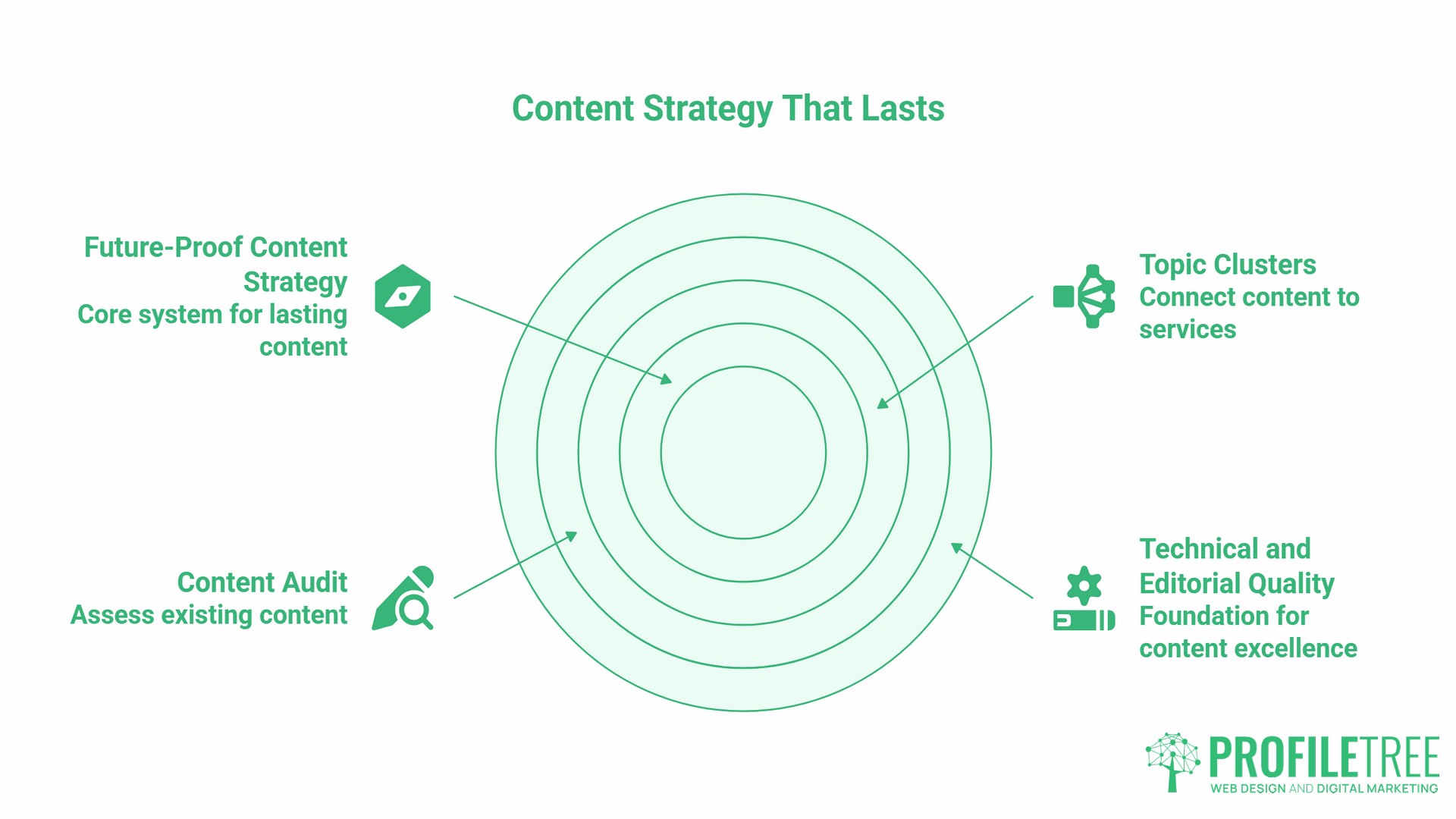
A future-proof content strategy isn’t a content calendar with a longer planning horizon. It’s a system where every format has a defined role, every piece of content connects to a wider topic architecture, and the whole thing is built on technical and editorial quality that compounds over time.
For SMEs across Northern Ireland, Ireland, and the UK, the practical question is where to start. In most cases, the answer is the audit, understanding what you already have before deciding what to build next. From there, the priority is usually to fill technical gaps, strengthen the highest-potential existing content, and then build out the topic clusters that connect most directly to your actual services.
ProfileTree works with businesses at each of those stages, from technical SEO audits and content strategy through to video production and in-house digital training. If you want to understand where your current content stands and what a resilient, future-proof content strategy would look like for your business, get in touch for a consultation.
Frequently Asked Questions
What does it mean to future-proof content?
A future-proof content strategy is one built to retain value amid algorithm changes, shifts in search behaviour, and the rise of AI-generated competition. It relies on original expertise, clear topic authority, and technical quality rather than volume or keyword saturation. The goal is content that gets more valuable over time, not less.
How is AI affecting content strategy for UK businesses?
AI has made generic informational content abundant and cheap. The practical effect for UK SMEs is that content competing purely on breadth, covering a topic well enough, is under pressure. Content that wins now demonstrates first-hand experience, includes specific, verifiable details, and is structured to be extracted by AI search systems as a citable source. UK GDPR and PECR also affect how AI tools can be used in content personalisation, particularly around data used to target or segment audiences through electronic marketing.
Should I stop writing blog posts and focus only on video?
No. The most resilient content systems use both, with clear roles for each format. Blog content and long-form articles carry SEO weight, serve informational queries, and build topical depth. Video builds trust, handles demonstrational content better than text, and is the hardest format for AI to replicate convincingly. A core-and-satellite model, one substantial written piece as the hub, with video and social content branching off it, tends to produce better results than treating the formats as alternatives.
How often should I review my content strategy?
A light review quarterly, looking at what’s ranking, what’s converting, and what’s drifted out of date. A full strategic review annually, covering topic cluster coverage, technical health, and whether the current content mix reflects your actual service priorities. The annual review is also the right time to run a content audit and decide whether to redirect or remove underperforming pages.
Is AI-generated content harmful to SEO?
Unhelpful content is harmful to SEO, regardless of how it was produced. Google’s helpful content system evaluates usefulness, not origin. AI-generated content that’s been properly briefed, accurately fact-checked, and reviewed for quality by someone with genuine expertise in the topic can perform well. AI-generated content produced at volume with no human quality layer is now one of the clearest routes to a site-wide rankings decline.
How do I measure the success of a long-term content strategy?
Focus on the share of search for your target topics, lead quality from organic channels, and AI citation rate for your key queries, rather than raw traffic volumes. These metrics reflect the compounding authority a future-proof content strategy is designed to build. Traffic is a lagging indicator; the leading indicators are coverage depth, topical authority signals, and conversion quality.