
Collaborative Video Production: A Professional Agency Guide
Table of Contents
Most businesses commissioning video for the first time have the same concern: the production process looks opaque from the outside, the terminology is unfamiliar, and it’s not always clear where your input is needed versus where you should step back and trust the team. Getting that balance wrong costs time and money on both sides.
This guide explains how professional collaborative video production works at each stage, what a business in Belfast or Northern Ireland should expect to contribute, and how to structure the working relationship so the final cut matches your brief. Whether you’re planning a corporate film, a product launch video, or a series of social content, the framework here applies.
For a broader overview of how productions are structured end to end, see the complete video production process explained, the guide that accompanies this one.
Defining the Brief Before Production Starts
The single biggest cause of delays in collaborative video production is a brief that gets revised after filming begins. Reshooting costs significantly more than getting the brief right at the outset. Before any pre-production work begins, a professional agency will want to agree on three things: the objective, the audience, and the constraints.
Objective: What the Video Needs to Do
A video designed to generate leads on a product page has a different structure from one building an employer brand on LinkedIn. Both require professional production, but the scripting approach, pacing, and call to action differ substantially. Being specific about the objective shapes every downstream decision. “We want a promo video” is not a brief; “we want a 90-second video explaining our new payroll software to HR managers, with a direct trial sign-up prompt at the close” is.
SMEs working with a Belfast agency for the first time often find it useful to define success before the shoot: what would a well-performing video achieve in three months? Tying the project to a measurable outcome, whether that’s enquiries, click-throughs, or social shares, also makes it easier to brief the editor on pacing and calls to action.
Brand storytelling examples can be a useful reference point at this stage if you’re unsure how to frame the narrative angle for your video.
Audience: Who Will Watch It
Audience definition affects tone, length, and platform. A manufacturing firm in County Down producing a video for procurement managers at UK distributors needs different content to a Belfast café producing a short social reel for a 25 to 35-year-old local audience. Providing your agency with a clear picture of who the viewer is, including where they’ll watch and what they already know about your business, prevents the generic output that comes from under-specified briefs.
Constraints: Budget, Timeline, and Approvals
Production budgets in Northern Ireland for professional corporate video typically start around £1,500 for a simple, single-location shoot and increase with the number of locations, actors, animation, and post-production complexity. (These are indicative figures only; actual costs depend on project scope; request a detailed quote for any specific project.) Being transparent about the budget early prevents an agency from scoping a five-day shoot when the client expects a one-day turnaround.
Approval chains matter just as much. If three internal stakeholders need to sign off on the final cut, the agency needs to build that into the timeline. A video with no agreed-upon approver often stalls at the feedback stage for weeks.
Pre-Production: What Happens and What You Decide
Pre-production is where the collaborative work is most intensive. The production team is building the blueprint; your role is to provide the raw material and make decisions that lock in direction before any cameras roll.
Scripting and Storyboarding
For most corporate and marketing videos, the agency will produce a first-draft script based on your brief. Your job at this stage is to check factual accuracy, confirm the tone reflects your brand, and flag anything that doesn’t sound like your business. Resist the urge to rewrite sentences word for word, as that often undermines the scriptwriter’s pacing. Instead, highlight where the substance is wrong and explain what you’d want instead.
A storyboard follows the script and visually maps each shot. For businesses new to video production, reviewing a storyboard can feel abstract, but it’s one of the most cost-effective checkpoints in the entire process. Changing a sequence on paper costs nothing; changing it after the shoot is expensive.
Businesses working on animated video production or explainer content will typically go through a more detailed storyboard stage, because there is no live footage to fall back on if the animation direction is wrong.
Shot Lists and Scheduling
The producer will build a shot list and production schedule once the storyboard is approved. For businesses, the main input here is logistics: confirming access to the location, ensuring the right people are available on shoot day, and flagging any access restrictions or health and safety considerations at your premises.
For Northern Ireland businesses, outdoor shoots carry weather risk. Professional productions build contingency time into outdoor schedules, but clients can help by being flexible on shoot dates when the forecast changes.
Roles in a Video Production Team
Understanding who does what prevents confusion on the day. A standard production crew for a corporate shoot in Belfast typically includes a director, a camera operator, and a producer managing logistics. Larger productions add a gaffer for lighting, a sound recordist, and a runner. Your point of contact is usually the producer; the director handles the creative on set. Directing creative notes through the producer rather than individual crew members keeps communication clear and prevents contradictory instructions mid-shoot.
If you’re commissioning narrative-driven work, such as a brand story or documentary-style profile, it’s worth reading about video storytelling techniques before your first pre-production meeting. Understanding basic story structure helps you give better feedback during scripting.
Good project management discipline is as important here as anywhere else in the pipeline. The project management methodologies that professional production agencies use to schedule shoots and manage approvals are the same ones that keep complex client projects on time and on budget.
Production Stage: Communication, Approvals, and Managing the Shoot
On a professional shoot, the director and crew lead. The client’s role is to be available for factual checks, product clarifications, and final approval of on-screen elements, not to art-direct individual shots. A well-briefed client who trusts the production team will consistently get better footage than one who second-guesses every camera angle.
Real-Time Communication and Feedback
For shoots involving multiple locations or remote participants, production teams use a range of communication tools. Slack channels or WhatsApp groups handle day-to-day logistics; dedicated video review platforms such as Frame.io allow clients to leave time-stamped notes on footage cuts as they are assembled. Using these tools properly, rather than sending feedback by email thread, compresses review cycles considerably.
“The businesses that get the strongest results from their video projects are the ones who treat production as a collaboration, not a handoff,” says Ciaran Connolly, founder of ProfileTree. “That means engaging during the brief, giving clear feedback at review stages, and trusting the creative team in between.”
Managing Version Control
Every cut of a video should be clearly labelled: rough cut, director’s cut, client review v1, client review v2, final cut. Keeping track of which version stakeholders are reviewing prevents the situation where different people send conflicting notes on the same file. Ask your agency upfront how they manage version control, and make sure everyone on your side reviews the same file at the same time.
UK Compliance and Data Considerations
Businesses commissioning video that involves customer testimonials, employee footage, or location shots on private premises need signed release forms before the footage is used commercially. UK GDPR applies to any identifiable person appearing in video content. A professional production agency will have release form templates as standard.
For productions involving sensitive client data, such as footage inside financial services firms or healthcare providers, check whether your agency stores raw footage on UK-based or EU-compliant servers. Most professional agencies operating in Northern Ireland use cloud storage that meets UK GDPR requirements, but it’s worth confirming when the footage involves commercially sensitive premises or individuals.
The ethics and legalities of digital marketing article covers the broader compliance landscape for businesses producing and distributing commercial content in the UK, including consent requirements and data handling obligations.
Producing Content Across Multiple Formats
Most businesses now need video delivered in multiple formats: a full-length version for YouTube, a 60-second cut for LinkedIn, a 15-second version for paid social, and a square-cropped version for Instagram. Agreeing on the full delivery list before the shoot means the camera operator can plan for different crop ratios from the start. Retrofitting a horizontal shoot into a square format is possible, but it often results in awkward framing.
For guidance on matching format to platform and building a distribution plan, see video content strategies. For businesses specifically distributing short-form content across social channels, the rise of short-form video pieces covers the platform dynamics driving format decisions in 2025 and 2026.
Post-Production: Review, Feedback, and Final Sign-Off
Post-production is where the footage becomes a video. Editing, colour grading, sound design, music licensing, motion graphics, and closed captioning all happen in this phase. The agency leads the creative work; your role is structured review at defined stages.
The Rough Cut Review
The rough cut is the first assembled version of the edit. It gives you the sequence and pacing, but colour grading and sound design will be unfinished. Reviewing a rough cut for story structure and messaging is the right approach at this stage; sending colour notes on an ungraded edit wastes the exchange.
The key questions to answer at the rough cut stage: Does the opening capture attention? Is the messaging clear and in the right order? Is the pacing appropriate for the intended platform?
Giving Constructive Feedback
Time-coded feedback is the professional standard. “At 1:24, the voiceover says X, but the screen shows Y (can these align?)” is actionable. “It just doesn’t feel right” is not. The more specific your notes, the faster the editor can implement them. Most production agencies will ask for all rough-cut feedback consolidated from your internal stakeholders into one document before they proceed to a revised cut. Sending notes in three separate emails from three different people creates version confusion and extends timelines.
Where stakeholders genuinely disagree on creative direction, the client’s business needs to resolve that disagreement internally before sending the agency notes. Production teams cannot adjudicate between conflicting client opinions.
The Online Cut and Final Approval
After rough-cut revisions, the agency delivers an online cut with full-colour grade, sound mix, and any motion graphics in place. This is your final chance to request changes before export. Most agencies include two rounds of revisions in their fee; additional rounds are typically charged at an hourly rate. Building a clean approval process with a named decision-maker on the client side prevents scope creep at this stage.
The final deliverables should be agreed upon before the project starts: file format (H.264 MP4 for web, ProRes for broadcast), resolution (1080p or 4K), and aspect ratios for each platform. Getting these specifications wrong means re-exporting, which costs time even if the edit itself is complete.
Understanding the power of video quality in search and social performance is worth reading before the final delivery conversation: output resolution and compression settings directly affect how platforms serve the content algorithmically.
Working with Remote and Hybrid Teams
Many video projects now involve a mix of Belfast-based crew and remote contributors, whether that’s a voiceover artist in London, a motion graphics designer in Dublin, or a client stakeholder reviewing footage from a home office. Managing large video files remotely, particularly raw 4K footage, is a practical challenge. Proxy workflows, where a lower-resolution version of the footage is used for editing, and the original is only referenced for the final export, make this manageable on standard UK broadband connections. Ask your agency whether they use proxy workflows for remote collaboration; they significantly reduce transfer bottlenecks.
Choosing a Video Production Partner in Northern Ireland
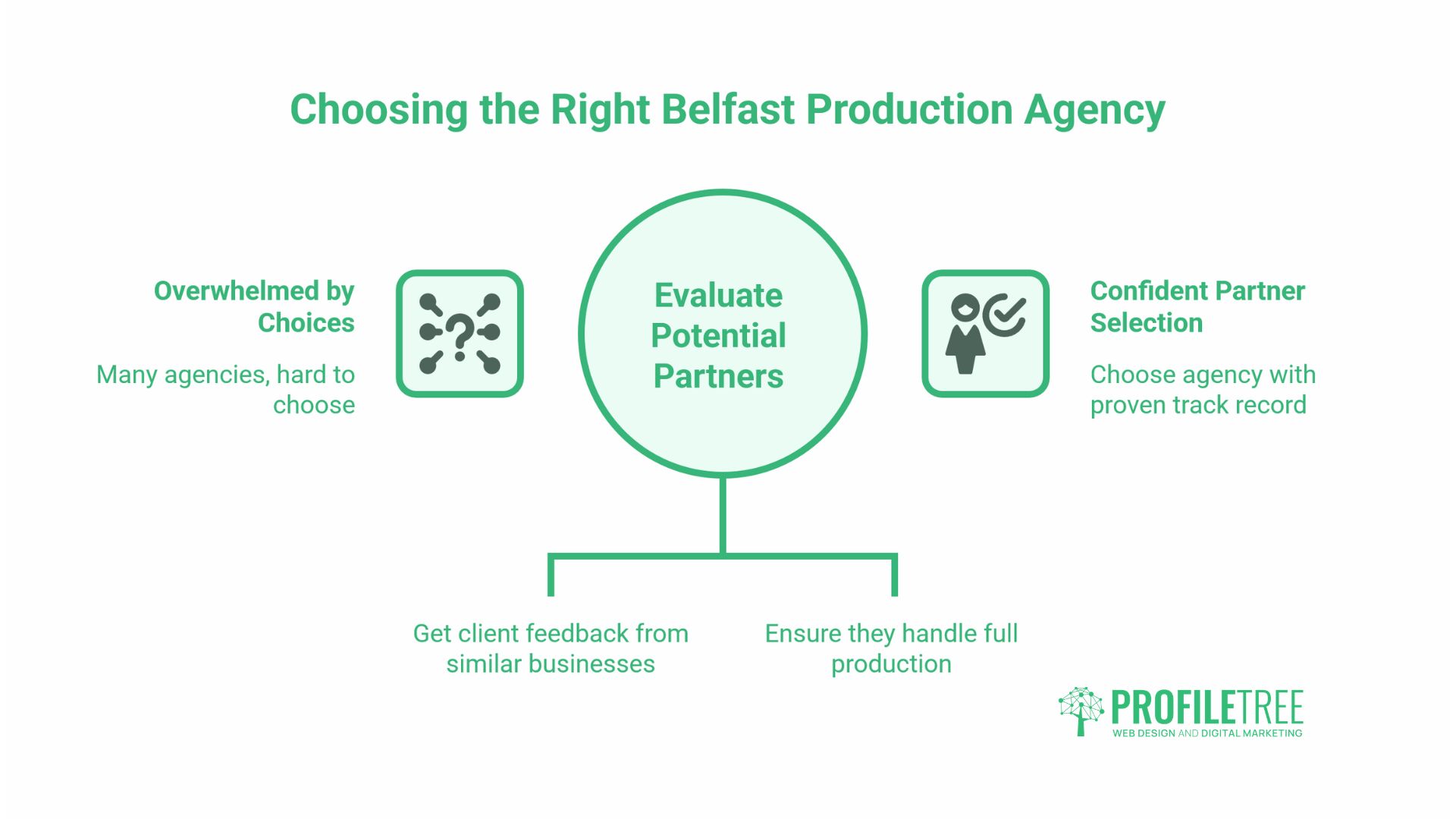
The production agency market in Belfast and across Northern Ireland has grown substantially in the last five years. When evaluating potential partners, look beyond the showreel. Ask for client references from businesses of a similar size and sector. Check whether they handle the full production pipeline (brief, scripting, shoot, edit, delivery) or whether they outsource significant parts of the post-production work.
Ask about project management. Do they assign a named producer to your project? How do they handle revisions, and what happens if your internal stakeholders provide conflicting feedback? The quality of the agency’s process is as predictive of your final result as the quality of their camera kit.
For SMEs integrating video into a broader digital strategy, the ProfileTree video marketing services page explains how production output connects to distribution, SEO, and paid campaign strategy. Video produced in isolation rarely delivers its full commercial value; it performs best as part of a planned content and channel approach.
Businesses in the food, hospitality, or tourism sectors should also learn how to produce and edit video for tourism businesses, with sector-specific guidance on locations, release forms, and seasonal planning.
For businesses distributing video to YouTube as a primary channel, optimising the upload properly matters as much as the production itself. The YouTube SEO guide covers titles, descriptions, chapters, and the ranking factors that determine whether a video gets served to new audiences.
The Collaboration Tools That Production Teams Use
Project management platforms, file sharing services, and video review tools all play a role in keeping collaborative production on track. The specific tools matter less than the discipline with which they’re used.
Project Management
Platforms such as Trello, Asana, or Monday.com are well-suited for tracking tasks, deadlines, and approvals throughout the production pipeline. For the client’s business, the key value is visibility: being able to see at a glance where the project is and what’s waiting on your input, rather than chasing the agency by email for status updates.
File Sharing and Video Review
Google Drive and Dropbox handle document sharing and low-resolution preview files comfortably. For video reviews specifically, Frame.io has become the industry standard because it allows reviewers to leave time-coded comments directly on the timeline, reducing ambiguity in written feedback and compressing revision cycles considerably. Wipster and Vimeo Review offer similar functionality.
For raw production files, particularly 4K footage that can run to hundreds of gigabytes on a multi-day shoot, physical hard drives shipped between parties or dedicated media asset management platforms are often more practical than cloud transfer on standard UK broadband. A NAS (network-attached storage) drive shared between the agency and the client solves the file-transfer problem for ongoing production relationships.
Communication
Slack and Microsoft Teams both work well for real-time communication on production projects. The main risk is over-communication: a message thread that includes every minor production query quickly becomes unmanageable. Set up a shared channel for project updates and approval requests, and keep creative feedback in the time-coded review platform where it belongs.
After Delivery: Getting the Most from Your Video Assets
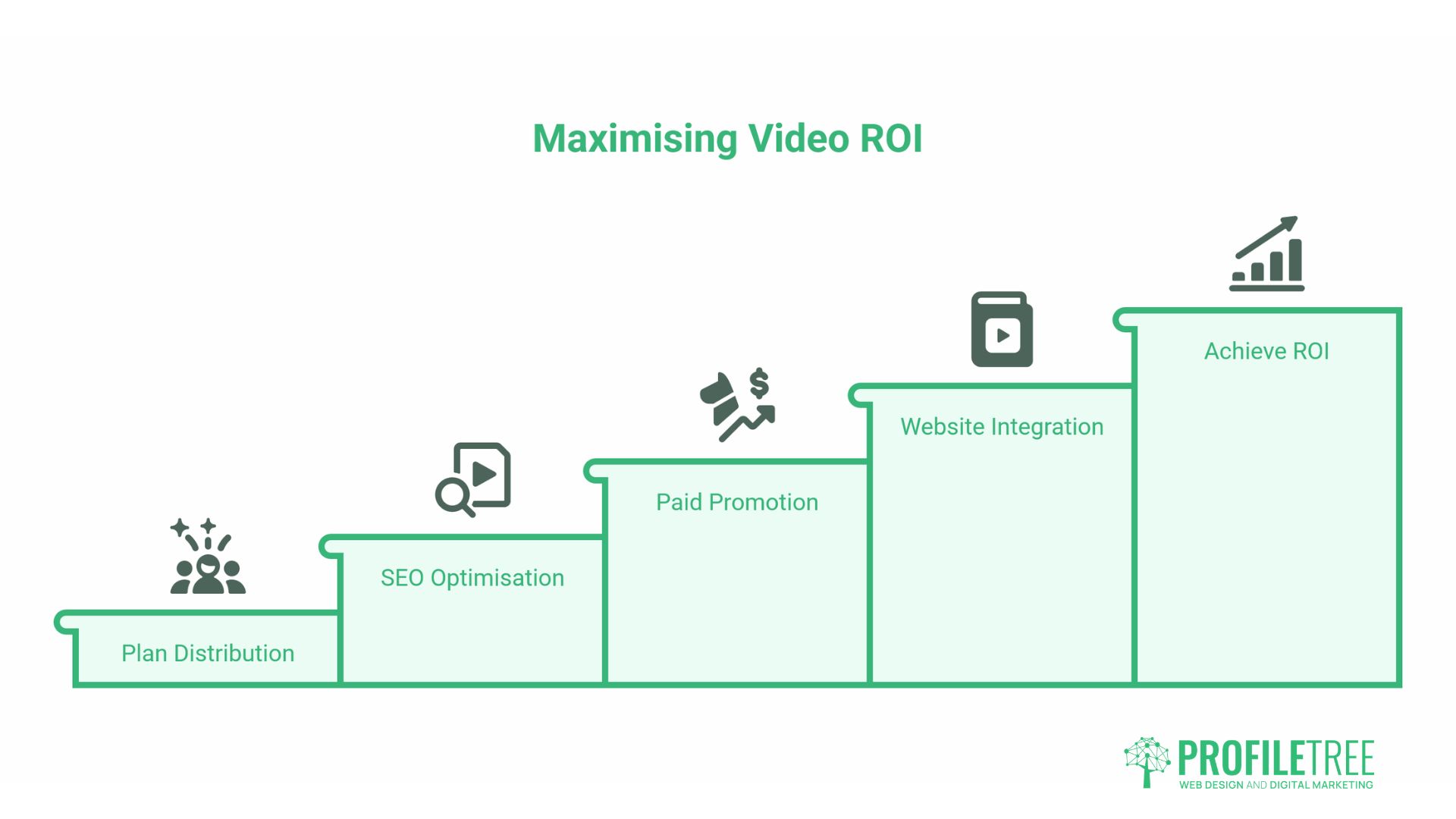
Production doesn’t end at delivery. The businesses that get the highest return on their video investment are those that plan distribution before the shoot, not after. A 90-second corporate video sitting on a company YouTube channel with no SEO optimisation, no paid promotion, and no integration into the website will underperform relative to the same video deployed as part of a planned campaign.
At minimum, each video asset should have a named home on your website, an optimised title and description on YouTube, and a distribution plan that includes at least one paid or organic social push within the first two weeks of publication. The window during which a new video is indexed and served by algorithms is short; front-loading distribution effort during that window significantly affects long-term view counts and search visibility.
A Short-form video content strategy covers how to repurpose production footage across short-form platforms without creating additional shoot days. Video email marketing data sets out the performance benchmarks for embedded video in email campaigns across UK and Irish SME audiences.
A structured content strategy that connects video with the rest of your digital marketing activity is outlined in the content strategy guide to maintain audience interest. Video is one format within a broader content architecture; the strongest results come when it’s integrated rather than siloed.
ProfileTree works with businesses across Belfast and Northern Ireland on video production projects at every scale, from single-day shoots for social content to multi-location productions for broadcast and brand campaigns. The team handles the full pipeline from brief to delivery, with a dedicated producer managing client communication throughout. More on how this works in practice is in the complete video production process guide.
Conclusion
Getting the most from collaborative video production comes down to clarity at each stage: a specific brief before pre-production, structured feedback during post-production, and a distribution plan before delivery. For businesses in Belfast and Northern Ireland, working with a production agency that manages the process end-to-end removes the logistical complexity and leaves you focused on the decisions only you can make.
FAQs
What is collaborative video production?
A structured working process between a client and a production team, with defined input at each stage. The client owns the brief, brand direction, and approvals; the agency handles scripting, shooting, editing, and delivery.
How do you collaborate on a video project remotely?
Use a video review platform (Frame.io, Wipster) for time-coded feedback, a project management tool (Asana, Trello) for task tracking, and cloud storage (Google Drive, Dropbox) for file sharing. For large footage files, ask your agency about proxy workflows. Consolidating stakeholder feedback before sending it to the editor matters more than the specific tools.
What are the best tools for video production collaboration?
Frame.io for time-coded video review, Google Drive or Dropbox for documents and previews, Asana or Monday.com for project tracking, and Slack for daily communication. A professional agency should work within your preferred stack or recommend one that needs no training.
How do you manage a video production team remotely?
Assign one producer to handle all client communication and one named contact on the client side to consolidate feedback. Define review stages in the project timeline before the shoot. With those protocols in place, physical location becomes secondary.