
How to Build a Strong Website Content Strategy Step by Step
Table of Contents
Most businesses approach content the wrong way round. They start writing, then wonder why nobody reads it. A strong website content strategy begins before a single word is drafted with a clear picture of who you are writing for, what they actually need, and how your content fits into the commercial goals of the business.
This guide walks through each stage of building a strong content strategy for your website: from understanding your audience to measuring what is working and adjusting accordingly. Whether you are starting from scratch or fixing a strategy that has stalled, the steps here apply to real businesses with real constraints.
What a Website Content Strategy Actually Does
A website content strategy is the planning layer that sits above content creation. It defines what to publish, why, for whom, and in what order so that every piece of content contributes to something beyond filling a page.
Without it, businesses end up with a site full of articles that do not connect to each other, do not address what potential customers are searching for, and do not support the services or products the business is trying to sell.
Content Strategy vs Content Marketing
These two terms get used interchangeably, but they are not the same thing.
Content strategy is the plan: the audience definition, the keyword logic, the topic architecture, the editorial standards, and the governance rules that determine what gets created and how.
Content marketing is the execution: creating and distributing content to attract and retain an audience. It sits inside the strategy, not above it.
You can run content marketing without a strategy. Most businesses do. The results are usually inconsistent, difficult to attribute, and expensive to sustain. A strategy changes that by making every content decision deliberate.
Understanding Your Audience Before You Write Anything
The most common reason content underperforms is that it was written for the business rather than for the reader. Understanding your audience is not a one-off exercise it shapes every content decision that follows.
Identifying What Your Audience Actually Needs
Start with the problems your audience is trying to solve, not the services you want to promote. For an SME owner in Northern Ireland, the question might not be “how do I get an SEO strategy?” It might be “why is my competitor appearing in Google and I am not?” Those two questions require different content.
Look at the language your audience uses when they search. Google Search Console query data is useful here: sort by impressions and look at the phrasing people use, especially longer queries with seven or more words. These reflect how people naturally describe their problems, and they often reveal angles your current content misses entirely.
Talk to your sales or customer service team. The questions that come up repeatedly in conversations are almost always better content topics than anything generated by keyword tools alone.
Building Audience Personas That Are Actually Useful
A persona is only useful if it drives decisions. Vague profiles (“marketing manager, 35–45, values quality”) do not help you choose between a how-to guide and a video explainer, or decide whether to target “web design Belfast” or “how much does a website cost in Northern Ireland.”
Useful personas include: what the person is trying to achieve, what is stopping them, what information they need before they will take action, and where they are in the buying process when they encounter your content. Those four points give you enough to plan content that actually connects.
Setting Goals That Connect to Business Outcomes
Content goals need to be tied to what the business is trying to achieve, not to vanity metrics like page views or social shares. If the business needs more enquiries from local businesses in Northern Ireland, the content goal should reflect that: ranking for specific service-area queries, building topical authority in relevant categories, and driving traffic that converts.
Defining the Right KPIs for Your Strategy
The metrics you track depend on the stage of the funnel your content targets. For awareness content, impressions and new users matter. For consideration content, time on page, pages per session, and return visits are more telling. For content aimed at conversion, form submissions, calls, and revenue attribution are the only figures that count.
Set targets in advance and tie them to timeframes. Content SEO typically takes three to six months to show results in search rankings. If you are expecting results in six weeks, you will likely make the wrong decisions when the numbers do not move fast enough.
“The businesses we work with that get the most from content are the ones that treat it as infrastructure rather than output,” says Ciaran Connolly, founder of ProfileTree. “They are not asking how many posts they published last month. They are asking whether their content is generating enquiries and if not, why not.”
Conducting a Content Audit Before Expanding
If your site already has content, auditing it before you create more is one of the highest-value things you can do. Publishing more content on top of a weak foundation does not fix the foundation.
A content audit looks at what you have, how it is performing, and what to do with each piece. The four decisions for any existing article are: optimise it (it has potential), reframe it (the topic is right but the angle is wrong), redirect it (consolidate with a stronger page), or remove it (it adds no value and has no traffic worth protecting).
What to Look for When Auditing Existing Content
Check Google Search Console for each URL. Look at clicks, impressions, and average position. A page with several hundred impressions but no clicks is ranking but not compelling enough to click that is a title and meta description problem. A page with no impressions at all either targets keywords nobody searches for or is not ranking anywhere meaningful.
Look at the content itself. Is it answering the question the searcher is asking? Is it thin? Does it connect to your services in any natural way? Does it link to other relevant content on your site? Most legacy content fails on at least two of these.
For more detail on structuring this process, ProfileTree’s content audit framework covers how to triage existing articles at scale.
Planning Your Content: Topic Clusters and Keyword Research
Random publishing does not build topical authority. Search engines and AI systems both reward sites that demonstrate deep, connected coverage of a subject area not sites with isolated articles scattered across unrelated topics.
Building a Topic Cluster Structure
A topic cluster organises your content around a central pillar page that covers a broad topic in depth, supported by several related articles that go deeper into specific subtopics. Every article in the cluster links to the pillar, and the pillar links back out to the supporting content.
This structure signals to search engines that your site has genuine authority on the subject, rather than just a single article that happens to rank. It also helps users navigate to the content most relevant to their specific question.
For a web design agency, the pillar might be a comprehensive guide to web design for small businesses, supported by articles on CMS comparisons, website costs, page speed optimisation, and conversion rate basics. Each supporting article handles one subtopic thoroughly rather than touching on everything lightly.
Choosing Keywords That Match Intent
Keyword research for a content strategy is not about finding the highest-volume terms. It is about finding terms where the intent matches what you are offering and where you have a realistic chance of ranking given your current authority.
Long-tail keywords phrases of four or more words typically have lower search volume but much higher intent. Someone searching “website content strategy for small business Belfast” is far closer to a buying decision than someone searching “content strategy.” The former tells you exactly who they are and what they need. Write for them.
Align your keyword choices with the URL slug. If the slug is already published and cannot be changed, your keyword strategy must work within that constraint rather than targeting something the URL does not support.
Creating a Content Calendar That Holds
A content calendar is a commitment device. It forces decisions about what to publish and when, rather than leaving those decisions to whoever has time this week.
What to Include in Your Content Calendar
At minimum, each entry in your calendar should include: the topic and working title, the target keyword, the content type, the author or owner, the publication date, and the internal links it should contain. Those six fields are enough to keep production on track without turning the calendar into a bureaucratic exercise.
Vary the content types across your calendar. Written guides, video content, comparison tables, and FAQ-focused articles all serve different search intents and get cited differently by AI systems. Content with tables gets cited significantly more often in AI-generated answers than prose-only articles a structural choice that costs nothing extra to make.
Optimising Content for Search Without Sacrificing Quality
SEO and readability are not in conflict. The content that ranks well is usually the content that actually answers the question clearly, covers the topic thoroughly, and is structured so both humans and search engines can follow it.
On-Page SEO: The Elements That Matter Most
The H1 should contain your primary keyword and be genuinely descriptive not a clever headline that leaves readers unclear about what the page covers. Each H2 should represent a distinct section of the topic, ideally phrased around a question or a specific user need.
Meta titles and descriptions should give the searcher a clear reason to choose your result over the others on the page. The meta description is not a ranking factor, but it directly affects click-through rate, which affects how much traffic your rankings actually deliver.
Internal links matter more than most businesses realise. Linking between related articles distributes authority across your site, helps search engines understand how your content connects, and keeps readers on your site longer. Place your most important links early in the content rather than clustering them at the bottom.
ProfileTree’s content creation services can take on this production process end to end, from keyword research through to published, optimised articles.
Structuring Content for AI Citations
AI systems including Google’s AI Overviews, Bing Copilot, and tools like Perplexity are now a meaningful source of referral traffic. The pages they cite tend to share common structural features: a direct answer in the first 50 words of each section, self-contained paragraphs that work out of context, and clear factual statements rather than vague generalisations.
Writing each major section so it can stand alone with a conclusion-first structure rather than building slowly to a point serves both AI citation and human readers who are scanning rather than reading linearly.
According to research published by Ahrefs, pages that cover multiple sub-questions within a single topic are 161% more likely to appear in AI Overviews. That is a structural argument for thorough, multi-faceted content rather than narrow, single-answer articles.
Localising Your Strategy for UK and Irish Markets
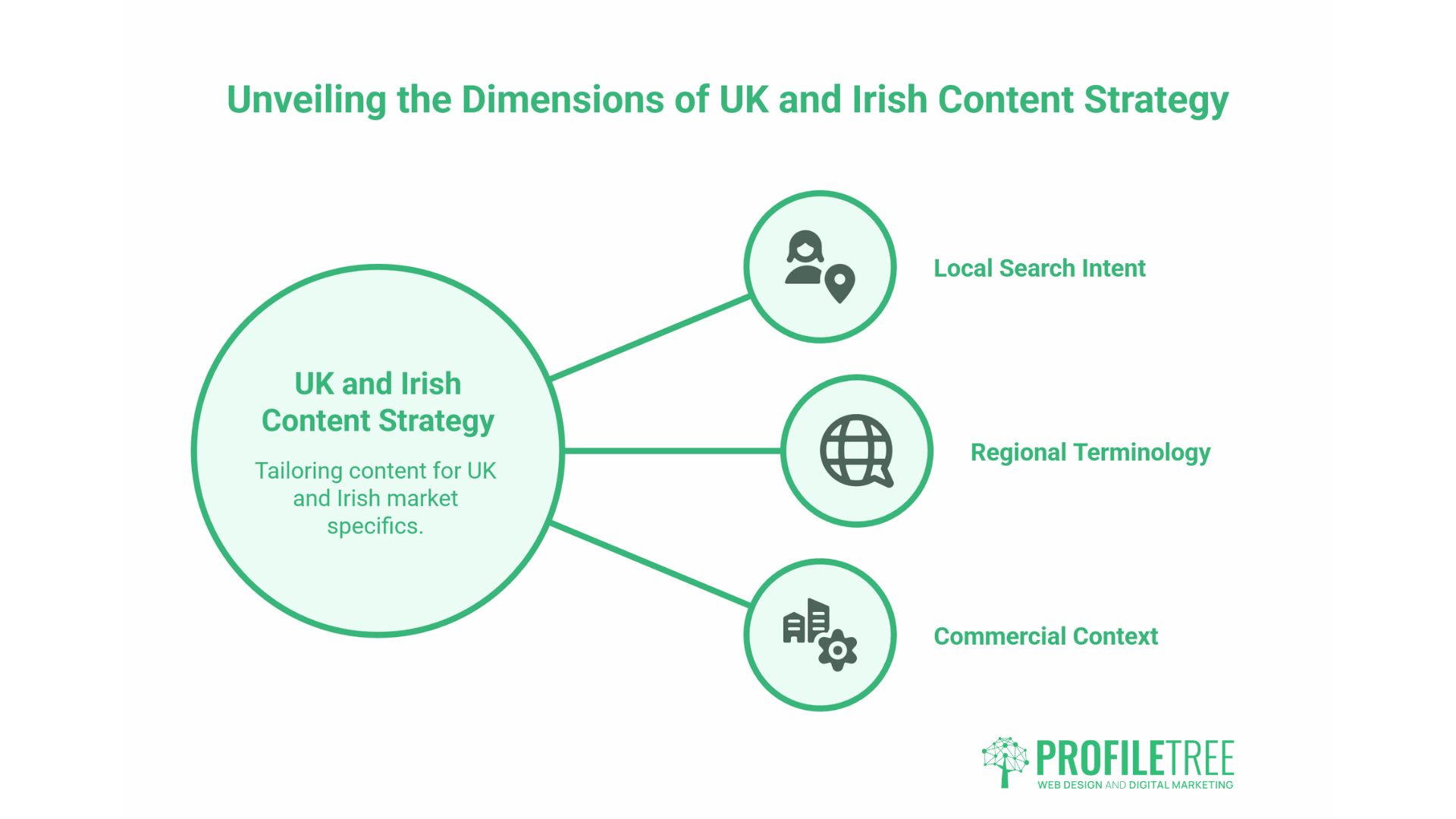
Generic content strategies written for global audiences miss the specific signals that matter in UK and Irish markets. Local search intent, regional terminology, and the commercial context for businesses operating in Northern Ireland, Ireland, and the wider UK require deliberate choices, not an afterthought.
Regional Search Intent and Language Differences
Search terminology differs more than people expect. A business in Belfast searching for legal advice looks for a “solicitor.” A US-focused search tool will optimise content around “attorney” or “lawyer.” These are not interchangeable for ranking purposes, and content that uses the wrong terminology will not appear in front of the right audience.
The same applies across services: “web development agency Belfast,” “digital marketing Northern Ireland,” “SEO services Ireland” these are the phrases local businesses actually type. Generic alternatives like “digital agency UK” may have higher search volume but rarely convert at the same rate as regionally specific terms.
For businesses targeting customers across the island of Ireland or the wider UK market, this also means thinking about which location signals to use and being consistent about them throughout title tags, H1 headings, body copy, and internal link anchor text.
GDPR and UK-Specific Compliance Content
Content that touches on data collection, email marketing, or user tracking needs to reflect UK GDPR requirements rather than the US-centric compliance framing that dominates most marketing content. This is both a credibility issue and a practical one: a business in Belfast advising its audience based on CCPA requirements is giving its readers incorrect information.
This is one area where regional specificity creates a genuine information advantage over generic competitor content. UK and Irish businesses are consistently underserved by content that treats compliance as a universal, US-led topic.
Aligning Content with the Marketing Funnel
Different content serves different stages of the buyer journey. A business that only publishes top-of-funnel awareness content will attract readers who are not close to a decision. A business that only publishes bottom-of-funnel sales content will miss the people who need to be educated before they will consider buying.
Top-of-Funnel Content
Awareness content answers broad questions from people who have just realised they have a problem. “What is a content strategy?” and “Why does my website not rank in Google?” are typical top-of-funnel queries. This content should be genuinely educational, not promotional. Its job is to build trust, not to pitch a service.
Blog articles, explainer videos, and statistics roundups tend to perform well at this stage. They attract significant search traffic and, if structured well, give search engines and AI systems strong signals about your topical authority.
Mid-Funnel Content
Consideration content serves people who understand their problem and are evaluating how to solve it. “How to choose a web design agency in Northern Ireland” or “content strategy vs content marketing: which do I need first?” are mid-funnel queries. These readers are closer to making a decision and respond to content that gives them clear criteria rather than generic advice.
Case studies, comparison frameworks, detailed how-to guides, and “how to choose” content with transparent evaluation criteria all work well here. For more on building mid-funnel content that converts, ProfileTree’s digital marketing strategy resources cover the decision-stage content types in detail.
Bottom-of-Funnel Content
Conversion content is for people who are ready to act. Service pages, pricing pages, testimonial pages, and contact pages sit here. These pages need to be clear, credible, and fast not cluttered with lengthy explanations of concepts the reader already understands.
Measuring Performance and Iterating
A content strategy that is never measured is a guess sustained indefinitely. The measurement stage is where you find out what is actually working, fix what is not, and make better decisions next time.
The Metrics That Matter by Content Type
For SEO-focused content, track impressions, clicks, average position, and CTR in Google Search Console. A page with strong impressions but weak CTR has a visibility problem in the SERP the title and description are not compelling enough. A page with good CTR but no conversions has a landing page problem the content does not deliver on what the search result promised.
For content supporting the full funnel, track user journeys: which articles lead to visits to service pages? Which content pieces generate email sign-ups or enquiry form submissions? These paths show you which content is actually contributing to commercial outcomes and which is generating traffic that never converts.
The Content Marketing Institute’s annual B2B research consistently shows that documented content strategies outperform undocumented ones on every metric including revenue attribution, content quality, and team confidence in their direction. Building measurement into your strategy from the start is what turns a documented plan into a living one.
Review performance quarterly at minimum. Content that ranked well 18 months ago may have slipped as competitors published better versions. Content that barely moved in its first six months may have aged into relevance as a topic grew. Regular review catches both.
Building Brand Consistency Across Content
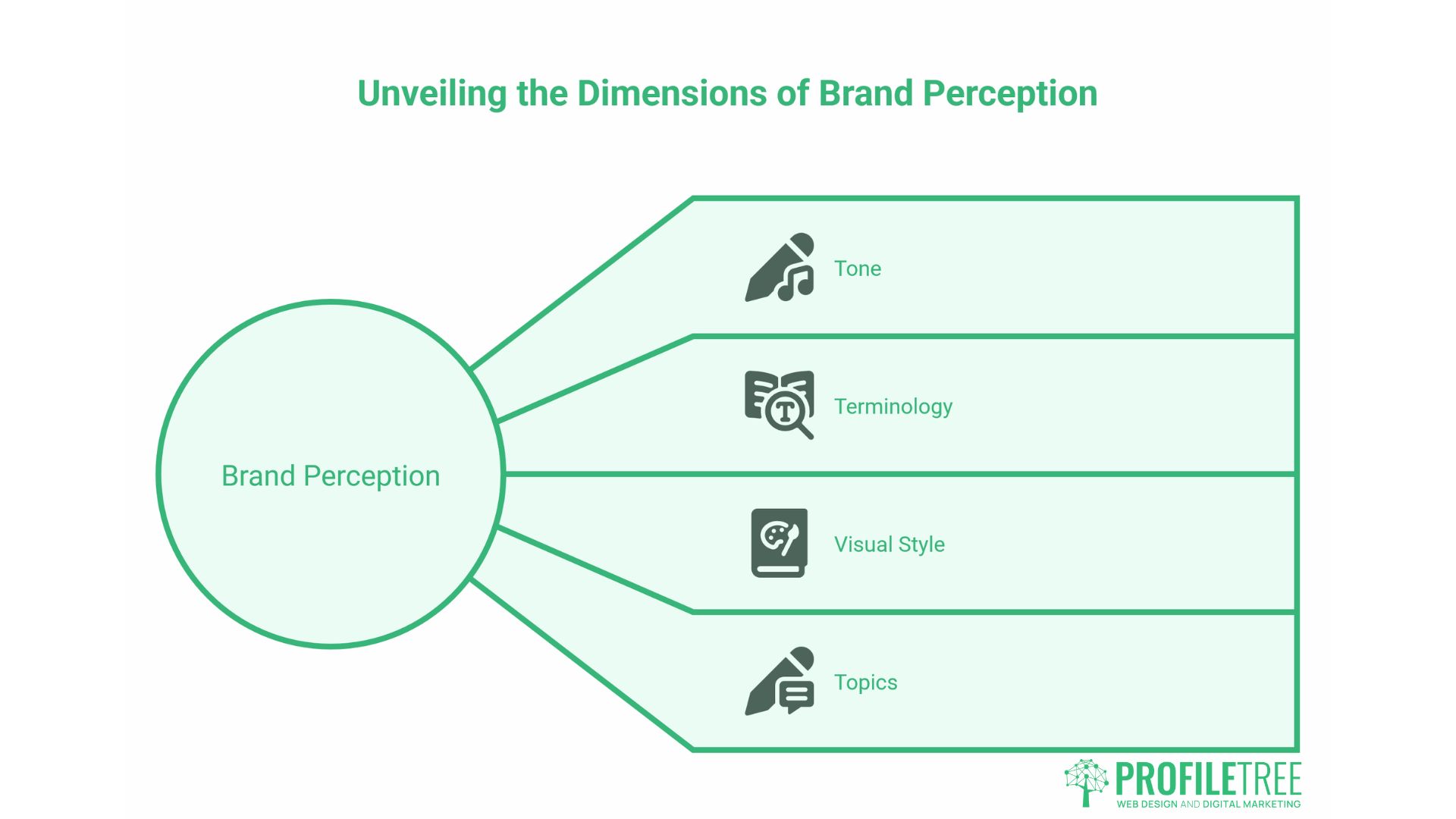
Every piece of content your business publishes shapes how your brand is perceived. Tone, terminology, visual style, and the topics you choose to cover all communicate something about who you are and who you serve.
Defining a Consistent Brand Voice
A brand voice is not a style guide full of adjectives. It is a set of decisions about how you communicate: how formal or conversational, how opinionated or neutral, how much jargon you use and for whom, and how you handle topics where your view might differ from conventional wisdom.
For most SMEs, the content that performs best is expert but approachable: confident enough to give clear recommendations rather than hedging everything, but accessible enough that a business owner without a marketing background can act on the advice.
Document these decisions so that anyone producing content for the business, whether in-house or through an agency, is working from the same starting point. Consistency across dozens of articles over several years is what builds recognisable topical authority not any single piece of brilliant content.
Conclusion
The businesses that get the most from content are not the ones publishing the most. They are the ones publishing with a clear sense of who they are writing for and how each piece connects to a commercial outcome.
Start with your audience, audit what you have, build from a topic cluster foundation, and measure what actually matters. ProfileTree works with SMEs across Northern Ireland, Ireland, and the UK on this entire process from initial audits through to ongoing production. If your current content is not generating enquiries, the content creation services and digital marketing support available through ProfileTree can help identify why.
FAQs
What is the difference between a content strategy and a content plan?
A content strategy defines the why and the what: the audience, the goals, the topic architecture, and the editorial standards. A content plan is the operational layer which articles get written, by whom, and when. The strategy stays stable; the plan is updated as priorities shift.
How long does it take to see results from a website content strategy?
Expect three to six months before new content generates meaningful organic traffic. Pages targeting competitive terms can take longer. The timeline depends on your domain authority, keyword competitiveness, and publishing consistency. Businesses that treat content as a one-month experiment consistently underestimate it.
What are the key components of a strong content strategy?
A well-built strategy includes a defined audience, keyword research mapped to intent, a topic cluster structure, clear editorial standards, a realistic publishing schedule, and measurement tied to business outcomes rather than vanity metrics.
How do you measure the success of a content strategy?
Match your metrics to your goals. Track impressions, clicks, and position in Search Console for SEO performance. Track form submissions and enquiries for commercial attribution. No single metric tells the full story combine them.