
Backlink Monitoring: Protect Your UK Search Rankings
Table of Contents
Backlinks remain one of the most significant signals Google uses to evaluate a website’s authority, yet most businesses spend far more energy acquiring them than protecting the ones they already have. For UK brands competing in a search landscape shaped by Digital PR, regional media cycles, and shifting editorial standards, monitoring what you have earned is as important as earning more.
This guide covers the full monitoring process: understanding what your link profile is telling you, setting up a reliable workflow, diagnosing why links disappear, and recovering them through direct outreach. It also addresses how agencies managing multiple clients can scale these processes without losing visibility.
Whether you are a business owner checking in monthly or an SEO manager tracking dozens of client profiles, the principles here apply. The aim is to move from reactive panic when rankings drop to a structured system that catches problems early.
What Monitoring Backlinks Actually Means for SEO
Backlink monitoring is the ongoing process of tracking which external websites link to your pages, identifying changes in that link profile, and taking action when links are gained, lost, or devalued. It is not a one-time audit; it is a continuous discipline that feeds directly into search ranking stability. Understanding why this matters requires a clear view of how search engines weigh inbound links as part of their overall ranking signals, something covered in depth in ProfileTree’s SEO guide to Google’s quality updates.
The Difference Between Dofollow and Nofollow Links
Dofollow links pass authority from the linking domain to your page, acting as a direct vote of confidence in the eyes of search engines. Nofollow links carry a tag instructing crawlers not to transfer that authority, which means they do not directly influence rankings.
That does not make nofollow links worthless. Links from high-traffic publications, even tagged nofollow, still send referral visitors to your site and increase brand visibility. A natural link profile contains both types, and monitoring should account for the distribution rather than fixating solely on dofollow counts.
Domain Authority, Trust Flow, and What the Metrics Mean
Third-party metrics like Domain Authority (Moz) and Trust Flow (Majestic) are proxies for link quality, not official Google scores. They estimate how well a site is likely to rank based on the quality of its own inbound links.
When evaluating a link you have earned, these scores give a rough indication of its value. A backlink from a government department or a national newspaper carries far more weight than one from a recently registered blog with no inbound links of its own. The metric is a starting point for prioritisation, not a definitive verdict on value.
Why Link Profiles Decay Without Active Management
Links disappear for many reasons: sites are redesigned and URLs change, journalists update articles and remove old references, domains expire, and CMS migrations cause widespread 404 errors. Research from SEO tools providers consistently shows that active link profiles lose a measurable percentage of links every quarter without any action from the site owner.
Without monitoring, these losses remain invisible until they appear as a ranking drop. By that point, the cause is harder to isolate, and the damage is already done. Proactive monitoring means catching individual losses before they compound into a trend.
The Strategic Importance of Monitoring for UK Brands
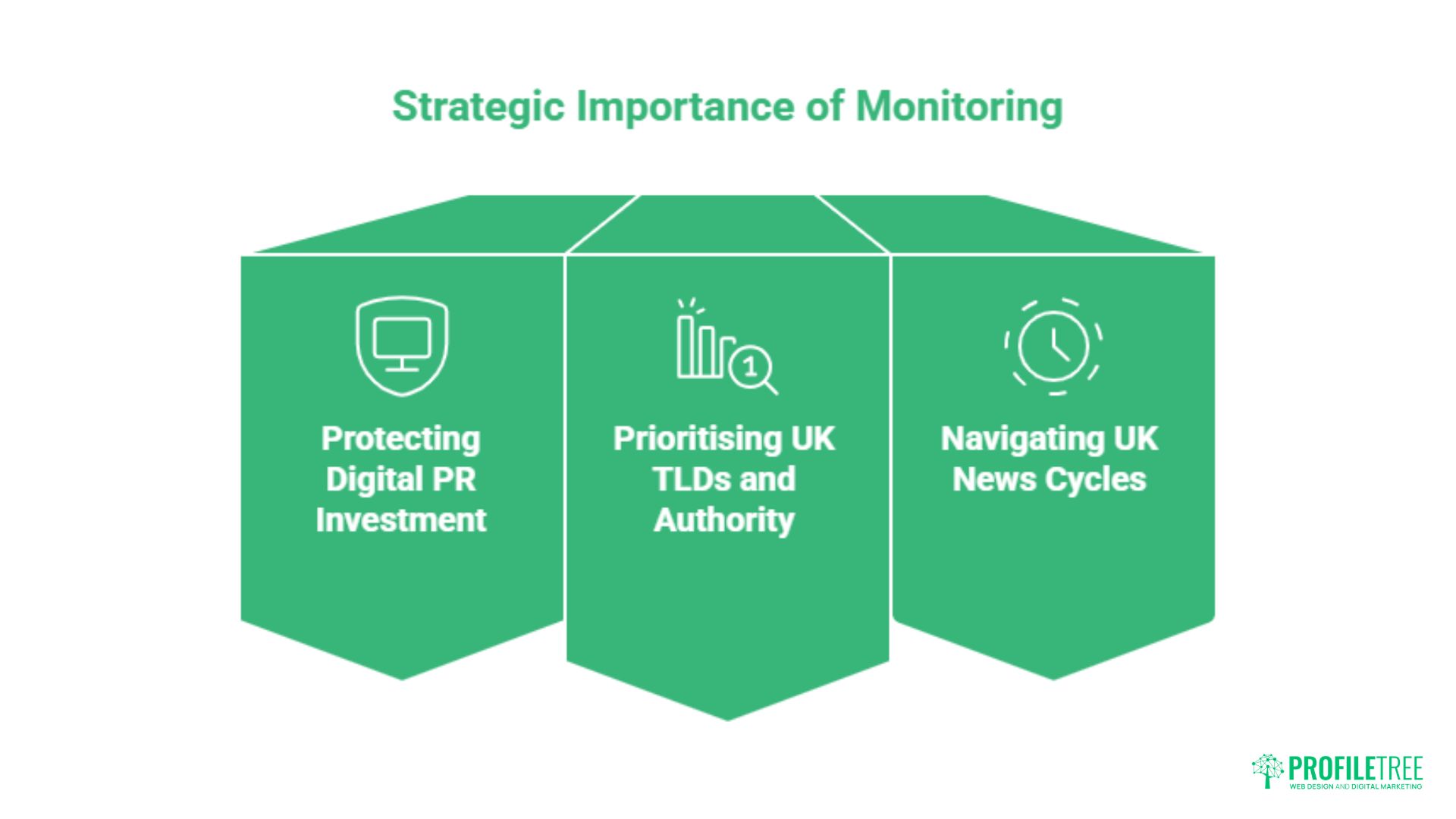
The UK search environment has characteristics that make backlink monitoring more demanding than generic global advice suggests. Understanding those specifics helps businesses allocate monitoring effort more effectively rather than treating every link as equally stable.
Protecting Your Digital PR Investment
Digital PR has become one of the primary link-building methods for UK businesses, involving proactive outreach to journalists, data-led stories, and expert commentary placed in national and regional publications. These placements are often costly in time and resources. A single piece of coverage in a major outlet can earn a link worth more than dozens of directory submissions.
The problem is that news sites republish, update, and prune content more aggressively than most other site types. An article from six months ago that originally included your link may have been updated to remove it, consolidated with another piece, or moved to a different URL without a redirect.
Monitoring allows you to catch these changes and act quickly, while the original journalist still has context for why the link was placed. If your SEO activity includes regular outreach, understanding how to sustain traffic from earned coverage is directly tied to how well you monitor and protect those links.
UK TLDs and Authority Signals Worth Prioritising
Links from .co.uk, .gov.uk, and .ac.uk domains carry specific authority signals that are particularly relevant for businesses targeting UK search results. A .gov.uk link is exceptionally difficult to earn and represents one of the highest-trust signals available in the UK search environment.
Monitoring these links separately from your general profile is worthwhile. If a .gov.uk or .ac.uk link disappears, the recovery effort is almost always justified given the disproportionate authority they carry. Standard commercial links, by contrast, require a more measured cost-benefit assessment before committing to outreach.
UK News Cycles and High-Churn Link Sources
UK tabloids and regional news outlets operate on extremely high editorial velocity. Content is added, updated, and archived rapidly, and links within those articles often disappear not because of editorial decisions about your brand but because the surrounding article has been restructured. The Manchester Evening News, for example, regularly consolidates its local business coverage, which can remove links from articles that are months old.
Setting monitoring alerts specifically for links from news domains helps you identify this pattern early. It also informs your Digital PR strategy: if certain outlet types have high link churn rates, you may choose to focus outreach on publications with more stable editorial archives. Northern Ireland businesses will find additional context on the UK media landscape relevant to their region via Connolly Cove’s guide to Northern Ireland, which illustrates how regional coverage differs from national UK media.
How to Set Up a Professional Monitoring Workflow
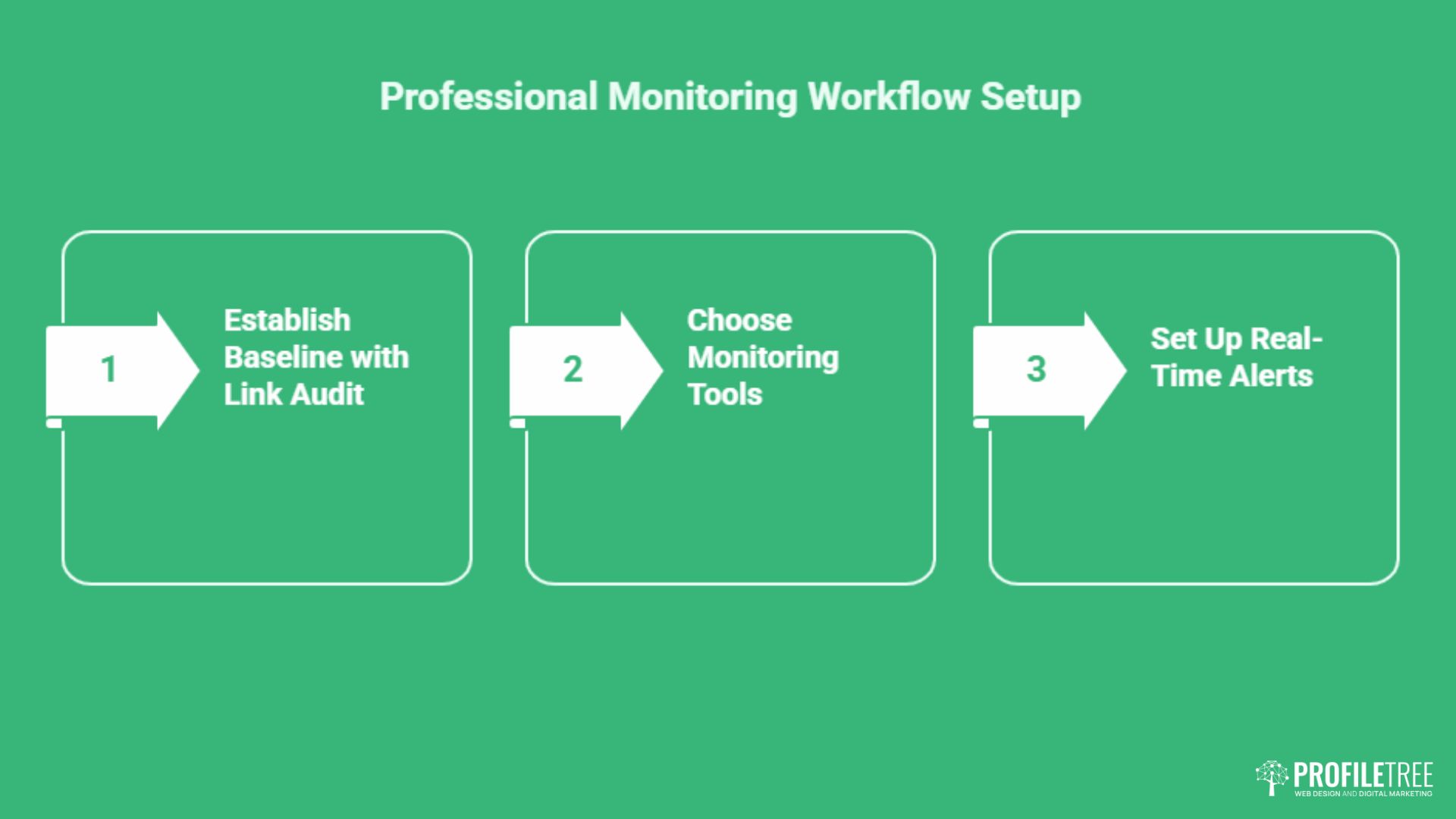
Effective backlink monitoring requires a structured workflow, not ad hoc checks. The difference between a business that catches link losses in days and one that notices them after rankings have already shifted is almost always the process. A solid content audit approach, as outlined in ProfileTree’s content audit framework, applies the same systematic thinking to backlinks that you would bring to your on-page content.
Step 1: Establish Your Baseline with a Link Audit
Before you can monitor changes, you need an accurate picture of your current link profile. Run an initial audit using at least two tools, since no single crawler indexes every link on the web. Export the full list of referring domains, the specific pages they link to, the anchor text used, and the approximate authority of each linking domain.
Segment this baseline into three categories: high-priority links from authoritative domains that would meaningfully affect rankings if lost; mid-tier links from relevant but lower-authority sites; and low-priority links that contribute minimal SEO value. This segmentation determines how much time you spend investigating each category when alerts fire.
Step 2: Choose Your Monitoring Tools
The tool landscape divides broadly into three tiers. Google Search Console is free and provides the most accurate data for your own site since it comes directly from Google’s index. The limitation is that it shows a sample of links and does not alert you to losses in real time.
Mid-tier paid tools such as SE Ranking and Mangools offer backlink monitoring with alert functionality at more accessible price points than the enterprise platforms. Ahrefs and Semrush sit at the top of the market with the largest link databases and the most granular reporting.
All prices and figures in this guide are indicative UK examples and correct at the time of writing; use them as a benchmark rather than fixed quotations. For agencies managing multiple client profiles, the enterprise tiers of these platforms typically offer the most efficient workflow, with consolidated dashboards and white-label reporting options.
The comparison below covers the main tools most UK agencies rely on:
| Tool | Best For | Alert Feature | UK Pricing (approx.) |
|---|---|---|---|
| Google Search Console | Free baseline monitoring | No real-time alerts | Free |
| Ahrefs | Largest link database, agencies | Yes, email alerts | From ~£99/mo |
| Semrush | Competitor monitoring, reporting | Yes, email alerts | From ~£100/mo |
| SE Ranking | SMEs, cost-efficient monitoring | Yes | From ~£35/mo |
Step 3: Set Up Real-Time Alerts
Every major paid tool offers email alerts for new and lost links. Configure these at the project level for each domain you manage, and set the sensitivity based on the link profile’s activity. A site that earns dozens of links weekly needs different alert thresholds than one with a slow-growing profile of fifty referring domains.
For high-priority domains identified in your baseline audit, consider daily alerts. For the mid-tier, weekly digests are usually sufficient. The goal is not to respond to every notification immediately but to catch every significant loss for more than a week.
The Link Loss Diagnostic: Why Backlinks Disappear
When a monitoring alert fires to tell you a backlink has been lost, the first task is diagnosis, not outreach. Acting without understanding the cause wastes effort and can occasionally make the situation worse. The following framework helps you identify the reason quickly, which then determines the correct response. This structured thinking mirrors the approach to diagnosing organic traffic drops, where root cause identification always precedes remediation.
Technical Causes: 404 Errors and Site Migrations
Check whether the linking page still exists. If it returns a 404, the link loss is almost certainly technical rather than editorial. The most common cause is a site migration or CMS update on the linking site that did not correctly redirect old URLs.
In this case, contact the site’s technical team or webmaster with the specific broken URL and your original link. Frame it as helping them fix a broken page rather than asking for a favour. Webmasters routinely appreciate this because a missing redirect affects their own SEO, not just yours. Recovery rates for technically caused link losses through this type of outreach are considerably higher than for editorial removals.
Editorial Changes: When Publishers Update or Prune Content
If the linking page still exists and loads correctly, but your link is gone, the cause is editorial. This happens when publishers update articles to reflect current information, consolidate multiple pieces into a single resource, or simply tighten content during a refresh cycle.
The appropriate response depends on how recently the link appeared and the relationship you have with the publication. If your brand or content was cited as a source and you can demonstrate continued relevance, a polite outreach message to the journalist or content manager can result in reinstatement. The key phrase here is “demonstrate continued relevance.” A generic request to restore a link is unlikely to succeed; a message that references the original context and offers updated information or a fresher resource has a reasonable chance.
Link Decay in UK News Cycles
“Link decay” describes the natural reduction in live links from time-sensitive content. A news article covering a survey your business published in January may link to your site prominently. By June, that article may have been archived, condensed, or replaced by a follow-up piece that no longer references the original data.
This is not always recoverable, and that is a legitimate outcome to accept. The monitoring value here is analytical rather than operational: tracking which content types suffer the highest decay rates helps you refine your Digital PR strategy. If your thought leadership pieces consistently earn links that survive twelve months while survey-based stories lose them within three, that data should shape your content investment decisions.
Toxic Links and When Disavowal Is Appropriate
The SEO industry went through a period of obsessive disavowal following Google’s Penguin algorithm updates, and many businesses still carry that anxiety about low-quality links. The modern position, reflected in Google’s own guidance, is that disavowal should be reserved for situations where you have received a manual action for unnatural links or where your profile contains a concentrated cluster of clearly manipulative links.
Automatically disavowing every link from a low-authority site is unnecessary and occasionally counterproductive. Focus monitoring effort on gaining and protecting quality links rather than managing every low-authority signal in your profile. If you are concerned about your site’s overall link health, a structured marketing audit provides the broader strategic context that a link-only review cannot.
The Link Recovery Protocol: Outreach That Actually Works
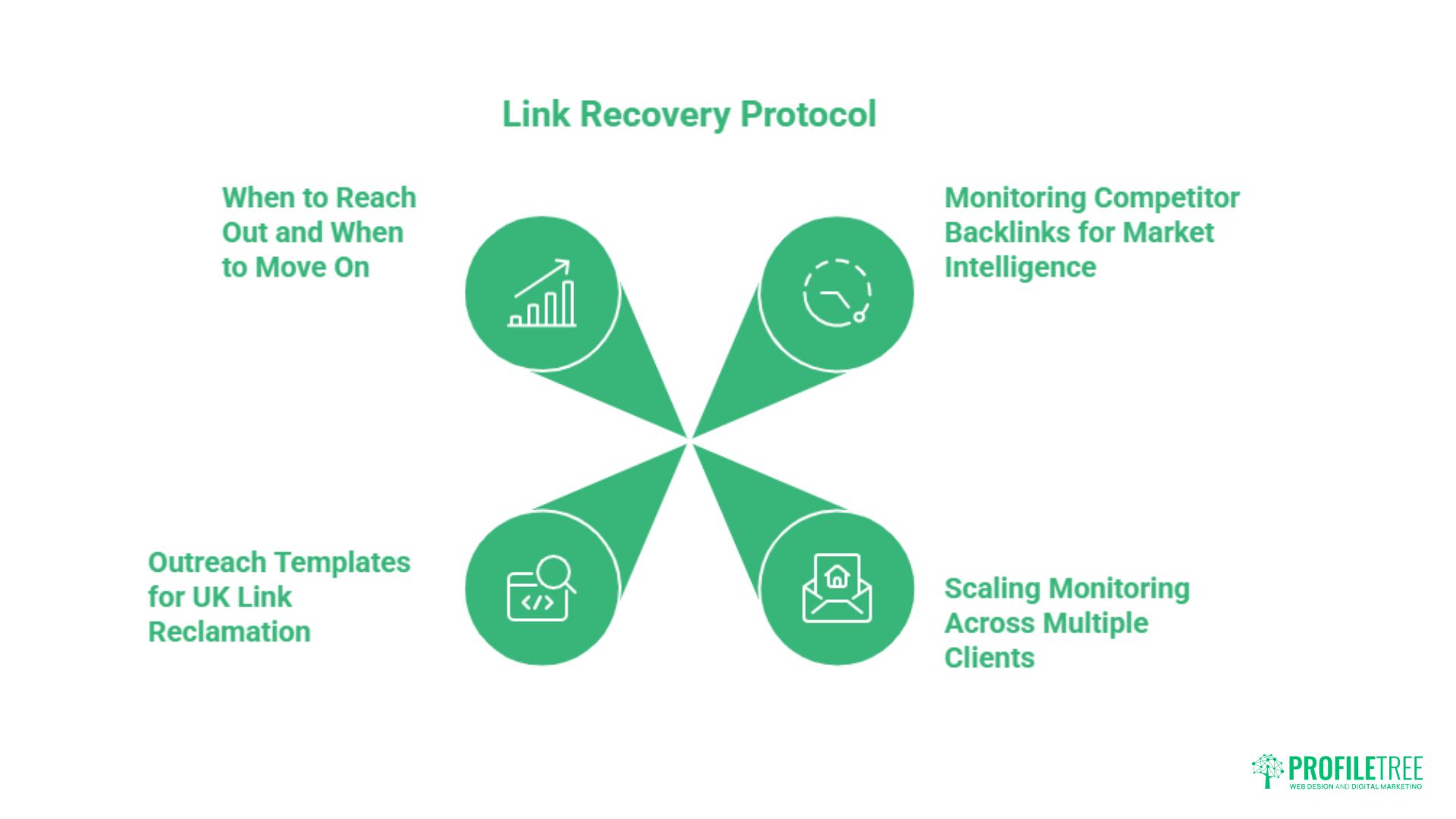
Automated monitoring tools tell you when a link is lost. They do not tell you how to get it back. The recovery process is human, relationship-driven, and more effective than most SEO practitioners expect when approached correctly.
As Ciaran Connolly, founder of ProfileTree, notes: “The businesses we see retain the most link authority over time are the ones treating their link profile as a set of relationships, not just a set of metrics.
When to Reach Out and When to Move On
Not every lost link justifies outreach. Use the tiering you established during your baseline audit to prioritise. High-priority links from authoritative domains almost always justify at least one outreach attempt. Mid-tier links warrant outreach if they are topically relevant and the linking site is actively maintained. Low-priority links are generally not worth the time investment.
Timing matters considerably. Reaching out within two to four weeks of a link loss is far more effective than contacting a journalist about a piece they wrote eight months ago. Fresh losses are recoverable; old ones rarely are.
Outreach Templates for UK Link Reclamation
Outreach to UK journalists differs from outreach to B2B bloggers. Journalists work to deadlines and receive large volumes of email; brevity and clear relevance to their coverage are the priorities. B2B publishers and industry blogs are often more open to a longer explanation, particularly if you can offer updated information that improves their article for their readers.
For a journalist-focused recovery email, the structure should be: one sentence identifying the specific article and your original link, one sentence explaining why the link remains relevant or offering an updated resource, and a clear single request. Do not mention SEO value to you. Frame everything around value to their readers.
For a B2B or trade publication, you can be slightly more direct about the mutual benefit of maintaining accurate citations, particularly if your original placement came from data or research your business provided. A useful way to manage outreach at scale is to maintain a Google Sheet with each lost link, the contact details of the relevant editor or journalist, the date of outreach, and the outcome. This turns a reactive scramble into a managed process.
Monitoring Competitor Backlinks for Market Intelligence
Backlink monitoring need not be limited to your own domain. Tracking the link profiles of your primary competitors reveals the sources that are actively linking within your sector, the content formats that earn links in your niche, and the publications you should be targeting with your own Digital PR activity.
Most major monitoring tools allow you to run competitor profiles alongside your own. When a competitor earns a link from a high-authority domain, that is a signal worth investigating. The same publication that linked to them may well be interested in your angle on the same topic, provided you can offer genuine editorial value rather than a direct imitation of what they have already published.
For businesses looking to build broader visibility beyond backlinks alone, understanding how links affect SEO across different platforms provides useful additional context.
Scaling Monitoring Across Multiple Clients
Agencies managing SEO for multiple clients face a different challenge to in-house teams. The volume of monitoring data across even ten client accounts can quickly become unmanageable without a clear system.
The practical approach is to centralise alerts into a single channel, whether that is a shared Slack channel, a weekly digest email, or a project management tool where each alert creates a task. Assign triage responsibility to one person per account rather than allowing alerts to land in a shared inbox where accountability is unclear.
Weekly reporting to clients should include a brief summary of link gains, losses, and any recovery outreach undertaken, which reinforces the value of the service and keeps the client informed without requiring them to interpret raw data. ProfileTree’s approach to managing content audits for clients applies the same structured accountability model that works equally well for backlink management.
Conclusion
Backlink monitoring is not a passive task you check occasionally; it is an active discipline that protects the SEO authority your business has earned. A clear baseline, reliable alerts, and a structured recovery process keep you ahead of the losses that silently erode rankings. If you want support building a monitoring workflow or a broader SEO strategy for your business, get in touch with ProfileTree to discuss what an ongoing approach could look like for your site.
FAQs
How do I monitor my backlinks for free?
Google Search Console provides the most accurate free backlink data since it comes directly from Google’s own index. Go to the Links report to see your top linked pages, top linking sites, and the anchor text used. Ahrefs also offers a limited free tier that shows a sample of your backlink profile without requiring a paid subscription.
Why do I keep losing backlinks from news sites?
UK news sites operate on high editorial velocity, regularly updating, consolidating, and archiving content. Links placed in articles several months ago are frequently removed during these editorial updates, often for reasons unrelated to your brand. Setting up alerts specifically for links from news domains lets you identify losses quickly and reach out to the relevant journalist while the context is still fresh.
How often should I check my backlink profile?
For large sites earning links regularly, weekly monitoring is appropriate. Small business sites with slower-growing profiles can manage with a thorough monthly review. The most important principle is consistency: a review done on a set schedule is far more effective than irregular checks triggered by ranking anxiety.
Is a nofollow link loss worth recovering?
It depends on the traffic value and brand authority associated with the linking publication rather than the link’s direct SEO impact. A nofollow link from a major UK trade publication still sends referral visitors and builds brand recognition in your sector. If the link came from a source your target audience reads, recovery is worth attempting regardless of the follow attribute.
Can I automate backlink monitoring entirely?
Tools can automate the detection and alerting process, but the analysis and recovery require human judgment. Automated alerts tell you a link has been lost; they cannot assess whether recovery is strategically worthwhile, identify the correct contact for outreach, or write a contextually appropriate email to a journalist. Automation handles the data; people handle the decisions.