
Content Marketing Training For Your Business: Getting Started
Table of Contents
Most SMEs understand they need to produce content. Fewer understand why their content produces nothing. Blog posts sit unread, social feeds go silent, and video ideas stay on whiteboards. The gap is almost never an effort. It’s the absence of a coherent content marketing training framework that connects strategy, production, and measurement into a system that actually works.
This guide covers what effective content marketing training looks like for SMEs in the UK and Ireland, which skills matter most, how to decide between upskilling your team and working with a specialist agency, and how to tie all of it back to business results you can report on.
Why Generic Content Marketing Courses Often Fail SMEs
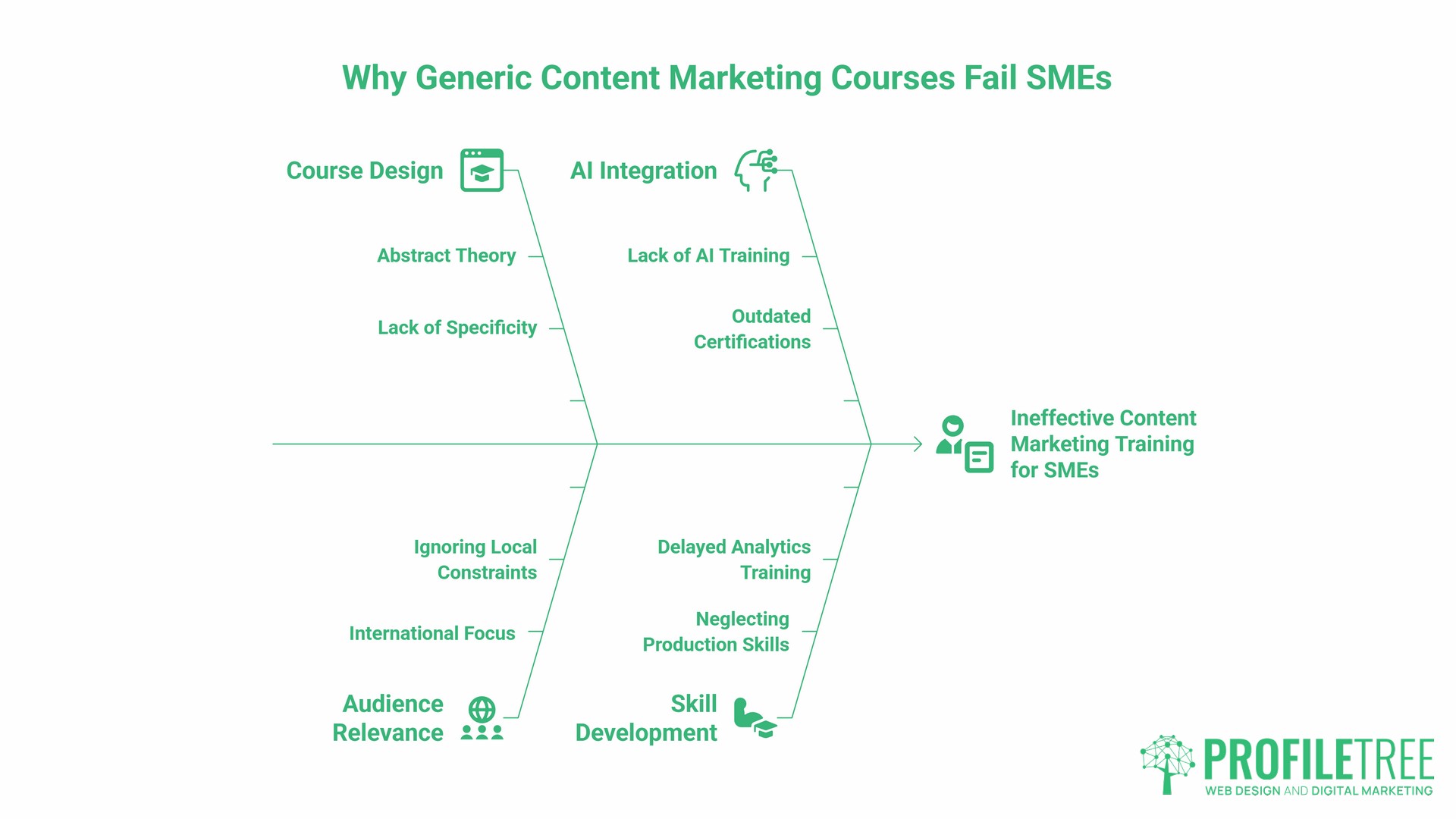
The market for content marketing training is dominated by US-based certification platforms built for large marketing teams, flexible budgets, and international audiences. A marketing manager at a manufacturing firm in Belfast, a professional services practice in Dublin, or a retail business in Glasgow faces different constraints and competitive pressures.
Generic courses teach the theory. They cover buyer personas, content calendars, and distribution frameworks in terms abstract enough to apply anywhere. That generality is also their limitation. SME business owners and their teams need training that connects directly to their specific audience, their existing website and SEO situation, and the content formats their customers actually consume.
The other gap is recency. Most widely cited certifications were last updated before generative AI became a practical content tool. Any content marketing training that does not address how to use AI responsibly within a business workflow is teaching a skill set that is already incomplete.
Effective training for a small business does three things that most courses skip: it starts with your existing situation, it teaches production skills alongside strategy, and it includes a measurement framework from day one rather than treating analytics as an advanced topic.
The Core Pillars of Content Marketing Training for SMEs
Strategy and Audience Definition
Content strategy is not a content calendar. A calendar tells you when to publish. Strategy tells you what to say, to whom, and why it will matter to them enough to take an action. Most businesses conflate the two and end up with a very organised schedule of content that no one reads.
Training in this area should cover how to map content to the customer journey, how to identify the questions your audience is asking at each stage, and how to structure a topic cluster that builds authority on the search terms that matter commercially.
For a firm offering professional services in Northern Ireland, this might mean building a cluster of articles around local business regulation, funding schemes, or sector-specific challenges that their clients search for. The content does not need to be about the service itself. It needs to be useful to the person most likely to need the service.
SEO and Keyword Intent
Content without SEO is writing in a room with the door closed. The piece might be excellent, but no one finds it.
Content marketing training should cover how Google evaluates content quality today, what keyword intent means in practice, how to structure a page so search engines can extract and surface it, and how local SEO works for businesses serving specific regions. UK GDPR considerations around data collection and email marketing also belong in this module, as many SMEs run campaigns that are technically non-compliant without realising it.
Understanding SEO as part of the content production process, rather than as something bolted on afterwards, changes the output significantly. ProfileTree’s SEO guide for Google’s YMYL update is a useful reference for teams getting to grips with how search intent affects content decisions.
Video Production for Business
Video is where many SMEs have the largest content gap relative to their competitors. It is also the area where training returns the most visible results quickly.
Business owners routinely assume that video requires expensive equipment, a production team, and significant post-production time. A modern smartphone, basic lighting, and a clear script structure is enough to produce content that performs well on LinkedIn, YouTube, and in email campaigns. Training on this does not need to be complicated: scripting, on-camera confidence, basic framing, and editing a short-form clip are skills a non-marketer can pick up in a day.
For businesses that want to produce higher-quality video or need professional production for key campaign assets, ProfileTree’s video marketing services support that escalation without requiring a permanent in-house production capability.
Content Writing and Editorial Standards
Writing for the web is a distinct skill from writing in general. Training should cover how to structure an article so key information appears early, how to write headings that match the questions people actually type into search, how to vary sentence length for readability, and how to maintain a consistent brand voice across multiple contributors.
For businesses where the writing is done by non-specialists, an editorial checklist and a simple style guide go a long way. These do not need to be sophisticated documents. They need to answer the questions a team member will have when they sit down to write: who is this for, what do they need to know, and what action should they take next.
Upskilling Your Team vs. Bringing in an Agency
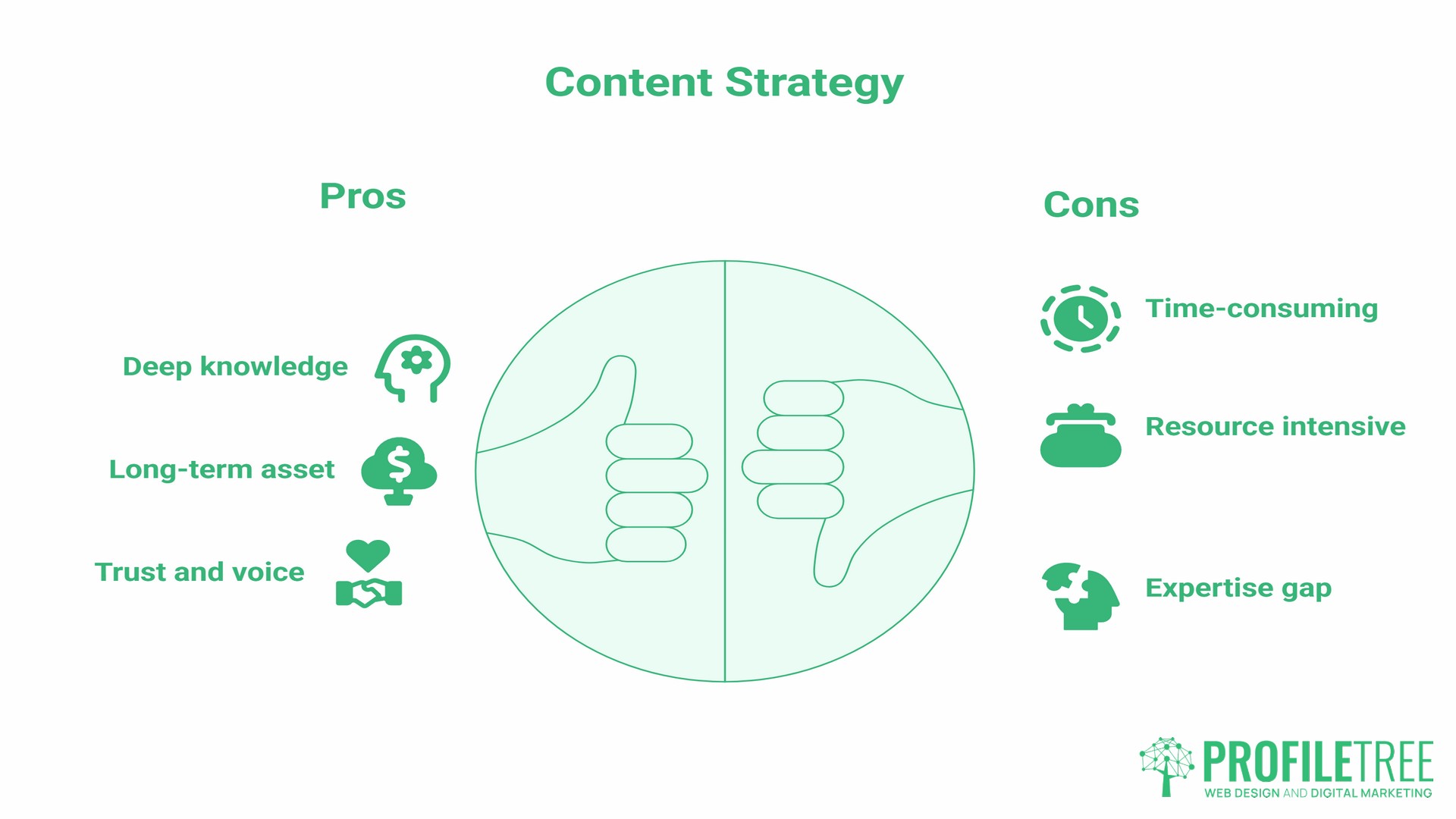
This is the question most SME owners arrive at after a few months of producing content that is not working. The honest answer is that it depends on what kind of business you are running and what you want content to do.
In-house upskilling makes sense when:
- You have at least one person with the capacity to own the content function
- Your content needs to reflect deep domain knowledge that an external team would need significant time to acquire
- You want to build a long-term owned media asset and have the patience for a 6 to 12 month ramp-up period
- You are in a sector where trust and personal voice matter more than production volume
Working with an agency makes sense when:
- You need consistent output, but do not have the internal bandwidth to sustain it
- You need video, SEO, and content working together and lack expertise in one or more of those areas
- You have a time-sensitive campaign or launch, and cannot wait for a team to develop skills
Many businesses settle on a hybrid. They use content marketing training to upskill their team on strategy, brand voice, and basic production, then bring in specialist support for SEO implementation, video production, or content types that require technical expertise.
ProfileTree’s digital training service is built around exactly this model: training business owners and their teams to run their own content operation while having access to specialist support when the work requires it. The Future Business Academy extends this further for SMEs working through structured digital skills development.
The AI-Enhanced Content Workflow
Generative AI has changed what is practical for a small content team. Tasks that previously took hours, such as researching a topic, generating a first draft, or repurposing a blog post into social content, can now be done in a fraction of the time.
The risk is quality erosion. AI-generated content published without editing, fact-checking, or adaptation to the business’s actual voice reads exactly like AI-generated content. Search engines are getting better at identifying it, and audiences notice.
Effective content marketing training now needs to include a module on AI tools: which tasks they handle well, where they consistently underperform, how to prompt effectively, and how to maintain brand voice and accuracy when working with AI-assisted drafts.
Practically, AI works well for topic research, outline generation, repurposing existing content across formats, and drafting FAQs or social captions. It does not replace the expertise, specific examples, and editorial judgement that make content authoritative.
For businesses looking to build a responsible AI workflow into their content operation, ProfileTree’s AI content detection guide covers the evaluation side of this in detail.
Building Your Content Marketing Training Plan
A content marketing training plan for an SME need not be a large document. It needs to answer four questions clearly.
- What should content do for the business? Lead generation, brand awareness, SEO authority, and customer retention are all legitimate goals, but they require different content types and different success metrics. Trying to achieve all four with the same content usually means achieving none well.
- Who is responsible for what? Content production distributed across a team without clear ownership produces inconsistent output and frequent delays. Assign a content lead, even if it is only a partial responsibility. That person owns the calendar, the quality check, and the monthly review.
- What does success look like at 90 days? Identify three to five metrics that are specific enough to act on. Organic traffic to specific articles, contact form submissions from content pages, and video view duration are more useful than vanity metrics like total page views.
- What skills does the team currently lack? Run a skills audit before allocating training time and budget. A team strong in writing but weak in SEO and video needs a different training investment than one that understands distribution but struggles to produce content consistently.
Measuring the Results of Your Content Marketing Training
Training without measurement is overhead. Every business investing in content marketing training should have a clear framework for tracking whether the skills are being applied and whether the content is performing.
“The most successful content marketing strategies are those that combine creativity with rigorous measurement,” says Ciaran Connolly, founder of ProfileTree. “Too many businesses create content without understanding what drives results, missing opportunities to improve their approach based on real performance data.”
The table below covers the core metrics to track, mapped to the business objective each one serves.
| Metric | What It Measures | Review Cadence |
|---|---|---|
| Organic sessions (content pages) | SEO performance of trained content | Monthly |
| Average time on page | Content quality and relevance | Monthly |
| Contact form submissions (source: organic) | Lead generation from content | Monthly |
| Video view duration | Video content engagement | Per video |
| Email list growth | Content promotion effectiveness | Monthly |
| Keyword position changes | SEO authority development | Monthly |
Review these metrics against the 90-day goals set during the planning stage. If organic sessions are growing but form submissions are not, the problem is usually in the calls to action or the match between the article topic and the buyer’s intent. If the video view duration is low, the opening ten seconds of the video need revisiting.
Measurement is not only about identifying what is not working. It is also the evidence base for making the case internally to continue investing in content marketing. A clear monthly report showing traffic and lead trends is the difference between content being seen as a cost and being understood as a growth channel.
Comparison: Generic Online Certification vs. Bespoke Business Training
| Factor | Generic Online Certification | Bespoke SME Training |
|---|---|---|
| Cost | Low to moderate | Moderate to higher |
| Customisation | None; standard curriculum | Built around your business, sector, and team |
| SEO relevance | General theory | Applied to your existing site and keywords |
| Video production | Usually excluded | Included as a practical skill |
| AI workflow | Rarely covered | Current and practical |
| Local market context | US or global focus | UK/Ireland specific |
| Support after training | None or community forum | Ongoing access to specialists |
| ROI timeline | 6 to 12 months minimum | Can produce results within 90 days with execution |
FAQs
How long does it take to see results from content marketing training?
The answer depends on which type of results you are measuring. Social media engagement can improve within weeks of applying better content practices. SEO results typically take three to six months to become visible in search rankings and organic traffic, according to consistent findings across multiple SEO studies and practitioner data published by Search Engine Land, Shopify, and WebFX. The reason is that search engines need time to crawl, index, and evaluate new or improved content against competing pages. Google itself confirms that new pages on established sites can take anywhere from a day to several weeks to be indexed, with ranking assessments continuing beyond that point. Businesses that start with a clear keyword strategy, structure their content correctly, and publish consistently see results at the shorter end of this range.
Does my business need a dedicated marketing manager to implement content marketing training?
No. Many SMEs that go through structured content marketing training have no dedicated marketing resource. The training is designed for business owners, operations managers, or administrative staff who take on content as part of a broader role. What matters more than a dedicated role is clear ownership, a realistic publishing schedule, and a simple review process to maintain quality.
What is the best content marketing certification for a UK business?
The Chartered Institute of Marketing (CIM) offers recognised UK qualifications for professionals looking for formal accreditation. For practical, business-focused training that applies immediately to your own content operation, structured programmes built around your sector and audience are usually more useful than platform-specific certifications. The question to ask is whether the training teaches you how to produce content that works for your specific business or whether it teaches you how to pass an exam.
Can content marketing training be delivered remotely?
Yes. Most content marketing training modules work well in a remote or hybrid format. Strategy sessions, SEO training, and writing workshops translate directly to video calls and shared documents. Video production training works best with some in-person time for camera confidence and practical filming exercises, though the theory and planning components can be covered remotely. Businesses across the UK and Ireland can access ProfileTree’s training without needing to attend in person in Belfast.
Is AI content marketing covered in training?
It should be, and any content marketing training programme that does not cover AI tools is not current. Effective AI training for content teams covers which tools are appropriate for research, drafting, and repurposing, how to maintain brand voice and factual accuracy when working with AI-assisted drafts, and how to audit AI-generated content before publication. The goal is not to automate content production but to make a small team significantly more productive without compromising quality.
What equipment does a small business need for video content training?
A current smartphone with a decent camera, a basic lapel microphone (widely available on Amazon UK for under £25), and a window or ring light for consistent lighting is sufficient for most business video content. Training should start from this baseline rather than assuming access to professional equipment. The skills that matter most at this stage are scripting, structuring a short video clearly, and maintaining consistent framing. Production quality can improve as confidence and output increase.