
How to Plan Promotional Videos That Win Business
Table of Contents
A promotional video is a short, conversion-focused asset built around one campaign, product or event. It sits at the sharp end of a wider video marketing strategy, and for businesses across Northern Ireland, Ireland and the UK, it remains one of the most direct ways to turn interest into enquiries.
- Promotional videos for business work best as a bottom-funnel tool: one clear action, one audience, one message.
- The fastest cost saving is in pre-production. A hybrid approach, where AI drafts and humans direct, cuts planning time without flattening your brand.
- UK and Irish rules apply. ASA and BCAP standards govern claims, and the Equality Act 2010 requires captions and transcripts.
What a Promotional Video Is, and How It Differs From Video Marketing
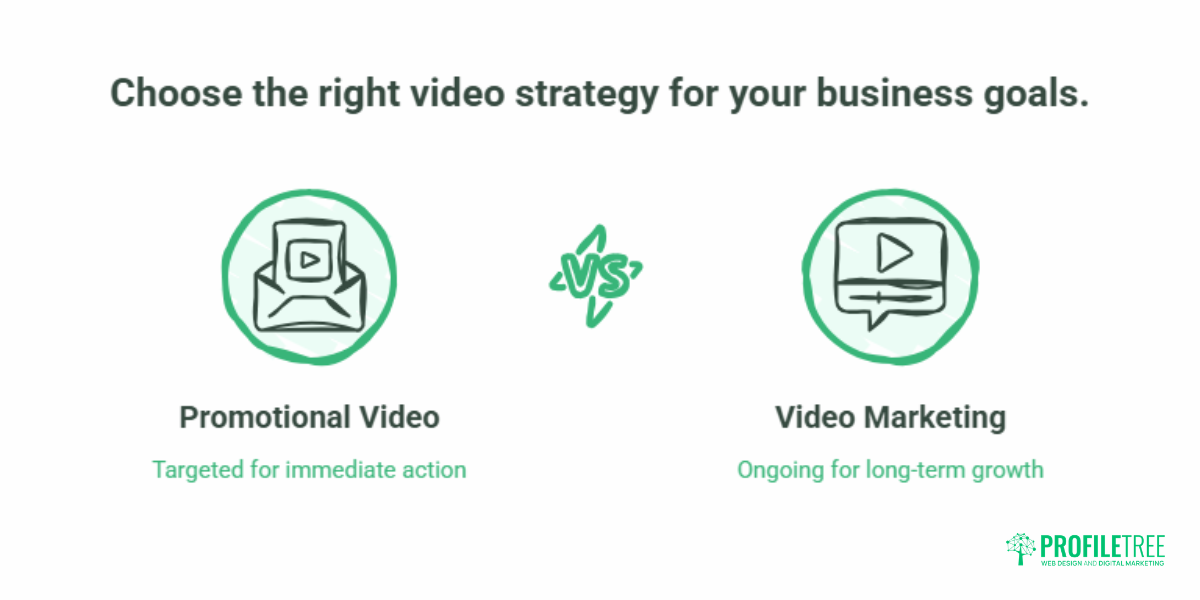
People use the two terms as if they mean the same thing. They don’t. Video marketing is the long game: an ongoing programme of content that educates, builds authority and keeps your brand in front of an audience over months and years. A promotional video is a single, targeted asset with a job to do now, usually tied to a launch, an offer or an event.
Think of it this way. Your top-of-funnel content, the how-to clips and social explainers, does the slow work of building trust. The promotional video is the piece you point at the moment of decision, when someone is close to buying and needs a final reason to act. Both matter. They just sit at different stages, and treating a promo video as if it were a brand documentary is one of the more common ways businesses waste a production budget.
Promotional video marketing pulls the two together. You plan the campaign asset alongside the evergreen content that feeds it, so a single shoot can produce a 30-second promo, a handful of social cut-downs and a longer piece for your website. That is the approach video marketing services are built around: getting more than one usable asset out of every day of filming. If you want to see how this looks in practice, the team has set it out in detail.
The Core Types of Promotional Videos
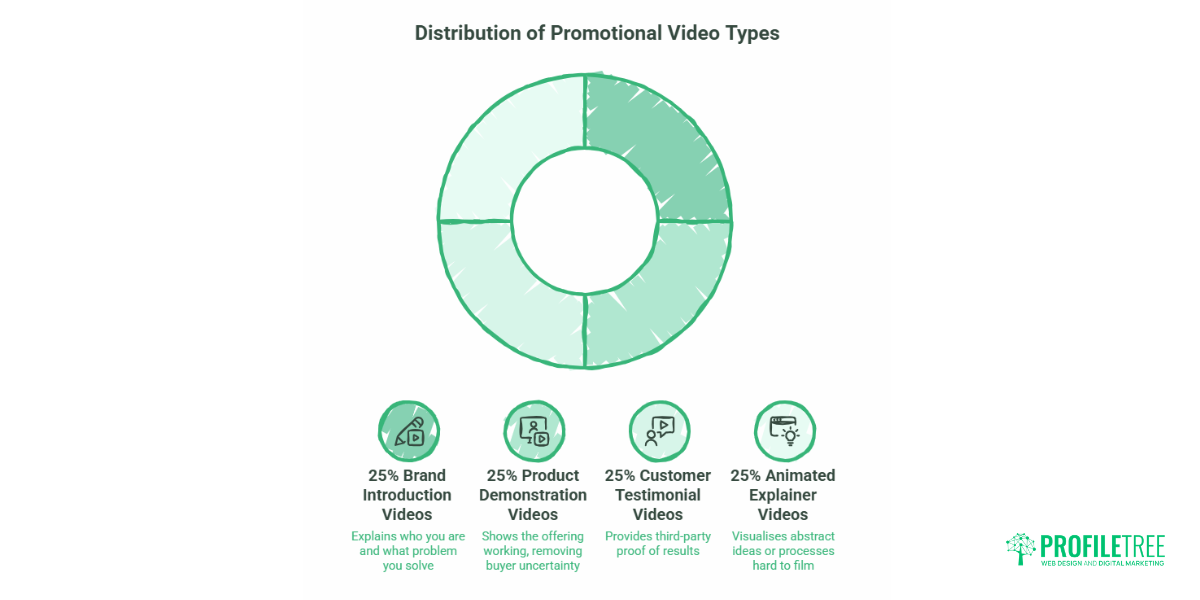
Different promotional video formats serve different objectives, and picking the wrong one is how good footage ends up doing nothing. Below are the four that earn their keep for most SMEs, with a note on when each one fits.
| Video type | What it does | Best for | Typical length |
|---|---|---|---|
| Brand introduction | Explains who you are and what problem you solve | B2B and professional services building first-contact trust | 60 to 90 seconds |
| Product demonstration | Shows the offering working, removing buyer uncertainty | Physical products, software, anything that needs showing, not telling | 30 to 90 seconds |
| Customer testimonial | Provides third-party proof of results | Higher-consideration purchases where trust is the barrier | 45 to 90 seconds |
| Animated explainer | Visualises abstract ideas or processes that are hard to film | Complex services, tech, anything intangible | 60 to 90 seconds |
Brand Introduction Videos
These introduce your company to a new audience and establish credibility fast. They work particularly well for B2B firms and professional services, where trust plays a large part in the buying decision. The strongest examples feature real team members rather than hired actors, and they answer three questions quickly: who you are, what you fix, and why someone should pick you.
Product Demonstration Videos
A product demonstration shows your offering in action, which eliminates the uncertainty that stops people from buying. For physical products, a demonstration video conveys scale, texture and performance in a way photographs cannot. For software or digital services, a screen recording with clear narration lets a viewer picture the experience before they commit.
Customer Testimonial Videos
Testimonial videos carry weight because they offer proof that comes from someone other than you. The effective ones focus on a specific outcome rather than general praise. “It saved us about three hours a week” lands harder than “great service.” That said, anything a customer states on camera as a result is a claim you may need to stand behind, which matters once you reach the compliance section below.
On the credibility point, Ciaran Connolly, founder of ProfileTree, puts it plainly:
“Customer testimonial videos tend to outperform other promotional content because they tackle the biggest barrier to a sale, which is trust. When a potential customer sees a real person describing a real result, the perceived risk drops, and that is usually what was holding the decision up.”Ciaran Connolly, founder, ProfileTree
Animated Explainer Videos
Animation earns its place when the thing you are selling is abstract or a process that would be awkward to film. It gives you full control over how an idea is shown, and it ages well because there is no dated footage to replace. For a software rollout or a service with several moving parts, an animated explainer often communicates in 80 seconds what a brochure struggles to do across two pages.
How to Plan and Create a Promo Video
The gap between a promotional video that brings in enquiries and one that gets skipped is mostly down to planning. Production quality matters, but a sharp 60-second piece shot on a decent phone with a clear goal will beat an expensive video that never decides what it wants the viewer to do.
Phase 1: Pre-Production and AI-Assisted Scriptwriting
Start by answering three questions before anyone touches a camera: what specific action do you want the viewer to take, who exactly is this for, and what message will move them. Audience research sits underneath all of it. Understanding what your customers actually worry about, as opposed to what you assume they worry about, is where most of the value in this phase comes from.
This is also where a hybrid AI workflow saves real time. You can use a large language model to draft a first script, rough out a shot list or sketch a storyboard, then bring human judgment in to shape tone, fix the brand voice and decide what stays. The draft is the machine’s job. The decisions are yours. ProfileTree’s digital training covers exactly this kind of practical AI use for marketing teams, and the firm’s AI in marketing work goes deeper for businesses ready to build it into their process.
A simple structure carries most short promos: hook in the first few seconds, name the problem, show the solution, then a single clear call to action. If the script wanders, the video wanders.
A practical 30-second blueprint: 0 to 5 seconds for the hook, 5 to 20 seconds to hold attention with the problem and solution, and the final 10 seconds for the action you want taken. Most weak promos spend too long on the setup and run out of room for the ask.
Phase 2: Production and Filming for Authenticity
Audio decides more than people expect. Viewers tolerate average visuals but abandon a video with poor sound within seconds, so a basic external microphone is a better first purchase than a better camera. Lighting comes next. Poor lighting makes good products look cheap, while decent lighting makes a modest setup look professional.
Where AI cannot help is here. The filming, the direction and the human presence on camera are what build genuine connection and keep your brand safe from the generic, slightly-off feel of fully automated video. The footage is the part worth getting right with real people.
Phase 3: Post-Production and Technical Localisation
Editing turns raw footage into something that holds attention: pacing that keeps people watching, natural transitions and colour correction that keeps your brand consistent. On-screen text reinforces key points and, importantly, makes the video usable for the large share of social viewers who watch with the sound off. That last point is not only good practice, but it also edges into legal territory, which the next section covers.
UK and Ireland Video Compliance and Cultural Nuance
Most promotional video advice is written for a US audience and quietly ignores the rules that apply on this side of the Atlantic. For a business marketing in Northern Ireland, Ireland or Great Britain, three things matter that the global guides skip.
ASA and BCAP Advertising Standards
Any video acting as a paid advert, or published on your own business channels, falls under the UK Committee of Advertising Practice code. In practice, that means claims have to be truthful, clear and capable of being substantiated. If your promo says you are the cheapest, or makes an environmental or performance claim, you need evidence to back it. This is one reason testimonial videos need care: a customer quoting a specific result is making a claim your business is responsible for.
Equality Act 2010 and Video Accessibility
Accessibility is a legal and ethical expectation, not an extra. Under the Equality Act 2010, spoken content should carry accurate, readable captions, and you should provide a transcript or audio-described alternative so the video works for viewers with hearing or sight impairments. For public sector and corporate work, this is closer to a requirement than a nice-to-have, and it also happens to help search engines read your content.
Cultural Nuance: Understatement Over Hype
The loud, high-energy US promo style often lands flat with UK and Irish audiences. Viewers here tend to respond better to a quieter, story-led approach, a bit of self-deprecation, something that feels authentic rather than shouted. A promo that would play well in California can read as overcooked in Belfast or Cork. Matching the tone to the audience is part of why local production knowledge is worth paying for.
Distribution and Platform Optimisation
Producing the video is half the work. Where it goes, and in what shape, decides whether it reaches anyone. Each platform wants something slightly different.
| Platform | Aspect ratio | Ideal runtime | Hook window |
|---|---|---|---|
| TikTok | 9:16 | 15 to 60 seconds | First 3 seconds, sound on |
| YouTube Shorts | 9:16 | Under 60 seconds | First 3 seconds |
| YouTube long-form | 16:9 | 2 minutes plus | First 10 seconds |
| Meta (Facebook/Instagram) | 1:1 or 9:16 | 15 to 30 seconds | First 3 seconds, captions on |
| 1:1 or 16:9 | 30 to 90 seconds | First 5 seconds, professional tone |
Video SEO helps your promotional content surface when people search for what you offer. Optimising titles, descriptions and tags improves discovery, and custom thumbnails with clear text tend to earn more clicks than the platform’s auto-generated frames. Owned channels matter too: a video embedded on a service page, with a transcript beneath it, gives you indexable text and keeps visitors on the page longer, both of which support your wider SEO work. Embedding promo content in email campaigns also tends to lift click-through, particularly when the preview image earns the open.
Measuring Whether It Worked
View count is the vanity number. What tells you the video is doing its job is how long people watch and what they do next. A retention curve that drops off a cliff in the first ten seconds usually means the hook missed or the audience was wrong. Engagement, the likes, comments and shares, signals emotional connection, which tends to track with conversion.
The metric that actually matters is conversion: leads, enquiries or sales you can trace back to the video. Set the tracking up before you publish, not after, so you can tell which videos earn their place and which were a one-off. A/B testing the opening few seconds or the call to action against a second version is the cleanest way to learn what your specific audience responds to.
Production Budgeting: DIY Versus Agency
Budget constraints do not rule out an effective promotional video, but it helps to be honest about what each route delivers. The table below sets out realistic expectations in pounds.
| Route | Typical cost (GBP) | Best for | Common pitfall |
|---|---|---|---|
| DIY (phone plus free editor) | Cost of your time | Quick social clips, testing ideas | Poor audio undoes everything |
| Freelancer | A few hundred pounds upward | One-off pieces with a clear brief | Variable reliability and strategy |
| Boutique or mid-tier agency | Roughly £1,500 to £5,000 | Brand and product promos with a plan behind them | Scope creep without a clear brief |
| High-end production | £15,000 plus | Custom animation, casting, and advanced post | Overspending for the actual goal |
The honest middle ground for most SMEs is a boutique or mid-tier agency that handles strategy as well as filming. A failed DIY attempt that has to be reshot often costs more than getting it right once. The value in working with a production team is usually the planning, the part that decides whether the video has a job to do at all. ProfileTree’s digital strategy work is where that planning sits, and the promotional video then slots into the broader plan rather than floating on its own.
Where Promotional Video Fits in the Bigger Picture
A promotional video rarely works as an isolated piece. It performs best when it is part of a connected programme: supported by content marketing that feeds it context, distributed through social media where your audience already is, and pointed at a well-built website that converts the traffic it generates. If the video sends people to a slow or confusing page, the production budget leaks out at the last step, which is why website design and the video strategy are worth planning together.
For businesses across Northern Ireland, Ireland and the UK, the practical version of this is straightforward. Decide the campaign goal, plan the promotional video as the conversion asset, produce a small set of supporting clips from the same shoot, and put the analytics in place to learn from it. Do that, and a single day of filming can carry a quarter’s worth of marketing.
Frequently Asked Questions
What is the difference between video marketing and a promotional video?
Video marketing is an ongoing, top-of-funnel strategy designed to educate an audience and build authority over time. A promotional video is a single, conversion-focused asset built for a specific campaign, product launch or event. The promotional video usually sits at the decision stage, while video marketing covers the whole journey that leads up to it. Most businesses need both, working together rather than in place of each other.
How long should a promotional marketing video be?
For social platforms, keep it between 15 and 60 seconds. For a landing page or website, 60 to 90 seconds gives you room to make the case without losing people before the call to action. Anything much longer risks the viewer leaving before the part that asks them to act.
Are UK promotional videos subject to ASA advertising regulations?
Yes. Any video acting as a paid advert, or published on your own business channels, must follow the Committee of Advertising Practice code. Any claim you make, on pricing, performance or environmental impact, has to be truthful, clear and capable of being substantiated. This applies to claims made by customers in testimonial videos, too, since you are responsible for what your marketing communicates.
How do I make my promotional videos compliant with the Equality Act 2010?
Add accurate, readable closed captions to all spoken content, and provide a written transcript or an audio-described alternative. These steps make your video accessible to viewers with hearing or sight impairments and are particularly important for corporate and public sector marketing.
What is the average cost of a promotional video in the UK?
It varies widely. A basic DIY effort costs little more than your time and editing software. A professional promotional video from a UK agency typically runs from around £1,500 for a straightforward single-day shoot up to £15,000 or more for high-end work involving custom animation, casting and advanced post-production. The right figure depends on the goal rather than a fixed rate.
Can I use copyrighted music in my business promo video?
No. Using commercial music without a sync licence is unlawful and can lead to platforms muting or removing your video. Use a reputable royalty-free music library, or pay for the appropriate commercial licence.