
Video Content Types Every UK Business Should Be Using in 2026
Table of Contents
Choosing the right video content types is no longer optional for businesses that want to be found, trusted, and chosen by their customers. With video now accounting for the majority of all internet traffic, the businesses winning attention are the ones matching specific video content types to specific stages of the buyer journey, rather than producing whatever looks impressive on a reel.
This guide breaks down the video content types that actually move business metrics: awareness, trust, and conversions. You’ll find practical guidance on production effort, expected impact, and which video content types suit a limited marketing budget versus a larger one. Whether you’re a Belfast retailer building a following on TikTok or a Northern Ireland B2B firm trying to shorten your sales cycle, there’s a video format here built for your goal.
“Most SMEs waste budget on video content that looks professional but fails to drive business results. The difference between vanity metrics and revenue comes down to strategic planning, knowing which video types support your specific goals and how to optimise each format for your target audience,” says Ciaran Connolly, founder of ProfileTree.
Why Video Content Types Matter for Business Growth
Not all video content types serve the same purpose, and treating them as interchangeable is one of the most common mistakes business owners make. A 90-second explainer video and a 10-minute customer testimonial solve entirely different marketing problems, and using the wrong one at the wrong stage wastes both budget and audience attention.
Understanding video content types by function rather than format helps you plan a content calendar with intent. Instead of asking “should we make a video this month,” you start asking “what is stopping prospects from buying, and which video content type addresses that specific blocker.” That shift in thinking is what separates businesses that see measurable returns from video from those treating it as a box-ticking exercise.
Video also carries weight beyond direct sales. Search engines index video transcripts and captions, meaning the right video content types can support your search engine optimisation alongside your wider marketing plan. Video shared on social platforms extends reach further than static posts, feeding naturally into social media marketing expertise already built into your strategy.
The Video Content Types Selection Framework: Effort Versus Impact
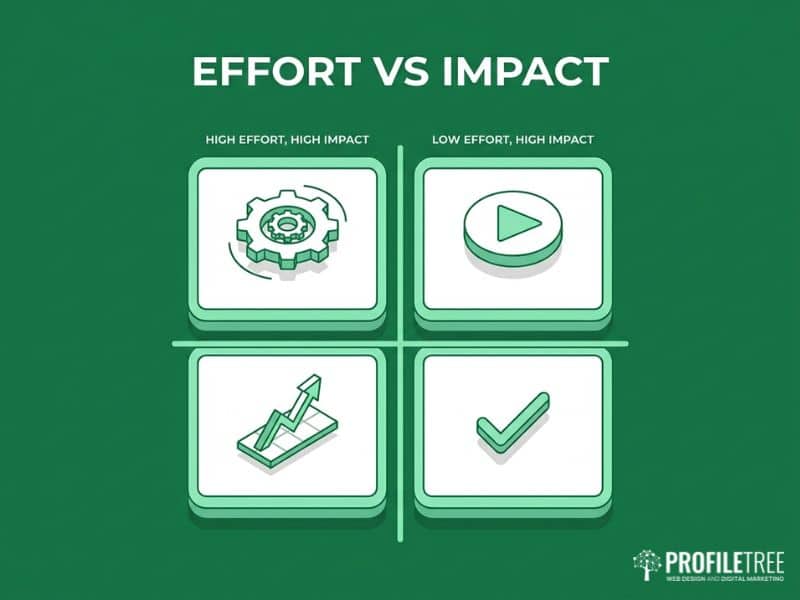
Before choosing between video content types, it helps to map them against two variables: how much effort they take to produce, and how much commercial impact they typically generate. This framework stops businesses pouring budget into polished films that don’t convert while ignoring low-cost formats that quietly perform.
High Effort, High Impact: Brand Anchor Videos
These are the “hero” video content types: cinematic brand films, documentary-style company stories, and flagship product launches. They demand scripting, filming, and post-production time, but they earn their place on your homepage or as a pinned introduction on social profiles, especially when paired with professional website design that gives them a proper stage. UK audiences tend to respond better to authenticity here than to glossy, sales-heavy American-style pitches, so keep the tone grounded.
Low Effort, High Impact: The Social Catalyst
This is the sweet spot for most SMEs. User-generated content, short customer clips, and informal “day in the life” videos rely on raw communication rather than expensive equipment. A 15-second behind-the-scenes clip filmed on a phone regularly outperforms a five-figure corporate showreel on engagement, because audiences increasingly trust unpolished content over anything that feels like an advert.
High Effort, Low Impact: The Video Types to Delay
Highly technical 3D animation or elaborate product visualisation can be a poor early investment if your audience doesn’t exist yet. Save these video content types until your core offer is proven and you have a warm audience ready to appreciate the extra production value.
Top-of-Funnel Video Content Types: Building Awareness
At the top of the funnel, the goal isn’t to sell, it’s to stop someone scrolling for long enough to register your brand. These video content types compete directly with news updates, memes, and personal messages, so the first second and a half matters more than almost anything else in the video.
Short-Form and Social Video Content Types
Vertical, short-form video has moved from a youth trend to a standard business requirement. Take one frequently asked question from your customer base and answer it directly in under 60 seconds, opening with a bold statement rather than a generic intro graphic. Roughly 40% of UK commuters watch video with the sound off, so captions aren’t optional if you want your message understood. Getting an internal team confident with this format is often best supported by team training services rather than outsourcing every clip.
Explainer and Educational Video Content Types
Explainer videos running 30 to 90 seconds remain some of the most effective awareness-stage video content types, particularly for abstract products like software. Two options dominate here: 2D animation, which suits SaaS products where filming the “real thing” isn’t possible, and whiteboard-style animation, which continues to perform well for technical B2B sectors like finance or legal services because it mirrors a teaching environment. These formats work best when they’re mapped out as part of a wider digital marketing strategy, rather than produced as one-off assets. Avoid overly formal narration; UK audiences respond better to natural, regional speech patterns than to a stiff, corporate voiceover.
Middle-of-Funnel Video Content Types: Building Trust
Once someone knows you exist, the objective shifts from reach to credibility. Middle-of-funnel video content types need to answer the question a prospect is quietly asking: is this business actually capable of solving my problem?
Product Demonstrations and Deep Dives
A proper product demo is an educational tool, not a features list. Structure it around the jobs your customer is trying to get done, using point-of-view filming or screen capture to show the product working in a realistic setting. Embedding these videos reliably on your site, without buffering or broken players, depends on solid website hosting services behind the scenes. Including a short “common pitfalls” section, where you show how to avoid mistakes, tends to build more trust than a flawless highlight reel, because it signals genuine expertise rather than a marketing script.
Expert Interviews and Thought Leadership
Positioning your own team as industry authorities is one of the highest-yield video content types available to B2B businesses. A five to ten minute “fireside chat” style interview can be repurposed into a month’s worth of shorter clips for social channels, extending the value of a single filming session considerably. This works especially well when tied to strategic digital planning, so the insights shared connect back to services you actually offer.
Bottom-of-Funnel Video Content Types: Driving Conversions
At this stage, a prospect is usually looking for a reason not to buy, and bottom-of-funnel video content types exist to remove that last piece of friction. These formats work best when they feel specific rather than generic.
Case Studies and Customer Testimonials
Generic testimonials rarely convince anyone anymore. Structure case study videos around situation, task, action, and result, and pair the numbers with genuine emotional relief from the customer. Under Advertising Standards Authority guidelines, testimonials must be genuine and verifiable, so always get written permission and avoid presenting one-off results as typical outcomes. Working with proper video production services makes it far easier to keep these assets consistent and compliant.
Personalised Video Outreach
A short, personalised video sent by a sales representative, mentioning the prospect by name and their specific challenge, consistently earns a stronger response than a cold email. This is one of the more underused video content types in UK B2B sales, largely because it requires no special equipment, just a webcam and a clear message. Following up automatically on the interest this generates pairs well with AI chatbot development that can qualify leads while your sales team focuses on filming the next batch.
Emerging Video Content Types: AI and Automation
AI-generated video is no longer an experimental format, it’s a practical cost-saving option for 2026. Business owners who dismiss these video content types as a gimmick are missing a genuine opportunity to scale content production without scaling budget.
AI avatars, built through tools like Synthesia or HeyGen, allow businesses to produce training and knowledge-base videos without a camera, studio, or presenter. When a process changes, you simply update the script and regenerate the video, avoiding the “legacy content” trap where footage becomes outdated the moment your software interface changes. Automated dubbing and lip-syncing tools also let UK businesses localise their flagship video content types for international audiences at a fraction of the cost of reshooting. These tools sit well alongside AI marketing automation already supporting your wider campaigns.
Choosing the Right Video Content Types for Your Budget
Matching video content types to your actual budget, rather than an idealised one, prevents the most common failure mode in video marketing: starting an ambitious project and abandoning it halfway through.
| Video Type | Recommended Length | Production Time | Typical UK Cost |
|---|---|---|---|
| Social short (UGC) | 15 to 60 seconds | 1 to 2 days | £100 to £500 |
| Animated explainer | 60 to 90 seconds | 2 to 4 weeks | £1,500 to £4,000 |
| Customer case study | 2 to 3 minutes | 1 to 2 weeks | £2,000 to £5,000 |
| Brand hero film | 2 to 5 minutes | 4 to 8 weeks | £10,000+ |
A sensible starting allocation across video content types follows roughly a 70/20/10 split: 70% on regular, low-cost social content and personalised outreach, 20% on monthly educational content like webinars and product updates, and 10% on one or two higher-production hero pieces per year. Whatever mix you choose, make sure your site can actually showcase it properly; custom website builds that support fast-loading video galleries make a measurable difference to how long visitors stay engaged.
According to the Content Marketing Institute, businesses that maintain consistent video output over time see stronger long-term engagement than those that produce occasional, high-budget pieces without a follow-up plan, reinforcing why frequency across multiple video content types tends to outperform a single flagship asset.
How to Build a Video Content Strategy That Works
Picking individual video content types matters less than having a coherent plan connecting them. Start by identifying the single biggest gap in your current funnel. If traffic is low, prioritise top-of-funnel short-form video. If trust is the issue, invest in case studies and testimonials. If prospects understand you but don’t convert, personalised outreach and product demos usually close that gap faster than another brand film.
Test one platform properly before spreading across five. A business that masters short-form video on Instagram or TikTok will typically see better returns than one maintaining a thin presence everywhere. Once a format is working, repurpose it: a single interview can become a dozen short clips, and a single case study can be cut into testimonial snippets for adverts, email, and social media.
ProfileTree’s professional video marketing team helps Belfast and Northern Ireland businesses plan, film, and distribute the video content types that actually support commercial goals, rather than chasing whatever platform trend is loudest this month. From short-form social clips to structured YouTube content and animated explainers, our team builds a plan around your specific funnel gaps, not a generic content calendar.
If you’re ready to put a proper video content strategy in place, ProfileTree’s team can help you plan a mix of video content types that fits your budget and your funnel, working alongside user-focused web design and WordPress development so video content performs everywhere it’s published, not just on the platform it was made for. That combination, paired with ongoing work on improving search visibility, is what turns a video library into a genuine source of leads rather than a one-off marketing project.
FAQs
What are the main video content types businesses should start with?
Short-form social clips, explainer videos, and customer testimonials cover the three key funnel stages and require the least production budget to begin.
How long should a business video be?
Most social clips work best under 60 seconds, explainers between 30 and 90 seconds, and case studies around 2 to 3 minutes. Longer isn’t better if it isn’t watched to the end.
Do I need expensive equipment to create video content?
No. Many of the highest-performing video content types, including UGC and personalised outreach, are filmed on a smartphone and rely on authenticity over production value.
How much should a small business budget for video each year?
A rough guide is 70% on low-cost, frequent content, 20% on mid-tier educational video, and 10% on a single higher-production piece per year.
Can AI really replace traditional video production?
Not entirely. AI avatars and automated tools work well for training and knowledge-base content, but customer trust still depends on real people and genuine testimonials for conversion-stage video.
How do I measure whether my video content is working?
Track watch time, click-through to your site, and conversion actions taken after viewing, rather than views alone, which don’t reflect commercial impact.
Is short-form or long-form video better for business growth?
Neither is universally better. Short-form suits awareness and reach, while long-form interviews and demos build the trust needed further down the funnel.