
What Are Negative Keywords? Learn an SEO Essential
Table of Contents
Negative keywords are critical to successful digital marketing campaigns, particularly in pay-per-click advertising and search engine optimisation. Understanding negative keywords and how to implement them effectively can dramatically improve campaign performance, reduce wasted spending, and increase return on investment for businesses across Northern Ireland, Ireland, and the UK.
Definition
Negative keywords are specific words or phrases digital marketers add to their campaigns to prevent advertisements from appearing for irrelevant search queries. When implemented correctly, negative keywords act as filters that block ads from showing when users search for terms unrelated to the advertiser’s products or services.
For example, a Belfast-based web design agency might add “free” as a negative keyword to avoid showing ads when users search for “free web design” or “free website templates.” This prevents budget waste on clicks from users seeking free services rather than paid professional solutions.
The fundamental principle behind negative keywords lies in search intent refinement. By excluding irrelevant terms, businesses can focus their advertising budget on users genuinely interested in their offerings, leading to higher conversion rates and improved campaign performance.
Types of Negative Keywords
Digital marketing professionals use three distinct negative keyword match types, each offering different levels of control:
Negative Broad Match prevents ads from appearing when all words in the negative keyword appear in the search query, regardless of order. This offers the broadest protection but requires careful implementation to avoid over-blocking relevant traffic.
Negative Phrase Match blocks ads when the exact phrase appears in the search query in the specified order. This provides balanced control between reach and precision, making it the most commonly used negative match type.
Negative Exact Match only blocks ads when the search query exactly matches the negative keyword with no additional words. This offers the most precise control but provides limited protection against variations.
How to Find Negative Keywords in SEO and PPC Campaigns
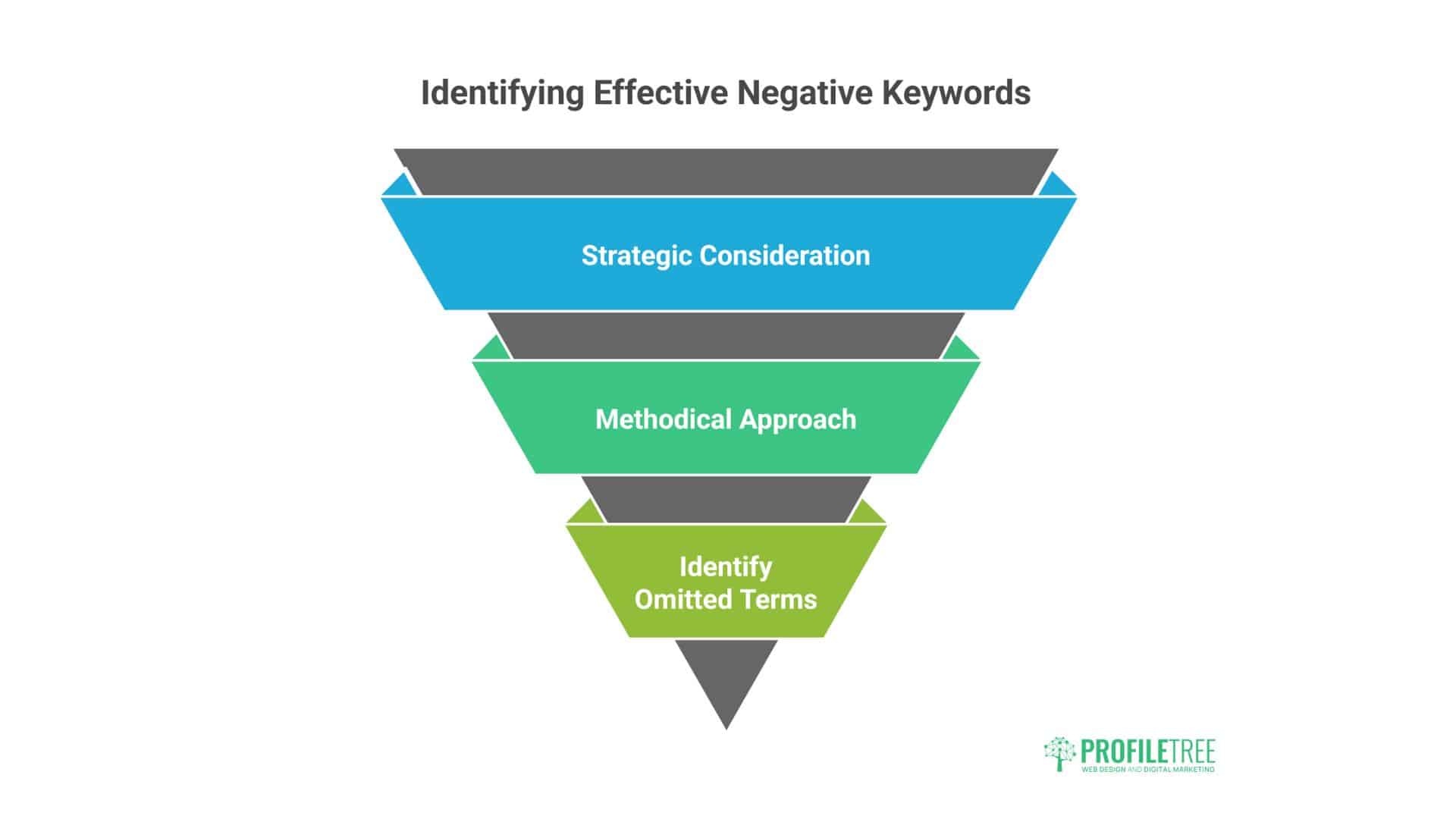
Identifying effective negative keywords requires systematic analysis and strategic thinking. Digital marketing agencies employ several proven methods to discover terms that should be excluded from campaigns.
Search Terms Report Analysis
The search terms report in Google Ads provides invaluable insights into user queries triggering advertisements. Regular analysis of this report reveals irrelevant terms that consume budget without generating conversions. Marketing professionals should examine this data weekly, looking for patterns in low-performing queries.
When reviewing search terms, focus on identifying themes rather than individual keywords. For instance, if multiple employment-related searches appear for a business software campaign, consider adding broad employment terms as negatives rather than blocking each specific job-seeking query individually.
Keyword Research Tools for Negative Discovery
Professional keyword research tools extend beyond finding positive keywords to uncovering potential negatives. Tools like Google’s Keyword Planner reveal related terms that might seem relevant but actually target different search intents.
When conducting keyword research for clients, create two lists simultaneously: target keywords and potential negatives. This proactive approach prevents irrelevant traffic from the campaign launch rather than addressing it reactively after budget waste occurs.
Competitor Analysis and Industry Research
Examining competitor advertisements and industry trends reveals common negative keyword opportunities. Businesses often share similar challenges in filtering irrelevant traffic, particularly within specific industries or geographical regions.
For example, digital agencies across Ireland frequently need to exclude terms like “jobs,” “courses,” “free,” and “DIY” to focus on qualified business clients rather than job seekers or individuals seeking educational content.
Negative Keywords in Digital Marketing Strategy
Modern digital marketing campaigns span multiple channels and platforms, each requiring tailored negative keyword strategies. Understanding how negative keywords apply across different marketing channels maximises their effectiveness.
Search Engine Marketing Applications
In search engine marketing, negative keywords directly impact Quality Score, ad relevance, and campaign efficiency. Higher click-through rates result from better traffic quality, improved quality scores, reduced cost-per-click, and improved ad positions.
Geographic businesses serving specific regions should implement location-based negative keywords. For example, a digital marketing agency in Belfast might exclude other city names or regions it doesn’t serve, preventing wasted spending on geographically irrelevant traffic.
Social Media Advertising Integration
Social media platforms increasingly offer negative keyword functionality, particularly in search-based advertising formats. LinkedIn Campaign Manager, Facebook Ads, and X/Twitter Ads all support various forms of negative targeting that parallel traditional search engine approaches.
Cross-channel consistency in negative keyword strategy reinforces brand messaging and optimises budget allocation across platforms. Terms excluded from Google Ads campaigns often warrant similar exclusion from social media campaigns targeting the same audiences.
Content Marketing and SEO Alignment
While negative keywords primarily apply to paid advertising, content marketing teams can use negative keyword research to identify topics to avoid or address differently. Understanding what audiences specifically don’t want helps shape content strategy and messaging.
Search engine optimisation benefits indirectly from negative keyword research through improved understanding of search intent and user behaviour patterns. This insight informs organic content creation and on-page optimisation strategies.
Examples of Negative Keywords Across Industries
Different industries face unique challenges in filtering irrelevant traffic. Understanding common negative keyword patterns helps businesses implement effective exclusion strategies more quickly.
Professional Services Negative Keywords
Digital marketing agencies, web designers, and professional service providers commonly exclude:
- Employment-related terms: “jobs,” “hiring,” “careers,” “employment”
- Educational queries: “course,” “training,” “learn,” “how to”
- Free-seeking behaviour: “free,” “cheap,” “budget,” “DIY”
- Competitor brand names (when appropriate)
- Review-seeking queries: “review,” “reviews,” “rating,” “comparison”
E-commerce Negative Keywords
Online retailers require different negative keyword strategies focused on purchase intent:
- Non-commercial queries: “images,” “pictures,” “wallpaper”
- Competitor platforms: “Amazon,” “eBay,” “marketplace”
- Research-only intent: “review,” “comparison,” “versus”
- Price-focused searches: “cheap,” “discount,” “sale” (depending on positioning)
Local Business Negative Keywords
Location-based businesses need geographic and service-specific exclusions:
- Other locations: cities, regions, or countries not served
- DIY-related terms: “how to,” “tutorial,” “guide,” “yourself”
- Wholesale or bulk queries (for retail businesses)
- Emergency or urgent requests (if not offering emergency services)
B2B Service Negative Keywords
Business-to-business service providers often exclude:
- Job-seeking behaviour: all employment-related terms
- Consumer-focused terms: “personal,” “individual,” “home”
- Small-scale queries: “cheap,” “small business” (depending on target market)
- Academic research: “study,” “research,” “report,” “statistics”
Negative Keywords Tools and Generators
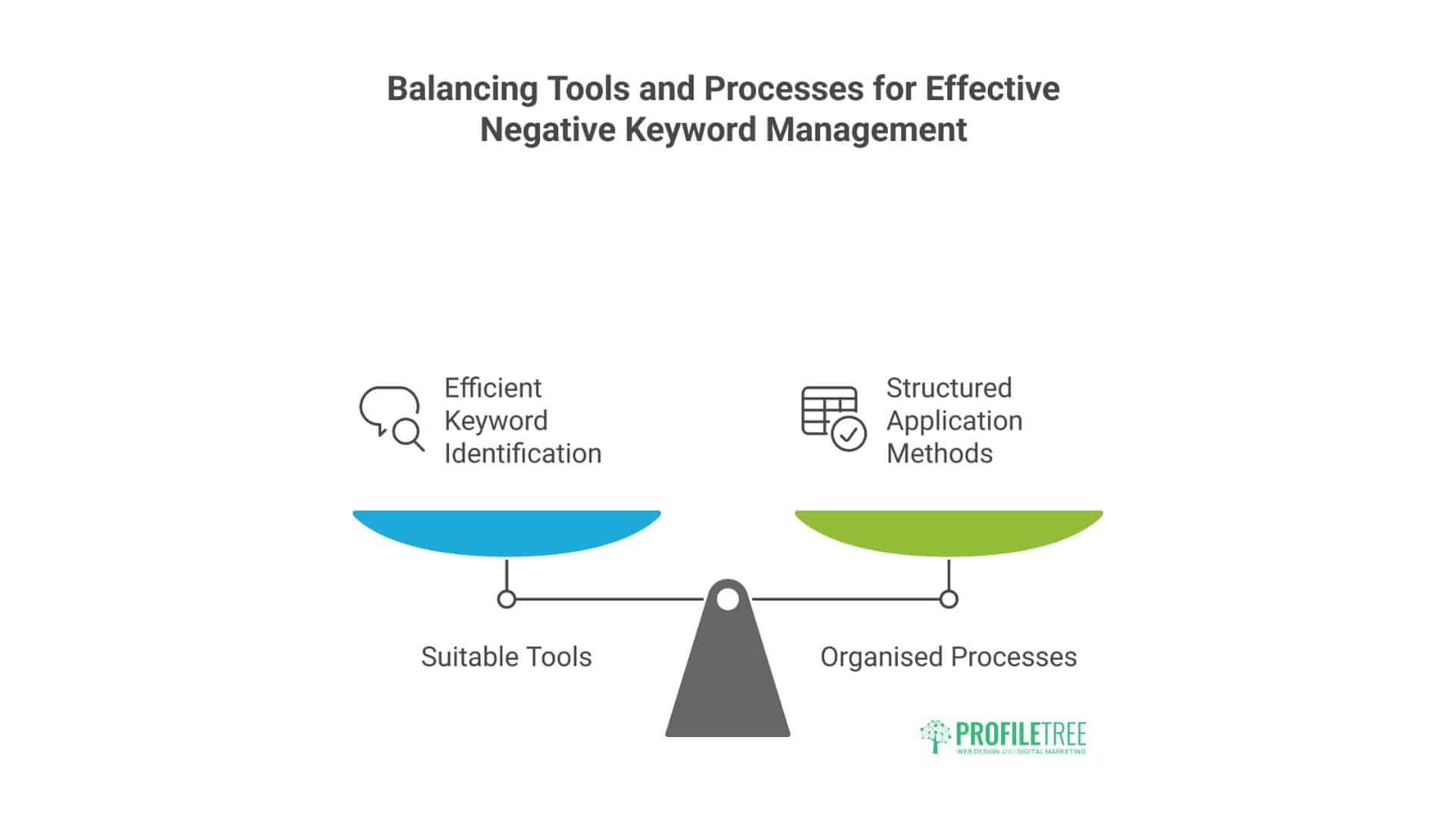
Effective negative keyword management requires appropriate tools and systematic processes. Digital marketing professionals use various tools to discover, implement, and maintain negative keyword lists.
Google Ads Native Tools
Google Ads provides several built-in features for negative keyword management:
Keyword Planner reveals related terms during research phases, helping identify potential negatives before campaigns launch. When researching positive keywords, note unrelated suggestions that should become negatives.
Search Terms Report remains the primary source for ongoing negative keyword discovery. Regular review and analysis of this report drives continuous campaign optimisation.
Shared Negative Keyword Lists allow efficient management across multiple campaigns and accounts. Digital agencies managing numerous clients benefit significantly from shared lists containing common industry exclusions.
Third-Party Negative Keyword Tools
Professional digital marketing tools offer enhanced negative keyword functionality:
WordStream’s Negative Keyword Tool automates the discovery process by analysing search term reports and suggesting relevant negatives based on performance data.
SEMrush and Ahrefs provide competitive intelligence that reveals negative keyword opportunities through competitor analysis and industry benchmarking.
Optmyzr and other PPC management platforms offer automated negative keyword suggestions and implementation features that streamline optimisation.
Custom Negative Keyword Generators
Advanced practitioners develop custom solutions for negative keyword generation:
Python scripts can analyse search term reports at scale, identifying patterns and suggesting negatives based on performance thresholds and semantic analysis.
Google Ads Scripts enable automated negative keyword addition based on predetermined rules, reducing manual management overhead for large accounts.
Spreadsheet-based tools provide structured approaches to negative keyword research and management, which is beneficial for agencies managing multiple client accounts.
How to Identify Negative Keywords: Advanced Strategies
Professional negative keyword identification goes beyond basic exclusion to strategic traffic refinement. Advanced practitioners employ sophisticated methods to optimise campaign performance.
Performance-Based Identification
Analyse keyword performance metrics to identify underperforming terms that should become negatives. Keywords with high impressions, low click-through rates, and poor conversion rates often indicate relevance issues requiring negative keyword intervention.
Set specific performance thresholds for negative keyword consideration. For example, keywords generating over 1,000 impressions with less than 1% click-through rate and zero conversions warrant negative keyword evaluation.
Semantic Analysis and Search Intent
Modern search behaviour involves complex, conversational queries requiring nuanced negative keyword strategies. Natural language processing helps identify semantic patterns in search queries that indicate irrelevant intent.
Consider search intent categories when developing negative keywords:
- Informational queries seeking knowledge rather than products
- Navigational searches looking for specific websites or locations
- Commercial investigation comparing options before purchasing
- Transactional queries are ready for immediate purchase
Seasonal and Trend-Based Negatives
Search behaviour changes seasonally and with current events, requiring dynamic negative keyword strategies. Monitor trending terms and seasonal patterns that might introduce irrelevant traffic to campaigns.
For example, digital marketing agencies might add “2024 predictions” or “2025 trends” as negatives if their services focus on immediate implementation rather than future planning.
Agency Best Practices for Negative Keywords Management
“Most businesses waste 20-30% of their advertising budget on irrelevant clicks,” explains Ciaran Connolly, Director at ProfileTree. “Through systematic negative keyword implementation, we’ve helped our clients reduce wasted spend by up to 45% while improving lead quality. Treating negative keywords as a strategic asset, not just a reactive optimisation task.”
Client Onboarding and Negative Keywords
Professional agencies integrate negative keyword planning into client onboarding processes. Initial client consultations should include discussions about:
- Services explicitly not offered
- Geographic limitations and service areas
- Target audience characteristics and exclusions
- Competitor relationships and brand protection needs
- Budget priorities and efficiency requirements
This information forms the foundation for initial negative keyword lists before campaigns launch, preventing immediate budget waste and establishing performance baselines.
Scalable Negative Keyword Systems
Agencies managing multiple clients require systematic approaches to negative keyword management:
- Master Negative Lists contain universally applicable terms across client accounts, such as employment-related queries for B2B service providers.
- Industry-specific lists address common challenges within particular sectors, enabling faster campaign setup and consistent optimisation approaches.
- Client-Specific Lists handle unique exclusions related to business circumstances, competitive situations, or strategic priorities.
Ongoing Optimisation and Maintenance
Negative keyword management requires continuous attention and strategic refinement:
- Weekly Review Cycles examine recent search terms and performance data, adding negatives as needed and monitoring impact on campaign metrics.
- A monthly strategic assessment evaluates the overall effectiveness of the negative keyword strategy and identifies opportunities for list expansion or refinement.
- Quarterly Client Reviews discuss negative keyword performance and strategy with clients, ensuring alignment with evolving business objectives and market conditions.
Cross-Channel Integration
Modern marketing campaigns span multiple channels, requiring coordinated negative keyword strategies:
- Platform Consistency applies similar negative keyword principles across Google Ads, Microsoft Advertising, social media platforms, and other advertising channels.
- Data Sharing leverages insights from one platform to improve performance on others, creating synergistic optimisation effects.
- Unified Reporting tracks negative keyword impact across all channels, providing comprehensive performance insights and optimisation opportunities.
Digital Marketing Training and Implementation
Effective negative keyword strategies require ongoing education and skill development. Digital marketing teams must stay current with platform updates, industry trends, and optimisation techniques.
Training Programme Components
Professional development in negative keyword management should include:
- Platform-Specific Training covering native tools and features across major advertising platforms, ensuring teams can maximise built-in functionality.
- Analytics and Reporting Skills enabling practitioners to analyse performance data effectively and make data-driven negative keyword decisions.
- Industry Knowledge Development, understanding sector-specific challenges and opportunities in negative keyword implementation.
AI and Automation Integration
Modern digital marketing increasingly relies on artificial intelligence and automation for negative keyword management:
- Machine Learning Algorithms analyse vast amounts of search term data to identify patterns and suggest negatives more accurately than manual processes.
- Automated Bidding Integration considers negative keyword impact when adjusting bids, creating more sophisticated optimisation strategies.
- Predictive Analytics anticipate seasonal trends and market changes that might require negative keyword strategy adjustments.
Performance Measurement and ROI
Measuring negative keyword success requires sophisticated tracking and analysis:
- Cost Savings Calculation quantifies the budget saved through irrelevant traffic prevention, demonstrating clear ROI from negative keyword implementation.
- Quality Improvements track increases in click-through rates, conversion rates, and Quality Scores resulting from better traffic targeting.
- Competitive Advantage monitors market position improvements as competitors waste budget on irrelevant traffic while optimised campaigns focus on qualified prospects.
Advanced Campaign Types and Negative Keywords

Modern digital advertising encompasses various campaign types, each requiring specific negative keyword approaches and considerations.
Performance Max and Smart Campaigns
Google’s automated campaign types present unique challenges for negative keyword implementation:
- Account-Level Negatives provide the primary control mechanism for Performance Max campaigns, requiring comprehensive negative keyword lists at the account level.
- Asset Group Optimisation uses negative keywords to guide automated systems toward relevant traffic sources and avoid problematic placements.
- Cross-Campaign Coordination prevents conflicts between different campaign types targeting similar audiences with different negative keyword strategies.
Shopping and Product Campaigns
E-commerce campaigns require product-specific negative keyword strategies:
- Product Category Exclusions prevent ads from appearing for unrelated product searches, focusing budget on qualified prospects.
- Brand Protection excludes competitor brand names and generic product terms that don’t align with specific product offerings.
- Price-Point Targeting uses negatives to focus on appropriate price ranges and customer segments for specific products or services.
Video and Display Network Applications
Visual advertising formats benefit from negative keyword refinement:
- Content Categorisation excludes inappropriate content categories and website placements through keyword-based targeting refinement.
- Audience Quality improves by preventing ads from appearing alongside content that attracts undesirable demographics or behaviours.
- Brand Safety protection through comprehensive negative keyword lists that prevent association with problematic content or contexts.
Regional Considerations for UK and Irish Markets
Businesses operating in Northern Ireland, Ireland, and the broader UK market face specific challenges requiring localised negative keyword strategies.
Geographic Exclusions and Inclusions
- Cross-border considerations for businesses serving both Northern Ireland and the Republic of Ireland markets require careful geographic negative keyword implementation.
- UK Market Variations account for regional differences in terminology, search behaviour, and commercial intent across England, Scotland, Wales, and Northern Ireland.
- Language and cultural factorsare particularly relevant for Irish-language searches and the cultural context that might affect search intent and keyword relevance.
Regulatory and Compliance Factors
- Industry Regulations vary across the UK and Irish markets, affecting which services can be advertised and how negative keywords should be implemented.
- Professional Standards requirements for regulated industries like finance, healthcare, and legal services influence negative keyword strategy and implementation.
- Data Protection considerations under GDPR and UK data protection laws affect the tracking and analysis of negative keyword performance.
Local Competition and Market Dynamics
- Market Saturation levels vary significantly across different regions and industries, affecting negative keyword strategy and competitive positioning.
- Economic Factors influence search behaviour and commercial intent, requiring adaptive negative keyword strategies that respond to local economic conditions.
- Seasonal Variations specific to the UK and Irish markets, such as holiday periods, school terms, and cultural events that affect search patterns and require negative keywords.
Measuring Success and ROI from Negative Keywords
Quantifying the impact of negative keyword strategies requires comprehensive measurement frameworks and sophisticated analysis techniques.
Key Performance Indicators
- Cost Efficiency Metrics track improvements in cost-per-click, cost-per-conversion, and overall return on ad spend resulting from negative keyword implementation.
- Quality Improvements measure increases in click-through rates, Quality Scores, and ad relevance scores that result from better traffic targeting.
- Conversion Optimisation analyses improvements in conversion rates, lead quality, and customer lifetime value achieved through refined audience targeting.
Attribution and Analysis
- Multi-Touch Attribution considers the role of negative keywords in complex customer journeys and recognises their contribution to overall campaign success.
- Incrementality Testing compares performance between campaigns with and without specific negative keyword implementations, isolating their actual impact.
- Predictive Modelling uses historical data to forecast the impact of negative keyword changes, enabling proactive optimisation decisions.
Reporting and Communication
- Client Reporting frameworks that communicate negative keyword impact and value to stakeholders and decision-makers.
- Performance Dashboards provide real-time visibility into negative keyword performance and optimisation opportunities.
- Strategic Planning integrates negative keyword insights into broader marketing strategy and budget allocation decisions.
Future Trends and Technological Developments
The landscape of negative keyword management continues evolving with technological advances and changing user behaviour patterns.
Artificial Intelligence Integration
- Machine Learning Enhancement improves negative keyword discovery and implementation through pattern recognition and predictive analytics.
- Natural Language Processing enables more sophisticated understanding of search intent and semantic relationships in query analysis.
- Automated Optimisation reduces manual workload while improving the precision and effectiveness of negative keyword strategies.
Privacy and Tracking Changes
- Cookieless Future impacts how negative keyword performance can be measured and optimised, requiring new approaches to analysis and attribution.
- First-party data becomes increasingly essential for negative keyword strategy development and performance measurement.
- Consent Management affects data availability for negative keyword optimisation while maintaining user privacy and regulatory compliance.
Platform Evolution
- Cross-Platform Integration improves through enhanced data sharing and unified negative keyword management across advertising platforms.
- Voice and Visual Search growth requires new approaches to negative keyword strategy that account for different query formats and intent patterns.
- Emerging Platforms present new opportunities and challenges for negative keyword implementation as advertising options expand.
Implementation Checklist and Action Steps
Implementing negative keyword strategies requires systematic planning and execution across multiple phases and stakeholders.
Pre-Launch Planning
- Industry Research identifies standard negative keyword requirements for specific business sectors and geographic markets.
- Competitor Analysis reveals negative keyword opportunities and potential traffic conflicts that should be addressed proactively.
- Client Consultation establishes a clear understanding of business objectives, service limitations, and target audience characteristics.
Campaign Setup
- Account Structure design incorporates negative keyword management capabilities and shared list functionality from campaign inception.
- Initial Lists implementation includes universal negatives, industry-specific terms, and client-specific exclusions identified during planning phases.
- Tracking Setup establishes measurement frameworks for assessing negative keyword impact and optimisation opportunities.
Ongoing Management
- Review Schedule establishes regular cycles for search term analysis, negative keyword addition, and performance assessment.
- Optimisation Process defines systematic approaches to identifying, testing, and implementing new negative keywords based on performance data.
- The Reporting Framework provides stakeholders with clear visibility into negative keyword performance and strategic recommendations.
Quality Assurance
- Testing Protocols verify that negative keywords function as intended without over-blocking relevant traffic or creating unintended consequences.
- Performance Monitoring tracks key metrics to identify negative keyword impact on campaign performance and overall objectives.
- Documentation Standards maintain comprehensive records of negative keyword decisions and performance outcomes for future reference and optimisation.
Conclusion
Negative keywords are essential for efficient digital marketing campaigns. They prevent budget waste, improve lead quality, and boost campaign performance through strategic traffic filtering. Success requires ongoing analysis and refinement rather than one-time implementation.
Negative keyword expertise provides a significant competitive advantage for agencies managing multiple client accounts. The future of digital advertising belongs to marketers who understand that strategic exclusion drives better results than broad targeting alone.
FAQs
What is a negative keyword in SEO?
A negative keyword is a word or phrase that prevents your ads from appearing when users search for that specific term. Unlike regular SEO keywords that help your content rank, negative keywords in paid advertising filter out irrelevant traffic to improve campaign efficiency and reduce wasted spend.
How do I find negative keywords for my campaigns?
The most effective method is analysing your search terms report in Google Ads to identify irrelevant queries triggering your ads. Additionally, use keyword research tools, examine competitor ads, brainstorm unrelated terms to your business, and regularly review industry-specific negative keyword lists.
What are examples of negative keywords for different industries?
Professional services often exclude “jobs,” “free,” “DIY,” and “courses.” E-commerce businesses typically block “images,” “Amazon,” and “reviews.” Local businesses exclude other city names and “wholesale” terms. B2B companies commonly filter “personal,” “cheap,” and employment-related searches.
Ready to Transform Your Campaign Performance?
Stop wasting budget on irrelevant clicks. At ProfileTree, we’ve helped dozens of businesses across Northern Ireland, Ireland, and the UK reduce their advertising waste by up to 45% while dramatically improving lead quality through strategic negative keyword implementation.
Whether you’re struggling with poor campaign performance, high costs per conversion, or simply want to maximise your digital marketing ROI, our certified specialists can audit your current campaigns and implement proven negative keyword strategies that deliver measurable results.
Get your free campaign audit today:
- Comprehensive review of your current negative keyword strategy
- Industry-specific recommendations tailored to your business
- Projected savings and performance improvements
- No obligation consultation with our digital marketing experts
Don’t let another day of wasted ad spend slip by. Contact ProfileTree to discover how strategic negative keyword management can transform your digital marketing results.
Get Your Free Campaign Audit | Call 028 9568 0364