
Natural Language Processing for UK SMEs: A Practical Guide
Table of Contents
Natural language processing (NLP) is the branch of artificial intelligence that gives machines the ability to read, interpret, and respond to human language, for small businesses, that translates into practical tools: chatbots that handle routine customer queries, software that reads and categorises incoming emails, and sentiment analysis that monitors what customers are actually saying about a brand online.
The barrier to entry has dropped sharply. A few years ago, implementing NLP meant hiring data scientists and building custom models. Today, a range of low-code and API-based tools puts the same capabilities within reach of an SME with no technical team on staff.
This guide cuts through the theory. It covers what natural language processing for small businesses looks like in practice, which tools are worth considering, what UK GDPR means for how you use it, and how to build a realistic implementation roadmap without blowing the budget. It also clarifies one persistent source of confusion: NLP in this context refers to AI and language technology, not neuro-linguistic programming, the coaching methodology that shares the same abbreviation.
What NLP AI Actually Does for a Small Business
Before choosing a tool, it helps to understand the specific tasks NLP handles well. Not every text-heavy process in your business is a good candidate, and overpromising has led many SMEs to invest in automation that solved the wrong problem. The starting point is identifying where language data is creating a genuine bottleneck.
Reading and Categorising Customer Messages
The most common entry point for NLP in a small business is the inbox. Most customer service teams spend a disproportionate amount of time on the first step: reading a message, working out what it is asking for, and routing it to the right person or response template. NLP handles that classification step automatically.
A tool connected to your support inbox can tag incoming messages by type (complaint, returns query, delivery question, general enquiry) and priority, so your team sees a pre-sorted queue rather than an undifferentiated pile. For a business receiving 50 to 200 emails a day, this alone can recover several hours each week.
Tools like Zapier Central and Make.com now offer NLP-powered classification steps that can be configured without writing code. You define the categories and a handful of example messages; the system learns the pattern and sorts from there. AI chatbot services can extend this further, handling full response cycles for common queries without any human involvement.
Sentiment Analysis Across Review Platforms
Knowing that a customer left a review is one thing. Understanding the emotional tone across hundreds of reviews, at a glance, is something else entirely. Sentiment analysis tools use NLP to score text as positive, negative, or neutral, and can identify which specific aspects of your service (delivery speed, product quality, customer support) are driving each sentiment cluster.
For a small business in retail or hospitality, this turns Google Reviews and Trustpilot data from a collection of individual opinions into an operational signal. If the negative cluster suddenly spikes around a particular product line or service shift, you see it in the dashboard before it escalates into a reputational issue.
The insights feed directly into how you approach customer segmentation: understanding not just who is buying, but how different groups feel about the experience, and where the gaps are between expectation and delivery.
Intelligent Document Processing
Invoices, purchase orders, contracts, and onboarding forms. Most small businesses handle a steady flow of structured documents that require someone to read, extract key data, and enter it somewhere else. This is one of the clearest use cases for NLP-powered automation.
Optical character recognition (OCR) combined with NLP can read a PDF invoice, extract the supplier name, invoice number, line items, and totals, and push those values directly into an accounting system or spreadsheet, with no manual keying. The error rate drops, the processing time drops, and the task disappears from someone’s to-do list.
UK SMEs that have applied this approach to accounts payable and supplier management report time savings in the range of 60 to 80 per cent on document-handling tasks. Research into AI solutions for SMEs consistently shows document processing as one of the highest-ROI starting points precisely because the labour cost of the manual alternative is easy to quantify.
Personalised Marketing and Outreach
NLP tools can analyse the language patterns in customer emails, chat transcripts, and survey responses to identify tone preferences, vocabulary, and the kinds of information each segment responds to. That analysis can then inform how marketing copy is written, which subject lines are tested, and how email sequences are personalised.
This sits naturally alongside a broader digital strategy, where the goal is not just sending more messages but sending messages that actually match what the reader wants to know at that moment in their journey with the business.
The Low-Code NLP Stack: Tools Worth Considering
The enterprise tools that dominate most NLP articles, IBM Watson, Google Natural Language AI, and AWS Comprehend, are capable products. They are also sized and priced for organisations with engineering teams and data infrastructure. For most UK SMEs, the more practical starting point is a tier of tools designed to work without code and integrate with software you already use.
Workflow Automation Platforms with NLP Capabilities
Zapier Central and Make.com both offer AI steps that can classify, summarise, or extract information from text within a workflow. A trigger (new email received, new form submission, new chat message) can pass the text through an NLP step and then route the result: creating a support ticket, tagging a contact in a CRM, sending an internal Slack notification, or generating a draft reply for human review.
The skill level required is equivalent to building a basic spreadsheet formula. The tools provide a visual interface; you define the inputs, the classification logic, and the outputs. Monthly costs for low-volume SME use typically start in the range of £20 to £50. All prices and figures in this guide are indicative UK examples and correct at the time of writing; use them as a benchmark rather than fixed quotations.
These platforms are also where many SMEs connect NLP to their existing email marketing workflows, using language analysis to inform segmentation and trigger logic rather than treating all contacts identically.
Specialist SME-Focused Tools
MonkeyLearn is a text analysis platform aimed specifically at non-technical users. It offers pre-built models for sentiment analysis, keyword extraction, and intent detection, as well as the option to train a custom classifier on your own data. The interface is visual; you upload labelled examples, the model trains, and the output integrates via API or directly into Google Sheets.
LangChain is a development framework for building NLP applications using large language models. It sits closer to the technical end of the spectrum than Zapier or MonkeyLearn, but a growing library of pre-built templates means it is accessible to someone comfortable working in a no-code interface or following a structured tutorial. It is particularly useful for businesses that want to build a document Q&A tool or internal knowledge assistant using their own company data.
For businesses already using ChatGPT for business tasks, connecting it to a workflow via the OpenAI API extends what the tool can do from a standalone assistant to an automated processing step inside a repeatable business process.
When Enterprise Tools Make Sense
There are situations where the larger platforms are the right choice. If you are processing thousands of documents per day, handling highly sensitive data under strict regulatory requirements, or building a customer-facing product rather than an internal tool, the additional capability, compliance features, and SLA guarantees of IBM Watson or Google Natural Language AI justify the cost and implementation effort.
The honest guidance is to start with the simplest tool that solves the problem. If Zapier plus GPT-4 handles your email triage adequately, there is no reason to invest in a custom enterprise build. Complexity has a cost that goes beyond the licence fee: it requires ongoing maintenance, staff training, and someone who understands the system when it breaks.
Ciaran Connolly, founder of ProfileTree, notes: “The SMEs that get the most from NLP are usually the ones that start with a single, very specific process they want to improve, rather than trying to automate everything at once. One well-chosen starting point, done properly, builds the confidence and internal knowledge to go further.”
UK GDPR and Data Privacy in NLP Systems
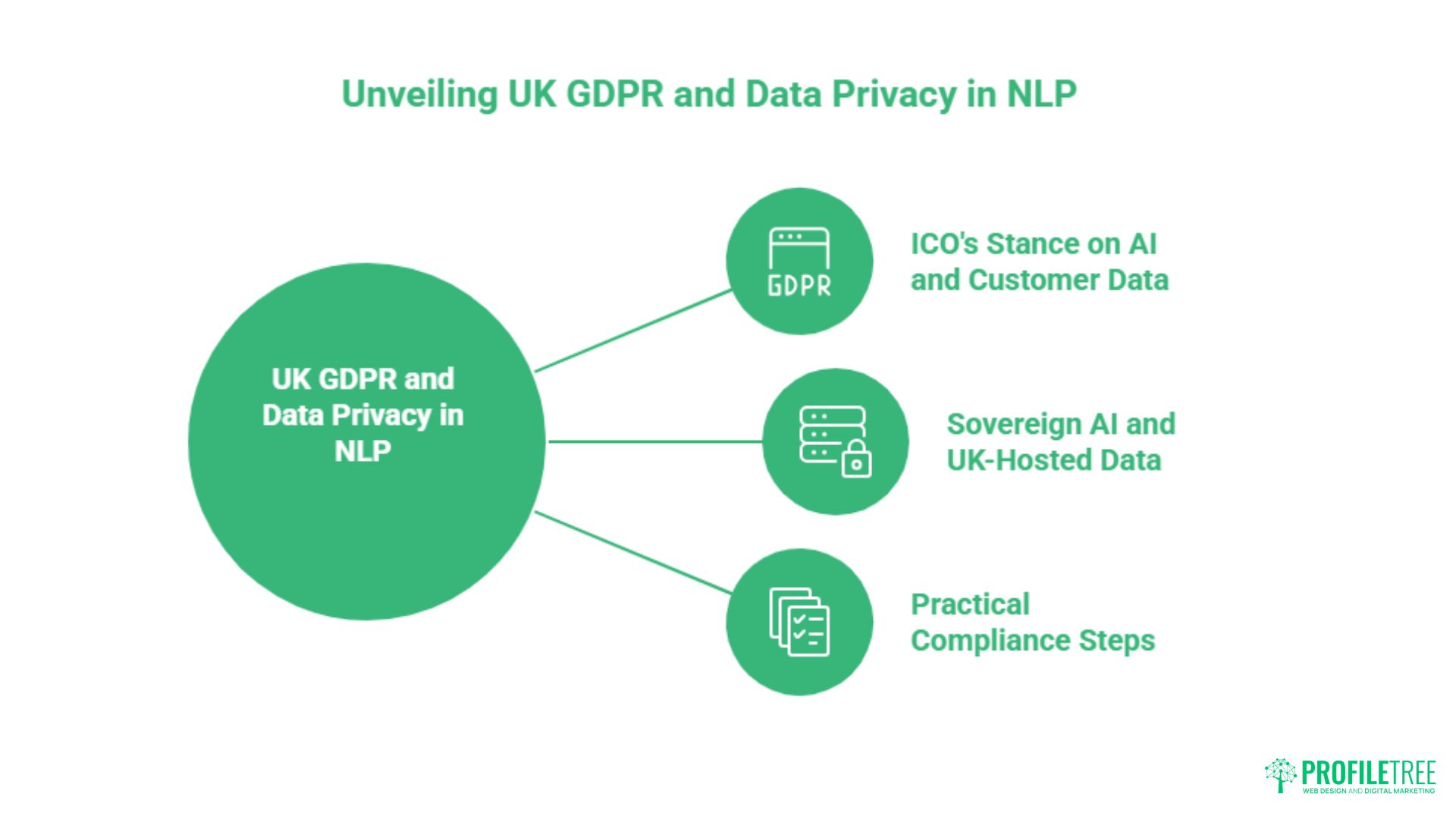
Any NLP system that processes customer communications, reviews, or personal data sits squarely within the scope of UK GDPR. This is the area most NLP guides written for a US audience skip entirely, and it is the area most likely to create legal exposure for a UK business that adopts these tools without proper consideration.
What the ICO Expects
The Information Commissioner’s Office (ICO) has published specific guidance on AI and automated decision-making under UK GDPR. The core obligations are familiar: you need a lawful basis for processing, you must be transparent with individuals about how their data is used, and you cannot use personal data for a purpose incompatible with the reason it was collected.
Where NLP creates specific tension is when customer communications are processed by a third-party AI system to train or improve that system’s models. Many API-based tools, by default, use submitted data to improve their underlying models. This means that a customer’s complaint email, processed through an unreviewed API, could potentially be used to train a public AI system. Checking and adjusting the data usage settings in any NLP tool you adopt is not optional from a GDPR compliance perspective.
The ICO recommends conducting a Data Protection Impact Assessment (DPIA) before implementing any AI system that processes personal data at scale. For a small business, this does not have to be a lengthy exercise, but it does need to document what data is being processed, where it goes, who has access, and what the lawful basis is.
Data Residency and Sovereign AI Options
One of the practical questions UK businesses face is where their data is actually processed. Many cloud-based NLP tools route data through US-based servers by default. While the UK-US data bridge framework provides some cover for this, the ICO has been clear that businesses must understand their data flows and be able to demonstrate they have assessed the transfer risk.
For businesses in regulated sectors (healthcare, legal, financial services), UK or EU-hosted processing options are worth the additional cost. Several providers offer data residency guarantees that keep customer data within the UK or EEA boundaries throughout processing. This is worth raising explicitly when evaluating any NLP vendor.
Bias and Fairness Considerations
NLP models reflect the data they were trained on. If that training data contained systematic biases (in how different customer groups are described, for instance), the model’s outputs will carry those biases forward. For a business using NLP to prioritise support tickets or make automated decisions about customers, this is not a theoretical concern.
Practical mitigation includes reviewing classification outputs regularly against demographic signals where they are available, testing the model with diverse input examples before deployment, and treating any fully automated decision that affects a customer as something requiring periodic human audit. The AI adoption challenges most SMEs face are less about the technology and more about building the internal governance to use it responsibly.
Implementation Roadmap: From Audit to Live System
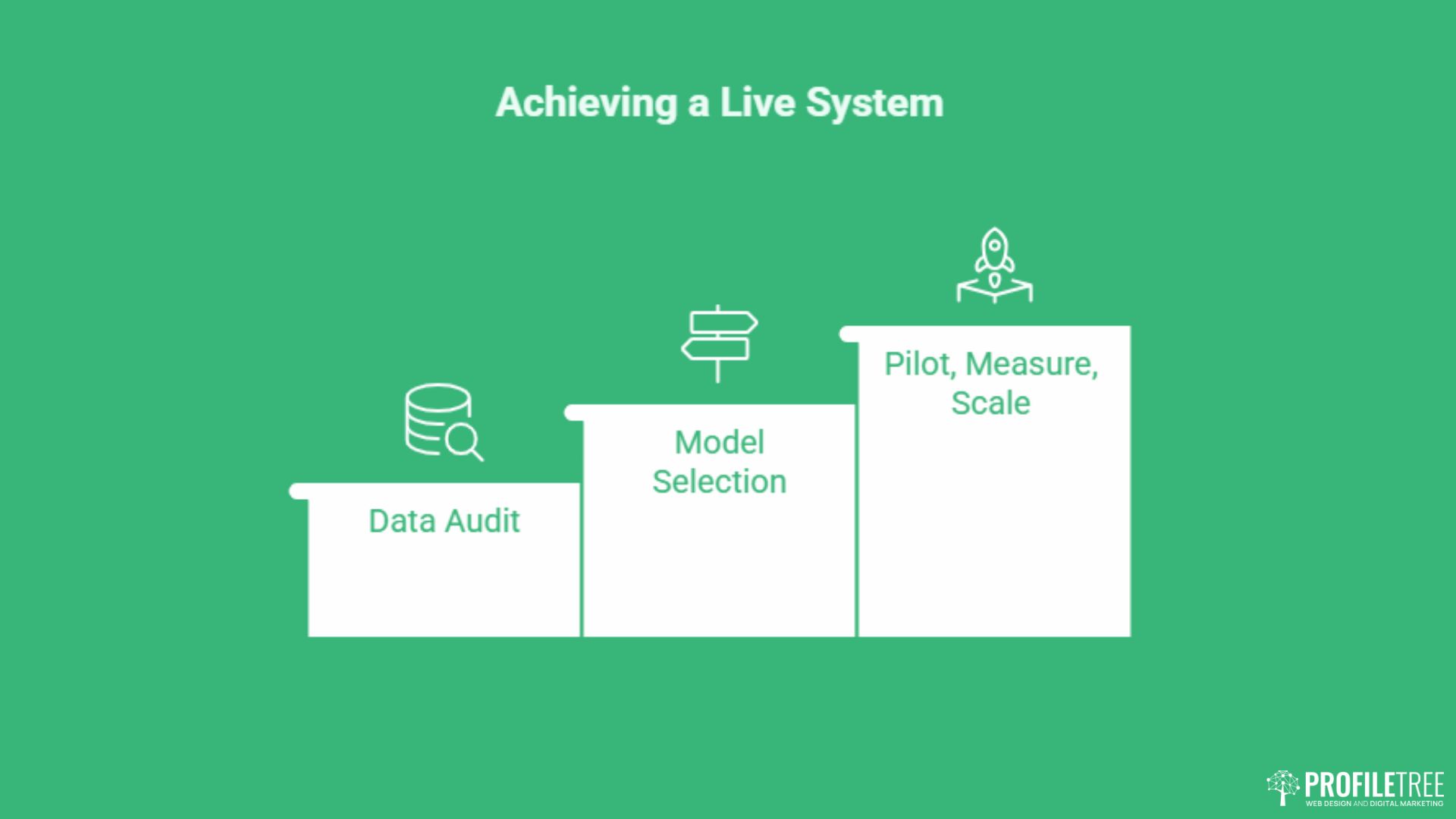
Most NLP implementations that fail do so at the planning stage. The technology is rarely the problem; the issue is deploying a solution before the problem has been clearly defined, or trying to automate a process that is too variable or low-volume to justify the setup cost. A structured approach to implementation reduces that risk significantly.
Step 1: The Data Audit
Before selecting a tool, audit your text-heavy processes. Look for tasks where a human being is regularly reading text, making a classification decision (what type of message is this?), and then taking a repeatable action based on that decision. That pattern, read, classify, act, is where NLP creates the most reliable value.
Good candidates typically share three characteristics: the volume is high enough that the manual time adds up to meaningful cost, the classification categories are well-defined rather than highly variable, and the downstream action is consistent enough to automate. Document processing, email triage, and review monitoring almost always qualify. Highly nuanced customer negotiations or complex complaints typically do not.
Reviewing AI cost-benefit analysis frameworks before committing to a tool helps set realistic expectations about where time savings will materialise and over what timeframe.
Step 2: Choosing Between Closed and Open-Source Models
Closed models (GPT-4, Claude, Gemini via API) give you access to highly capable language understanding without any training requirement. You provide the prompt and the text; the model provides the classification or output. The cost is typically per token (unit of text processed), making it scalable from very low volumes. The trade-off is that you are dependent on the provider’s pricing, availability, and data policies.
Open-source models (Mistral, LLaMA variants, BERT-based classifiers) can be self-hosted, which means the data never leaves your own infrastructure. The upfront effort is higher: you need somewhere to run the model, and for custom classification tasks, you will likely need to fine-tune on your own data. For businesses with strict data residency requirements or very high processing volumes where per-token costs become significant, this path is worth evaluating.
Pre-built SaaS tools (MonkeyLearn, Zapier AI, Tidio, Intercom AI) sit between these options: purpose-built for specific tasks, priced as a monthly subscription, and designed to work without any model knowledge. They are the fastest route to a working system, though less flexible if your needs diverge from what the tool was designed for.
Step 3: Pilot, Measure, Then Scale
Run any NLP implementation as a pilot first. Define a narrow scope (one email category, one document type, one review platform), deploy the tool for four to eight weeks, and measure the output against your baseline. Useful KPIs include: time saved per week on the target task, classification accuracy (spot-check a sample of outputs manually), and any reduction in errors or delays downstream.
Only expand the scope once the pilot results justify it. The pattern of NLP adoption that consistently works for UK SMEs, based on UK SME AI adoption survey data, is narrow initial deployment with clear measurement, then a deliberate decision to scale based on evidence rather than enthusiasm.
Embedding NLP within a wider programme of digital training for staff means the tools get used correctly, and the business builds internal capability rather than relying on an external consultant to maintain the system.
The True Cost of NLP for a Small Business
One of the most common blockers to NLP adoption among UK SMEs is uncertainty about what it actually costs. Most articles either quote enterprise-scale figures that bear no resemblance to an SME budget or understate the implementation effort involved. The reality sits somewhere between the two extremes, and it depends heavily on which tool category you choose and what you are automating.
API Costs Versus Manual Labour
Processing 1,000 customer emails per month through the OpenAI API at GPT-4 pricing costs approximately £2 to £5, depending on email length and the complexity of the prompt. Processing 5,000 emails, roughly the volume a mid-sized SME customer service team might handle, costs in the range of £10 to £25 per month in API charges alone.
Set against even a part-time administrator’s time (typically £1,200 to £1,600 per month for a part-time role in Northern Ireland), the cost comparison is stark for high-volume text processing tasks. The relevant question is not whether NLP is cheaper than a human, but whether the automation is reliable enough to handle the volume without introducing errors that cost more to fix than the time saved.
For lower-volume businesses processing fewer than 500 documents or messages per month, the ROI calculation is less clear-cut. At that volume, a well-designed manual system with clear templates and routing rules can be faster to implement and easier to maintain than an NLP pipeline. The AI content detection principle applies here,e too: knowing when AI adds genuine value versus when it adds unnecessary complexity is a skill in itself.
When NLP Is Not Worth the Investment
Most NLP guides are written to sell AI tools. This one takes a different stance. There are situations where NLP is not the right answer, and recognising them early saves wasted time and money.
Low-volume processes where the manual effort is minimal and already handled efficiently are poor candidates. If your team processes 20 customer emails a day and each takes two minutes to read and respond to, that is roughly 40 minutes of daily labour. The ROI on building and maintaining an NLP pipeline for that volume is unlikely to be positive for at least 12 to 18 months.
Highly contextual decisions that require judgment, nuance, or relationship knowledge are also poor fits for current NLP tools. A complaint from a longstanding client that involves a complex history and an emotionally sensitive situation is not something to route through automated classification. The cases where NLP works best are genuinely repetitive: the ones where a human reader is essentially doing the same thing each time.
Comparison Table: Manual Processing vs NLP Automation
| Task | Manual Time (per 100 items) | NLP API Cost (per 100 items) | Accuracy | Scalability |
|---|---|---|---|---|
| Email triage and categorisation | 2 to 3 hours | £0.20 to £0.50 | 85 to 95% (with review) | Linear cost; scales freely |
| Review sentiment scoring | 3 to 5 hours | £0.10 to £0.30 | 90 to 95% | Scales freely; no added labour |
| Invoice data extraction | 4 to 6 hours | £0.50 to £1.50 | 95%+ (structured docs) | Scales freely with minor QA |
| Complex complaint handling | Variable; 15 to 45 min per case | Not appropriate | High risk of errors | Human involvement required |
ProfileTree’s AI Services for SMEs
ProfileTree works with SMEs across Northern Ireland, Ireland, and the UK on AI transformation projects that include NLP implementation as part of a broader operational improvement programme. The team also delivers structured AI training for business owners and staff who want to build internal competence rather than outsourcing every AI decision to an external provider.
For businesses at the start of that journey, an audit of current text-heavy processes, a clear recommendation on tool selection, and a supported pilot implementation reduce the risk of investing in the wrong solution for the wrong problem.
Northern Ireland’s business community is increasingly well-placed to adopt these tools. As noted in reporting on cities across Northern Ireland, Belfast’s growing tech sector and strong SME base create a practical ecosystem for businesses exploring AI implementation, with local support available.
Conclusion
Natural language processing for small businesses is not a future technology: it is available now, at prices that make sense for an SME budget. The starting point is simpler than most guides suggest: map your text-heavy processes, pick one, and run a four-week pilot with a no-code tool.
To discuss how ProfileTree can support your AI strategy from audit to implementation, visit our AI transformation services page.
FAQs
Is NLP the same as ChatGPT?
ChatGPT is one application of NLP, but NLP covers a much wider range of tasks. Natural language processing includes sentiment analysis, document classification, named entity recognition, translation, and speech-to-text transcription, among others. ChatGPT is a generative AI product built on large language model technology, which is itself a subset of NLP.
Does my small business have enough data for NLP?
For most common use cases, yes. Pre-trained models have been trained on vast datasets and can perform well on standard business-language tasks (sentiment analysis, email classification, document summarisation) without requiring your own data for training. Custom model training, which does require a reasonable volume of your own labelled data, is only necessary when your business uses highly specialised language that general models consistently misclassify.
How much does a basic NLP setup cost per month?
For a low-volume SME using a no-code tool connected to an API, the realistic range is £20 to £60 per month, depending on the volume of text processed. A Zapier or Make.com subscription combined with OpenAI API usage typically sits in this range for businesses processing a few hundred to a couple of thousand text inputs per week.
Will NLP replace my customer service staff?
No, and framing it as a replacement is the wrong lens. NLP handles high-volume, repetitive text tasks: sorting enquiries, flagging urgent issues, and generating first-draft responses, so that your team spends less time on administration and more time on complex interactions that genuinely benefit from human judgement.
Can NLP understand UK accents, slang, and regional dialect?
Modern large language models perform well on standard UK English, including common regional variations and colloquialisms. They are less reliable on very strong regional dialects or highly informal written speech, particularly in text form. For voice-based NLP applications such as call transcription, accuracy varies by accent and audio quality.