
Ad Targeting on Social Media: A Practical Guide for UK Businesses
Table of Contents
Social media ad targeting enables UK businesses to deliver a specific message to a specific person at a specific moment. Done well, it is one of the most cost-efficient forms of paid marketing available to an SME. Done without a strategy, it burns through the budget on audiences that were never going to convert.
This guide covers how ad targeting on social media works, which platforms suit which objectives, what UK compliance obligations apply, and how businesses in Northern Ireland, Ireland, and across the UK can build targeting approaches that produce measurable results.
What Is Ad Targeting on Social Media?
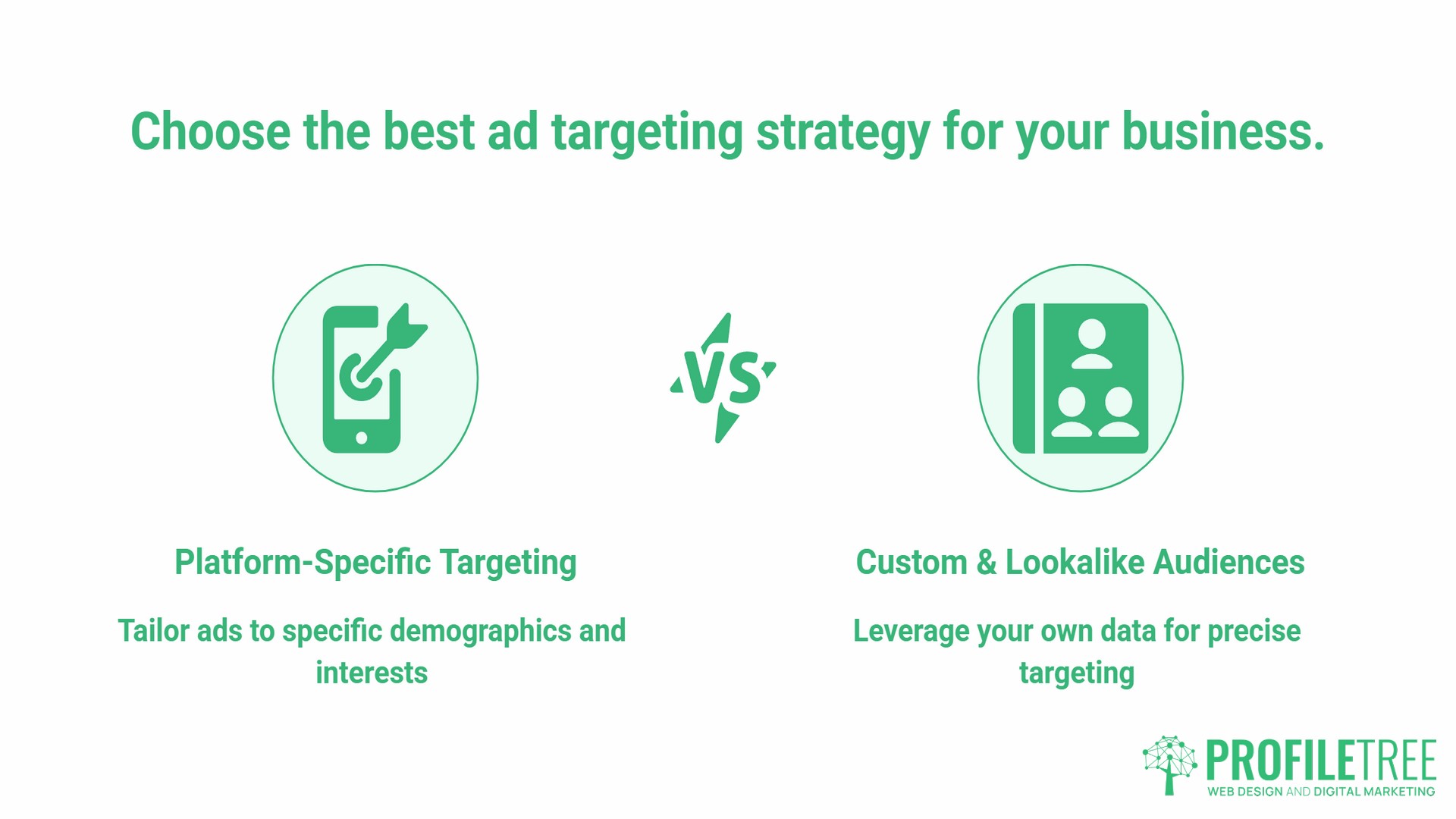
Ad targeting on social media is the process of serving paid content to defined audience segments rather than to all users on a platform. Platforms collect data on user behaviour, demographics, interests, and location, then allow advertisers to select which combinations of those signals should trigger ad delivery.
For a business in Belfast targeting homeowners aged 35 to 55 within a 20-mile radius, that level of precision is available in a few clicks inside Meta Ads Manager. For a B2B firm targeting procurement managers at manufacturing companies across the Midlands, LinkedIn Campaign Manager offers job title and industry filters that no traditional advertising channel can match.
The four core targeting pillars across most platforms are demographic, geographic, interest-based, and behavioural. Custom audiences (built from your own customer data or website visitors) and lookalike audiences (built by platforms to find users similar to your existing customers) layer on top of those.
The Main Types of Social Media Ad Targeting
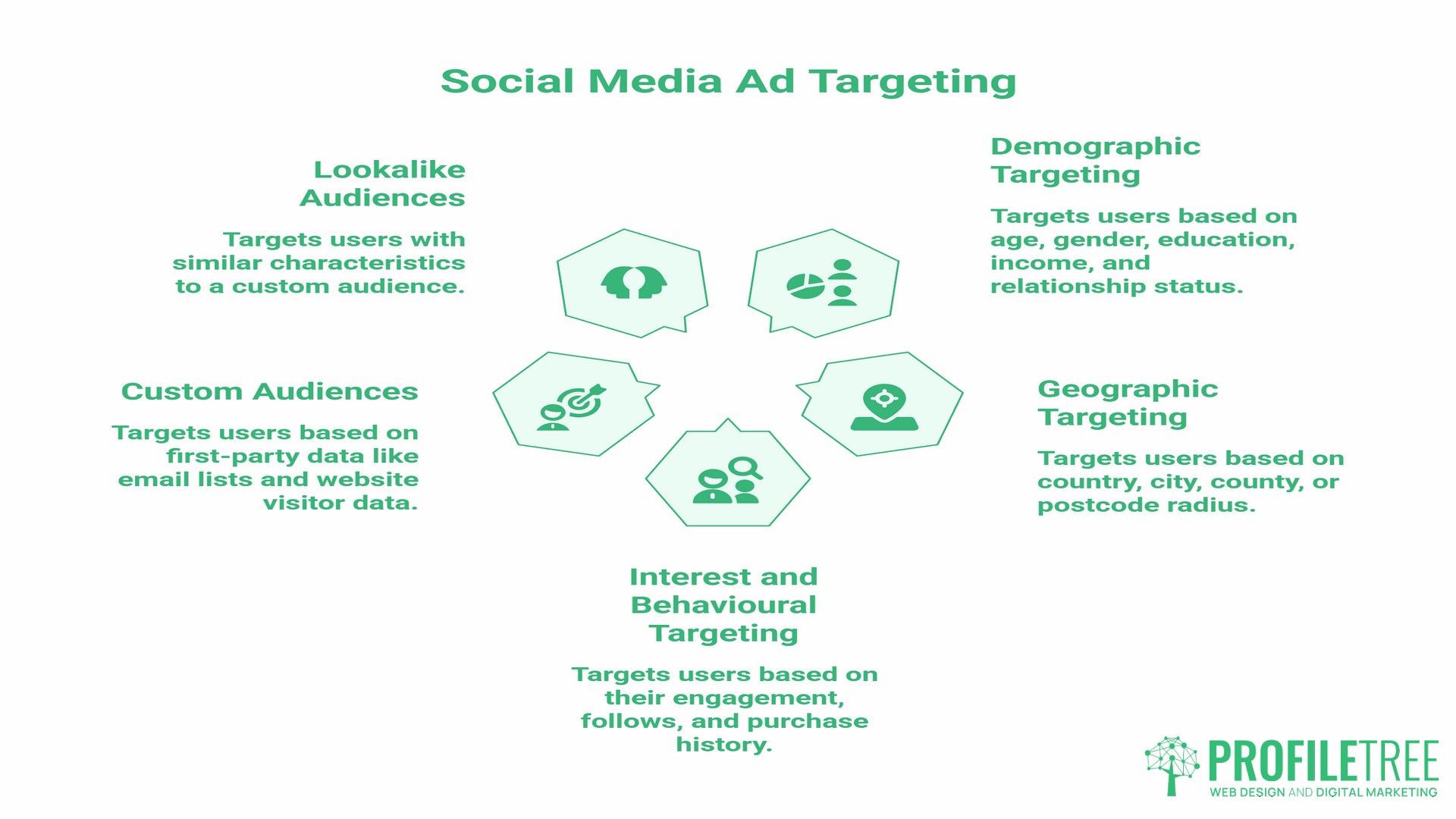
- Demographic targeting covers age, gender, education, household income, and relationship status. It is the starting point for most campaigns and sets the outer boundary of who sees your ads.
- Geographic targeting goes from the country level down to the postcode radius. Meta allows advertisers to target users within a set radius of a specific postcode, which is practical for local service businesses. LinkedIn allows filtering by city, county, or country.
- Interest and behavioural targeting use platform data on what users engage with, follow, and purchase. On Meta, this includes declared interests and inferred behaviours based on platform activity. On TikTok, it draws on video interaction patterns.
- Custom audiences are built from first-party data: email lists, phone numbers, website visitor data collected via the Meta Pixel or LinkedIn Insight Tag, or app activity. These are your warmest audiences and typically produce the lowest cost per result.
- Lookalike audiences use a custom audience as a seed to find users with similar characteristics. A lookalike built from your best customers is one of the most effective prospecting tools available to SMEs, particularly on Meta, where the algorithm has access to large volumes of behavioural data.
Here is a comparison of core targeting strengths across the four platforms UK SMEs use most:
| Platform | Strongest Targeting Feature | Best Use Case | Minimum Daily Budget |
|---|---|---|---|
| Meta (Facebook/Instagram) | Custom + Lookalike audiences | Consumer products, local services, lead generation | No fixed platform minimum in GBP; practitioners recommend £20+/day for meaningful optimisation data |
| Job title, seniority, company size | Budget varies; no verified GBP minimum published by the platform | Approximately £7–£10/day minimum; £25+ recommended for meaningful data | |
| TikTok | Interest + behavioural signals | Brand awareness, younger demographics | £15–£20/day at ad group level (TikTok platform minimum) |
| X (formerly Twitter) | Keyword and follower targeting | Event promotion, thought leadership | Budget varies; no verified GBP minimum published by platform |
Platform Breakdown: Where Should UK SMEs Invest?
Meta (Facebook and Instagram)
Meta remains the highest-reach option for UK consumer targeting. Its custom audience and lookalike tools are mature, and the Advantage+ campaign automation suite now handles significant parts of audience and placement optimisation without manual intervention.
For UK SMEs, Meta works well for local service businesses (trades, clinics, hospitality), e-commerce brands, and any business with an existing email list that can be used to seed a lookalike. Based on a dataset of £3 billion in Facebook advertising spend analysed by Superads, the UK median CPC across all industries ran at approximately £1.11 between mid-2025 and mid-2026, with a low of £0.92 in April and a December peak of £1.50. Competitive sectors such as financial services and real estate run considerably higher than the cross-industry median.
The introduction of Meta’s Conversions API (CAPI) is important for UK advertisers post-iOS 14.5. Because browser-based pixel tracking has become less reliable as users opt out of device-level tracking, CAPI sends conversion data directly from your server to Meta, bypassing browser restrictions. For any business spending meaningfully on Meta ads, setting up CAPI alongside the standard pixel is now standard practice.
LinkedIn is the default platform for B2B targeting in the UK. No other channel allows you to filter by job title, seniority level, company headcount, and industry simultaneously. For a professional services firm in Belfast targeting financial directors at companies with 50 to 200 employees, that specificity is unmatched.
The trade-off is cost. LinkedIn CPCs vary considerably by ad format, audience size, and industry. Based on published benchmark data from ZenABM and HockeyStack covering 2025 to 2026, UK Sponsored Content campaigns typically run from £5 to £12 per click, with the global quarterly average ranging from $10.48 in Q1 to $15.72 in Q3. Narrow targeting and competitive industries push CPCs toward the higher end of that range. That makes LinkedIn impractical for low-ticket offers but well-suited to high-value B2B services, where a single converted lead justifies the spend.
LinkedIn’s Lead Gen Forms pre-populate from profile data, eliminating the friction of manual form completion. According to LinkedIn’s own published data and multiple independent benchmark studies, Lead Gen Forms convert at approximately 6 to 13 per cent of ad clicks, compared to 2 to 5 per cent for off-platform landing pages. The higher conversion rate comes with a trade-off: landing page leads are typically better qualified because they require more deliberate intent to complete.
TikTok
TikTok’s advertising platform has matured considerably. UK user penetration is high among 18- to 34-year-olds, making it the most effective platform for brands targeting younger adult consumers. The ad formats are native to the feed: short-form video that stops the scroll rather than interrupting it.
Targeting on TikTok draws more heavily on behavioural and interest signals than on demographic data. The platform’s algorithm is strong at finding engaged audiences without heavy manual segmentation, which suits brands with high-quality creative but limited targeting expertise.
X and Pinterest
X’s targeting has become less reliable since significant platform changes in 2023 and 2024. For most UK SMEs, the CPM rates and audience quality make it difficult to justify over Meta or LinkedIn. It remains useful for real-time event targeting and for brands whose audience is active in specific topic communities.
Pinterest is used by fewer UK SMEs than the major platforms, but it’s worth considering for visually driven product categories such as home interiors, food, fashion, and occasion-based retail. No independently verified UK CPC benchmarks were available at the time of writing; if considering Pinterest, use the platform’s Campaign Budget Optimiser alongside a defined test budget to establish your own cost-per-result baseline before scaling.
UK Compliance: GDPR, ICO, PECR, and the ASA
This is the section most guides skip because their authors are based in the US. For UK and Irish advertisers, compliance is not optional, and the risks of getting it wrong range from reputational damage to enforcement action.
- GDPR and the UK Data Protection Act 2018 govern how you collect and use personal data. If you are building custom audiences from email lists or website visitor data, you need a lawful basis for processing that data. For most marketing purposes, consent or legitimate interests is the applicable basis, and either requires documentation.
- PECR (Privacy and Electronic Communications Regulations) covers the use of cookies and tracking technologies. If your Meta Pixel or LinkedIn Insight Tag fires on a user’s browser before they have given cookie consent, you are breaching PECR. A compliant cookie consent banner that genuinely blocks tracking scripts until consent is given is a legal requirement, not a best practice.
- The ICO’s guidance on tracking technologies, published in April 2026, expressly covers tracking pixels alongside cookies and device fingerprinting. Under the Data (Use and Access) Act 2025, PECR penalties have been aligned with UK GDPR maximums, rising to up to £17.5 million or 4 per cent of global annual turnover. The ICO has confirmed it will prioritise enforcement against organisations whose tracking practices affect the most people, though there is no exemption for smaller businesses. Any business running a Meta Pixel or LinkedIn Insight Tag should ensure it has a PECR-compliant consent mechanism in place before those tags fire.
- The ASA CAP code applies to all paid social media advertising by UK businesses. Ads must be obviously identifiable as advertising. Targeting rules under the CAP code include restrictions on advertising certain product categories (gambling, alcohol, high-fat food and drink) to users under 18, using age-based exclusion targeting within platform ad managers.
“One question we consistently get from SMEs is whether targeting makes their ads creepy,” says Ciaran Connolly, founder of ProfileTree. “The answer is that consent-based targeting, built from first-party data and properly consented audiences, produces better quality leads and a far cleaner compliance position than chasing third-party signals that are disappearing anyway.”
If you are collecting data through website forms, running remarketing campaigns, or building email list audiences, a privacy policy review alongside your ad strategy setup is not optional. ProfileTree’s digital marketing strategy services include compliance-aware campaign architecture for businesses that want to run paid social without the legal exposure.
The AI Shift: Predictive Targeting and the Post-Cookie Landscape
Third-party cookie deprecation has been discussed for years, but the direction of travel is clear: behavioural targeting built on third-party data is contracting, and AI-driven, first-party targeting is taking its place.
Meta’s Advantage+ suite uses machine learning to optimise audience selection, placement, and creative delivery simultaneously. Rather than the advertiser manually defining a narrow audience, Advantage+ campaigns start with a broad signal and let the algorithm identify which users are most likely to convert based on real-time performance data. According to Meta’s published documentation, the system uses signals from across Meta’s entire ecosystem to make real-time predictions about audience segments, creative performance, and placement allocation. For SMEs without large custom audiences to work from, this approach often outperforms tightly defined manual targeting.
LinkedIn’s Predictive Audiences function works similarly, using engagement signals from your existing followers and website visitors to identify new prospects algorithmically.
The practical implication for UK SMEs is that campaign setup is shifting away from granular manual audience building and towards feeding the algorithm with quality first-party data: clean CRM lists, properly configured Conversions API, and well-structured conversion events. Businesses that invest in their data infrastructure now will have a structural advantage in paid social performance as third-party signals continue to decline.
ProfileTree’s AI implementation services help SMEs configure their data infrastructure correctly, from conversion tracking to audience seeding, so that AI-driven platforms are working from quality inputs rather than guesswork.
Crafting Effective Targeted Ad Campaigns
Targeting precision only delivers results when the campaign itself is built correctly. The following elements determine whether a well-targeted campaign converts or underperforms.
Define the Audience Before Opening the Ad Manager
Build a clear audience definition before touching any platform interface. Identify the job title or life stage, the problem your product or service solves for that person, and the specific action you want them to take. An audience brief of two or three sentences reduces the temptation to over-broaden targeting out of anxiety about reach.
Match the Objective to the Platform Mechanic
Each platform optimises for the objective you select. Choosing “Traffic” when you want leads will get you clicks to a landing page, but will not optimise delivery towards users likely to fill in a form. Selecting the correct objective at the campaign level is more important than most SMEs realise.
Set Clear KPIs
The key metrics for ad targeting on social media vary by objective:
- Awareness campaigns: CPM (cost per thousand impressions), reach, frequency
- Traffic campaigns: CPC (cost per click), CTR (click-through rate)
- Lead generation: CPL (cost per lead), form completion rate
- Sales/conversions: ROAS (return on ad spend), CPA (cost per acquisition)
Set a KPI before the campaign launches. Without a benchmark, optimisation decisions become subjective.
Ad Creative and Copy
Targeting determines who sees your ad. Creativity determines whether they act. Video consistently outperforms static image ads across Meta, LinkedIn, and TikTok for SME lead generation. Short-form video between 15 and 30 seconds, with the key message in the first three seconds, performs best on mobile placements, which account for the majority of social media ad impressions in the UK.
ProfileTree’s video production services are specifically built for SMEs that need short-form video content for paid and organic social without the overhead of broadcast production.
Measuring and Optimising Ad Targeting Performance
Running ad targeting on social media without structured measurement is how budgets disappear without results to show for it.
A/B Testing
A/B testing (also called split testing) is the practice of running two versions of an ad simultaneously, changing one variable, and measuring which performs better. Test one variable at a time: audience, creative, headline, or call to action. Running tests that change multiple variables simultaneously makes it impossible to identify which change drove the result.
Most platforms require a minimum number of conversions, typically around 50 per ad group per week, before the algorithm exits its learning phase and results become reliable. Underfunded tests produce misleading conclusions.
Retargeting
Retargeting shows ads to users who have previously visited your website, watched a video, or interacted with your social media content. These audiences are warmer than cold prospecting audiences and typically convert at a lower cost.
A basic retargeting structure for SMEs: serve awareness content to cold audiences, and retarget website visitors and video viewers with a more direct offer. Keep retargeting audience windows between 7 and 30 days to avoid spending on users whose interest has lapsed.
Continuous Optimisation
Review performance weekly at a minimum. Pause ad sets with CPAs above your target threshold after sufficient data has accumulated (typically 1,000 impressions or more). Reallocate budget to the best-performing audiences and creatives rather than spreading it evenly across all ad sets.
Budgeting for Social Media Ad Targeting in the UK
The figures below are indicative ranges drawn from third-party benchmark reports. Actual CPCs depend on audience size, campaign objective, creative quality, and seasonality. Use platform forecasting tools in Ads Manager or Campaign Manager before setting budgets.
| Sector | Platform | Indicative UK CPC Range |
|---|---|---|
| General (cross-industry) | Meta | £0.92–£1.50 (median £1.11, Superads June 2025–May 2026) |
| Professional services | Meta | Above cross-industry median; sector data variable |
| B2B / technology | £5–£12 (Sponsored Content; ZenABM / HockeyStack 2025–2026) | |
| Consumer / lifestyle | TikTok | £0.10–£0.80 (UK estimate, Digiwoods Marketing 2025) |
| Financial services | Meta / LinkedIn | Considerably above median; no verified GBP figure available |
A working budget for an SME testing paid social for the first time is between £500 and £1,000 per month. Below that threshold, the platform algorithms have insufficient conversion data to optimise effectively, and test results are statistically unreliable.
Common Mistakes in Social Media Ad Targeting
- Targeting too narrowly too early. Audiences under 10,000 people constrain platform optimisation and drive up CPMs. Start with broader targeting and let performance data narrow the focus.
- Ignoring mobile optimisation. The majority of social media ad impressions in the UK are served on mobile. Ads designed for desktop crop badly on mobile placements, reducing engagement and wasting spend.
- Ad fatigue. Showing the same creative to the same audience repeatedly drives down CTR and increases CPM. Refresh creatives every three to four weeks for active campaigns and use frequency caps on awareness campaigns.
- Skipping the compliance setup. Running a Meta Pixel without a compliant cookie consent mechanism is a PECR breach regardless of campaign performance. Sort the compliance infrastructure before spending.
- Measuring the wrong metric. Optimising for clicks when you need leads, or for reach when you need sales, produces data that looks active but does not connect to business outcomes.
- Over-reliance on interest targeting. Interest-based targeting is a starting point, not a strategy. Custom and lookalike audiences built from your own first-party data consistently outperform interest targeting for conversion-focused campaigns.
FAQs
Is social media ad targeting legal in the UK?
Yes, provided you comply with UK GDPR, the Data Protection Act 2018, PECR, and the ASA CAP code. The key requirements are a lawful basis for processing personal data used in custom audiences, a PECR-compliant cookie consent mechanism that blocks tracking pixels until consent is given, and age-targeting exclusions for restricted product categories. The ICO published updated guidance on cookies and tracking technologies in April 2026, which now expressly covers tracking pixels alongside cookies and device fingerprinting. UK advertisers should review that guidance before running campaigns that rely on pixel-based audience building.
How much should a UK SME spend on social media ads?
A meaningful starting budget for testing is £500-£1,000 per month. Below that level, you will not accumulate enough conversion data for platform algorithms to optimise effectively, and split test results will not be statistically reliable. Budget allocation should then follow performance data: increase spend on the audience and creative combinations that are converting, and pull budget from those that are not.
Can I target ads to a specific UK postcode?
Yes. Meta Ads Manager allows radius targeting around a specific postcode. LinkedIn allows geographic filtering by city, county, and country, but does not currently support postcode-level radius targeting. For hyper-local campaigns, Meta is the most practical option.
What is the best platform for B2B targeting in the UK?
LinkedIn is the strongest platform for B2B targeting by job title, seniority, and company characteristics. It is more expensive than Meta on a CPC basis, but for high-value B2B services where a single converted lead is worth thousands of pounds, the cost is proportionate. For B2B businesses with strong email lists, Meta’s custom and lookalike audiences can be more cost-efficient than cold LinkedIn targeting for equivalent audience quality.
How has iOS 14.5 affected social media ad targeting?
iOS 14.5 introduced App Tracking Transparency, which requires apps to ask users for permission before tracking them across other apps and websites. A significant proportion of UK iOS users opted out, reducing the volume of browser-based conversion data available to platforms like Meta. The practical effect was reduced signal quality for website conversion campaigns. The recommended response is to implement Meta’s Conversions API alongside the standard Pixel, configure aggregated event measurement, and prioritise first-party data collection over reliance on pixel-based tracking.
How do I avoid ad targeting that feels intrusive to users?
Value-led retargeting is more effective than aggressive frequency-based follow-up ads. Show retargeted users content that advances their understanding or addresses a specific next step rather than repeating the same promotional message. Frequency caps, varied creative formats, and retargeting windows that expire after 14 to 30 days keep campaigns relevant rather than irritating.