
AI Content Detection: Words to Avoid for Human Content
Table of Contents
Ask whether a piece of writing was made by AI, and a detector will give you an answer. Ask how often that answer is correct, and the research gets uncomfortable fast. For businesses publishing content at any volume, whether that is blog posts, product copy, or output from an AI content generation platform, the accuracy of AI content detection matters more than most marketing advice admits, because the honest answer changes what you should spend your editing time on.
Why AI Content Detection Fails More Often Than Tools Admit
The core problem with AI content detection is well documented rather than anecdotal. A 2025 study from the University of Maryland tested how detectors handle text that has only been lightly polished by AI rather than generated from scratch. The researchers found that minimal GPT-4o polishing triggered detection rates anywhere from 10% to 75%, depending entirely on which tool ran the check. Two detectors given the same paragraph can disagree by a wide margin, which means the label a piece of writing gets often says more about the tool than the text.
A 2026 evaluation published in the International Journal for Educational Integrity, run by researchers at Sultan Qaboos University, tested leading detectors directly against human, AI, and blended text. Overall accuracy came out at 69% and 61% for the two tools assessed, and performance on hybrid writing, text that mixes genuine human drafting with AI editing, dropped close to zero. The same study found a consistent bias against scientific and technical writing, with accuracy running 28 to 38 percentage points lower than for humanities content. Formal, dense, specialist writing gets flagged more, not because it is more likely to be AI-written, but because it reads less like casual prose.
A separate 2025 comparison from researchers at the University of Chicago Booth School of Business tested three commercial detectors, GPTZero, Originality.ai and Pangram, against the same body of text. Results varied enormously between tools: one detector’s false negative rate climbed as high as 40% in some tests, while another stayed under 4% on the same material. That gap matters because it means the accuracy of an “AI detected” claim depends far more on which tool made it than on the text itself. A business that runs a page through one detector and gets a clean result has learned very little about what a different detector would say.
Older research tells the same story from a different angle. An earlier academic comparison of detection tools, including Turnitin and GPTZero, found that every tool scored below 80% accuracy and only a handful cleared 70%. The same testing found a tendency to lean towards calling text human rather than AI, and a sharp drop in accuracy once the text had been paraphrased even slightly. None of this is a fringe result. It is the consistent pattern across several years of independent testing, running from 2023 through to studies published this year.
The practical risk sits on both sides of the error. A false negative lets fully AI-generated, unedited text pass as human. A false positive flags a person’s own careful writing as machine-made, and that mislabelling has landed hardest on non-native English speakers and on writers working in formal or technical registers, exactly the people least able to shrug off the accusation. Building a content process around “will this pass a detector” solves the wrong problem twice over.
How AI Content Detection Tools Actually Work
Before getting into the AI words to avoid, it helps to understand what detectors are measuring. Most tools assess two things, and once you know what they are, the editing choices that follow make a lot more sense.
Perplexity and Burstiness
Perplexity is a measure of how predictable the next word is. Human writing tends to be less predictable because people make odd word choices, change direction mid-thought, and reach for the specific over the generic. Burstiness measures variation in sentence length and structure. Humans write in bursts, a short sentence followed by a long one, while AI tends to produce a steady, even rhythm. Most AI detection tools score a passage on both and flag text that is too smooth and too predictable.
Why AI Detection Tools Get It Wrong
No detector is fully reliable. They produce false positives, and they flag genuine human writing surprisingly often, particularly from people writing in formal registers or in their second language. That unreliability is exactly why the goal should never be to beat the AI detection tools. The goal is to write content good enough that the question of AI detection becomes irrelevant. If the copy is specific, varied, and grounded in real knowledge, it reads as human because it largely is. For a business worried about a false flag on legitimate work, the defence isn’t a humanising tool that scrambles the text; it’s a clear editorial process and version history showing how the content was produced and reviewed.
The Words That Give an AI Draft Away
Detection accuracy is unreliable, but human readers and editors still notice certain patterns on sight, and these are worth fixing regardless of what any detector says. AI drafts lean on a narrow set of words and structures, and cutting them is one of the few edits that reliably improves both readability and the “does a person clearly stand behind this” test.
Formal vocabulary is the first tell. Leverage, robust, facilitate and comprehensive all sound impressive and say very little. “Leverage your analytics” becomes “use your analytics.” “A robust SEO strategy” becomes “a strong SEO plan.” The plainer version is not a downgrade; it is usually the version that converts better, because a reader can picture what it means.
| Instead of | Use |
|---|---|
| Leverage | Use |
| Robust | Strong, reliable |
| Facilitate | Help, enable |
| Comprehensive | Thorough, complete |
| Utilise | Use |
Transition words are the second tell, and the fix is not swapping one connector for another. Furthermore, moreover and therefore stack up because AI habitually opens every paragraph with a bridge. Human writing frequently starts a new thought with no connector at all. Cutting half of a draft’s transitions usually does more for the rhythm than finding softer synonyms for them.
Marketing clichés round out the list. “Unlock the potential of” and “revolutionise the way you work” read as advertising copy dressed up as advice. A direct claim, backed by a specific number or example, reads as more credible than an inflated one every time. If a claim genuinely matters, the fix is evidence, not stronger adjectives.
Professional Content Alternatives
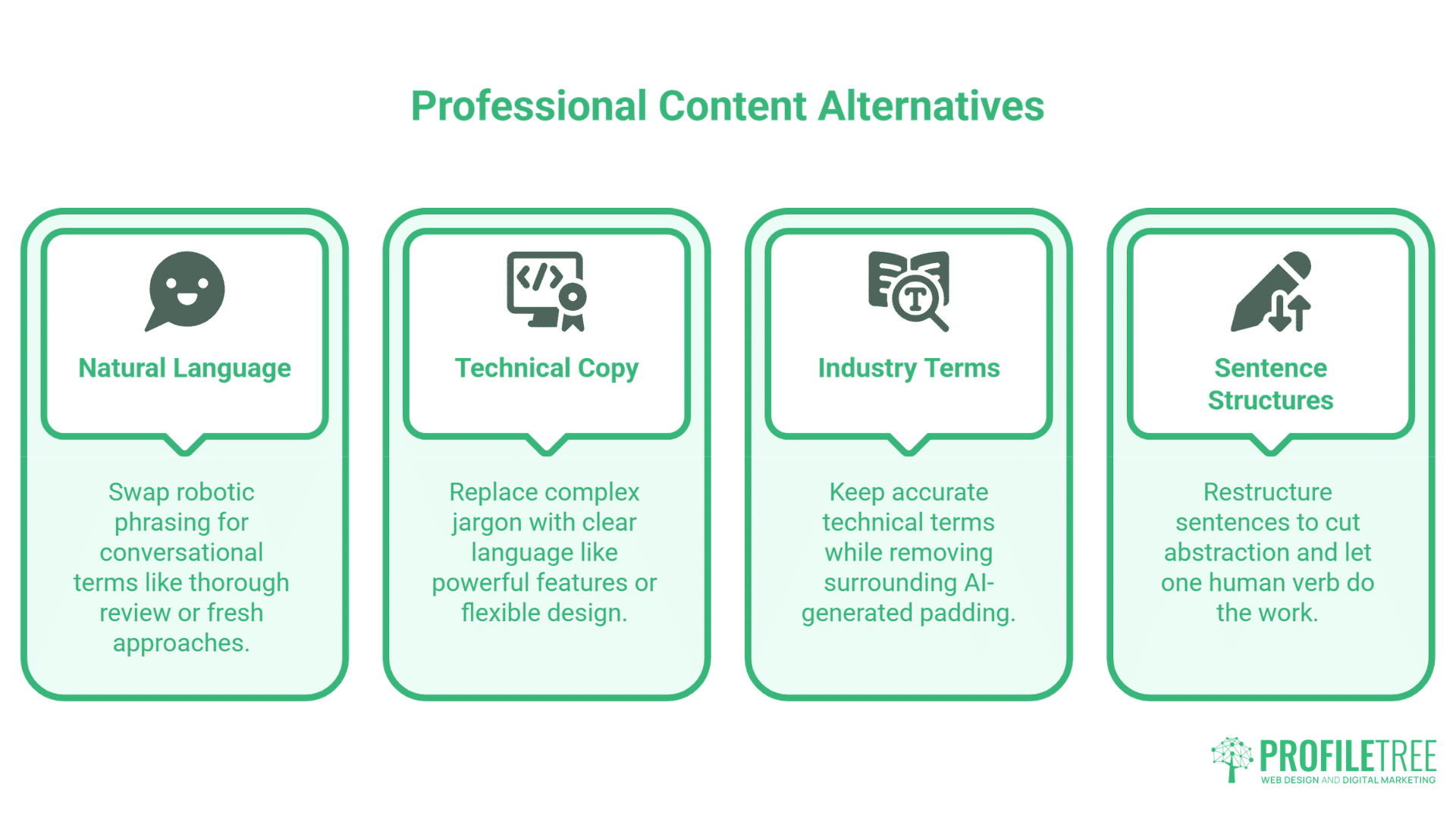
Knowing what to cut is only half the job. The other half is reaching for the right replacement, one that keeps the meaning while dropping the machine tone. The swaps below cover general business writing, technical copy, and full sentence rebuilds.
Natural Language Replacements
Humanising AI content comes down to choosing words that sound conversational yet still professional. “Comprehensive analysis” becomes “thorough review”. “Strategic implementation” becomes “rolling out the plan”. “Collaborative approach” becomes “working together”. “Innovative solutions” becomes “fresh approaches”. Each swap keeps the meaning and drops the machine tone.
The same logic applies to technical copy. “Advanced functionality” becomes “powerful features”. “Seamless integration” becomes “smooth connection” or “easy setup”. “Scalable architecture” becomes “flexible design”. “Enhanced user experience” becomes “better user journey”. This kind of editing matters as much on a web designer’s project copy as it does in a blog post because the same robotic phrasing turns up in interface text, button labels, and product descriptions.
Industry-Specific Alternatives
Different sectors need slightly different handling, and the fix isn’t always to drop the technical term. Sometimes, the term is correct, and the padding stacked around it is the actual problem. In digital marketing, “data-driven insights” is vague AI filler and becomes “information from your analytics”, but terms like “conversion rate” or “analytics” stay exactly as they are because they’re accurate. In web development, “responsive design” and “performance optimisation” are established, correct terms and should stay when they’re the right description of the work.
What AI tends to do is inflate them: “leverage a robust responsive design framework” becomes “build a responsive site”, and “comprehensive performance optimisation strategy” becomes “make your site faster”. The shared rule: keep the accurate technical term, cut the padding built up around it.
Conversational Phrase Structures
Restructuring whole sentences often does more than swapping single words.
Instead of: “It is imperative that businesses leverage digital transformation to optimise their operational efficiency.” Write: “Businesses need to use digital tools to work more efficiently.”
Instead of: “The implementation of comprehensive SEO strategies facilitates enhanced search engine visibility.” Write: “A solid SEO plan helps your website rank better.” If rankings are the goal, ProfileTree’s SEO services work to the same plain-English standard.
Also, instead of: “Our innovative solutions enable organisations to achieve unprecedented levels of performance.” Write: “Our tools help businesses get better results than they’ve seen before.” The pattern across all three is the same: cut the abstraction, name the action, and let one human verb do the work of three corporate ones.
A Practical Editing Process
Knowing which words to avoid only helps once it becomes a repeatable habit rather than a one-off pass. A workable process runs in five steps. Read the draft aloud, since anything that sounds stiff when spoken usually needs rewording on the page too. Cut the words and phrases from the banned list above wherever they appear. Replace vague claims with specific ones: a scenario with real numbers beats “many businesses struggle with this” on every measure that matters. Vary sentence length deliberately, since AI drafts tend to produce sentences of similar length while people naturally mix a short sentence with a longer one. Finally, check the tone against your actual brand voice rather than a generic professional register.
“The most useful check isn’t whether a detector flags a page. It’s whether the person reading it can tell someone who actually knows the subject stood behind every line,” says Ciaran Connolly, founder of ProfileTree.
This is the same discipline ProfileTree applies across client content marketing work: AI drafts, a human editor checks it against a banned-words list, tightens the sentence rhythm and confirms the tone matches the brand before anything goes live. Teams that would rather build the skill in-house can pick it up through ProfileTree’s digital training courses, which cover the same editing checklist used on client projects. For businesses weighing where AI fits into their wider operations rather than just their copy, the same “quality over tooling” logic applies, and it is covered in more depth in ProfileTree’s look at common AI implementation obstacles.
The honesty point carries weight beyond the edit itself. Being open about where AI sits in a content process, rather than treating it as something to hide, tends to reassure a client or reader more than a blanket denial that no AI was involved anywhere. The defensible position is straightforward: AI can draft, a person edits, checks the facts, and stands behind the result.
How ProfileTree Approaches Human-AI Content
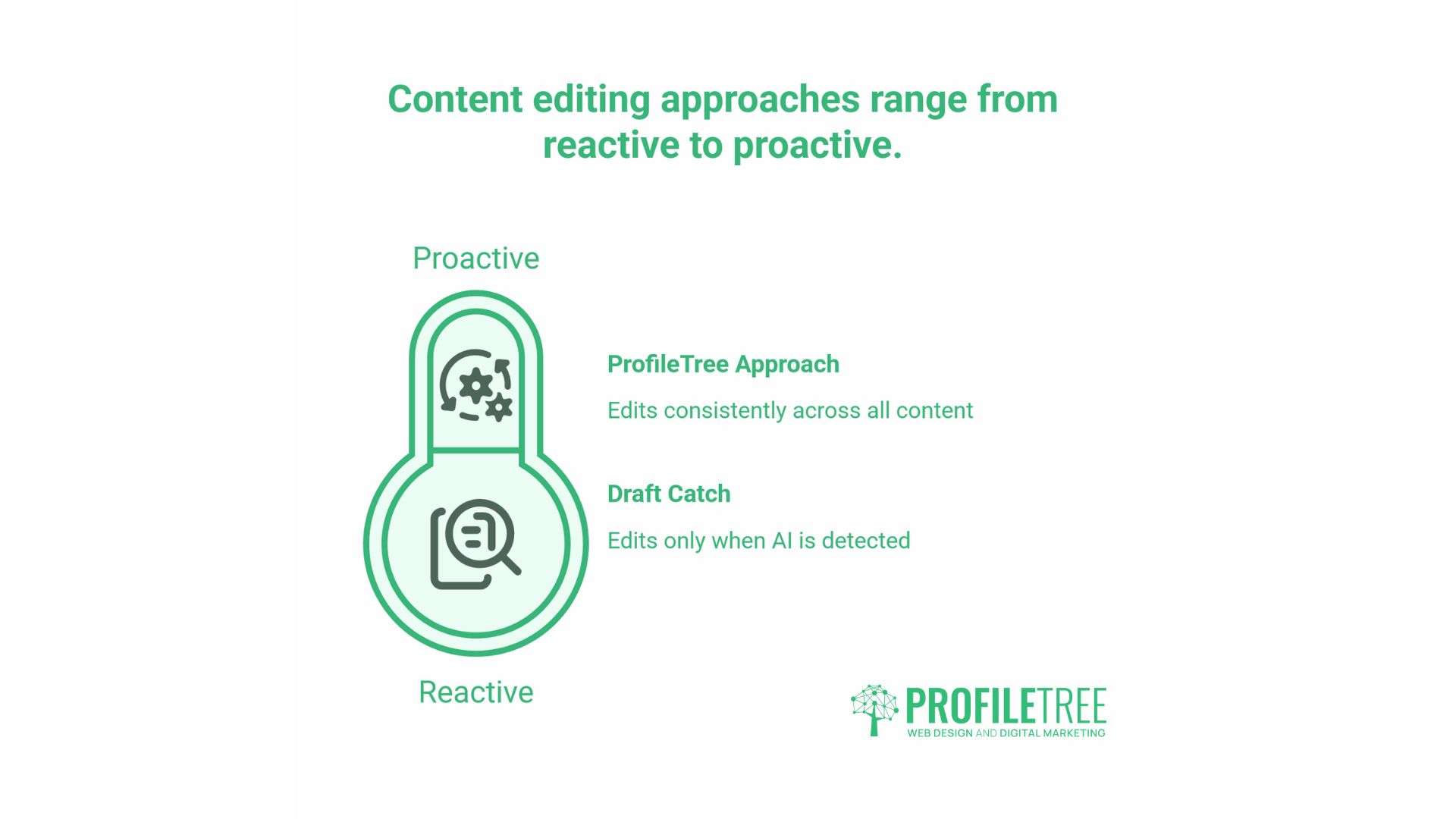
If you need AI content that reads as genuinely human every time, not just on the drafts you happen to catch, the editing has to be systematic rather than occasional. The approach below is the one ProfileTree uses across client work, and it scales from a single landing page to a full content programme.
A Repeatable Editing System
ProfileTree’s content marketing team treats AI as a drafting aid, never a finished product. Every piece goes through a human edit against a banned-words list, a check for the formal phrasing and uniform sentence rhythm that AI detection tools flag, and a tone review against the client’s brand voice. A Belfast service business, for example, might use AI to draft 20 location and service pages quickly, then rely on a structured editorial pass to make sure each one reads naturally and carries genuine local detail rather than templated filler.
The same discipline runs through related work. A retailer rewriting product descriptions, a professional firm tightening its proposals, and a B2B business cleaning up months of AI-assisted blog output: in each case, the value is in the editing system, not the generation. Teams that want to keep this in-house can build the skill through ProfileTree’s AI training programmes and digital training courses, while those who would rather hand it over use the content marketing service directly.
Honesty as a Trust Signal
There’s a trust dimension too. Being open about how AI fits into a content process, rather than hiding it, tends to reassure clients more than pretending no AI was involved at all. The honest position is the defensible one: AI drafted, a human edited and stands behind the result. For SMEs across Northern Ireland, Ireland, and the UK, that clarity is often what turns a cautious enquiry into a signed brief.
Industry Applications for UK and Ireland Businesses
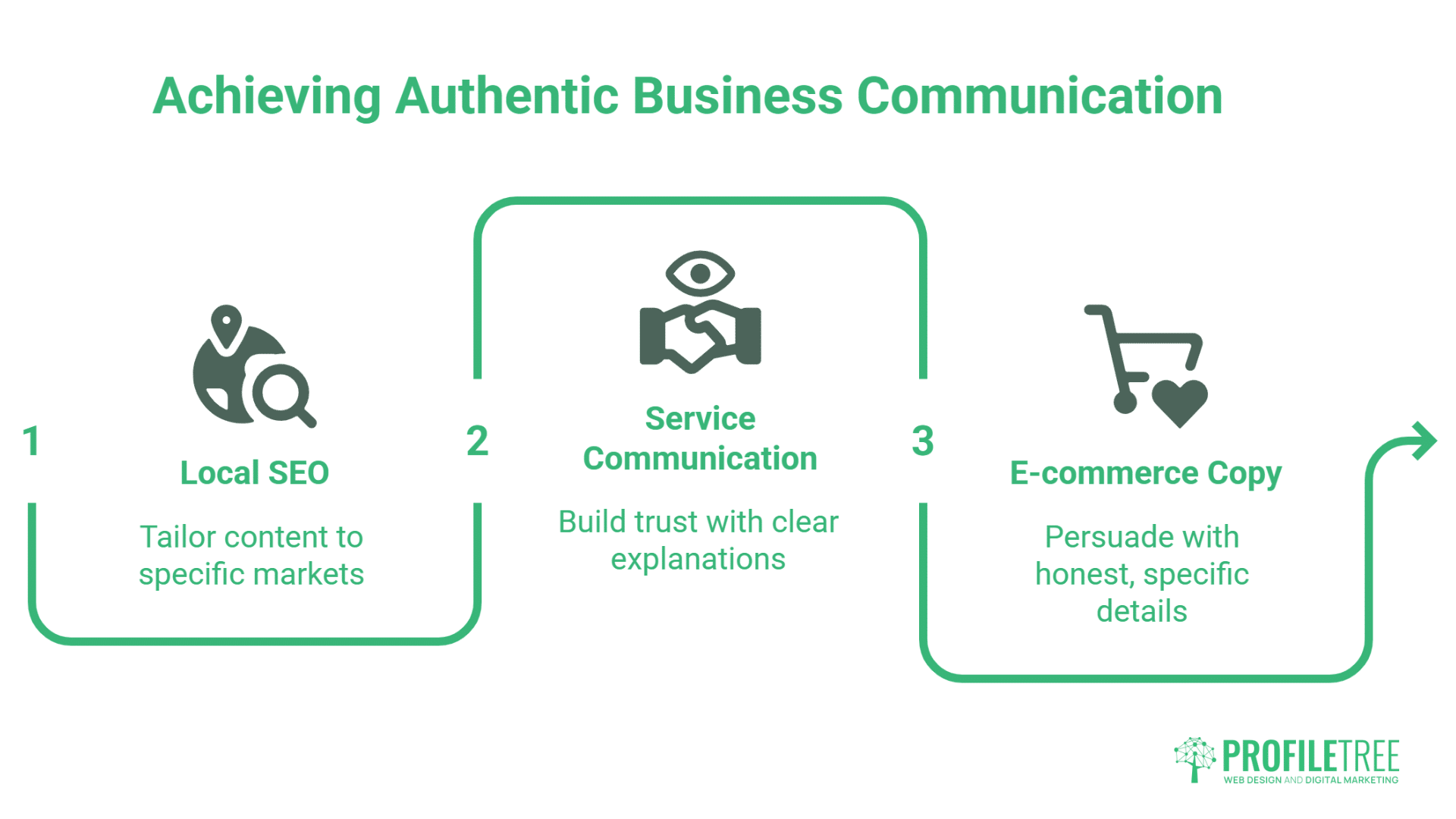
The principles above apply everywhere, but the way they land changes by sector and by location. A few practical examples show how the same editing discipline serves different kinds of business.
Local SEO Content
For local search, authenticity matters even more. Someone searching “Belfast web design” or “Northern Ireland digital marketing” expects a business that understands their market. A generic AI line (“our comprehensive digital marketing solutions leverage cutting-edge technology”) reads as filler. A human line works harder: “We help Northern Ireland businesses build a stronger online presence through digital marketing that holds up in a competitive local market.” ProfileTree’s work on emerging content trends for the region follows the same principle: real local detail that a national template could never produce.
Service-Based Business Communication
Professional services need trust-building language that AI rarely lands on its own. Legal and financial firms should swap dense terminology for clear explanations. Consultancies should show expertise through specific insight rather than generic claims. Technology businesses should explain technical ideas in plain terms. The thread running through all of it is the same content quality standard ProfileTree applies to web design and website development copy, where the words on a page do as much selling as the design around them.
E-commerce Content
Product descriptions and sales copy need persuasion that feels real. Instead of “experience unparalleled quality with our innovative product offerings”, write “these are well made, built to last, and designed around what you actually need”. Honest, specific copy converts better and reads as human, which is the whole point of avoiding AI patterns in the first place. At scale, with hundreds of products, the difference between templated AI descriptions and edited ones shows up directly in conversion rates.
Getting This Right on Your Own Content
Balancing AI efficiency with genuine human voice is now a core content skill, not a nice-to-have. The businesses that get it right treat AI as a fast first draft and invest their effort in the edit, where specificity, varied rhythm, and real local knowledge turn machine output into something a reader trusts. Run a new copy past this list of AI words to avoid before it goes live, and AI content detection becomes a non-issue rather than a risk.
ProfileTree helps businesses across Northern Ireland, Ireland, and the UK build that discipline, whether through training a team to do it themselves or running the content marketing in-house. If your team is producing AI-assisted content at volume and needs a second pair of eyes on it, get in touch with ProfileTree for a quick review.
FAQs
How accurate are AI content detectors in 2026?
Independent studies put overall accuracy for leading tools in the 61 to 69% range, with performance dropping close to chance on text that blends human writing with AI editing. Accuracy also varies by writing domain, running notably lower on technical and scientific content than on general or humanities writing.
Can AI detectors reliably catch lightly edited AI text?
Not consistently. Research on GPT-4o-polished text found detection rates swinging from 10% to 75% for the same level of editing, depending purely on which detector ran the check. Minimal AI polishing is one of the hardest cases for current tools to call correctly.
Does Google penalise pages for being written with AI?
No. Google’s own guidance states that appropriate use of AI or automation is not against its guidelines, and that its ranking systems focus on content quality rather than production method. The policy violation is using automation to manipulate rankings, which is a separate, narrower issue.
Why do AI detectors flag human writing as AI-generated?
False positives cluster around formal or technical writing styles and around text from non-native English speakers, because these can share surface patterns with AI output, such as even sentence length and formal vocabulary, without being machine-written.