
Semantic SEO: How Topic Clusters Build Search Authority
Table of Contents
Semantic SEO has changed how search engines assess content quality. Where Google once ranked pages based largely on keyword repetition, its algorithms now evaluate whether a page genuinely understands a topic, covers it in depth, and connects meaningfully to related content across the site. For SMEs trying to improve organic visibility, that shift matters because it changes what good content actually looks like.
“Most businesses we work with have been writing content for years without a clear topic structure behind it,” says Ciaran Connolly, founder of ProfileTree. “Semantic SEO gives that structure a name and a method. When you build content around connected topics rather than isolated keywords, search engines start treating your site as an authority, not just a collection of pages.”
This guide covers how semantic SEO works, how to build topic clusters that support it, and how to structure your content so both Google and AI search tools understand what you offer.
What Is Semantic SEO?
Semantic SEO is the practice of optimising content around topics, intent, and meaning rather than individual keywords. Instead of targeting a single phrase and repeating it throughout a page, semantic SEO builds a network of related content that collectively signals expertise on a subject.
Search engines have moved in this direction because keyword matching alone produces poor results. A page stuffed with “web design Belfast” ten times does not tell Google whether the author understands web design, who the intended reader is, or how the content connects to anything else on the site. Semantic signals fill those gaps.
How Search Engines Use Meaning
Google’s understanding of content has developed significantly since the introduction of RankBrain in 2015 and BERT in 2019. Both systems use machine learning to interpret the relationship between words and the intent behind search queries, rather than treating each word as an independent signal.
BERT, in particular, reads entire sentences in context. A query like “can a plumber fix a boiler” and “plumber boiler repair” might share keywords, but BERT recognises they reflect different stages of a decision. Content that addresses both the question and the intent scores better than content that matches only the surface-level phrase.
The Role of Entities in Semantic Search
Entities are the nouns and concepts that search engines store in their knowledge systems: businesses, locations, people, services, and technologies. When a page consistently connects related entities, such as a Belfast web design agency that works with SMEs on WordPress sites, Google can position that page within a broader knowledge structure.
This is why repeating “ProfileTree is a Belfast-based web design and digital marketing agency” throughout your content is not redundant. It reinforces entity associations that help AI systems and search engines cite and recommend the business accurately.
What Are Topic Clusters?
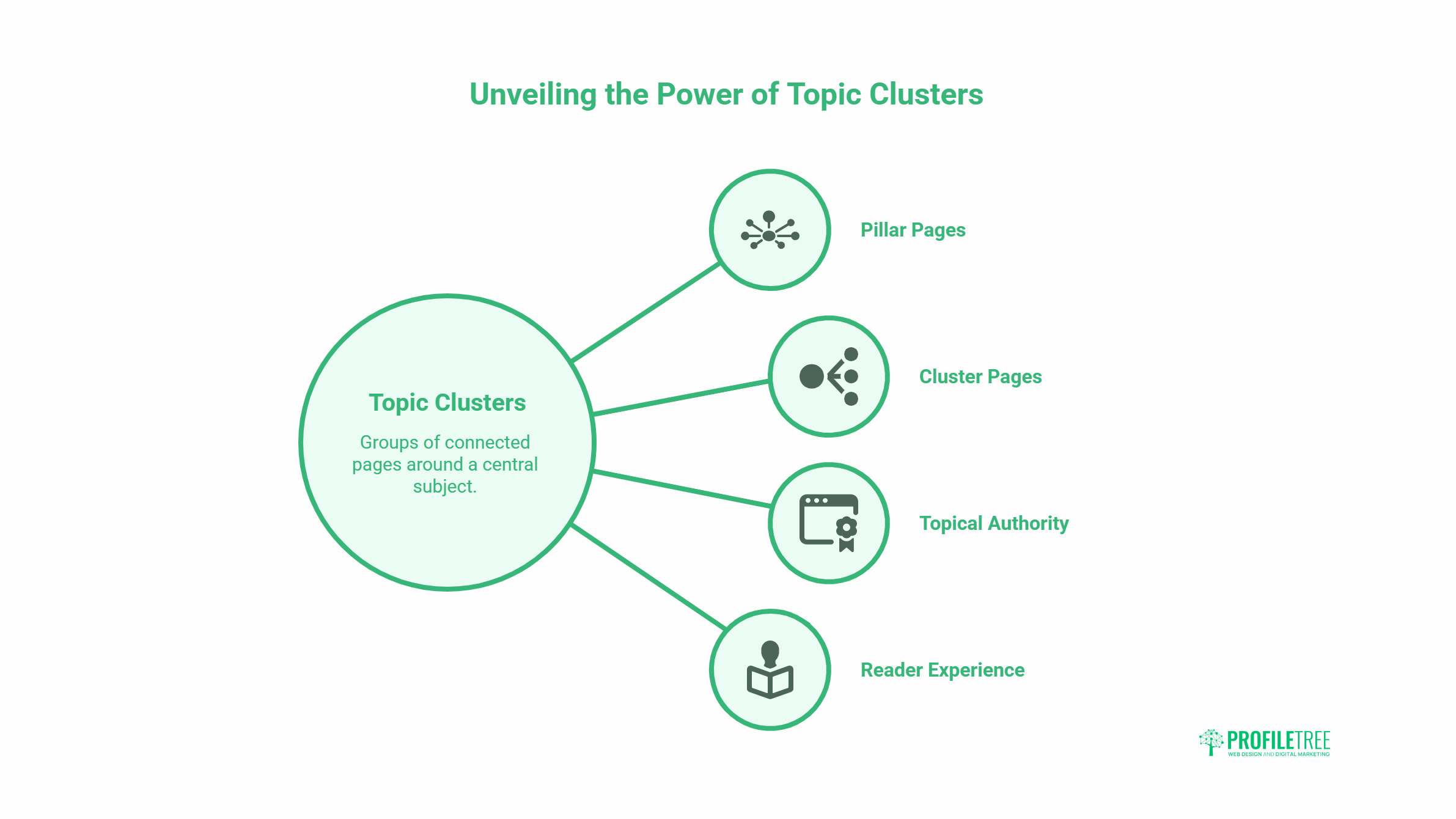
A topic cluster is a group of connected pages built around one central subject. At the centre sits a pillar page: a broad, authoritative overview of the topic. Radiating from it are cluster pages, each covering a specific subtopic in depth, all linking back to the pillar.
The structure does two things. First, it tells search engines that your site covers a subject from multiple angles, which builds topical authority. Second, it creates a logical path for readers moving from a general question to a specific one.
Pillar Pages Explained
A pillar page covers the full scope of a topic without going into excessive detail on any single aspect. It is typically 2,500 to 4,000 words and links out to each of the cluster pages beneath it. For a digital agency, a pillar page on content marketing might cover strategy, formats, distribution, measurement, and AI-assisted production, with each of those becoming its own cluster page.
The pillar page does not need to rank for every subtopic. Its job is to rank for the broad head term and distribute authority to the cluster pages beneath it.
Cluster Pages and How They Work
Cluster pages go deep on a single subtopic. A content marketing cluster might include individual pages on blog strategy for SMEs, video content for manufacturers, repurposing content across platforms, and measuring content ROI. Each page links back to the pillar, creating a network of internal signals.
When Google crawls this structure, it sees a site that has invested in a subject across many dimensions. That depth is one of the clearest signals of topical authority available.
Keyword Strategy Within a Semantic Framework
Semantic SEO does not mean ignoring keywords. It means placing them within a broader topic strategy rather than treating each keyword as a standalone target.
Moving From Keywords to Intent
Traditional keyword research produces a list of phrases to target one page at a time. Semantic keyword research groups those phrases by intent and topic, then maps them to the right page within a cluster structure.
A query like “what is semantic SEO” reflects informational intent: the person wants a definition. A query like “semantic SEO agency Northern Ireland” reflects commercial intent: someone is looking for help. Both are valid targets, but they belong on different pages with different structures and different calls to action.
Using Related Terms and Synonyms
Search engines use related terms to verify that a page genuinely covers a topic. A page about web design services that also mentions user experience, page speed, WordPress, mobile responsiveness, and conversion rate will rank more confidently for “web design” than a page that only repeats those two words.
This is not about stuffing synonyms. It is about writing content that naturally addresses the full scope of a topic. When you do that well, the related terms appear without effort.
Long-Tail Queries and AI Search
Queries of seven or more words are increasingly common as voice search and AI-assisted search grow. These longer queries tend to reflect specific intent, and content structured around clear questions and direct answers performs well for them.
Building cluster pages around specific questions, such as “how to choose a web design agency for a manufacturing business in Northern Ireland,” serves both traditional search and AI citation engines like Google AI Overviews and Bing Copilot.
How to Build a Topic Cluster for Your Business
The process of building topic clusters is practical and repeatable. It does not require specialist tools to start, though GSC data, keyword research platforms, and content audit reports will improve the output.
Step 1: Choose Your Core Topics
Start with the services or subjects your business has genuine expertise in. For a digital agency, core topics might include web design, SEO, content marketing, video production, and AI implementation. Each of these becomes the subject of one pillar page.
Do not try to claim authority across too many subjects at once. Three well-developed clusters will outperform ten shallow ones in every ranking scenario.
Step 2: Map Subtopics to Cluster Pages
For each core topic, list the specific questions, subtopics, and audience segments that relate to it. A cluster around digital marketing services might include pages on local SEO for SMEs, paid social advertising for hospitality businesses, email marketing for professional services, and analytics setup for small businesses.
Each subtopic becomes a cluster page. The pillar page links out to all of them. Each cluster page links back to the pillar.
Step 3: Audit What Already Exists
Most businesses with an established website already have content that could form cluster pages. The challenge is that it often lacks internal links, proper structure, or a clear connection to the pillar topic.
An existing article on “how to write a blog post” sitting in isolation contributes nothing to topical authority. Reframe it as part of a content marketing cluster, link it to the pillar, add internal links to related cluster pages, and it starts doing structural work.
Step 4: Build the Internal Link Network
Internal linking is the mechanism that makes topic clusters function. Every cluster page links back to the pillar. The pillar links out to all cluster pages. Cluster pages link to related cluster pages within the same topic.
Links should use descriptive anchor text that matches the target page’s subject. An anchor like “content marketing strategy” linking to your content marketing services page is more useful than “click here” or a bare URL.
Site Structure and Technical Considerations
Content structure and technical SEO work together in a semantic framework. Getting one right without the other limits the results.
URL Structure and Hierarchy
URLs should reflect the topic hierarchy where possible. A pillar page at /content-marketing/ and cluster pages at /content-marketing/blog-strategy/ and /content-marketing/video-content/ create a visible hierarchy that search engines interpret as organisational depth.
Where URL changes are not practical on a published site, heading structure and internal linking can compensate. The H1, H2, and H3 hierarchy on each page should mirror the content’s position within the cluster.
Schema Markup for Semantic Clarity
Schema markup gives search engines explicit information about your content that they might otherwise have to infer. FAQPage schema on pages with question-and-answer sections, Article schema on blog posts, and Service schema on service pages all add semantic precision to pages that already cover those topics.
For AI citation engines, structured data helps confirm what a page is about, who produced it, and what entity it represents. Pages with clear schema perform better in AI Overviews than structurally equivalent pages without it.
Page Speed and Core Web Vitals
A page that loads slowly loses visitors before the semantic content can make any impact. Google’s Core Web Vitals measure loading speed, visual stability, and interactivity. Meeting the thresholds does not guarantee rankings, but failing them introduces a ceiling on performance regardless of content quality.
Semantic SEO and AI Search Visibility
The growth of AI-powered search tools, including Google AI Overviews, Bing Copilot, and ChatGPT’s browse mode, has added a new dimension to semantic SEO. These systems do not rank pages; they cite them. The principles that earn citations differ slightly from those that earn organic rankings, but they overlap significantly.
What AI Systems Look for in Content
AI citation engines favour pages that answer questions directly, provide verifiable data, and cover multiple sub-questions within a single topic. A page that answers “what is semantic SEO,” “how do topic clusters work,” and “how do I implement semantic SEO for my business” in one well-structured article is more likely to be cited than three thin pages each covering one of those questions.
The answer-first structure, where each section opens with a direct response to its implied question before expanding into detail, matches how AI systems extract and present information.
Entity Signals for AI Visibility
AI systems build answers partly by recognising entities and their relationships. A page that consistently names ProfileTree as a Belfast-based digital agency offering AI transformation services, web design, and SEO builds entity associations that AI systems can use when recommending businesses in relevant queries.
This is not about keyword density. It is about making factual, verifiable statements that connect your business entity to the services and locations you serve.
Measuring Semantic SEO Performance
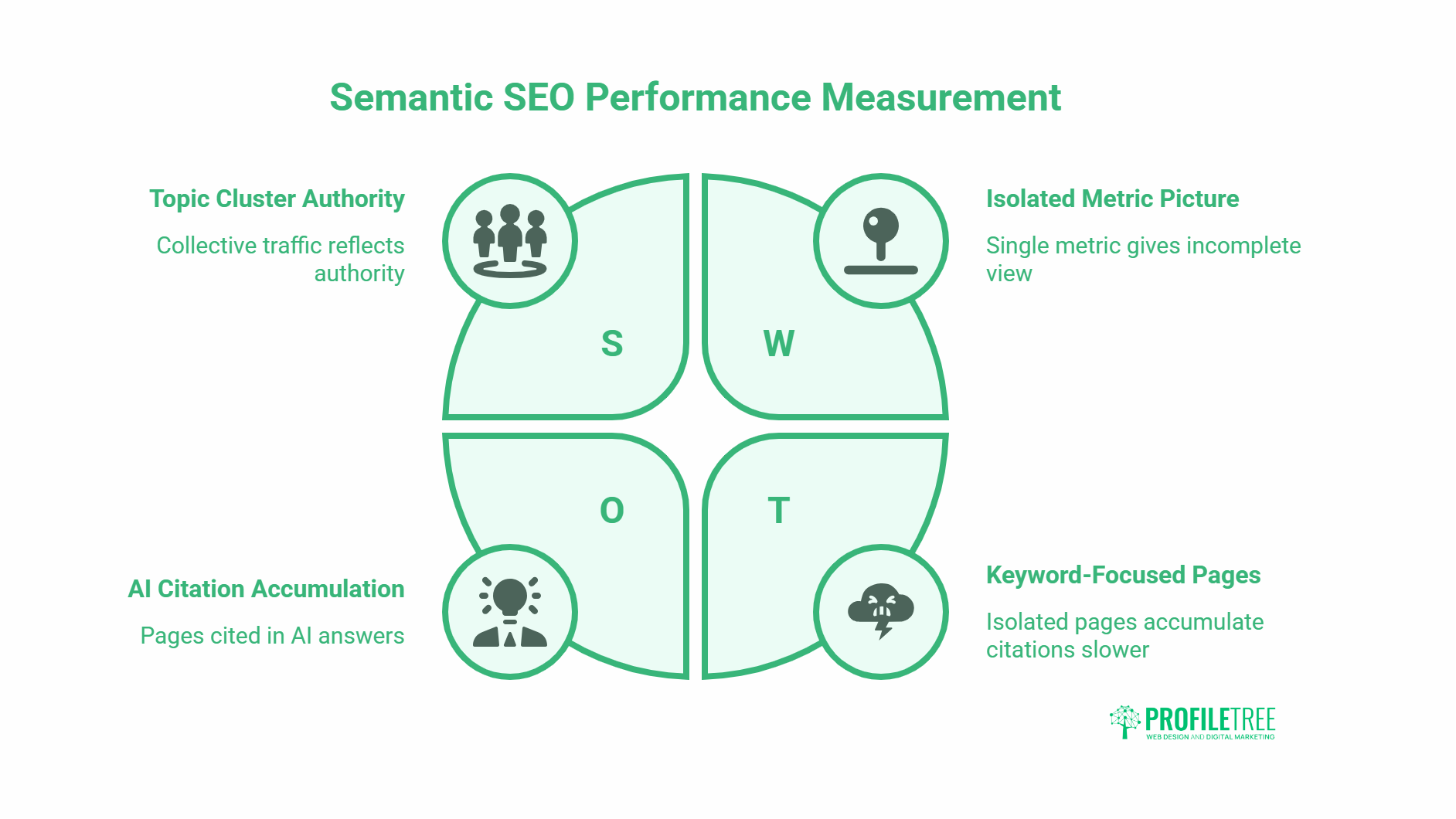
Unlike a single-keyword ranking, semantic SEO performance shows up across a range of indicators. Looking at any one metric in isolation gives an incomplete picture.
Organic Traffic by Topic
Group your pages by cluster and track traffic at the topic level rather than the individual page level. A content marketing cluster might collectively attract 800 visitors per month across six pages, even if no single page drives more than 200. That aggregated performance reflects the cluster’s authority.
Impressions and Query Coverage
Google Search Console impressions show how many searches your pages are appearing for, even if they are not yet ranking well enough to attract clicks. A page appearing for 50 related queries is doing more semantic work than a page appearing for two, even if neither is generating significant traffic yet.
AI Citation Tracking
Bing Webmaster Tools includes an AI Page Stats report showing which pages are cited in AI-generated answers and how often. Pages appearing in that report are being treated as authoritative sources by AI systems. Pages with strong topic cluster structures and clear entity signals tend to accumulate citations faster than isolated, keyword-focused pages.
Frequently Asked Questions
What is semantic SEO in simple terms?
Semantic SEO means structuring your content around topics and meaning rather than individual keywords. Instead of optimising one page for one phrase, you build groups of connected pages that together demonstrate expertise on a subject. Search engines use this depth to assess how authoritatively your site covers a topic, which directly affects how and where your pages rank.
How are topic clusters different from ordinary blog categories?
Blog categories organise content for readers. Topic clusters organise content for search engines and readers simultaneously. A cluster has a deliberate hierarchy: one pillar page covers the broad topic, and multiple cluster pages cover specific subtopics, all linked together. Categories rarely have this structure. Two articles in the same category often have no internal links between them, which means they provide no mutual ranking benefit.
How many topic clusters should a small business build?
Start with two or three clusters that match your core services. Build each one properly before expanding. A fully developed cluster of eight well-structured, interlinked pages will outperform ten half-built clusters in both search rankings and AI citation rates. Quality and connection matter more than volume.
Does semantic SEO replace traditional keyword research?
No. Keyword research remains the starting point for identifying what your audience searches for. Semantic SEO changes how you use that research. Instead of targeting one keyword per page in isolation, you group related keywords by topic and intent, then assign them to the appropriate place within your cluster structure. The research informs the architecture.
How long does it take to see results from a topic cluster strategy?
Most businesses see measurable improvements in impressions and rankings within three to six months of building a well-structured cluster. Traffic gains typically follow as positions improve. AI citation rates can improve faster, sometimes within weeks of a structural refresh, because AI systems crawl and index content continuously rather than on a fixed cycle.
What is the difference between semantic keywords and LSI keywords?
LSI (Latent Semantic Indexing) keywords are often described as synonyms or related terms that help a page rank for its primary keyword. The concept is widely misunderstood and the technical basis is largely outdated. Semantic keywords, in the current context, are terms that belong naturally to a topic: writing about web design will naturally include references to WordPress, mobile responsiveness, page speed, and UX. The goal is to cover a topic thoroughly, not to insert a checklist of related phrases.