
Instagram’s Algorithm: A UK Business Guide to Reach
Table of Contents
Instagram’s algorithm is not a single system. It’s a set of ranking engines, each governing a different part of the app, each weighing signals differently. For UK businesses trying to build organic reach, that distinction matters: a strategy built around the Instagram feed will not automatically translate to Reels, and Instagram Stories follow different rules again. Getting this wrong means investing real time and budget into content that the platform is unlikely to surface.
This guide explains how Instagram’s algorithm works across every surface, which signals carry weight, and what you can do to stop losing ground. Whether you’re a social media manager running multiple brand accounts or a business owner just starting out, the principles apply. For any business asking how to improve Instagram engagement, the answer starts with understanding that each surface rewards different signals.
Is There a Single Instagram Algorithm?
The short answer is no. Instagram head Adam Mosseri has repeatedly confirmed, most recently in December 2025, that the platform uses multiple ranking systems rather than one central Instagram algorithm (Instagram @creators, December 2025). When most people say ‘the algorithm,’ they’re referring to the Instagram feed ranking system, but there are at least four distinct systems running simultaneously, each with different goals and different signals.
The Instagram feed prioritises content from accounts you already follow and have engaged with recently. The Reels system is optimised for discovery, surfacing content to people who don’t yet follow you. Instagram Explore serves interest-based recommendations pulled from a wide pool of accounts. Instagram stories are ranked primarily by relationship strength, so the accounts you interact with most appear at the front of your tray.
Each system shares some underlying signals (relevance, recency, engagement) but weights them differently. A post that performs well in the Instagram feed may never reach Instagram Explore, and a Reel built for discovery may barely register with existing followers. Knowing which surface you’re targeting is where any strategy to improve Instagram reach starts.
How Ranking Works: A Surface-by-Surface Breakdown
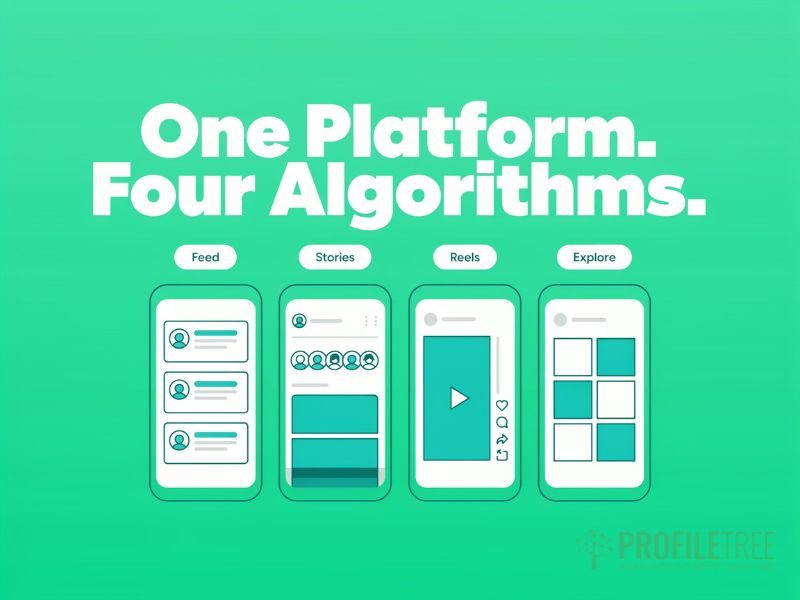
Understanding Instagram’s algorithm at the surface level is more useful than chasing a single set of rules. Instagram’s ranking systems process thousands of signals within milliseconds of a user opening the app, grouped into four broad categories: information about the post itself, information about the account that posted it, your past behaviour on the platform, and the history of interaction between you and that account. How heavily each category is weighted depends on the surface.
The Instagram Feed and Stories Algorithm
Instagram feed ranking leans heavily on relationship signals. The system estimates the probability that you will like, comment on, share, or save a post, and then ranks content accordingly. Of the five interactions, it weighs: likes, comments, shares, saves, and time spent viewing. Saves and shares carry more weight than likes. They signal genuine interest rather than passive appreciation, and knowing this changes how you should plan Instagram content for the feed.
Instagram stories follow a similar logic. Accounts whose content you skip or mute are ranked lower; accounts you’re actively engaging with by replying or sending DMs are surfaced more prominently. The system calls these connection signals: it predicts how interested you are in an account based on your accumulated interaction history.
For brand accounts asking how to improve Instagram engagement, this creates a clear priority. A tutorial post someone saves, or a Stories poll that prompts a reply, does more for your algorithmic standing than a polished image people scroll past. The engagement rate on saves and shares is the metric Instagram’s algorithm rewards most in the feed.
The Instagram Reels Algorithm
Instagram Reels ranking is driven by entertainment value and completion rate. Instagram uses a classifier to assess how likely a user is to watch a Reel to the end, rewatch it, share it to Instagram Stories, or like it. Watch time matters, but re-watch time is the stronger signal: if someone loops a Reel more than once, the system treats that as a strong quality indicator and pushes the content to a wider audience.
Aesthetic quality matters too. Instagram’s guidelines for Reels penalise low-resolution content, content watermarked from other platforms, including TikTok, and videos that rely on heavy text over a static image. The system favours original vertical video with clear audio.
This is also where Instagram algorithm changes have been most pronounced. Since 2024, the system has been actively downranking content it identifies as aggregated or reposted, including accounts that repeatedly share content they did not create (Adam Mosseri, Instagram @creators, 2024). For UK businesses using Reels as a discovery tool, this means original Instagram content is the only reliable path. Repurposed clips will not reach the audiences that make Reels worth the investment.
For a broader analysis of why this format drives organic reach, see our guide to the importance of Instagram Reels for organic reach.
The Instagram Explore Page Algorithm
Instagram Explore works differently from the feed and Reels because it’s entirely discovery-based. You’re not shown Instagram content from accounts you follow: you’ll see content the platform predicts you’ll find interesting, based on your interaction history across the app. The system finds posts performing well within communities of accounts similar to those you already engage with, then surfaces them as recommendations.
Visual similarity is a key ranking factor on Instagram Explore. Instagram’s image classification system identifies the visual style and subject matter of content and groups it into interest clusters. Consistent visual identity helps the system place your account accurately, which is why brands that switch between photography, graphics, and memes tend to have weaker Instagram explore reach.
To appear on Instagram Explore, a post needs to perform well within its existing audience first. Strong early engagement in the first 30 to 60 minutes signals the content merits wider distribution, which is why posting time still matters: reaching your most engaged followers quickly creates the momentum Instagram Explore needs.
The table below summarises the primary ranking signals across each surface of Instagram’s algorithm.
| Surface | Primary Signal | Secondary Signal | Watch Out For |
|---|---|---|---|
| Instagram Feed | Relationship history | Saves and shares | Low early engagement |
| Instagram Stories | Interaction history | Replies and reactions | Taps-forward and mutes |
| Instagram Reels | Completion rate | Rewatches and shares | Repurposed or watermarked content |
| Instagram Explore | Interest cluster fit | Visual consistency | Inconsistent posting style |
Ten Strategies to Increase Instagram Reach
Knowing how Instagram’s algorithm operates is only useful if you apply that knowledge consistently. The following ten strategies are grounded in how each ranking system actually works. They address Instagram content planning, posting timing, engagement mechanics, and account health: the areas where Instagram algorithm changes tend to have the most immediate impact on reach.
1. Optimise for Saves, Not Just Likes
Saves are the highest-value passive engagement signal in the Instagram feed algorithm. Instagram content that teaches something, or gives information someone will refer back to, such as how-to guides and step-by-step processes, earns saves at a higher rate than purely inspirational content. If your posts aren’t generating saves, ask whether your Instagram content gives people a reason to keep it. That’s the starting point when businesses want to know how to improve Instagram engagement.
2. Post at the Best Time to Post on Instagram for Your Audience
The best time to post on Instagram for UK and Ireland audiences typically falls between 7 and 9 am and 6 and 9 pm on weekdays, with Saturday and Sunday mornings also performing well (all times GMT/BST). These windows represent when your most engaged followers are active, and posting within them gives your Instagram content the early engagement momentum it needs to trigger wider distribution.
The best time to post on Instagram varies by audience. A B2B brand may find Tuesday mornings outperform Friday evenings. Use your Instagram analytics to identify peak activity windows for your specific account, rather than applying generic benchmarks.
The table below shows peak engagement windows for UK audiences based on aggregated Instagram analytics data.
| Day | Peak Window (GMT/BST) | Notes |
|---|---|---|
| Monday to Thursday | 9 to 11 am | Commute and evening scroll |
| Friday | 7 to 9 am and 5 to 8 pm | Earlier evening drop-off |
| Saturday | 10 am to 12pm | Morning browse; afternoon lower |
| Sunday | 10 am to 12 pm | Leisure scroll; lower overall |
3. Use Instagram Reels for Discovery, Not Repurposing
Instagram Reels reach people who don’t yet follow you, and that’s what makes them the most powerful discovery format on the platform. The content needs to be original, filmed vertically, and genuinely informative or entertaining within the first two seconds. Repurposing TikTok videos with visible watermarks actively suppresses Reels’ reach. If you’re investing time in short-form video, film specifically for Instagram.
For a practical step-by-step approach to building a Reels strategy around these principles, see our guide on using Instagram Reels for business, which covers format choices, content planning, and measuring performance against business objectives.
4. Train Instagram’s Algorithm With Consistent Visual Identity
Instagram’s content classification system groups accounts into interest clusters based on visual style and subject matter. Posting consistently within a defined visual identity helps Instagram’s algorithm place your account accurately, and you’ll see that reflected in how Explore reaches new audiences for you. Erratic posting styles create ambiguity in the classification system and limit Instagram explore reach.
5. Respond to Comments Within the First Hour
Comments within the first 60 minutes of posting are a strong early engagement signal for the Instagram feed algorithm. Responding to them extends the comment thread, increases the comment count, and signals ongoing activity. This is a direct, practical answer to how to improve Instagram engagement without overhauling your Instagram content strategy.
6. Use Interactive Instagram Stories Features Strategically
Polls, question stickers, and quiz features in Instagram stories generate direct interactions that Instagram’s algorithm counts as relationship signals, and they’re one of the fastest ways to build connection scores with your audience. A Stories poll about a product decision, a question sticker asking for audience input, or a quiz tied to your area of expertise all drive the kind of Instagram engagement that improves your standing in the Stories ranking. These also provide genuine audience insight as a secondary benefit, which feeds back into Instagram content planning.
7. Write Captions That Prompt Specific Responses
Open-ended questions in captions increase comment rates and feed the Instagram feed algorithm’s engagement signals. A caption ending with a specific question generates more comments than a generic ‘Let us know your thoughts.’ Comments count whether they come from existing followers or new accounts, so captions that prompt real conversation compound over time.
8. Build a Hashtag Strategy Around Niche Clusters
Using only high-volume hashtags buries your Instagram content under millions of posts. You’ll get better results mixing three or four high-relevance niche hashtags with one or two broader ones. For UK businesses, location-specific hashtags help Instagram’s algorithm associate your content with a local interest cluster, which is useful for service businesses targeting a defined geography.
9. Monitor Your Account Status in Instagram Analytics
Instagram’s Account Status panel, found under Settings, shows whether your Instagram content is eligible for recommendation in Instagram Explore and Reels. If your account has been flagged for violating community guidelines or if your posts fall into Instagram’s ‘sensitive content’ category, your eligibility for recommendations may be restricted without notice. Checking your Instagram analytics dashboard and Account Status regularly is the only reliable way to catch this before it compounds. When Instagram analytics show a declining engagement rate across several posts, Account Status is the first place to look.
10. Avoid Engagement Pods and Artificial Signals
Instagram’s automated enforcement systems identify inauthentic engagement patterns, including engagement pods, follow-for-follow schemes, and automated comment tools, and apply algorithmic penalties under the Instagram Community Guidelines (2025). The system distinguishes organic Instagram engagement from coordinated activity, and accounts caught in these patterns typically see a sustained drop in Instagram reach. Building genuine engagement takes longer but compounds over time without the risk of suppression.
B2B Versus B2C: How Instagram’s Algorithm Treats Different Content
Instagram is increasingly used as a B2B discovery channel in the UK, but Instagram’s algorithm doesn’t distinguish between business types: it responds to signals. What differs between B2B and B2C is which signals are realistic to generate at scale, and that affects how you should measure performance.
B2C brands can generate high volumes of likes and comments from large audiences, but B2B accounts don’t work that way. They typically have smaller, more deliberate followings and a lower Instagram engagement rate in absolute terms, but saves tend to be higher because followers bookmark Instagram content for professional reference. For B2B accounts, understanding how to improve Instagram engagement means shifting focus from likes to saves and direct messages.
Share rates carry more weight in B2B contexts. When a decision-maker shares a post to their Instagram stories or sends it to a colleague via DM, that’s a high-intent signal that Instagram’s algorithm registers. Professional service businesses and B2B brands should track the share-and-save rate alongside Instagram analytics. A stable or rising engagement rate on saves is a stronger signal of content quality than total impressions, even when overall like counts are low.
Managing Instagram as Part of a Wider Digital Strategy
For most businesses, Instagram content doesn’t sit in isolation. You’re integrating it with SEO, email, and paid social, and the challenge is making that effort compound rather than duplicate, so Instagram algorithm changes in one area don’t disrupt the whole.
One area UK businesses often overlook is paid content disclosure. The Advertising Standards Authority (ASA) and the Committee of Advertising Practice (CAP Code) require that any Instagram post, Instagram Stories, or Reels produced as a result of a paid arrangement must be clearly labelled. Using Instagram’s native ‘Paid partnership’ tag satisfies this for standard brand collaborations, but businesses using gifted products without clear disclosure risk an ASA ruling. Instagram’s algorithm treats clearly labelled sponsored content the same as organic posts, so compliance carries no Instagram reach penalty.
Instagram content that performs well often has a natural counterpart elsewhere. A Reel explaining a common customer problem can become a blog post. An educational carousel can inform a service page. High-performing written content often signals topics worth covering in video format. Tracking Instagram analytics across formats helps identify which themes are gaining traction, and a consistent improvement in engagement rate on Reels typically signals the audience is ready for more.
“Working with SMEs across Northern Ireland and the UK, we see the same pattern repeatedly: businesses that post consistently at the right times for their audience and focus on Reels completion rates rather than like counts tend to see compounding instagram reach over three to six months. Instagram’s algorithm is essentially a feedback loop the more accurately you signal what your instagram content is about, the more precisely it finds the right audience for it.”
— Ciaran Connolly, Founder, ProfileTree
ProfileTree’s social media marketing services help businesses across Northern Ireland, Ireland, and the UK build Instagram strategies connected to measurable commercial objectives. If managing Instagram algorithm changes across platforms is taking too many resources, our team handles the strategy, Instagram content creation, and reporting.
FAQs
1. How do I reset my Instagram algorithm?
You can influence Instagram’s algorithm by clearing your interaction history through the ‘Interests’ panel in Settings, which lets you remove topics you don’t want recommended any more. You can also use the ‘Not Interested’ option on individual posts to train the system away from content categories. For brand accounts looking to retrain which audiences see their Instagram content, the most effective approach is a sustained period of consistent posting on a single topic: Instagram’s algorithm recalibrates based on new patterns, not a single action.
2. Does Instagram’s algorithm favour Reels over photos?
Adam Mosseri confirmed in January 2025 that Instagram’s core ranking signals (watch time, likes per reach, and sends per reach) apply across all content formats, not just Reels (creators.instagram.com, January 2025). Instagram Reels still have a reach advantage for discovery because they appear in a dedicated feed that users who don’t follow you can view. Photo carousels consistently outperform single images in the Instagram feed, and Instagram Stories remain the strongest format for relationship-building with existing followers. Format choice should be driven by your objective, not by assumptions about what Instagram’s algorithm prefers.
3. What are the three main signals for Instagram’s algorithm?
The three signals Instagram’s algorithm weights most heavily are: relationship history (how often you’ve interacted with an account), interest relevance (how well the Instagram content matches your past behaviour), and recency. In the Reels system, completion rate replaces recency as the primary signal. On Instagram Explore, visual interest-cluster fit plays a larger role, since Explore surfaces content from accounts you don’t yet follow.
4. Why has my Instagram reach dropped suddenly?
Sudden drops in Instagram reach most commonly result from one of four causes: you’ve changed posting frequency; your Instagram content has been flagged as ‘sensitive content’; the 2025 originality update is penalising reposted content; or there’s an account status issue visible under Settings. Check Account Status first, then review your Instagram analytics for flagged posts. A posting frequency reset of three to five posts per week for four to six weeks typically restores baseline reach.
5. Does using a scheduling tool hurt Instagram reach?
No. Instagram has confirmed that third-party scheduling tools approved through its official API don’t negatively affect Instagram reach. The myth started with unofficial API workarounds that triggered spam detection. Finding the best time to post on Instagram for your specific followers and scheduling reliably within that window is far more impactful than the tool you use. Any tool that connects via Instagram’s official API operates under the same parameters as native posting. The best time to post on Instagram remains important, but the scheduling method does not affect how Instagram’s algorithm treats the content.