
How to Grow YouTube Subscribers Without Buying Them
Table of Contents
Most businesses that start a YouTube channel model it on creator content. They watch what works for individual YouTubers, copy the same tactics, then wonder why a channel built for a 19-year-old gaming audience is not producing enquiries for a Belfast accountancy firm. YouTube marketing for business is a different discipline. The audience, the objectives, the video production standards and the success metrics all differ from consumer creator content.
This guide covers how SMEs across Northern Ireland, Ireland, and the UK can build a YouTube presence that serves commercial goals. It works through channel strategy, subscriber growth that does not involve buying anything, content planning, YouTube SEO, video production decisions and the point at which professional video marketing support starts to pay for itself.
Three things to understand before reading further:
- YouTube is the world’s second-largest search engine. For SMEs that makes it a discovery and trust-building tool rather than an entertainment platform.
- Subscriber count on its own tells you very little. A firm with 200 engaged subscribers and 15 enquiry-generating videos runs a better channel than one with 10,000 bought subscribers and no conversions.
- Video production quality matters, but consistency matters more. A well-structured smartphone video will outperform an expensive production that answers the wrong question.
Why SMEs Need YouTube Marketing for Business, Not Just a Channel
A channel is a container. A strategy defines what goes in it, who it is for and what it is supposed to achieve. Most small-business channels follow the same pattern: a few videos in the first month, a longer gap, one or two sporadic uploads, then nothing. The channel exists but does not work. YouTube marketing for business works when the channel is treated as a long-term asset, with objectives defined before you film anything and a publishing rhythm you can sustain for 12 months rather than a burst of activity followed by silence.
YouTube as a Search Engine for Your Buyers
When a prospect searches ‘how to choose an accountant in Belfast’ on YouTube, they are not looking for entertainment. They are in research mode, and a business with video answering that exact question appears at the moment of highest intent. This is YouTube marketing for business in its most effective form: showing up with something useful while your buyer is deciding.
The businesses that benefit most from YouTube SEO have longer sales cycles or higher-value services, which is why professional SEO support and video planning belong in the same conversation. Professional services firms, training providers and specialist retailers across Northern Ireland share one advantage: their buyers need to understand before they commit, and video builds that trust faster than written content alone.
What SME YouTube Success Actually Looks Like
Success for a business channel is measured in commercial outcomes, not views: website visits from video descriptions, enquiries referencing a specific video, and visitors who watched several videos before contacting you.
Watch time on videos with a clear next step is the most useful proxy metric. If someone watches 80 per cent of your explainer and clicks through to your services page, that video is working. Connecting YouTube marketing for business to pipeline outcomes rather than vanity metrics, the approach behind ProfileTree’s digital strategy services is what separates SMEs who keep investing in video from those who quietly stop.
Setting Measurable Objectives for Your Business YouTube Channel
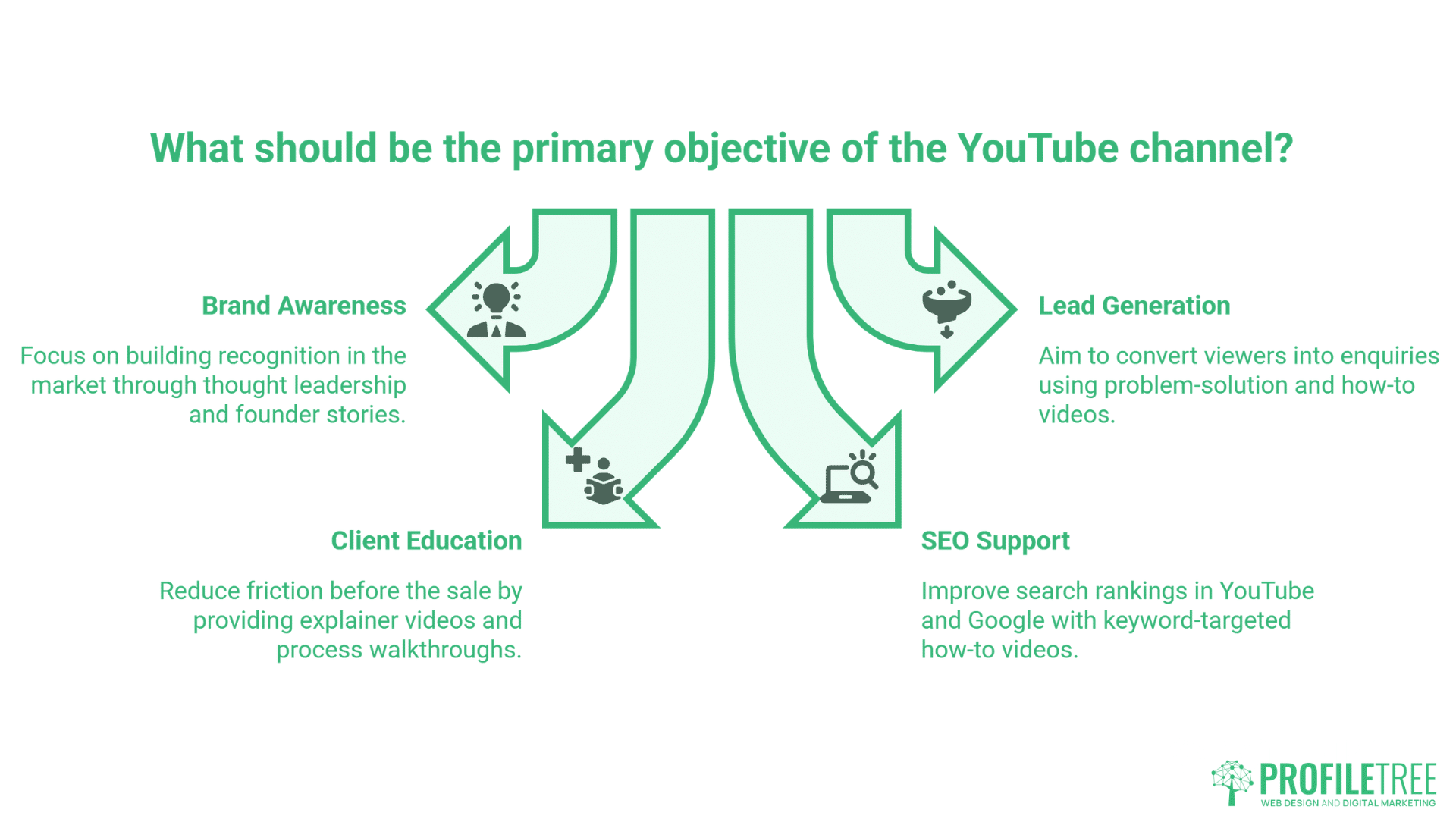
Before you plan a single video, define what you need the channel to do. Setting clear objectives is one of the most overlooked elements of YouTube marketing for business, and the right content strategy depends entirely on which objective you are serving. The table below maps the four objectives most SMEs choose between.
| Objective | What it means | Content type | Key metric |
|---|---|---|---|
| Brand awareness | Build recognition in your market | Thought leadership, founder story | View count, subscribers |
| Lead generation | Convert viewers to enquiries | Problem and solution, how-to | Click-throughs, form fills |
| Client education | Reduce friction before the sale | Explainer, process walkthrough | Watch time, return visits |
| SEO support | Rank in YouTube and Google search | Keyword-targeted how-to | Impressions, search rankings |
Most SMEs are best served by lead generation and client education in their first 12 months, and digital training programmes are the quickest way to get an internal team producing that content. Brand awareness takes longer to compound. These two objectives also produce the strongest retention signals, which feed back into the algorithm and extend your organic reach.
Aligning YouTube Objectives With Business Goals
Every objective in YouTube marketing for business should tie to a business goal and include a number. ‘Increase inbound enquiries from marketing decision makers in Belfast by 20% over 12 months’ is a useful objective. When it is that specific, every content decision becomes easier, and the channel slots into your wider strategic digital planning rather than sitting apart from it.
For service businesses, identify the three questions you hear most often on sales calls and film one video for each. They attract prospects searching for those answers and cut the time your team spends repeating the same explanation.
How to Grow YouTube Subscribers Without Buying Them
Subscriber growth is where most business owners get the worst advice, and where YouTube marketing for business most often goes wrong. Search for how to get subscribers on YouTube, and you will find hundreds of services promising 1,000 subscribers for a fixed fee. For a commercial channel, that route is worse than doing nothing. This section covers why, what works instead, and where to check the numbers you already have.
Why Buying YouTube Subscribers Damages a Business Channel
YouTube’s fake engagement policy prohibits artificially inflating subscriber counts, views or other metrics, and states that subscribers identified as spam do not count towards your total. Channels that buy YouTube subscribers watch the numbers climb and then fall away, sometimes with a strike attached.
The commercial damage runs deeper than the policy risk. Bought subscribers never watch anything, so average view duration collapses relative to your subscriber base. YouTube reads that gap as a signal that your content disappoints the people following you, and recommends your videos less. You pay to make organic reach harder. There is also a reputational cost. A channel with 5,000 subscribers and 40 views per video is obviously bought, and prospects assessing you as a supplier can see it.
Organic Ways to Get More Subscribers on YouTube
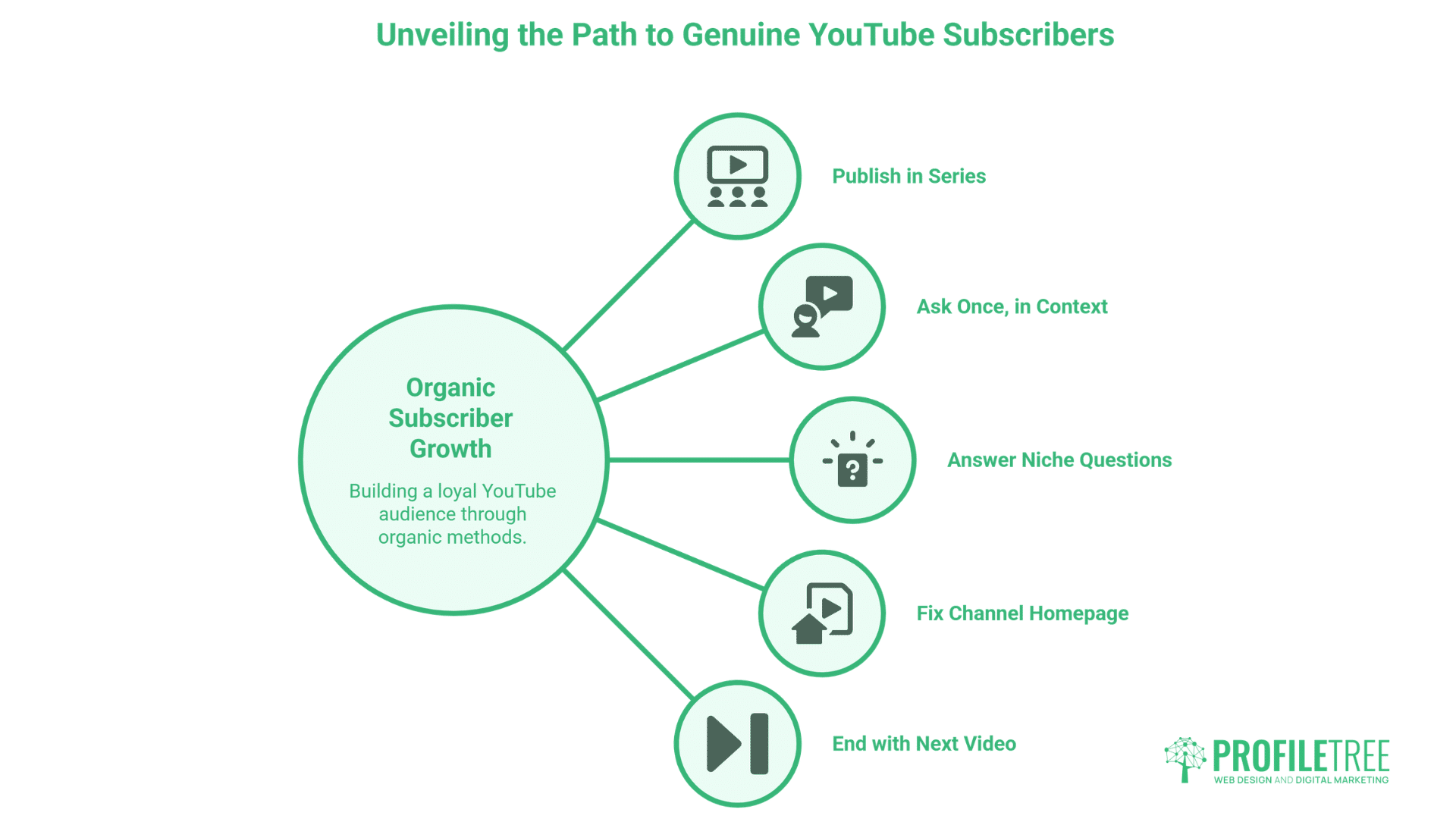
The reliable route to increase YouTube subscribers is to give a specific audience a reason to expect more of the same. In YouTube marketing for business, these are the tactics that hold up:
- Publish in series, not one-offs. Three connected videos on one topic give viewers a reason to subscribe rather than watch and leave.
- Ask once, in context. A short spoken prompt after you have delivered the useful part converts better than a request in the first 10 seconds.
- Answer questions nobody else is answering. Niche, regionally specific topics attract fewer viewers but a far higher proportion who subscribe.
- Fix your channel homepage. A channel trailer, tidy playlists and a clear description of who the channel is for do a lot of the persuading, and the same principles apply to the professional website design viewers land on next.
- End every video with the next one. End screens that point to a related video keep the session going, and session length drives recommendations.
Pair this with AI chatbot development on the pages your videos point to, so a viewer can ask a question the moment they arrive. None of this grows YouTube subscribers quickly, and that is the point. Twenty to fifty genuinely interested subscribers a month beats 5,000 bought accounts because those people open your videos when the notification arrives.
How to See Your Subscribers on YouTube
Business owners running YouTube marketing for their business often ask how to see who has subscribed. In YouTube Studio, open Analytics and then Audience for subscriber totals over time, new versus returning viewers, and which videos gained or lost subscribers. The recent subscriber list under Settings shows individual accounts, but only those who made their subscriptions public, so it will always be shorter than your total.
The more useful view is the per-video subscriber column. It shows which topics persuade people to commit, which is the fastest way to work out what to film next.
Planning Content That Serves a Business Audience
Content planning is where YouTube marketing for business diverges most sharply from the creator approach. You are not building a daily audience with algorithmic hooks. You are building a library of searchable content serving prospects at different stages of the buying cycle. Depth and relevance beat volume.
The Three-Stage Content Framework
Map content to three stages. Awareness content answers the broad questions your ideal buyer searches for before they know they need you. Consideration content helps them compare options. Decision content removes the final objections between interest and contact.
A professional services firm in Belfast or elsewhere in Northern Ireland might build awareness content around ‘what does a digital marketing agency do’ and ‘how much does website design cost’. Consideration content covers ‘how to choose a web design agency’ and ‘what to expect from an SEO retainer’. Decision content includes client walkthroughs and process videos showing exactly how you work, and these sit well on the service pages produced through custom website builds.
Batch Recording for Consistency
The biggest failure mode for SME channels is inconsistent publishing. The fix is not hiring a full video production service on day one. It is batch recording.
Batch recording means dedicating one day per quarter to filming eight to twelve videos in one session. You need a script outline for each, a consistent backdrop, decent audio and a schedule. One round of team training services covers the on-camera basics. The output covers three months and removes the weekly decision about whether you have time to film.
Video Length and Format for SME Content
Business content performs best in the five- to twelve-minute range: long enough for real depth, short enough to hold a professional audience. Process walkthroughs can run longer if they stay specific. Short-form content works for distribution but rarely drives the engagement that generates enquiries. YouTube’s Shorts format now allows videos up to three minutes long, up from the original 60-second cap, though most business Shorts still perform best kept well under that ceiling.
YouTube SEO and Keyword Optimisation for Business Channels
YouTube SEO is not optional for YouTube marketing for business. The algorithm cannot watch your video. It reads metadata, analyses watch time and compares your click-through rate against similar content. Every video needs keyword thinking applied before filming, not bolted on afterwards.
Finding the Right Keywords for Business Video Content
Business video keywords differ from creator keywords, and AI-powered marketing tools have made clustering them into topics much faster. You are targeting searches like “how to choose a web design agency Belfast” rather than broad informational queries. These carry lower volumes but far higher commercial intent and much less competition from creator channels.
Start with the questions your customers ask. Use Google autocomplete, People Also Ask boxes, and YouTube auto-suggest to build a list of 20 to 30 terms, then plan your calendar around them. This is the same research that underpins search engine optimisation services for written content. Applying YouTube SEO consistently across every upload is what separates channels that grow from channels that stall, and it is the part of YouTube marketing for business most SMEs skip. For a closer look at ranking individual uploads once they are live, see how to optimise YouTube videos for maximum visibility.
Writing Titles and Descriptions That Work for Business Searches
Your title should contain the phrase that your target viewer is searching for and give them a specific reason to click. For business content, specificity is the competitive advantage. ‘What is digital marketing?’ faces fierce competition from high-authority channels. ‘What is digital marketing for a Belfast service business?’ has almost none.
Descriptions should open with a two-sentence summary that naturally uses the primary keyword, then what the viewer will learn, links to relevant service pages, and your contact details. The first 150 characters sit above the Show More fold, so front-load the keyword. A strong description is a second-ranking signal on top of your title, though the click is wasted if the destination page is slow, which is where managed WordPress hosting earns its keep.
Playlists as a YouTube SEO and Discovery Tool
Playlists do two jobs. They group content by topic so prospects find related videos without leaving your channel, and YouTube treats playlists as indexable entities in their own right, making each one an extra ranking opportunity. Build one per major subject area and label them with the terms your buyers search, not your internal department names.
Video Production Trade-offs for SME YouTube Content
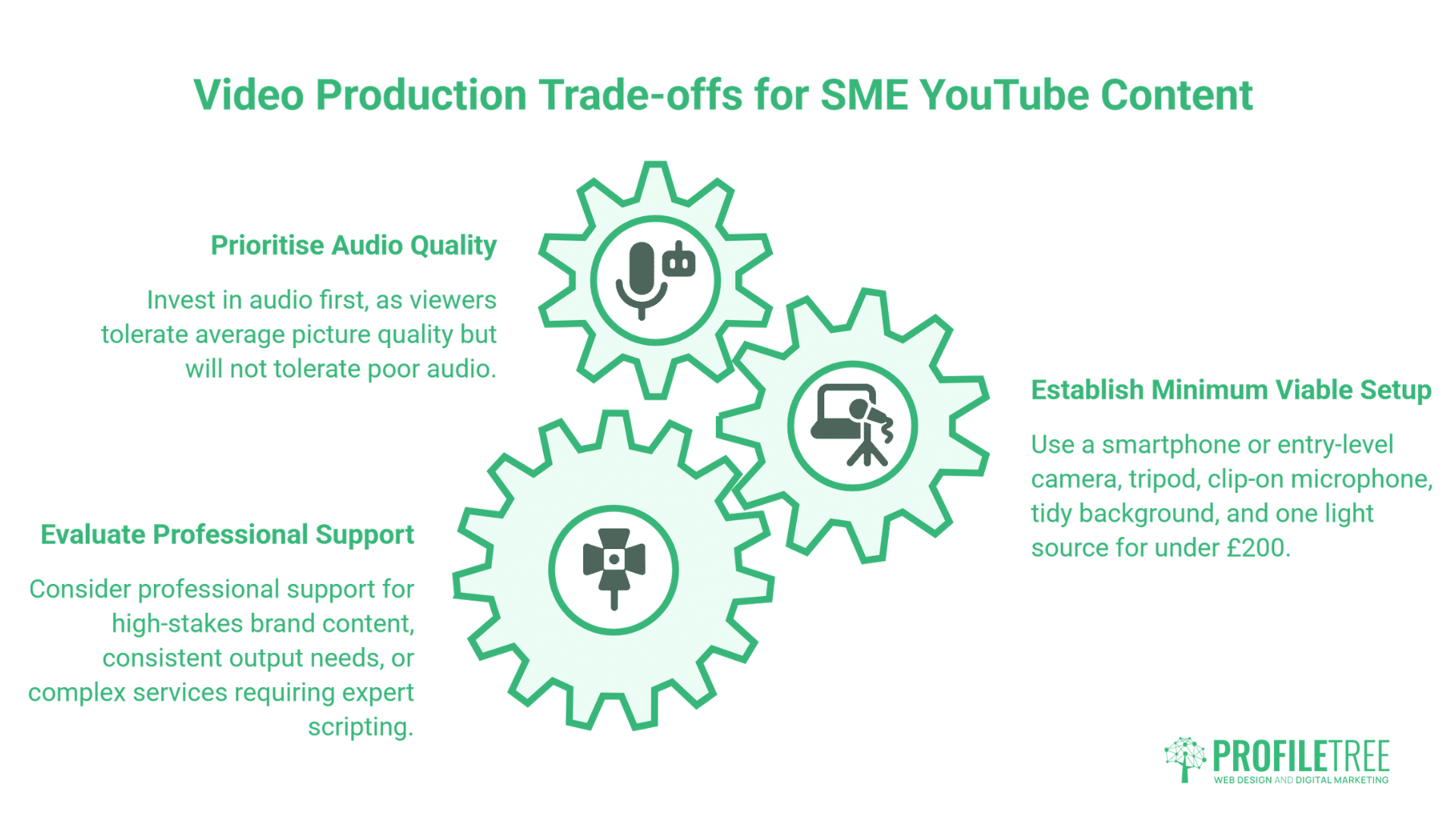
One of the most common questions businesses ask when planning YouTube marketing for business is how much video production quality actually matters. The answer depends on the competitive context and the objective. For a plumber filming a how-to explainer, a smartphone with decent lighting and clear audio performs well. For a corporate law firm introducing its partnership to enterprise clients, production values need to match the brand promise.
The Audio Rule
If one video production investment directly affects audience retention, it is audio. Viewers tolerate average picture quality for useful content. They will not tolerate poor audio. A smartphone video with a clip-on microphone in a quiet room beats a 4K production with echoing sound in almost every business context. Before you spend anything on cameras, sort your audio.
Minimum Viable Video Production for SME Channels
The minimum viable setup for most SME content is a smartphone or entry-level camera on a tripod, a clip-on microphone, a plain or tidy background and one consistent light source. A large window to the side works well. This costs under £200 and produces content professional enough for YouTube search, and the same footage feeds your social media marketing services without further work.
The trade-off is time. Self-produced content requires confidence on camera and the ability to manage the setup and basic editing. For many SMEs, the cost outweighs the equipment savings within months.
When Professional Video Production Support Pays for Itself
Three situations move professional support from optional to sensible in YouTube marketing for business. The first is high-stakes content that represents your brand at scale, such as a homepage video or anything shown to enterprise clients, which needs a different standard than a weekly update. The second is consistent output without internal resources, where a professional video marketing retainer removes the management overhead. The third is complex services needing proper scripting, where a partner brings the post-production skills that make a multi-stage process watchable. For manufacturing, technology, legal, and financial services firms, this separates effective video from content that confuses its audience.
Measuring What Matters for Business YouTube Channels
YouTube Analytics produces a large amount of data, and for business channels, most of it is noise. The metrics that matter for YouTube marketing for business are a small subset, and tracking the wrong ones is why many SMEs stop investing in video before they see a return.
The Metrics That Indicate Commercial Performance
Audience retention on your key videos is the most important number. A video where 70 per cent of viewers reach the end is performing well. One where a 60% drops off in the first 90 seconds needs its opening reworked. Click-through rate from video to website, tracked through UTM parameters in your description links, shows whether your content drives real traffic. Overall channel watch time determines how aggressively the algorithm recommends you.
Track impressions, click-through rate and average view duration in the first 30 days, and consider AI marketing automation to pull that reporting together. After 90 days, check whether those videos are generating website visits, and connect the data back to your enquiry pipeline.
A Practical 90-Day Review Framework
Review performance quarterly rather than weekly, because weekly data is too noisy for business channels with modest volumes. A quarterly review asks three questions: which videos generated the most watch time, which drove the most website clicks, and which search queries are surfacing your content. Build the next content plan around the answers.
“The businesses we work with that get the most from YouTube aren’t the ones who post the most videos. They’re the ones who know exactly who they’re talking to, what problem they’re solving, and what they want the viewer to do next. YouTube for business is a precision tool, not a broadcasting platform. One well-planned video that answers the right question can generate enquiries for two years without any additional spend,” says Ciaran Connolly, Founder of ProfileTree.
Building a Channel That Compounds
YouTube marketing for business rewards patience and punishes shortcuts. The channels that generate enquiries for SMEs across Northern Ireland, Ireland, and the UK are built on a defined objective, a library of videos answering questions buyers actually ask, and a measurement habit that looks past subscriber counts to the pipeline.
Take three actions this quarter. Write down one commercial objective with a number attached. List the ten questions your sales conversations keep returning to, and film the first three in one batch session. Set a date 90 days out to review retention, click-throughs and enquiries rather than views. Get those habits working, and YouTube marketing for business becomes a compounding asset instead of an abandoned channel.
FAQs About How to Grow YouTube Subscribers
How many videos does an SME need before YouTube starts working?
Ten to fifteen well-optimised videos. Below five, there is not enough content to judge whether the channel is gaining traction in search.
Does buying YouTube subscribers ever make sense for a business?
No. It breaches YouTube’s fake engagement policies, the accounts get removed, and the gap between subscriber count and watch time suppresses your organic reach.
How long does it take to grow YouTube subscribers organically?
Expect months, not weeks, to grow your YouTube subscribers. A consistent weekly or fortnightly upload schedule typically shows steady subscriber growth from around the third month.
How do I see who subscribed to my YouTube channel?
Open YouTube Studio, go to Analytics and then Audience. Only subscribers who have made their subscriptions public appear in the individual list.
Is YouTube marketing worth it for a local service business?
Yes. Location-specific queries face far less competition than national searches, and the lower search volume is offset by much higher commercial intent.
Should SMEs use YouTube Shorts?
Use Shorts for discovery, not as the foundation. Long-form content between five and fifteen minutes drives the watch time and rankings that produce commercial results.
How does YouTube SEO differ from Google SEO?
YouTube weighs watch time and audience retention heavily. Google weighs links and page authority. A well-optimised business video often ranks on both.