
YouTube Channel Basics: The UK Guide to Starting and Growing
Table of Contents
YouTube is the world’s second-largest search engine, sitting behind only Google in global reach. For UK and Irish businesses, it represents one of the most underused channels available – a permanent, searchable library of content that compounds in value over time.
Most guides to getting started with YouTube channels are written for US audiences and stop at “upload your first video.” This one goes further. It covers account setup, channel branding, the 2026 YouTube Studio interface, AI-assisted workflows, UK-specific legal obligations, and the basics of community growth – everything a business or creator in the UK or Ireland needs to build a channel properly from the start.
Whether you are a sole trader in Belfast, a marketing manager in Dublin, or a small business owner anywhere across the UK, the steps below apply directly to your situation. Topics covered include technical setup, gear budgeting, AI tools, HMRC considerations, and how to grow your first audience without shortcuts.
Phase 1: Technical Setup and YouTube Studio
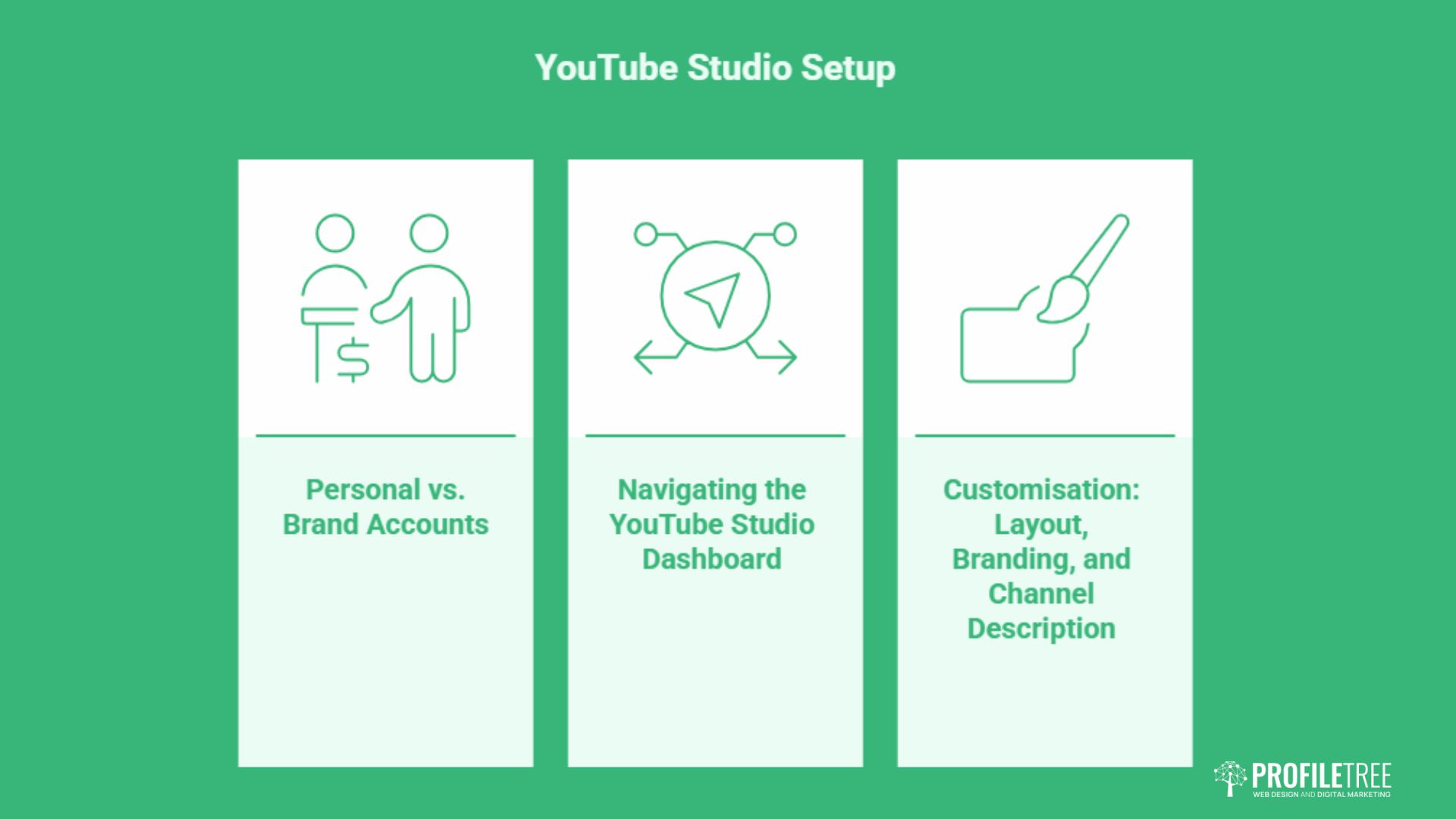
Getting the technical foundation right takes less than an hour, but the decisions you make here affect how your channel is discovered, managed, and monetised. Start with the account type, then work through YouTube Studio before you publish a single frame of video.
Personal vs Brand Accounts
A personal account ties your channel to one Google login. A Brand Account allows multiple people to manage the channel and separates it cleanly from any personal Gmail. For any business, a Brand Account is the correct choice from day one.
To create one, sign into YouTube, click your profile icon in the top right, select “Settings,” then “Add or manage your channels.” Name the channel with your business name, confirm, and the Brand Account is ready. You can then grant manager or editor access to team members without sharing login credentials.
Navigating the 2026 YouTube Studio Dashboard
YouTube Studio is where you manage every aspect of your channel. The 2026 interface has been updated to surface AI-generated insights alongside traditional analytics, and the layout is more streamlined than earlier versions.
The main sections to know are: Dashboard (channel overview and notifications), Content (all uploaded videos and their performance), Analytics (detailed breakdown by overview, content, audience, and research tabs), Comments (all viewer interactions across videos), Subtitles (caption management), and Customisation (layout, branding, and channel information).
Spend time in the Analytics “Audience” tab early. It shows you which other channels your viewers watch, which is one of the most useful signals for shaping your content strategy. The “Research” tab within Analytics also surfaces trending search queries relevant to your channel’s topics – a feature many creators overlook.
For businesses already investing in video, whether it is made in-house or by our Belfast video production team, Studio analytics are how you measure the return on that investment.
Customisation: Layout, Branding, and Channel Description
Before uploading any video, complete the Customisation section. This is what a new visitor sees first, and a bare or inconsistently branded channel signals low credibility.
Under “Branding,” upload your channel icon (ensure no text is clipped by the circular crop), your channel banner (YouTube provides preview templates for mobile, desktop, and TV; check all three), and optionally a watermark that appears during video playback.
Under “Basic Info,” write a channel description rich in keywords related to your business and content. A bakery might use “cake decorating,” “baking tutorials,” and “Belfast bakery”; a digital agency would include terms like “web design,” “SEO tips,” and “digital marketing for SMEs.” The description is indexed by both YouTube and Google, so treat it with the same care as a page meta description.
Under “Layout,” set a channel trailer for new visitors and a featured video for returning subscribers. Update the featured video weekly to keep returning viewers engaging with your newest content.
Phase 2: Branding, SEO, and Your First Upload
Channel setup and video publishing are separate disciplines. Once your channel looks professional, the focus shifts to making individual videos discoverable – through titles, descriptions, tags, thumbnails, and the structural elements YouTube uses to assess quality and relevance.
Writing a Search-Optimised Video Title and Description
Every video title should lead with the keyword phrase a viewer would actually search. Keep titles under 60 characters where possible – YouTube truncates longer titles in search results and suggested feeds. Avoid clickbait; YouTube’s algorithm penalises high click-through rates paired with low watch time, which is exactly what misleading titles produce.
Your description should open with a concise summary of what the video covers, followed by a call to action (subscribe, comment, or visit a link), and close with evergreen business information: website URL, contact details, and relevant channel links. The first two to three sentences of the description appear in search results, so front-load them with the most important information.
Tags matter less than they did five years ago, but still serve as a relevance signal. Use your title keywords as tags, add two to three broader category terms, and include your brand name.
Thumbnails That Drive Clicks
YouTube presents three auto-generated screenshots when you upload a video. Use them only as a temporary placeholder. Custom thumbnails consistently outperform auto-generated ones across all content categories.
A strong thumbnail for a business channel uses a clear, bold headline (three to five words maximum), a face or product image with high contrast against the background, and brand colours that are consistent across all uploads. Canva has free templates built specifically for YouTube thumbnails, and the 1280×720 pixel format at 72 dpi is the correct specification.
Before you can upload custom thumbnails to a new channel, YouTube requires identity verification via phone number. This is a one-time step completed in YouTube Studio under “Settings > Channel > Feature eligibility.”
Playlists, End Screens, and Cards
Playlists increase session watch time by automatically queuing related videos. Organise your uploads into topic-based playlists from the start, and include keywords in both the playlist title and description. A channel with well-structured playlists looks more credible to new visitors and performs better in YouTube’s suggested video algorithm.
End screens appear in the final 5 to 20 seconds of a video and can promote another video, a playlist, a channel subscription, or (once you are in the YouTube Partner Programme) an external link. Cards are interactive overlays that appear at any point during a video and serve the same purposes. Use both to keep viewers moving through your content rather than leaving after a single video.
Subtitles are worth adding to every video. YouTube’s auto-captions have improved significantly but still produce errors, particularly with names, technical terms, and regional accents. Editing captions inside YouTube Studio is straightforward and takes roughly 15 minutes for a 10-minute video.
Research consistently shows that captioned videos outperform uncaptioned ones in watch time and accessibility reach. This connects directly to broader SEO best practices – accessibility and discoverability overlap more than most creators realise.
Phase 3: Equipment, AI Tools, and the 2026 Workflow
Two of the biggest gaps in most YouTube starter guides are realistic equipment budgeting for a UK audience and practical AI integration. Both are addressed below. The gear section uses UK prices as a reference point; the AI section covers the tools that meaningfully reduce production time in 2026.
All prices and figures in this guide are indicative UK examples and correct at the time of writing; use them as a benchmark rather than fixed quotations.
The 2026 UK Creator Budget: Three Tiers
The table below outlines realistic starter, intermediate, and professional kit configurations using UK market pricing. Audio quality matters more than video quality for beginners – a clear voice recorded on a decent microphone with mediocre visuals will outperform crystal-clear footage with poor audio in audience retention.
| Tier | Camera | Audio | Lighting | Approx. Total (£) |
|---|---|---|---|---|
| Starter (£0–£150) | Smartphone (existing) | Rode SmartLav+ lapel mic (~£55) | Ring light (~£25–£40) | £80–£100 |
| Intermediate (£500–£1,000) | Sony ZV-E10 (~£500) | Rode NT-USB Mini (~£85) | Elgato Key Light (~£150) | £700–£800 |
| Professional (£2,000+) | Sony A7 IV (~£2,300) | Shure SM7dB (~£380) | 3-point LED softbox kit (~£200–£400) | £2,800–£3,200 |
UK retailers worth checking for competitive pricing include Wex Photo Video, Andertons Music Co. (for audio), and Scan Computers. Amazon UK frequently matches or undercuts specialist retailers on popular entry-level items.
For businesses that want professionally produced video without building an in-house setup, a video production agency removes the gear and technical overhead entirely, allowing the focus to stay on strategy and content.
AI Tools for Script Outlining and Title Ideation
Creators who are not using AI assistance for at least part of their workflow in 2026 are spending more time on lower-value tasks than they need to. The tools below address the most time-consuming basics.
| Tool | Primary Use | Free Tier | Paid Tier (approx.) |
|---|---|---|---|
| ChatGPT | Script outlines, title options, description drafts | Yes (GPT-4o limited) | ~£16/month (Plus) |
| Descript | Transcript-based editing, auto-captions, overdub | Yes (1 hour/month) | ~£19/month (Creator) |
| Midjourney / Adobe Firefly | Thumbnail concept generation | Limited (Firefly free) | £8–£36/month |
| TubeBuddy / vidIQ | Keyword research, tag suggestions, competitor analysis | Yes (basic features) | £7–£25/month |
A practical AI-assisted workflow for a 10-minute video looks like this: use ChatGPT to generate a script outline from a brief, write the script yourself using the outline as a framework, record the video, use Descript to generate a transcript and edit by cutting unwanted text, export captions, and use TubeBuddy to identify the strongest keyword variations for the title and tags.
This approach cuts scripting and editing time roughly in half while keeping the actual on-camera content fully human. For businesses exploring broader AI transformation strategies, YouTube production is one of the most accessible entry points.
Using AI for Thumbnail Concept Generation
Thumbnail creation is one of the highest-leverage tasks for improving click-through rate. AI image tools can generate multiple thumbnail concept variations in minutes, which you then refine in Canva. Describe the video topic, target emotion (curiosity, surprise, urgency), and brand colour palette in the prompt, and iterate from there.
The goal is not to publish an AI-generated thumbnail directly (font rendering and brand consistency still need human review), but to eliminate the blank-canvas problem and accelerate the design process. Businesses already using AI to enhance marketing will recognise this as part of the same efficiency gain available across content production.
Phase 4: UK and Ireland Legal Basics
Almost no mainstream YouTube starter guides address the legal and financial obligations specific to UK and Irish creators. This is a significant gap. The section below is intended as general guidance only; consult a qualified accountant for advice specific to your situation.
HMRC and the Hobby-to-Business Threshold
HMRC does not distinguish between a YouTube channel and any other form of self-employment when assessing tax obligations. If your channel earns more than £1,000 in a tax year from any combination of ad revenue, brand sponsorships, affiliate commissions, or merchandise, you have exceeded the trading allowance and must register for Self Assessment.
Registration is done through the HMRC website and must be completed by 5 October in the tax year following the one in which you first exceeded the threshold. Missing this deadline carries a penalty. If your taxable turnover goes above £90,000 in any rolling 12-month period, VAT registration also becomes mandatory.
For creators based in the Republic of Ireland, Revenue Ireland operates a similar self-assessment system, and the same principle applies: once income from a channel exceeds the equivalent threshold, it must be declared. The Universal Social Charge (USC) and PRSI contributions also apply to self-employment income from content creation.
Businesses running a branded channel under a limited company structure have different obligations again – channel income is treated as company revenue and subject to Corporation Tax rather than Income Tax. If you are uncertain which structure applies, an accountant familiar with the digital economy (increasingly common across Belfast and Dublin) will give you clarity quickly.
GDPR, Filming in Public, and Children’s Content
Filming in public spaces in the UK is broadly permitted, but GDPR introduces a complication: if your video clearly identifies individuals who did not consent to being filmed, you may be processing their personal data without a lawful basis. This applies particularly to footage where faces, vehicle number plates, or identifiable locations create a record linked to a specific person.
The practical guidance for most business channels is: blur faces of bystanders in public footage where people are identifiable, avoid filming children without explicit parental consent, and include a clear privacy notice on your channel if you collect viewer data through linked forms or newsletter sign-ups.
COPPA (the Children’s Online Privacy Protection Act) is a US regulation, but its scope extends to any channel accessible by US viewers. YouTube requires all creators to declare whether their content is “made for kids.” If it is, comments and personalised ads are disabled automatically, which significantly affects monetisation potential. This declaration is made at the video level in YouTube Studio under “Audience.”
For businesses considering Northern Ireland as a filming location, the range of locations across Northern Ireland’s cities offers genuinely distinctive backdrops – something that US-centric content cannot replicate and that adds immediate regional identity to a channel.
Phase 5: Community Management and Channel Growth
Most YouTube starter guides end at “upload your first video.” The section that follows addresses what happens next – how to build an audience from zero, manage your community as it grows, and use the platform’s built-in tools to sustain momentum. These are the basics of sustainability, not just setup.
The First 100 Subscribers: A Realistic Roadmap
Reaching 100 subscribers typically takes two to eight weeks for a business channel posting consistently – longer if the niche is highly competitive, faster if the content solves a specific problem that gets searched regularly. The most effective early actions are straightforward: tell existing contacts the channel exists, share each video across your other platforms, and reply to every comment personally during the first few months.
Consistency beats volume in the early stages. A channel posting one well-produced video per week will grow faster than one posting three rushed ones. YouTube’s algorithm rewards watch time and return viewers over raw upload frequency, so the quality-to-frequency balance matters from the start.
The YouTube Partner Programme has two tiers. The lower tier needs 500 subscribers, three public uploads in the last 90 days, and either 3,000 public watch hours in the last 12 months or 3 million Shorts views in the last 90 days, and it unlocks channel memberships and Super Thanks but not ad revenue. Full ad revenue sharing needs 1,000 subscribers and 4,000 public watch hours in the last 12 months until 31 January 2027. From 1 February 2027, new applicants need 8,000 watch hours in the last 365 days or 20 million Shorts views in the last 90 days. A business channel posting weekly can realistically reach the lower tier within a year, while the full tier is a much higher bar under the new rules.
Comment Engagement and the Community Tab
YouTube’s comment section is one of the most direct feedback channels available to any content creator. Responding to comments within the first 24 hours of a video going live builds genuine audience relationships. A response does not need to be lengthy; acknowledging the comment and asking a follow-up question is sufficient.
YouTube Studio has built-in filters to catch comments containing harmful language or spam links. These catch most issues, but not all; review held comments regularly and set keyword filters for anything specific to your channel’s comment patterns.
The Community Tab unlocks at 500 subscribers and allows you to post text updates, polls, images, and video previews directly to subscribers’ feeds. Used consistently, it maintains audience connection between video uploads and performs particularly well for polls that feed directly into content planning – asking your audience what they want to see next is both an engagement tactic and a content research method.
For businesses that want their YouTube presence to complement a broader social presence, a joined-up social media marketing strategy ensures each channel reinforces rather than duplicates the others.
YouTube Shorts and the Audio Library
YouTube Shorts (vertical videos of up to three minutes) have grown substantially in distribution since 2023 and now serve as a discoverability tool for full-length content. A short clip that teases a key insight from a longer video drives traffic to that video while independently reaching audiences who would not otherwise find the channel.
The YouTube Audio Library, accessible within Studio, provides royalty-free music and sound effects for free. This is the safest audio source for business channels – using unlicensed music triggers Content ID claims that can strip ad revenue from a video or block it in certain territories. Use the Audio Library for background music until you have a clear understanding of music licensing for commercial use.
For businesses that want support in structuring a content strategy across video and other channels, digital training programmes are available through ProfileTree that cover YouTube strategy alongside broader digital skills for teams.
Build the Foundations Before the First Upload
Building a YouTube channel properly from the start saves significant time and avoids the rework that comes from skipping the basics. The steps above (from Brand Account setup and YouTube Studio navigation through to UK legal obligations and community management) give any business or creator in the UK or Ireland a solid foundation. To get expert support with video strategy or production, speak with the ProfileTree team about what a structured approach looks like for your business.
FAQs
Do I need a 4K camera to start a YouTube channel?
No. A modern smartphone shooting 1080p produces more than adequate quality for a beginner channel in 2026. Viewers will leave a video with poor audio far faster than one with average visuals. Prioritise a decent microphone before upgrading your camera.
Is it free to start a YouTube channel?
The technical setup is entirely free. A Google account, a channel name, and an internet connection are all that is required. Costs begin when you invest in equipment, editing software, or paid promotion – but none of these is mandatory to start.
How do I pay tax on YouTube earnings in the UK?
If your channel earns over £1,000 in a tax year from any source (ad revenue, sponsorships, merchandise, or affiliate links), you must register for Self Assessment with HMRC. Earnings below this threshold fall within the trading allowance and do not need to be declared separately. Consult an accountant if you are uncertain about your specific situation.
How many subscribers do I need to get monetised on YouTube?
The full YouTube Partner Programme requires 1,000 subscribers and 4,000 public watch hours in the past 12 months, rising to 8,000 watch hours in the past 365 days for channels applying from 1 February 2027. A lower tier requires 500 subscribers and 3,000 watch hours, unlocking memberships and tipping features but not ad revenue sharing.
What is the best time to post for a UK audience?
YouTube says publish time is not known to affect a video’s long-term performance, because videos are recommended whenever viewers are on the platform. Publishing when your own audience is most active can bring faster early views, and the “When your viewers are on YouTube” report in the Analytics Audience tab shows that pattern once the channel has some history.