
What is Keyword Research? A Complete Guide for Effective SEO Strategy
Table of Contents
Every successful digital marketing campaign starts with understanding exactly what your customers search for online. Yet many business owners across the UK and Ireland struggle with keyword research, either relying on guesswork or focusing on terms that sound important but drive little qualified traffic. The difference between businesses that thrive online and those that remain invisible often comes down to strategic keyword research that reveals genuine customer intent and market opportunities.
In this comprehensive guide, we’ll cut through the complexity to provide a practical framework for discovering keywords that drive business growth. Whether you’re a startup in Belfast, an established retailer in Dublin, or a service provider anywhere across the UK, you’ll learn proven techniques for finding high-value search terms, understanding competitor strategies, and integrating keyword insights across your entire digital marketing approach. By the end, you’ll have the knowledge and tools needed to transform your online visibility and attract customers actively searching for your offer.
What is Keyword Research?
Keyword research forms the foundation of successful digital marketing campaigns. This systematic process involves identifying and analysing search terms that potential customers use when looking for products, services, or information related to your business.
When done correctly, keyword research transforms your digital marketing from guesswork into a data-driven strategy. It reveals exactly what your audience searches for, how they phrase their queries, and what content they expect to find.
What is Keyword Research?
Keyword research is the practice that marketers and business owners use to discover search terms that drive qualified traffic to their websites. Rather than simply targeting obvious terms, effective keyword research uncovers the complete spectrum of language your customers use throughout their buying journey.
This process becomes particularly valuable for businesses across Northern Ireland, Ireland, and the UK when targeting local markets. Local businesses must understand regional search patterns, seasonal trends, and location-specific terminology that resonates with their audience.
The Strategic Value of Keyword Analysis
Modern keyword research extends beyond traditional SEO rankings. It provides crucial insights for:
- Content Strategy Development: Understanding what topics generate genuine interest allows you to create content that attracts and engages your target audience. When ProfileTree develops content marketing strategies for clients, keyword research guides every piece of content creation.
- Market Intelligence: Search data reveals customer pain points, common questions, and emerging trends within your industry. This intelligence informs product development, service offerings, and business strategy.
- Competitive Positioning: Analysing competitor keywords reveals market gaps and opportunities. Many businesses discover untapped niches through thorough competitive keyword analysis.
- Digital Marketing Integration: Keyword insights inform paid advertising campaigns, social media content, email marketing, and website development projects.
Search Intent and User Behaviour
Understanding search intent separates effective keyword research from basic keyword collection. Every search query represents a specific user intent:
- Informational Intent: Users seeking knowledge or answers to questions. These searches often begin with “how to,” “what is,” or “why does.” Local businesses can capture these searches by creating educational content that positions them as industry experts.
- Navigational Intent: Users are looking for specific websites or pages. Brand searches and location-based queries fall into this category.
- Commercial Investigation: Users comparing options before making decisions. These searches include terms like “best,” “reviews,” or “comparison.”
- Transactional Intent: Users are ready to make purchases or take action. These high-value searches often include terms like “buy,” “hire,” or “book.”
What are You Looking for?
Of course, before we discuss how to research keywords, we must first determine what makes a keyword good or bad.
Let’s look at the primary variable you should look out for.
Keyword Competition
Keyword competition measures how difficult it will be to rank for a particular keyword. It can vary depending on the keyword’s popularity and industry competition.
Competitive keyword research is one of the highest-return activities in search marketing. Ranking for the right keywords can make or break your website. You can also learn more about your customers by researching your market’s keyword demand.
Most of all, it’s not always about getting visitors to your site but about getting the right kind of visitors.
The value of this cannot be overstated. With keyword research, you can predict shifts in demand, respond to changing market conditions, and produce the products, services, and content that web searchers seek.
Keyword Difficulty
To know which keywords to target, it’s essential to understand the demand for a given term or phrase and the work required to achieve high rankings.
If big brands take the top 10 results and you’re just starting on the web, the uphill battle for rankings can take years of effort. This is why it’s essential to understand keyword difficulty.
Search Volume
Search volume is simply the number of searches that occur for a particular keyword or term, often expressed as searches per month. The ideal combination is a term with high search volume and low competition. These terms are hard to find.
Often, the popular search terms already have significant competition, making it challenging to achieve top-position search engine rankings. The competition is already there and has been there for a while.
Competitive Keyword Analysis
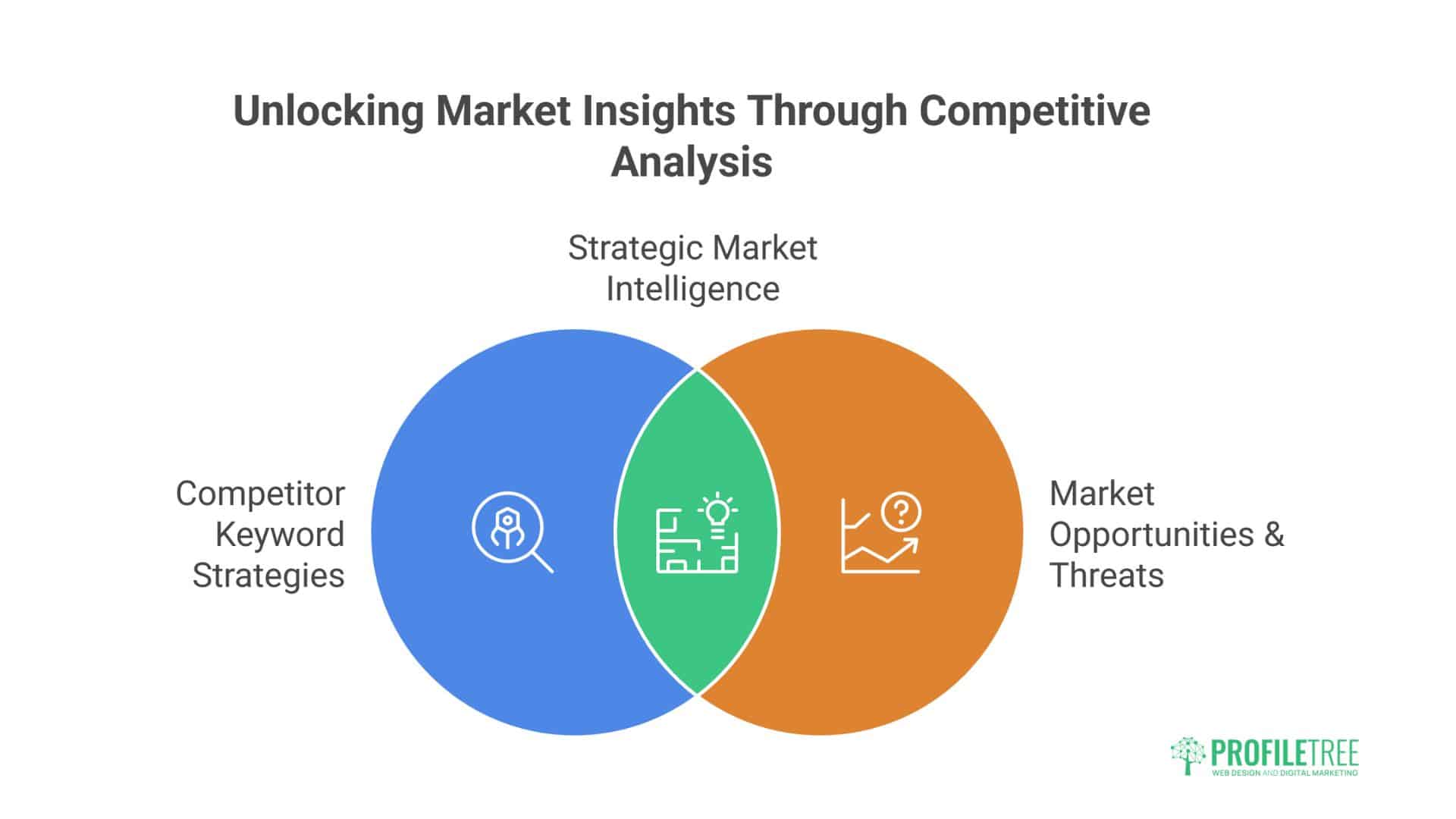
Understanding competitor keyword strategies reveals market opportunities and potential threats. Practical competitive analysis goes beyond simple keyword lists to understand the strategic thinking behind competitor content.
Identifying Key Competitors
Begin by identifying direct competitors (businesses offering identical services) and content competitors (websites ranking for your target keywords). Many companies overlook content competitors, missing valuable insights about what type of content performs well in their market.
Use SEMrush or Ahrefs to analyse competitor organic traffic, identifying their most successful pages and highest-traffic keywords. This analysis reveals which content types generate the most engagement within your industry.
Gap Analysis Techniques
Keyword gap analysis identifies opportunities where competitors rank successfully, but your website doesn’t appear in search results. These gaps represent immediate opportunities for content creation or website optimisation.
Most keyword research tools offer gap analysis features that compare multiple competitor domains simultaneously. This comparison reveals common keywords that successful competitors target, suggesting valuable opportunities for your business.
Content Strategy Insights
Analyse competitor content to understand how they integrate keywords naturally while maintaining readability. Successful competitors balance keyword optimisation with user experience, creating content that ranks well and engages readers.
Look for patterns in competitor content structure, topic coverage, and keyword placement. These insights inform your content creation process, helping you create superior resources that outrank competitor pages.
Essential Keyword Research Tools
Successful keyword research requires the right tools and techniques. While numerous options exist, specific platforms consistently deliver reliable data and actionable insights.
Google Keyword Planner
Google’s keyword research platform directly provides foundational data from the search engine. Initially designed for Google Ads campaigns, it offers valuable insights for organic SEO strategies.
The platform excels at providing search volume estimates and related keyword suggestions. However, it focuses primarily on paid advertising applications, which limits its effectiveness for comprehensive SEO research.
Google Keyword Planner offers a cost-effective entry point for businesses starting their keyword research journey. The tool provides basic search volume data and helps identify seasonal trends within specific markets.
SEMrush for Comprehensive Analysis
SEMrush stands out as one of the most comprehensive keyword research platforms available. Its strength lies in competitive analysis capabilities, allowing businesses to reverse-engineer successful competitor strategies.
The platform provides detailed insights into competitor organic rankings, paid advertising campaigns, and content performance. This information proves invaluable when developing digital marketing strategies for competitive markets.
“Businesses are treating keyword research as a one-off task rather than an ongoing strategic process, and this is a big mistake. At ProfileTree, we’ve found that companies that regularly review and update their keyword strategies based on performance data consistently outperform those who set and forget,” explains Ciaran Connolly, Director of ProfileTree.
SEMrush particularly excels in local market analysis, making it valuable for businesses targeting specific geographic regions across the UK and Ireland.
Moz Keyword Explorer
Moz Keyword Explorer offers user-friendly keyword research with intuitive difficulty scoring. The platform provides clear metrics that help prioritise keyword opportunities based on realistic ranking potential.
The tool’s “Priority” score combines multiple factors, including search volume, difficulty, and opportunity, to provide actionable recommendations. This feature is particularly valuable for businesses with limited resources that must focus their efforts strategically.
Ahrefs for Deep Analysis
Ahrefs provides extensive keyword databases and detailed competitive analysis features. The platform excels at identifying content gaps and keyword opportunities that competitors haven’t fully exploited.
Its “Keywords Explorer” tool offers comprehensive data, including click-through rates, keyword difficulty scores, and related keyword suggestions. The platform’s massive keyword database and accurate difficulty assessments are its strengths.
Specialised Research Tools
- UberSuggest is an affordable keyword research tool with basic competitive analysis features. Founded by Neil Patel, it provides keyword suggestions and basic volume estimates without requiring a significant investment.
- KWFinder focuses on long-tail keyword discovery with user-friendly difficulty assessments. The platform excels at finding low-competition keywords that newer websites can realistically target.
- Answer the Public visualises search queries in question format, revealing your audience’s specific questions about your industry topics.
Advanced Research Techniques

Beyond fundamental keyword discovery, advanced techniques uncover opportunities that most businesses miss. These methods require additional effort but often reveal the most valuable keyword opportunities.
Long-Tail Keyword Discovery
Long-tail keywords represent detailed search queries that often indicate higher purchase intent. While individual long-tail terms have lower search volumes, they typically face less competition and attract more qualified traffic.
Use Google’s autocomplete feature to discover long-tail variations of your primary keywords. Type your main keyword into Google and note the suggested completions that appear. These suggestions represent real search queries that users frequently enter.
Question-Based Keyword Research
Many searches take a question format, particularly on mobile devices and voice searches. Identify common questions within your industry using tools like Answer the Public or by analysing forum discussions and social media conversations.
Create comprehensive content that directly answers these questions, positioning your business as a helpful resource while targeting valuable long-tail keywords.
Seasonal and Trending Keywords
Monitor keyword trends to identify seasonal opportunities or emerging topics within your industry. Google Trends reveals how search volume changes over time, helping you plan content calendars around peak interest periods.
For local businesses, seasonal keywords often relate to weather, holidays, or regional events. A Northern Ireland-based business might target different seasonal terms than businesses in warmer climates.
Location-Based Keyword Research
Local businesses must understand location-based search patterns. Users often include location terms when searching for local services, creating opportunities for geographically targeted content.
Research location-specific terminology, including neighbourhood names, regional landmarks, and local colloquialisms. This research helps create content that resonates with local audiences while capturing location-based search traffic.
Keyword Research for Different Platforms
While Google dominates the search market share, other platforms offer valuable keyword opportunities for businesses willing to diversify their digital marketing approaches.
YouTube Keyword Research
Video content continues growing in importance, making YouTube keyword research valuable for businesses creating video content. YouTube’s search algorithm differs from Google’s, requiring platform-specific research approaches.
Use tools like Keyword Keg or YTCockpit to identify YouTube-specific keyword opportunities. These tools analyse YouTube’s autocomplete suggestions and provide search volume estimates specific to the video platform.
Consider question-based keywords for YouTube content, as many users search for tutorial or educational videos. How keywords often perform exceptionally well on YouTube, creating opportunities for businesses to demonstrate expertise while building audience engagement.
Social Media Keyword Research
Social media platforms use hashtags and keywords differently than search engines, but keyword research still provides valuable insights for social media content strategy.
Research trending hashtags and topics within your industry, identifying opportunities to join conversations and increase content visibility. Tools like Hashtagify or RiteTag help identify effective hashtag strategies for different social platforms.
E-commerce Keyword Research
Online retailers face unique keyword research challenges, needing to balance product-specific terms with broader category keywords. E-commerce keyword research focuses heavily on commercial and transactional intent keywords.
Research product comparison terms, review-related keywords, and shopping-specific phrases. Users often search for terms like “best [product] for [specific use]” or “[product] vs [competitor product] when making purchase decisions.
Measuring Keyword Research Success
Effective keyword research requires ongoing monitoring and adjustment. Track key metrics to understand which keywords drive meaningful business results rather than simply ranking improvements.
Key Performance Indicators
- Organic Traffic Growth: Monitor overall organic search traffic increases, particularly from target keywords. Quality keyword research should drive sustained traffic growth over time.
- Conversion Rates: Track how keyword-targeted traffic converts into leads or sales. High-ranking keywords that don’t convert may need content optimisation or represent poor keyword choices.
- Search Visibility: Use rank tracking tools to monitor your website’s visibility for target keywords. Improved visibility across multiple related keywords often proves more valuable than ranking #1 for single terms.
- Local Search Performance: For location-based businesses, track local search visibility and Google Business Profile performance for location-specific keywords.
Content Performance Analysis
Analyse which keyword-targeted content performs best, identifying patterns for future content creation. Successful content often targets multiple related keywords within comprehensive, authoritative resources.
Monitor content engagement metrics, including time on page, bounce rate, and social sharing. High-ranking content that fails to engage users may need improvement to maintain search visibility over time.
Integration with Business Strategy
Keyword research becomes most valuable when integrated with broader business and marketing strategies. Rather than existing in isolation, keyword insights should inform multiple aspects of business operations.
Website Development and Design
Keyword research informs website structure, navigation, and content organisation. Understanding how users search for your services helps create intuitive website experiences that support both user needs and search engine optimisation.
For businesses working with web design agencies, keyword research should guide site architecture decisions, ensuring important pages target valuable search terms while maintaining logical user flows.
Content Marketing Strategy
Effective content marketing relies heavily on keyword research to identify topics that resonate with target audiences. Rather than creating content based on assumptions, keyword data reveals exactly what information your audience actively seeks.
Develop content calendars around keyword themes, creating comprehensive resources that target multiple related search terms. This approach builds topical authority while maximising the SEO value of content creation efforts.
Digital Marketing Training Applications
Businesses investing in digital marketing training should understand how keyword research integrates with various marketing channels. Keyword insights benefit SEO, pay-per-click advertising, social media, and email marketing.
Training programs should cover technical keyword research skills and strategic application of keyword data across marketing channels. This comprehensive approach helps businesses maximise their digital marketing investments.
Conclusion
Effective keyword research transforms digital marketing from guesswork into a strategic, data-driven activity. The tools and techniques outlined in this guide provide a comprehensive framework for discovering keyword opportunities that drive qualified traffic and business growth.
Remember that keyword research is an ongoing process that should evolve with your business and market conditions. Professional assistance can accelerate results while avoiding common pitfalls that waste time and resources.
FAQs
How often should businesses conduct keyword research?
Keyword research should be ongoing rather than a one-time activity. Conduct comprehensive research quarterly, with monthly reviews of performance and emerging opportunities. Industries experiencing rapid change may require more frequent analysis.
What’s the ideal keyword difficulty for new websites?
New websites should initially target keywords with difficulty scores below 30-40, focusing on long-tail terms and location-specific keywords. As domain authority grows, it gradually targets more competitive terms.
How many keywords should a single page target?
Focus on one primary keyword per page, with 3-5 related secondary keywords. This approach allows for comprehensive topic coverage while maintaining clear search intent alignment.
Do keyword research tools provide accurate search volume data?
Keyword tools provide estimates rather than exact figures. Use multiple tools to cross-reference data, focusing on relative volume comparisons rather than absolute numbers.
Ready to Transform Your Digital Marketing Strategy?
ProfileTree has helped hundreds of businesses across Northern Ireland, Ireland, and the UK achieve dramatic improvements in search visibility and online leads through strategic keyword research and digital marketing.
Ready to get started?
- Contact our SEO specialists for professional keyword research
- Book digital marketing training for your team
- Explore our web design services with built-in SEO optimisation
Call 028 9568 0364 or email hello@profiletree.com to discuss how strategic keyword research can drive your business growth.