
SEO for Small Businesses: Cost-Effective Tactics
Table of Contents
SEO for small businesses is the work of getting your site to show up when local customers search for what you sell. The fastest wins for most SMEs are a complete Google Business Profile, consistent name, address and phone details across UK and Irish directories, and a handful of pages that answer real buyer questions. You can do the basics yourself for free; the harder technical and content work is where a specialist usually pays for itself.
Most small business owners in Northern Ireland, Ireland and the rest of the UK are not short of SEO advice. They are short of time, and most of the advice they find is written for a US market that lists businesses on Yelp and prices everything in dollars. This guide is built for the search landscape you actually operate in: Google Maps, UK postcodes, Eircodes, and a budget that has to stretch.
Search engine optimisation for small businesses has also changed shape. The same listings and reviews that win you a spot in the Google map pack now feed AI answers in ChatGPT, Perplexity and Google’s AI Overviews. Get the foundations right, and you compete in both.
What is SEO, and how does it work for small businesses?
SEO, or search engine optimisation, is the process of improving where your website appears in search results for the terms your customers use. For a small business, that usually means ranking for local, buying-intent searches: “emergency plumber Belfast”, “wedding photographer Cork”, “accountant near me”. Win those, and you reach people at the moment they are ready to act.
Search engines work in three stages. They crawl pages, index what they find, then rank results against a query. Easy SEO for small businesses starts by making sure those first two stages go smoothly, because a page that cannot be crawled or indexed will never rank.
The components that actually move rankings
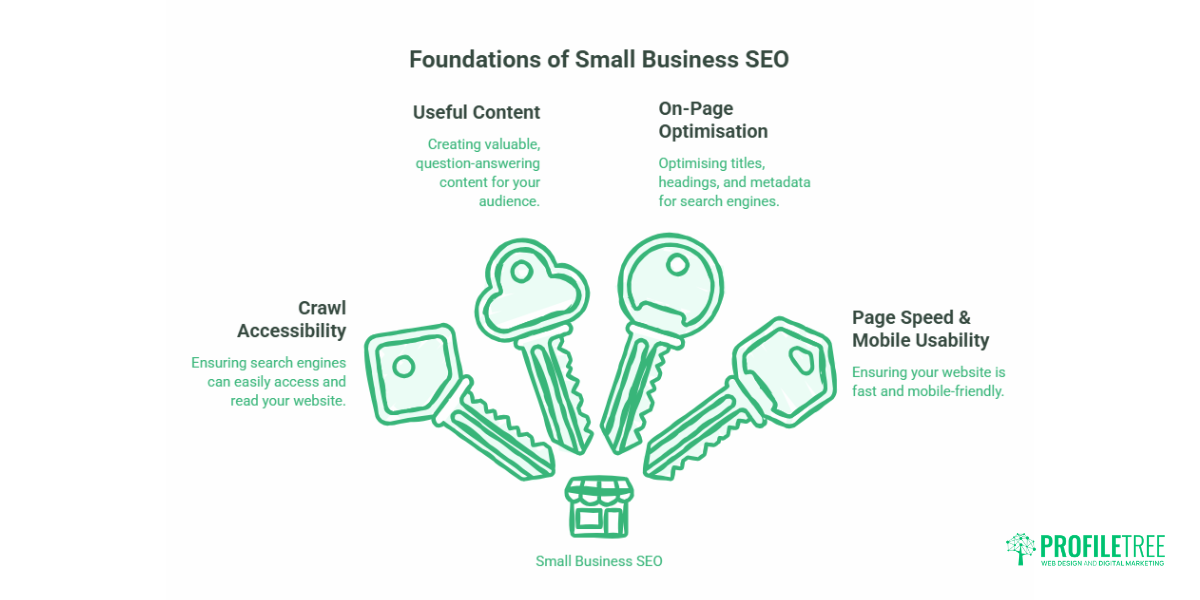
A handful of factors carry most of the weight for a typical SME site. Crawl accessibility comes first: search engines need clean code and a logical structure to read your site. Useful content matters next, written to answer a specific question rather than to repeat a keyword. Then there is on-page work, including titles, headings and on-page metadata that tell engines what each page covers.
Page speed and mobile usability sit alongside those. Most local searches now happen on a phone, so a slow or awkward mobile site loses both visitors and rankings. The good news is that these are fixable, and many of them cost nothing but attention. A well-built small business website handles most of them before you write a single blog post.
Why small businesses can compete on search
Paid advertising charges you for every click. Organic search does not, which is why it suits a tight budget. SEO also targets people already looking for your service, so the traffic tends to convert better than interruptive ads. And because local intent is so specific, a focused small business can outrank a national brand for “barber Derry” without spending more than its time.
Search visibility builds trust as well as traffic. People treat a top map result as a recommendation, much as they treat a high review count. That credibility is hard to buy and is one reason organic search remains a sound long-term play for small business survival.
Local SEO in the age of AI search
The biggest shift in search engine optimisation for small businesses is that local listings now power AI answers, not just blue links. When someone asks ChatGPT Search or Perplexity for “a reliable locksmith in Lisburn”, the model draws on the same signals Google uses for its map pack: a verified Google Business Profile, consistent directory data, and genuine reviews. Optimise once, and you show up in both places.
This is sometimes called Generative Engine Optimisation. The practical takeaway is simple: the structured, factual information about your business that search engines can read cleanly is exactly what AI systems quote when recommending a local provider. Vague, inconsistent data gets skipped.
| Signal | Traditional search use | AI search use |
|---|---|---|
| Google Business Profile | Map pack ranking | Primary source for “near me” AI recommendations |
| NAP consistency (directories) | Trust and proximity signals | Cross-checked to confirm a business is real |
| Customer reviews | Local ranking factor | Quoted as reputation evidence in AI answers |
| On-site local content | Keyword and intent matching | Extracted as factual context for queries |
| Structured data (schema) | Rich results in SERPs | Machine-readable facts for model grounding |
This is also where many owners decide whether to bring in help. Connecting your listings, reviews and content into one coherent entity is fiddly, and ProfileTree covers the practical side of it in its work on AI-enhanced marketing for SMEs.
Ciaran Connolly, ProfileTree Founder, puts the priority plainly: “For local businesses, the single most valuable asset in 2026 is a complete, verified Google Business Profile backed by real reviews. AI search and the map pack both lean on it, so it is the first thing we tell any small business to fix.”
For a closer look at how this plays out in practice, ProfileTree has written separately on AI local search and how it reshapes city-level competition.
The step-by-step roadmap to local search visibility
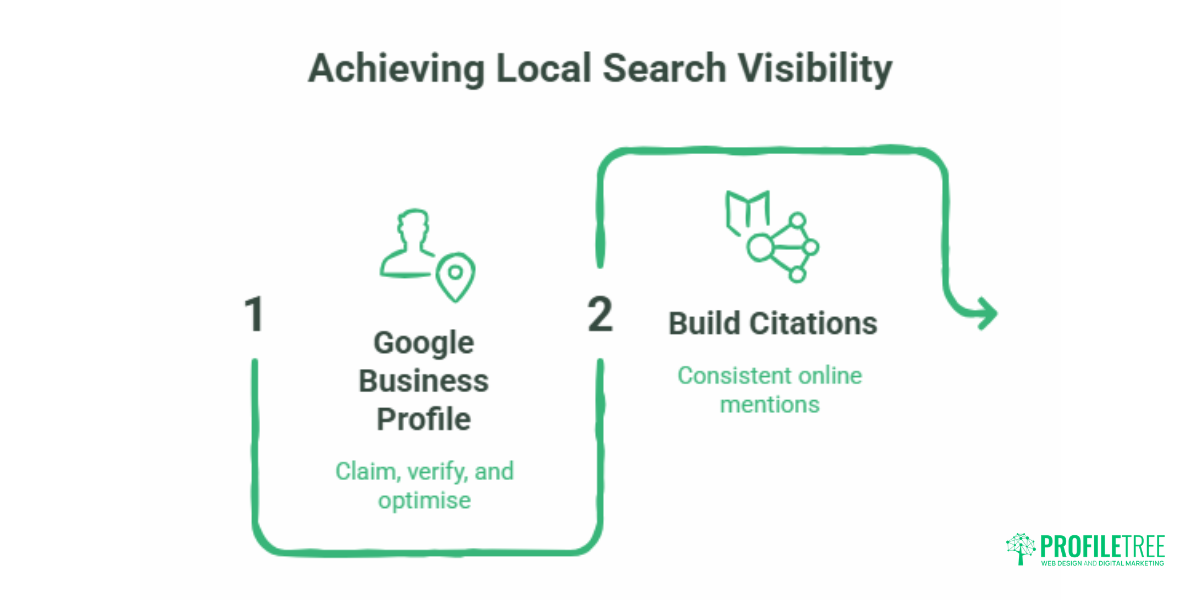
Local SEO for small businesses follows a reliable order. Start with your profile, make your data consistent, build out your site, then earn reviews and links. Working through it in sequence stops you from spending money on advanced tactics while the basics are still broken.
Step 1: Claim and optimise your Google Business Profile
Your Google Business Profile is the foundation of local search. Claim it, verify it, and complete every field: categories, services, hours, photos and a written description. Choosing the right primary category matters most. A “Plumber” listed under the generic “Contractor” category will lose the map pack to a competitor who categorised correctly, because category alignment is among the strongest local ranking factors.
Service-area businesses without a shopfront, such as mobile plumbers or home-visit consultants, can hide the street address and define service areas by town or postcode instead. Keep the profile active with regular posts and prompt review responses, both of which signal that the business is real and current. ProfileTree has documented the wider numbers behind this in its piece on Google Maps visibility.
Step 2: Build citations in UK and Irish directories
A citation is any online mention of your business name, address and phone number. Consistency is the point: the same details, formatted the same way, everywhere they appear. Mismatched data confuses search engines and weakens proximity signals.
Most US guides send you to Yelp and the Better Business Bureau, neither of which carries much weight here. UK businesses should prioritise Yell, Thomson Local, Scoot and 192.com. Irish businesses should look to Golden Pages, YourLocal, i.e., and Local Ireland. Northern Irish businesses benefit from both UK and all-island directories, which is a quiet advantage when you serve customers on either side of the border. ProfileTree maintains a fuller list of business listing sites for the UK and Ireland.
| Directory | Geographic focus | Cost | Submission |
|---|---|---|---|
| Google Business Profile | UK / IE / NI | Free | Manual |
| Yell | UK | Free tier | Manual |
| Thomson Local | UK | Free tier | Manual |
| Scoot | UK | Free | Manual |
| Golden Pages | Ireland | Free tier | Manual |
| YourLocal.ie | Ireland | Free | Manual |
| Bing Places | UK / IE / NI | Free | Manual |
For micro-businesses, manual submission beats automated syndication tools. Paid syndicators charge a monthly fee and can push inconsistent data across the web faster than you can correct it. A careful afternoon of manual listings protects your data integrity for nothing.
Step 3: Localise your website content and postcode structure
Your website needs to tell search engines where you operate. Use natural location language in titles, headings and body copy: not “we offer cleaning services” but “office cleaning across Belfast and Lisburn”. Where you serve several distinct areas, build a genuinely separate page for each, with local detail rather than a template that swaps the town name.
UK postcodes and Irish Eircodes carry geographic meaning that search engines parse. An outward code, such as BT1, M1 or LS1, maps to a district, so referencing the areas you cover by their real local names and codes reinforces proximity. Keep your content useful and the right length for the query; ProfileTree’s guidance on content length helps you judge that. For SMEs trading across the Irish border, the cross-border trading picture adds another reason to localise both markets properly.
Step 4: Earn reviews with a repeatable process
Reviews influence both ranking and the click. The businesses that collect them consistently are the ones that ask consistently. Build a simple routine: a short message or email to every satisfied customer with a direct link to your Google review form. Respond to every review, positive or negative, because visible engagement is itself a trust signal.
Keep it honest. Never buy reviews or incentivise them in ways that breach Google’s policies, since a soft suspension can wipe out months of progress overnight.
Step 5: Add local business schema markup
A schema is structured data that spells out your business facts in a format that machines can read directly. LocalBusiness schema confirms your name, address, phone, opening hours, and area served, which supports rich results and gives AI systems clean facts to quote. A basic JSON-LD block looks like this:
{
  "@context": "https://schema.org",
  "@type": "LocalBusiness",
  "name": "Your Business Name",
  "address": {
    "@type": "PostalAddress",
    "streetAddress": "31 Henry Place",
    "addressLocality": "Belfast",
    "postalCode": "BT15 2AY",
    "addressCountry": "GB"
  },
  "telephone": "+44 28 9568 0364",
  "areaServed": "Belfast and Northern Ireland"
}
If the schema feels beyond your comfort zone, it is a small job for a developer and is covered as part of ProfileTree’s SEO services. Getting it right also depends on the broader Google quality signals that govern trust-sensitive content.
Step 6: Build local backlinks
Links from relevant local sites tell search engines your business is established in its area. Sponsor a local club, contribute to a regional news piece, join a chamber of commerce, or partner with a complementary local business. Quality and relevance matter far more than volume; one link from a respected Belfast publication outweighs dozens from generic link farms.
The free DIY local SEO tool stack
You do not need a paid subscription to start. Local SEO for small businesses can be run entirely on free tools, which is exactly what most owners should do before committing to a retainer. Google Business Profile and Bing Places cost nothing. Google Search Console shows what you already rank for and which pages get clicks. Google Keyword Planner gives search-volume estimates. A simple spreadsheet tracks your directory submissions and review counts.
The honest limit of the free approach is time and judgment, not tools. Knowing which fixes matter most, and reading the data correctly, is where many owners get stuck. If you would rather learn to run it in-house than outsource it, ProfileTree’s digital training teaches the workflow directly to your team. The wider context for why this matters to local firms sits in ProfileTree’s UK small business data.
Content, keywords and on-page work
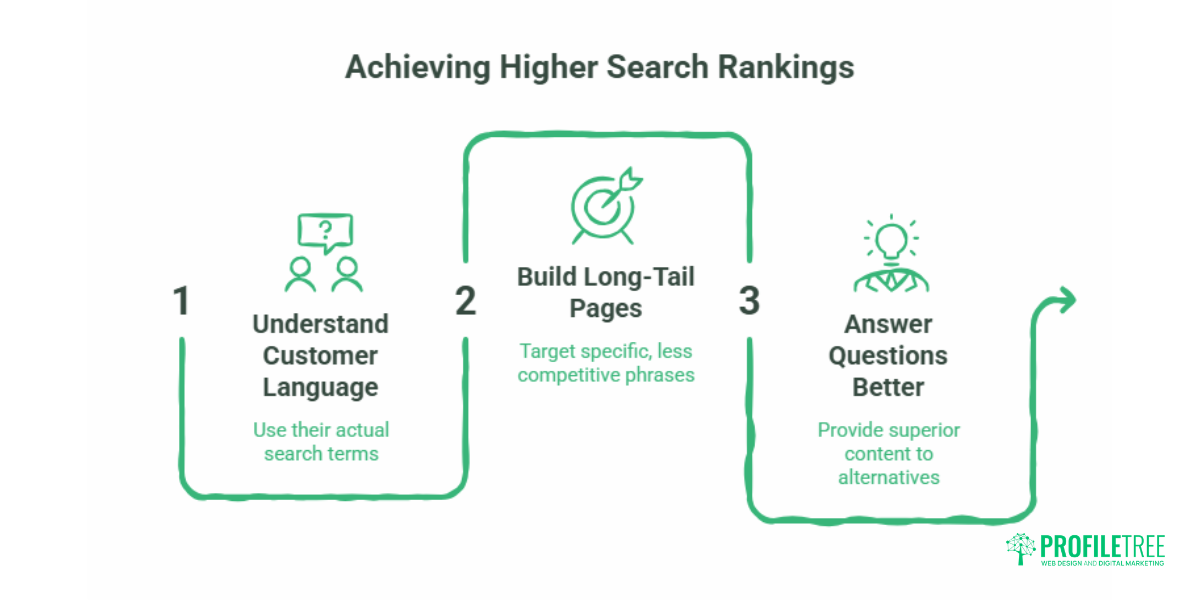
Rankings follow content that answers a real question better than the alternatives. Start with the language your customers actually use, then build pages around those phrases rather than guessing. Long-tail terms such as “gluten-free bakery south Belfast” are less competitive and convert better than broad heads like “bakery”.
Matching content to search intent
Every query carries an intent: to learn, to compare, to find, or to buy. An informational search, such as “how to descale a coffee machine”, wants a guide; a transactional one, such as “buy an espresso machine Belfast”, wants a clean product page. Map your pages to those intents, and you stop competing against yourself.
Consistent publishing compounds over time, which is the principle behind a working content marketing programme. The aim is not volume for its own sake but a steady stream of pages that each answer something a customer was already searching for.
On-page essentials
Give every page a unique title tag under 60 characters with the primary term near the front. Write a meta description that earns the click, capped at around 155 characters. Use one clear H1, logical subheadings, and descriptive internal links rather than “click here”. Link related pages together so both readers and search engines can follow the path through your site.
Measuring and improving over time
SEO is a routine, not a one-off project. Check Google Search Console monthly for the queries bringing impressions and the pages earning clicks. Watch your map pack position for core terms, and keep an eye on review volume against local competitors. When a page slips, look first at whether a competitor has published something more useful, then improve yours rather than starting over.
A light quarterly audit catches the rest: broken links, slow pages, outdated information and any directory listing that has drifted out of sync. Small, regular maintenance keeps results stable far more cheaply than periodic rescue jobs.
For broader marketing inspiration beyond search, ProfileTree’s sister publication Connolly Cove covers culture, travel and storytelling that local brands can draw on for content ideas.
Conclusion
SEO for small businesses rewards the basics done consistently: a complete Google Business Profile, clean directory data, useful local content and a steady habit of earning reviews. Those same foundations now feed AI search as well as Google’s map pack, so the work pays off twice. Start free, measure what moves, and bring in specialist help for the technical and content jobs that are worth more than the time they cost you.
Frequently Asked Questions
How much does local SEO cost for small businesses in the UK and Ireland?
Agency retainers typically range from around £300 to £1,200 a month in the UK, and roughly €350 to €1,400 a month in Ireland, depending on competition and scope. Lower tiers usually cover profile management and basic citations; higher tiers add content, technical work and link building. These figures are indicative and vary by provider and market.
Can I do local SEO myself for free?
Yes. Google Business Profile, Bing Places, Google Search Console, and Google Keyword Planner are all free, and manual directory submissions cost nothing but time. The basics are well within reach of any owner willing to learn them.
How long does local SEO take to show results?
Technical changes and directory listings are usually indexed within a few weeks. Meaningful movement in a competitive map pack, though, normally takes three to six months of consistent review generation, citation building and content work.
Do I need a physical shopfront to do local SEO?
No. Service-area businesses such as mobile plumbers or home-visit consultants can hide their address on Google Business Profile and define target areas by town or postcode instead.
Why is my business not showing up on Google Maps?
The usual causes are an unverified profile, inconsistent name, address or phone data across the web, search proximity limits, or a soft suspension on the account. Check verification and data consistency first, as they fix most cases.
What is the single most important local ranking factor?
Aligning your primary Google Business Profile category exactly with what customers search for, supported by proximity and review volume.