
How to Build a Topic Cluster Model to Boost SEO
Table of Contents
Search engines no longer reward sites that publish isolated articles on loosely related keywords. The topic cluster model replaces that scattergun approach with something far more durable: a structured network of content built around a single authoritative pillar page, supported by interconnected cluster articles that each address a specific subtopic in depth.
This guide covers what a topic cluster is, how to build one for a UK or Irish service business, how to maintain it once it is live, and why this architecture now determines whether your content gets cited in AI Overviews as well as traditional search results. Whether you are starting from scratch or trying to bring order to an existing content library, the steps below apply directly to your situation.
What Is the Topic Cluster Model and Why It Replaced Keyword-First SEO
The topic cluster model organises your site’s content into a hub-and-spoke system. One broad pillar page covers a core topic in full, and a set of cluster pages each explores a specific subtopic in detail. Every cluster page links back to the pillar, and the pillar links out to each cluster. This bidirectional internal linking architecture signals to search engines that your site has genuine depth and breadth on a subject, rather than a handful of loosely related posts.
Understanding why this model displaced keyword-first content planning requires a brief look at how search engines changed. Google’s Hummingbird update shifted the engine’s focus from matching keyword strings to understanding search intent.
Subsequent updates deepened that shift, and the integration of large language models into Google’s ranking infrastructure made semantic relationships between pages a first-class ranking signal. A site whose content is structurally connected around clear entities is far easier for both traditional crawlers and AI systems to interpret accurately.
The Limits of Single-Keyword Content Planning
Publishing one article per keyword, with no deliberate internal linking strategy, creates a flat content library. Pages compete against each other for similar queries, link equity is spread thinly, and no single page accumulates enough topical signals to rank well for competitive terms. This is keyword cannibalisation at scale, and it is one of the most common structural problems found when auditing content against Google’s quality standards.
The topic cluster model fixes this by concentrating authority. When ten cluster pages all link to one pillar, that pillar page accumulates internal link equity from across the cluster. Each cluster page, in turn, benefits from being closely associated with a well-linked hub. The result is a rising tide: individual pages rank better because they are part of a coherent structure, not despite standing alone.
The Hub-and-Spoke Architecture Explained
The pillar page sits at the centre. It covers the core topic broadly enough to serve as a reference point for the whole cluster, but it does not try to answer every subtopic in exhaustive detail. That depth is delegated to the cluster pages, each of which tackles one specific angle: a process, a tool, a use case, an audience segment, or a common question.
Internal links connect every piece. The pillar links out to each cluster page at a natural point in the content, and each cluster page links back to the pillar using descriptive anchor text. Some cluster pages may also link to each other where the content is genuinely related. This web of links creates the semantic structure that search engines and AI systems use to map your site’s authority on a subject.
Why Topical Authority Now Determines AI Citation
AI Overviews, ChatGPT, Perplexity, and Gemini all draw on the same underlying principle: they cite sources that have demonstrated authority on a topic across multiple pieces of content. A single well-written article rarely earns a citation when a competitor has an entire cluster covering the subject from multiple angles. Pages that are part of a structured cluster are overrepresented in AI citations because LLMs can identify the site as an entity with genuine expertise, not just a page that happens to contain relevant text.
Ciaran Connolly, founder of ProfileTree, puts it directly: “The businesses we see earning consistent AI citations are not the ones with the most content. They are the ones whose content is the most structurally coherent. A cluster tells an AI system exactly what your site is authoritative about.”
How to Build a Topic Cluster: A Step-by-Step Process for UK Service Businesses
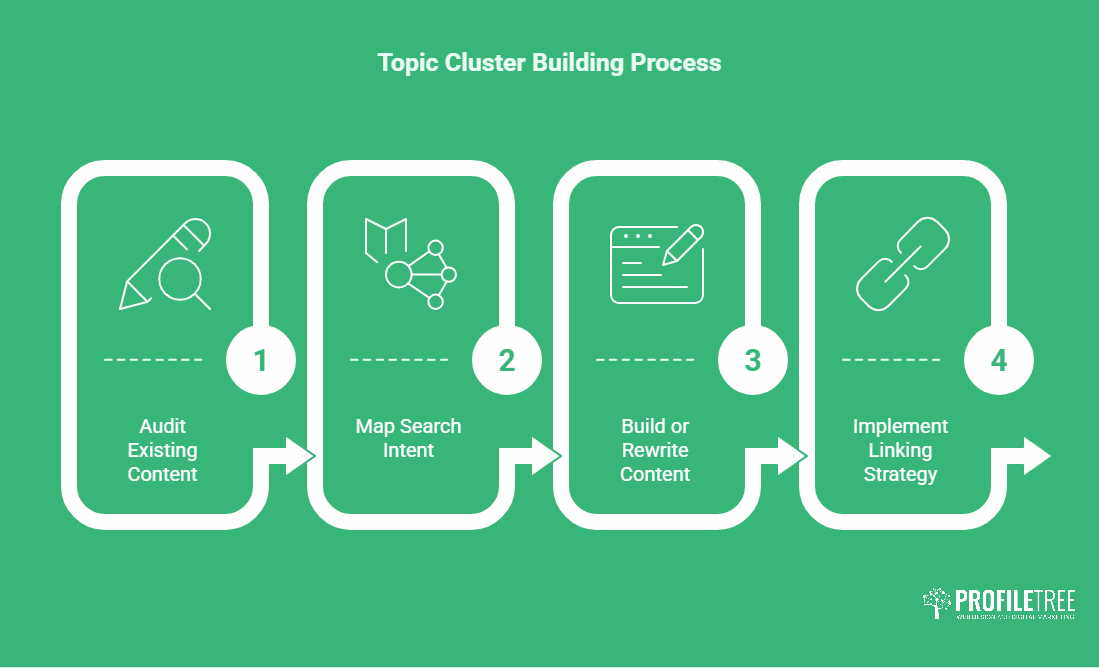
Building a cluster from scratch is a four-stage process: audit what you have, map the cluster structure, create or rewrite the content, and implement the internal linking. For most UK and Irish SMEs, the audit stage reveals that a substantial amount of useful content already exists but is not connected in any deliberate way. Bringing orphaned articles into a cluster is often faster than building from scratch, and it protects any existing search equity those pages carry.
The approach below is designed to be practical rather than theoretical. Each stage includes the decisions you will actually need to make, not just the concept behind them. Businesses that have worked through a content strategy framework will find many of these steps familiar, though the cluster model adds a structural layer that a standard editorial calendar does not.
Stage One: Audit Existing Content for Orphaned Topics
Export every URL on your site and sort pages by organic traffic. Identify which pages address the same broad subject and group them together. Any page that covers a subtopic of a broader theme but has no internal links connecting it to related content is an orphan. Orphaned pages are the most common wasted resource in content libraries built without a cluster strategy.
For each group of related pages, ask two questions. First, does any existing page cover the core topic broadly enough to serve as a pillar? Second, do the remaining pages in the group each cover a distinct enough subtopic to function as a cluster page without cannibalising each other? If two pages target the same subtopic, consolidate them before building the cluster around them.
Stage Two: Map Search Intent Across Cluster Levels
Not every page in a cluster serves the same intent. Pillar pages typically serve informational intent: the reader wants an overview. Cluster pages often serve a mix of informational and navigational intent, and some will serve commercial intent if they cover a specific service, tool, or decision. Mapping intent accurately before you write means each page satisfies the reader at the right stage of their journey.
For a solicitors’ firm in Belfast, for example, a pillar page might cover “employment law for small businesses” broadly. Cluster pages could then each address one specific area: unfair dismissal claims, redundancy procedures, settlement agreements, and TUPE transfers. Each cluster page satisfies a specific search query while collectively reinforcing the firm’s authority on employment law as a whole. This kind of intent-led content strategy produces measurable improvements in both rankings and user engagement.
Stage Three: Build or Rewrite Content to Cluster Standards
Pillar pages require a minimum of 2,500 words covering the core topic with clear H2 sections, a table of contents, at least one comparison or data table, and outgoing links to every cluster page in the set. They do not need to be exhaustive on every subtopic; they need to be authoritative on the whole subject and signpost where readers can go for more detail.
Cluster pages are typically 1,500 to 2,000 words each, focused tightly on one subtopic. The opening paragraph must address the reader’s specific question immediately, following a bottom-line-up-front structure. Every cluster page must include at least one link back to the pillar and, where genuinely relevant, links to sibling cluster pages. Pages that have been sitting as orphans may need a full rewrite to meet this standard, or they may only need new internal links and a strengthened introduction.
Stage Four: Implement the Golden Thread Linking Strategy
Once all pages are written or updated, implement internal links systematically. Every cluster page should carry a link back to the pillar within the first three paragraphs, using descriptive anchor text that includes the pillar’s primary keyword. The pillar page should link to each cluster page at the natural point in the text where the reader would benefit from more detail on that specific subtopic.
Resist the temptation to add all internal links as a final step using a list at the bottom of each page. In-text links placed where the content naturally calls for them pass far more value than footer-style link blocks. Review the anchor text across the cluster to confirm you are not repeating identical phrases on every page, as this can trigger over-optimisation flags. Varied, descriptive anchor text is both more natural to read and more effective as an SEO signal.
Generative Engine Optimisation: Structuring Clusters for AI Visibility
Traditional SEO aimed to rank pages in the ten blue links. Generative Engine Optimisation (GEO) aims to be cited in the AI-generated summaries that now appear above those links. The two goals are not in conflict; the same structural qualities that help pages rank in Google also help AI systems identify your content as a reliable source. But there are specific ways to optimise a cluster for AI citation that go beyond standard SEO practice.
AI systems extract information at the passage level, not the page level. A cluster that structures each section as a self-contained, answerable unit performs significantly better in AI citation than a cluster whose content is only coherent when read in full. The businesses earning the most AI citations are not those with the longest pages; they are those whose pages are organised so that individual sections can be extracted and cited independently. Reviewing your site’s SEO health is a useful starting point for identifying which pages are currently structured well enough to earn those citations.
Entity Signals and Brand Association Within a Cluster
AI systems build a model of what your site is authoritative about by reading semantic triples: factual statements that connect two entities through a clear relationship. “ProfileTree is a web design and digital marketing agency based in Belfast” is a semantic triple. Every cluster page should include at least one statement that explicitly connects your business to the topic the cluster covers, using consistent naming across every page.
Brand association within a cluster matters because AI citation is partly a brand recognition exercise. An LLM that has encountered “ProfileTree” associated with “SEO strategy for SMEs” across multiple pages on the same site is far more likely to cite ProfileTree when answering a query on that subject than if the brand appears on only one page. Consistent entity mentions across the cluster accumulate into a strong, clear association that AI systems can extract and use.
Self-Contained Sections and the BLUF Structure
BLUF stands for Bottom Line Up Front. Every section of every cluster page should open with a direct, concise answer to the question implied by the heading, followed by supporting detail, examples, and qualifications. This structure serves two audiences simultaneously: a human reader who wants the key point immediately, and an AI system that extracts passage-level answers to use in generated responses.
A section that opens with a vague introduction before eventually arriving at the point is unlikely to be extracted by an AI system, because the answer is buried rather than leading. Sections structured with the answer first, then the evidence, are 161% more likely to appear in AI Overviews according to Ahrefs’ analysis of 17 million AI citations. That structural shift alone, applied consistently across a cluster, produces a measurable improvement in AI visibility without requiring any additional content.
The Role of Tables and Structured Data in AI Citation
Content containing tables is cited in AI Overviews 2.5 times more often than content without them, based on the same Ahrefs citation study. A comparison table within a cluster page, whether comparing two approaches, two tools, or two stages of a process, functions as a highly extractable data unit that AI systems can present to users in a compact, usable format.
For UK and Irish SMEs, this creates a straightforward opportunity. Adding one well-structured table to every cluster page costs relatively little time but significantly increases the page’s AI citation potential. The table does not need to contain proprietary data; a clear comparison of options, presented accurately and with appropriate sourcing, is sufficient. The structure of the data matters more than its exclusivity.
Cluster Maintenance: Pruning and Refreshing Over Time
Most guides on topic clusters explain how to build one. Very few explain what to do with it twelve or eighteen months later, when some cluster pages have climbed in rankings while others have stalled, when search intent has shifted, and when new subtopics have emerged that were not part of the original plan. Cluster maintenance is the phase that separates a strategy from a one-time project, and it is where long-term topical authority is either consolidated or allowed to decay.
Content decay is a real and measurable phenomenon. Pages that are not updated lose rankings gradually as fresher, more thorough alternatives appear. Within a cluster, a single decaying page can drag down the pages linked to it, because internal link equity flows in both directions.
Monitoring the performance of every page in the cluster, not just the pillar, is essential to protecting the overall structure. Tools like Google Search Console provide the impression and click data you need to identify which pages are losing ground before the decline becomes significant. Reviewing organic traffic drops at the page level is the most reliable early warning signal.
Identifying Underperforming Cluster Pages
A cluster page that generates impressions but very few clicks is usually suffering from one of three problems: the title and meta description do not match search intent accurately enough, the page has fallen behind competitors on content depth, or search intent for the subtopic has shifted since the page was first written. Each of these problems has a different fix, so diagnosing the cause before acting is important.
A page with very low impressions is a different kind of problem. It may have slipped out of the index for technical reasons, or the subtopic it covers may simply not have enough search volume to generate impressions at a meaningful scale. In the latter case, consider whether the page should be consolidated with a related cluster page, redirected to the pillar, or left as thin supporting content. Consolidation is almost always preferable to deletion, because it preserves the content’s existing link equity rather than discarding it.
When to Prune and When to Expand
Pruning means removing or consolidating content that is cannibalising another page, generating no impressions, or actively harming the cluster’s overall quality signals. It does not mean deleting content arbitrarily to reduce page count. A page with zero impressions over six months on a topic the site actively covers is a candidate for consolidation. A page with low clicks but deep impressions is a candidate for rewriting, not removal.
Expanding the cluster means adding new spoke pages to cover subtopics that have emerged since the cluster was built, or that the original planning missed. A useful prompt for identifying expansion opportunities is the People Also Ask box in Google Search results for the pillar’s primary keyword.
Questions that appear there but are not answered by any page in the existing cluster represent gaps that a new spoke page could fill. For businesses in competitive UK sectors, a cluster that is regularly expanded tends to compound its authority over time rather than plateau.
How Many Cluster Pages Do You Need?
The honest answer is that it depends on the competitive landscape for your core topic. For niche or low-competition topics, five to eight cluster pages are usually sufficient to establish topical authority. For highly competitive topics in sectors like law, finance, or digital marketing in the UK, twenty or more cluster pages may be required before the pillar page gains enough structural support to rank on page one.
A practical approach is to start with six to eight cluster pages covering the most frequently asked questions and most searched subtopics, then monitor rankings for twelve weeks. If the pillar is climbing but has not yet broken into the top ten, add two to four more cluster pages targeting related long-tail queries. Continue this cycle until the pillar ranks in the target position, then shift focus to maintenance rather than expansion.
Measuring Success: What to Track Beyond Keyword Rankings
Keyword rankings are a useful signal, but they are a lagging indicator of cluster performance. By the time a ranking improvement appears in your tracking tool, the underlying structural work has already done its job. Tracking the metrics that lead rankings, rather than just the rankings themselves, gives you a faster feedback loop and a more accurate picture of whether the cluster is working.
The most important leading indicators for a new cluster are crawl frequency, internal link equity distribution, and impressions at the cluster level rather than the page level. A cluster that is being crawled more frequently after its internal linking structure is completed is a positive sign.
Impressions growing across multiple cluster pages, even before clicks follow, indicate that the cluster is being indexed and considered for more queries. Businesses that need to understand these signals in more detail often benefit from structured digital training covering analytics interpretation alongside content strategy.
Topical Share of Voice as a Cluster KPI
Topical Share of Voice measures what percentage of the visible search results for a given topic your site occupies, relative to competitors. A site with one ranking page on a topic has a low share of voice. A site with the pillar page, three cluster pages, and a featured snippet holding on a related question has a significantly higher share of voice, and that breadth of visibility is both harder for competitors to displace and more likely to earn AI citations.
Tracking topical share of voice requires exporting ranking data for a defined set of queries related to the cluster’s core topic, then calculating what percentage of the top ten results your site appears in across those queries. This is more labour-intensive than tracking individual keyword positions, but it gives a far more accurate picture of how the cluster is performing as a system rather than as a collection of individual pages.
Common Pitfalls That Prevent UK Clusters From Performing
The most common reason a well-structured cluster fails to deliver expected results is that the pillar page itself is not detailed enough to serve as a genuine authority hub. A pillar page that is shorter than 2,000 words, lacks outgoing links to all cluster pages, and does not address the reader’s most important questions at a structural level will not accumulate the internal link equity the cluster is trying to send it. The pillar is the most important page in the cluster; it deserves the most editorial investment.
The second most common pitfall is building a cluster and then stopping. Clusters are living structures. A cluster built in 2024 and left untouched through two Google core updates and a year of shifting search intent will have lost ground to competitors who continued to add and maintain their cluster pages. Scheduling a cluster review every six months, in which you check rankings, impressions, and content freshness for every page in the structure, is the minimum maintenance commitment required to protect the initial investment.
Northern Ireland and the Republic of Ireland offer a genuinely differentiated context for digital content, from localised search behaviour to sector-specific funding and regulation. For businesses building clusters that target local search, grounding cluster pages in that regional context produces both stronger topical relevance and a differentiation that US-produced competitor content simply cannot replicate.
If you are exploring the business environment in which your content will need to perform, resources covering Northern Ireland’s cities and economy provide a useful background on the regional landscape your content will serve.
The video below provides a practical overview of how ProfileTree approaches content strategy and SEO structure for UK and Irish SMEs, including how cluster architecture fits into a broader digital strategy.
Conclusion
The topic cluster model is not a content trend. It is the structural foundation that determines whether your pages rank in Google, earn citations in AI Overviews, and accumulate authority over time rather than losing it. Building a cluster is a defined, manageable project. Maintaining one is an ongoing commitment that consistently outperforms any volume-first publishing strategy.
If you would like ProfileTree’s team to audit your existing content structure and build a cluster strategy tailored to your market, get in touch today.
FAQs
Does the topic cluster model still work now?
Yes, and it is more effective now than it was when it was first popularised. AI-driven search engines rely on semantic relationships between pages to assess topical authority, and those relationships are precisely what a cluster structure creates. A site with a well-maintained cluster is better positioned for both traditional SERP rankings and AI citation than one that publishes content without structural organisation.
What is the difference between a topic cluster and a category page?
A category page is a functional taxonomy in WordPress or a similar CMS, grouping posts by label. A topic cluster is a deliberate link structure connecting a pillar page to a set of cluster pages through in-text internal links. They are not mutually exclusive, but they serve different purposes and are built differently.
How many cluster pages do I need for one pillar page?
For niche topics with low to moderate competition, five to eight cluster pages is a reasonable starting point. For high-competition topics in sectors like law, finance, or digital services in the UK, you may need fifteen to twenty or more before the pillar accumulates enough structural authority to rank competitively. Start with eight, monitor for twelve weeks, then expand based on ranking data.
Can one page belong to two different clusters?
Yes, but it should have a primary cluster. Designate one cluster as the main home for the page, link back to that pillar from the first section of the content, and treat any secondary cluster links as supplementary. Trying to serve two pillars equally tends to dilute the page’s topical focus and weaken its contribution to both clusters.
How do I measure the ROI of a topic cluster?
The most reliable measures are organic traffic growth at the cluster level, change in topical share of voice across the cluster’s core queries, and assisted conversions attributed to cluster pages in Google Analytics. Tracking the pillar page’s ranking position for the primary keyword over time provides a simple headline metric, but cluster-level impression growth is the more sensitive early indicator.