
Demography-Driven Content: The Audience-First Strategy
Table of Contents
Most content struggles not because it lacks quality, but because it speaks to no one in particular. Demographic data changes that. When you understand who your audience actually is, not just who you imagine them to be, your content becomes specific, relevant, and measurably more effective.
This guide covers how to build a demography-driven content strategy from the ground up: how to gather and segment audience data, how to tailor tone and format to different generational groups, and how demographic alignment directly improves your organic search performance. There is also a section specific to the UK and Northern Ireland context, an angle the majority of existing guides ignore entirely.
Whether you are a marketing manager trying to justify a budget, a content team looking to get more from what you publish, or a business owner planning a digital strategy refresh, the frameworks here are practical and replicable.
What Is Demography-Driven Content?
Demography-driven content is the practice of shaping what you publish, where you publish it, and how it is written based on the statistical characteristics of your target audience. Those characteristics typically include age, gender, location, income, education level, and employment status. Used properly, this data does not just tell you who your audience is; it tells you how they make decisions, what problems they prioritise, and which formats they are most likely to engage with.
The shift matters because mass-broadcast content is losing ground. Audiences have become accustomed to content that feels made for them, and generic marketing now attracts lower engagement across almost every platform and channel. For UK businesses in particular, where regional identity, economic variation, and generational differences are all pronounced, a one-size approach leaves significant reach on the table.
Defining the Core Metrics: Age, Gender, Location, and Socio-economics
Age is the demographic variable with the greatest influence on content format preferences. A 22-year-old and a 52-year-old may both be interested in your product, but they consume information differently, trust different sources, and respond to different tones.
Gender shapes purchasing intent and messaging receptivity, though the relationship is more nuanced than it once was and should inform rather than stereotype. Location affects cultural references, regulatory context, and platform habits; a Northern Irish audience, for instance, brings dual-market awareness that mainland UK content rarely accounts for.
Socio-economic variables, particularly income and education level, influence how much detail your audience wants and what friction they will tolerate in a purchase journey. Higher-income decision-makers often respond to depth and credentials; audiences with less disposable income prioritise clarity on value and price transparency. Both signals are useful. Knowing which combination you are working with focuses your content marketing approach considerably.
Demographics vs Psychographics vs Firmographics
It is worth separating three terms that are often conflated. Demographics answer the question “who”: age, location, income, and gender. Psychographics answer “why”: values, attitudes, lifestyle, and motivation. Firmographics, relevant in B2B contexts, answer “what kind of organisation”: company size, industry sector, job function, and revenue band.
| Type | What does it tell you | Example data sources | Content application |
|---|---|---|---|
| Demographics | Who the audience is | GA4, Census data, CRM | Format, platform, tone level |
| Psychographics | Why they act as they do | Surveys, qualitative research | Messaging, values alignment |
| Firmographics | What their organisation looks like | LinkedIn, CRM, industry databases | B2B content depth, sector specificity |
An effective strategy uses all three in combination. Demographics give you the starting segmentation. Psychographics explain the motivation behind behaviour within each segment. Firmographics let B2B teams treat company characteristics the way B2C teams treat consumer profiles, shaping content around industry, seniority, and organisational need rather than just individual preference.
Why Demographics Matter More in the Privacy-First Era
Until recently, third-party cookies allowed marketers to track individual users across websites and build behavioural profiles without ever asking permission. That infrastructure is collapsing. Google has progressively limited cross-site tracking within Chrome, Apple’s App Tracking Transparency framework has sharply reduced mobile data availability, and GDPR enforcement in the UK and EU has raised the cost of non-compliance to the point where many businesses have retreated from aggressive data collection entirely.
The result is a shift from tracking individuals to understanding populations. Demographic data, collected ethically through first-party and zero-party sources, is now one of the most reliable signals available for content planning. It does not tell you what a specific user clicked on last Tuesday, but it tells you what your audience segment cares about, how they search, and what formats they complete, which is ultimately more actionable for content strategy.
First-Party and Zero-Party Data Collection
First-party data is information you collect directly from your audience through your own channels: website analytics, email list behaviour, CRM records, and purchase history. It requires consent but is yours to use within the terms agreed. Zero-party data goes a step further: it is information your audience proactively shares with you, usually through surveys, preference centres, quizzes, or onboarding flows. Someone telling you they are a small business owner in Belfast looking for SEO guidance is far more valuable than a cookie inferred from browsing behaviour.
For UK businesses, both data types are now the primary levers available. Building an email list with a clear value exchange, adding a short preference survey to your onboarding sequence, and reviewing GA4 audience demographics regularly are all low-cost ways to accumulate demographic intelligence without third-party dependency. ProfileTree’s approach to digital marketing integrates this kind of audience intelligence from the start of any content programme.
GDPR and Demographic Targeting in the UK
Demographic targeting is lawful under UK GDPR, provided it is based on consented data and does not involve special-category attributes such as health, religion, or political opinion without explicit consent. Anonymised aggregate demographic data, the kind pulled from GA4 or survey responses at scale, poses no compliance risk and is the standard approach for content planning.
Where businesses run into difficulty is in combining demographic data with behavioural tracking or purchase history to create detailed individual profiles. That level of profiling requires a documented lawful basis, a privacy notice, and often a Data Protection Impact Assessment. For content strategy purposes, sticking to aggregate audience-level demographics keeps you firmly within acceptable practice and produces insights that are actually more useful for editorial decisions.
How Demographic Alignment Improves SEO Performance
One of the least-discussed benefits of demographic-led content is its effect on organic search signals. When content matches the specific language, intent, and complexity level of a defined audience segment, it produces better behavioural outcomes: lower bounce rates, longer dwell time, and more pages per session. These are precisely the engagement signals that search engines use as quality indicators.
Google’s E-E-A-T framework rewards content that demonstrates experience of a specific context. An article written for “small business owners in Northern Ireland exploring email marketing for the first time” will outperform a generic “email marketing guide” on relevance signals, even at lower domain authority, because it matches user intent more precisely. The same logic applies across any segment. Building your analytics for content review around demographic signals, not just keywords, is a practical application of this principle.
The UK and Northern Ireland Context
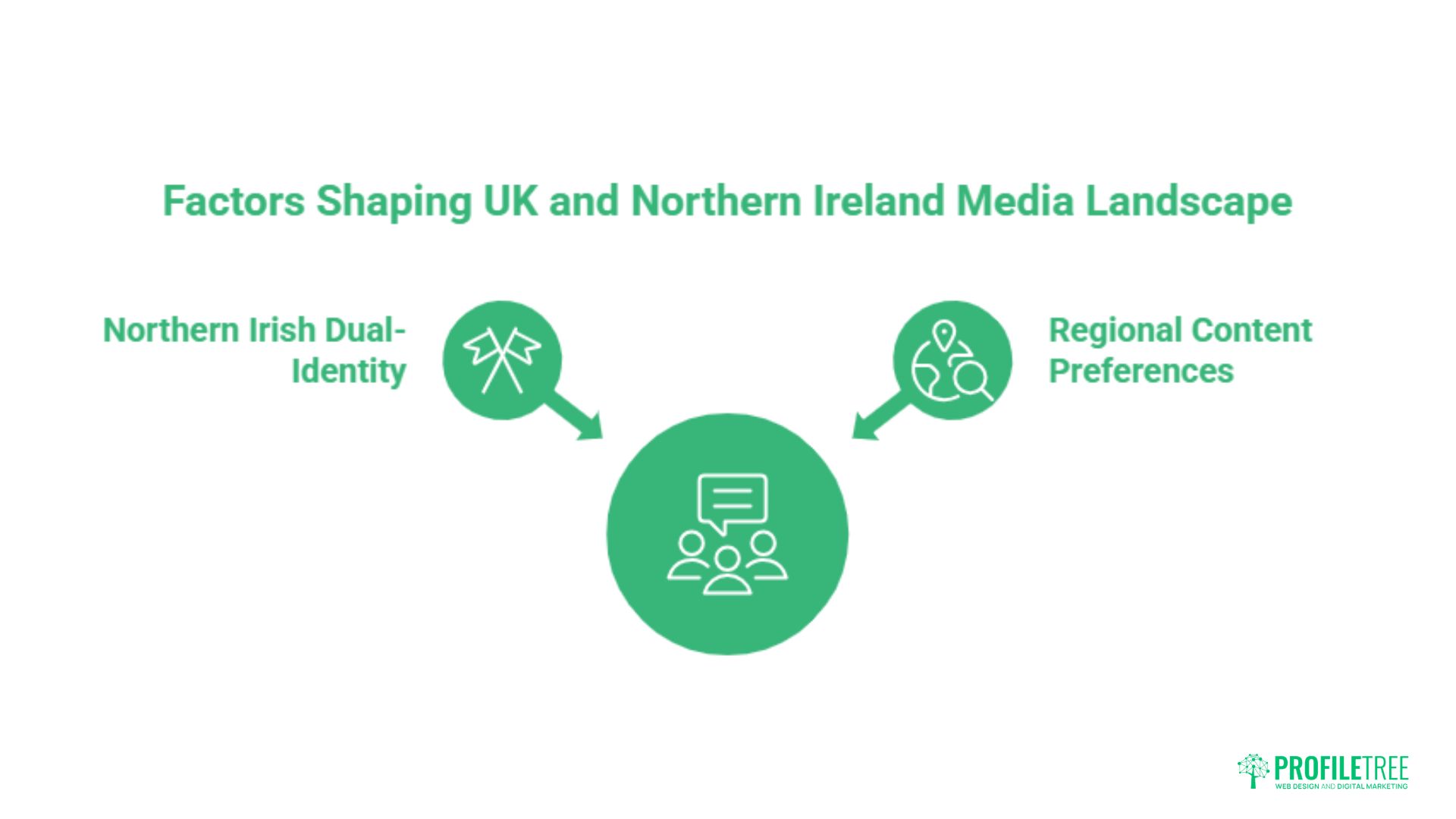
Most published guides on demographic content strategy are written for a US audience and treat demographic data as a single national picture. The UK is considerably more fragmented than that, and Northern Ireland more so.
The 2021 Census for England and Wales, and the corresponding 2021 Census for Northern Ireland conducted by NISRA, revealed several shifts that carry real implications for content planning. England and Wales recorded an ageing population, with the 65+ age group growing faster than any other cohort. Northern Ireland’s demographic profile remains younger overall, with a higher proportion of under-34s relative to the GB average, but that is changing as emigration trends among young graduates put upward pressure on the median age in rural areas.
The Northern Irish Dual-Identity Consideration
Northern Ireland’s content environment is distinctive in ways that straightforward demographic variables do not fully capture. A significant proportion of the population holds or is eligible for dual British-Irish citizenship, engages with both UK and Republic of Ireland media, and makes purchasing decisions within both markets. Content that assumes a purely British frame of reference can alienate part of the audience; content that defaults to a purely Irish context can feel misaligned for the remainder.
The practical implication is that Northern Irish business content benefits from a deliberately neutral tone on cultural-identity markers, an awareness of both UK and ROI regulatory contexts where relevant, and a geographic specificity (“Northern Ireland” rather than either “Britain” or “Ireland”) that respects the audience’s lived reality. ProfileTree, based in Belfast, works across both markets and brings that dual-context awareness to every content marketing brief it takes on.
Ciaran Connolly, founder of ProfileTree, notes: “When we work with Northern Irish SMEs on their content, the dual-market context comes up in almost every brief. The businesses that get the most traction are the ones that speak to both sides of that audience without trying to force an artificial identity on them.”
Regional Content Preferences Across the UK
Beyond Northern Ireland, regional variation in the UK affects content receptivity in ways that national averages obscure. Scotland has its own distinct regulatory environment post-devolution, particularly in areas like planning, education, and health, and Scottish audiences are more likely to distrust content that assumes a purely English legislative framework. Wales has a bilingual context that affects SEO as well as editorial choices for businesses operating there.
| Generation | Preferred format | Primary platform | Tone preference | UK-specific note |
|---|---|---|---|---|
| Gen Z (born c.1997 to 2012) | Short-form video, memes | TikTok, Instagram, YouTube | Authentic, direct, values-led | Higher cost-of-living anxiety than peers globally; price transparency matters |
| Millennials (born c.1981 to 1996) | Long-form, UGC, stories | Instagram, YouTube, LinkedIn | Peer-validated, experience-focused | Squeezed middle; respond well to “get more for less” framing |
| Gen X (born c.1965 to 1980) | In-depth articles, email | LinkedIn, Facebook, email | Practical, evidence-based | Primary B2B decision-makers in UK SME sector |
| Boomers (born c.1946 to 1964) | Long-form, video tutorials | Facebook, YouTube, email | Formal, trust-signalling | “Silver economy” is fastest-growing UK consumer segment |
For businesses operating across Northern Ireland, these regional nuances compound generational ones. A Gen X audience in Belfast brings different reference points to a piece of content than a Gen X audience in Bristol, even if their demographic profile on paper looks identical. Local examples, regional economic context, and awareness of proximity to the Republic all change how the same message lands. Visit Connolly Cove’s guide to Northern Ireland’s cities for a useful sense of the regional landscape and how distinct each area is.
The Five-Step Framework for Implementing Demography-Driven Content
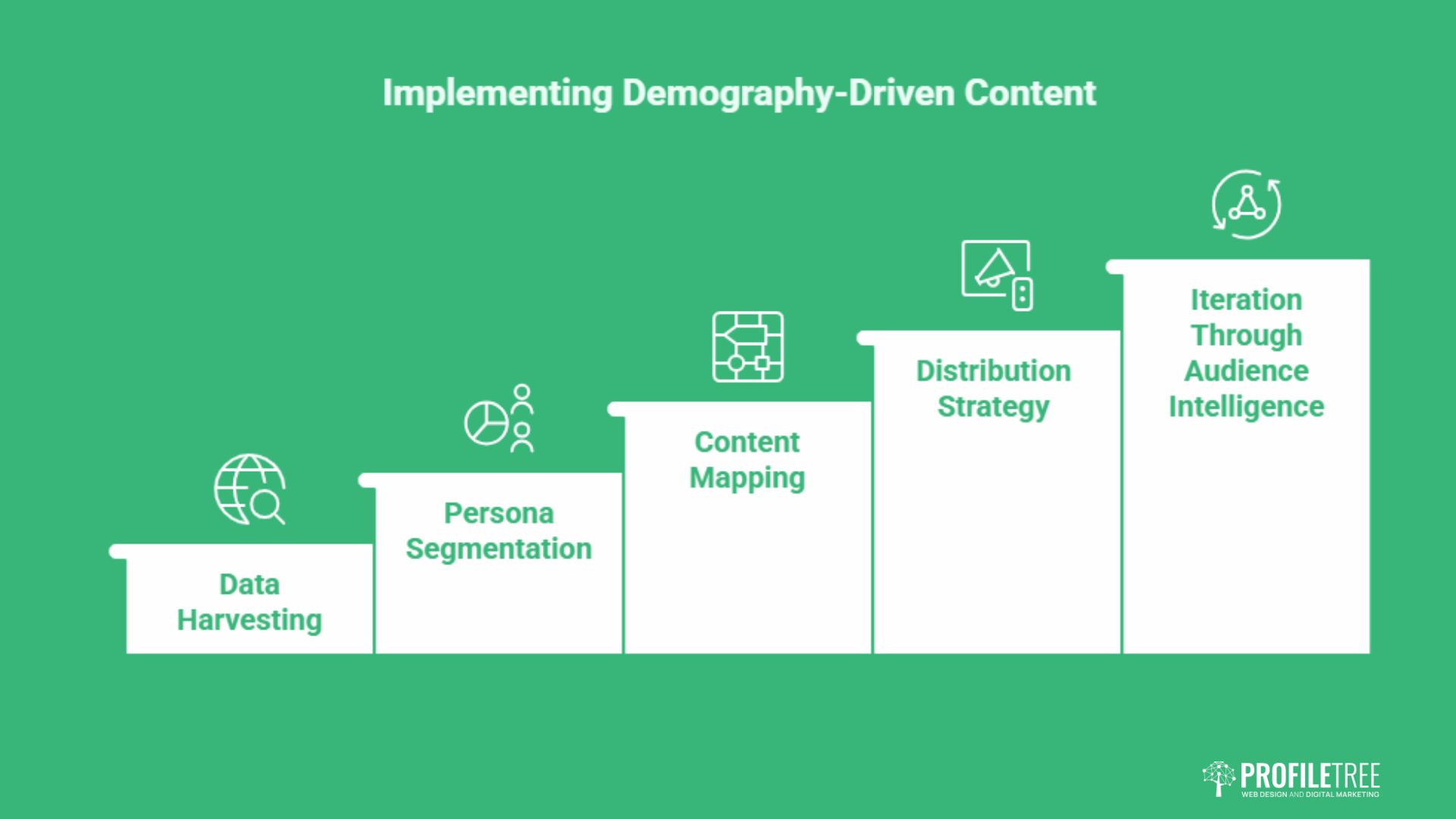
Knowing that demographics matter is not useful in itself. What follows is a five-step process for moving from raw audience data to published content that performs measurably better because of it. Each step builds on the previous one, and the cycle is intended to repeat as your data matures.
Step 1: Data Harvesting
Start with what you already have. GA4’s audience demographics report provides age, gender, and location breakdowns for your website visitors. Your email platform provides open and click data by segment. Your CRM holds industry, company size, and job function if you are selling B2B. Most businesses sit on enough demographic data to begin segmenting; the problem is that it rarely gets used for content decisions.
Where gaps exist, plug them with zero-party collection. A two-question onboarding survey, a newsletter preference centre, or a lead magnet that asks for role and company type in exchange for a resource will all generate demographic data with full consent. Avoid the temptation to ask for too much at once; one or two questions with a clear value exchange will convert far better than a ten-field form.
Step 2: Persona Segmentation
Once you have demographic data, segment it into three to five distinct audience personas. Each persona should reflect a real cluster of people in your data, not an aspirational customer type invented in a workshop. A good persona captures age range, role or life stage, primary information source, key concern or goal, and the format they are most likely to complete.
For B2B audiences, firmographic segmentation often produces more actionable personas than demographic segmentation alone. A Finance Director at a 50-person manufacturing company in Belfast has different content needs than a Marketing Manager at a 200-person professional services firm in Dublin, even if their age and education level are identical. Treating company size, sector, and seniority as persona inputs produces better B2B content than any purely demographic framework. Building out these profiles connects directly to a stronger social media content strategy, since platform choice and format follow naturally from who each persona is.
Step 3: Content Mapping and Tone Selection
Map each persona to a content format and a tone register. This is where the generational table above becomes useful in practice. A 28-year-old marketing coordinator and a 52-year-old operations director may both be researching the same product, but one will find a 90-second explainer video sufficient while the other wants a 2,000-word comparison with pricing detail and a clear process outline.
Tone mapping goes beyond the formality level. It includes vocabulary choice (technical vs accessible), evidence type (case studies vs data vs peer recommendations), and call-to-action framing (urgency vs considered). Getting this right is the difference between content that converts within a segment and content that gets read and forgotten. ProfileTree’s content creation work integrates tone mapping as a standard pre-production step for exactly this reason.
Step 4: Distribution Strategy
Demographics and platform behaviour are closely linked. Gen Z audiences are on TikTok and Instagram; trying to reach them through LinkedIn organic is largely a wasted effort. Gen X decision-makers are reachable through LinkedIn content and email, not through Instagram Stories. Boomers, who now represent the UK’s fastest-growing consumer segment by spending power, are highly active on Facebook and YouTube but often ignored by brands chasing younger-skewing impressions.
Distribution strategy also determines what format you lead with. A blog post can be adapted into a LinkedIn article, a short-form video script, an email sequence, or a downloadable guide, depending on which platform you are prioritising for which persona. That kind of deliberate repurposing, rather than posting the same thing everywhere, is what a demographic-first distribution approach produces. It connects naturally to broader social media marketing planning, where platform selection should always follow audience data rather than habit.
Step 5: Iteration Through Audience Intelligence
The framework only improves with use. After publishing demographically targeted content, review your analytics data against the persona assumptions you made. Did the Gen X audience segment actually engage with that long-form piece, or did engagement cluster in a younger cohort? Did the email open rate for the “SME owner” persona confirm your tone choice, or does it suggest a different angle?
Using customer feedback alongside platform analytics closes the loop. A short post-read survey or a reply-to ask in your email sequence will surface qualitative data that raw engagement numbers cannot. Over time, this iteration narrows the gap between who you think your audience is and who is actually reading, watching, and converting.
Demography-Driven Content and SEO: The Connection Competitors Ignore
The question “Does demographic targeting help my Google rankings?” appears regularly in search data for this topic, and existing guides largely ignore it in favour of discussing social media and paid advertising. The answer is yes, and the mechanism is more direct than most marketers realise.
Search engines measure content quality partly through engagement signals: how long users stay on a page, how many go on to visit other pages, and how quickly they return to the search results (a high bounce rate being a negative signal). Content well-matched to its audience’s demographic profile produces better outcomes across all three measures because it is more relevant, uses language that resonates, and addresses the actual concerns of the people who found it. Demographic alignment is, in effect, a form of user intent matching at the segment level.
How Audience Demographics Connect to E-E-A-T
Google’s E-E-A-T framework rewards content that demonstrates direct experience of the context it addresses. A piece about marketing to Northern Irish SMEs, written by a Belfast agency that has worked with hundreds of them, carries more experiential authority than the same piece produced by a US marketing blog. That experiential specificity is also demographic specificity: it signals to both algorithms and readers that the content comes from someone who understands the audience’s actual situation.
Author credentials amplify this. Since early 2026, Google’s documentation has included author information as an explicit quality signal, and crawlers now link author profiles across platforms. Ensuring your content team’s bios reflect genuine sector experience, and that those bios are consistent across your website, LinkedIn, and any guest publications, builds the author entity that search algorithms use to assess E-E-A-T. Reviewing your competitive content analysis through this lens often reveals that authority gaps, not just keyword gaps, are limiting your rankings.
Demographic Signals as Content Planning Data
GA4 audience demographics also inform keyword strategy. If your highest-converting audience segment is 35-to-54-year-old business owners in Northern Ireland, the search queries that segment uses will skew towards longer, more specific terms: “how to choose an SEO agency for a small manufacturing business” rather than “SEO agency”. Content built around those longer-tail queries will draw lower search volume but substantially higher conversion rates, because the demographic specificity of the query reflects genuine purchase intent.
Connecting demographic audience data to keyword research is a practical application of the broader shift in search towards digital content trends that reward depth and relevance over volume. The businesses ranking well in 2026 are those whose content was built with a specific audience in mind from the first paragraph.
Video as a Demographic-Led Format
Video consistently outperforms text for certain demographic segments, particularly under-35s and the growing “Silver Economy” audience who have adopted YouTube as a primary information source. ProfileTree’s own research across client projects in Northern Ireland has found that adding a well-structured explainer video to a high-intent blog post can increase average session duration by 40% or more, depending on the audience segment.
For businesses considering video as part of their demographic content mix, the key is matching video length and format to the audience segment. Gen Z audiences respond to under-90-second formats with a direct hook in the first five seconds. Millennial audiences engage with 3-to-5-minute explainers that validate a decision they are already considering. Gen X and Boomer audiences are most receptive to tutorial-format videos that walk through a process in full. ProfileTree’s video marketing services are built around these segment-specific format distinctions rather than a single production template.
Conclusion
Demographic data transforms content from a broad broadcast into a targeted conversation. The businesses seeing the strongest results from their content programmes in 2026 are those that have built audience segmentation into their planning process rather than treating it as a post-publication analysis task. In the UK and Northern Ireland specifically, regional nuance, generational diversity, and the shift to first-party data all make demographic-led content strategy more valuable, not less, than the US-centric frameworks that dominate most published guidance.
If you want to put this into practice, ProfileTree’s team works with SMEs across Northern Ireland, Ireland, and the UK to build content strategies grounded in real audience data. Get in touch to discuss your content strategy and find out how a demographic-first approach can improve both your reach and your conversion performance.
FAQs
What is a demography-driven content strategy?
A demography-driven content strategy uses statistical characteristics of your audience, such as age, gender, location, income, and education, to shape what content you produce, in what format, and on which platforms. Rather than creating content for a hypothetical average reader, it builds material for defined segments of real people.
How do I collect demographic data without third-party cookies?
The most practical approaches are first-party and zero-party data collection. First-party data comes from your own channels: Google Analytics 4 provides age, gender, and location data for consented users; your email platform gives you open and click behaviour by segment; your CRM holds firmographic data for B2B audiences. Zero-party data is actively provided by your audience through surveys, preference centres, or onboarding questions.
Can I target multiple demographics with one piece of content?
Yes, but it requires a primary and secondary audience logic. Every piece of content should be written with a primary demographic segment in mind, as that is what determines tone, format, depth, and platform. A secondary audience can be served by the same piece if their intent overlaps significantly with the primary segment’s, but trying to satisfy three or more distinct segments in a single article usually results in content that serves none of them well.
What is the difference between demographic and psychographic content targeting?
Demographic targeting answers who: age, gender, location, and income. Psychographic targeting answers why: values, attitudes, lifestyle, and motivation. In practice, demographic data tells you which platform to use and what format to adopt; psychographic data tells you what angle or framing will resonate. The most effective content strategies use both.
Is demographic targeting legal under UK GDPR?
Yes, provided it is based on consented data and does not involve special-category attributes without explicit consent. Aggregate demographic data drawn from analytics or surveys at scale, anonymised so that no individual is identifiable, presents no compliance risk under UK GDPR.
Does demographic targeting help my Google rankings?
Yes, through its effect on engagement signals. Content that is closely matched to a defined demographic segment tends to produce longer dwell times, lower bounce rates, and more pages per session than generic content on the same topic. These behavioural signals are used by search algorithms as quality indicators. Additionally, demographic specificity in content, particularly regional and audience-specific language and examples, aligns with Google’s E-E-A-T framework, which rewards demonstrable experience of the context the content addresses. Writing for a specific audience is, in practice, a form of user intent matching that search engines reward.