
Hiring a Copywriter: What It Costs and How to Choose
Table of Contents
Hiring a copywriter is one of those decisions most business owners put off, usually because it’s hard to tell whether it’s worth the money. You can see the website isn’t pulling its weight, but you can’t quite say whether the problem is the design, the offer, or the words. More often than people expect, it’s the words. This guide is for SME owners across Northern Ireland and the UK, weighing up whether to bring in help: it covers what copywriting actually involves, the signs that point to hiring a professional, how to choose between a freelancer and an agency, and how to brief whoever you pick so you get copy that earns its keep.
What Copywriting Is and What It Covers
Copywriting is persuasive writing aimed at a result you can measure, not just words that read well. A blog post that ranks but never turns a reader into an enquiry hasn’t done its job. Good copy moves someone from “interested” to “in touch”.
The Formats Copywriting Covers
The work spans more formats than most business owners expect. Website and landing page copy carries the heaviest commercial load, since it’s where buying decisions happen. Email campaigns, blog and article content, social posts, advertising lines, and video scripts each ask for a different rhythm and a different level of directness. A video script that sounds natural when read aloud looks nothing like a service page on screen.
Why Copywriting and Search Belong Together
Modern copywriting also overlaps with search. Copywritten for the web has to satisfy a reader and a search engine at the same time, which is why copywriting, SEO, and content strategy are usually handled together rather than as separate jobs. Research on how people read online found that users typically read only about 20 to 28 per cent of the words on a page, which is why copy has to lead with the point and stay scannable (Nielsen Norman Group). On a website project, the copy and the build shape each other; ProfileTree treats copywriting and design as one process for that reason.
Hiring a Copywriter: When Is It Worth the Cost?
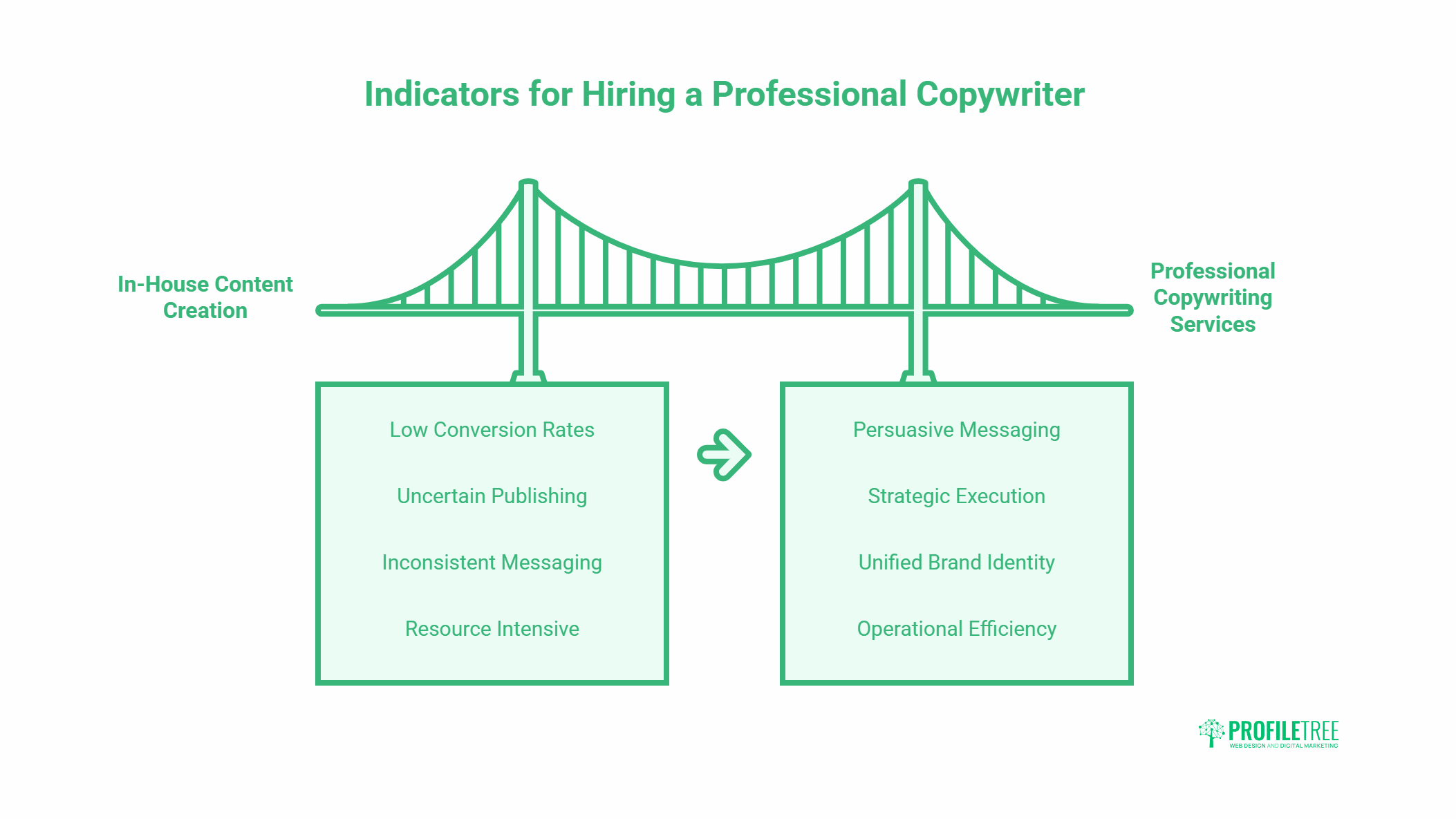
Bring in a professional when poor copy is costing you more than the writing would. A few signals make the case clearly.
Your site gets visitors, but few enquiries. Traffic that doesn’t convert usually points at the message, not the design. If people land and leave without acting, the copy isn’t doing the persuading.
You’re second-guessing what you publish. If every blog post or email feels like a guess, you’re spending time without confidence in the return. A writer who does this daily works faster and with a clearer sense of what prompts a response.
Your content is inconsistent across channels. When the website, emails, and social feed sound like three different companies, the brand reads as unfocused. Consistent copy builds recognition, and recognition supports trust.
You don’t have the hours. Writing well at volume is slow if it isn’t your main job. For many owners, the time spent labouring over copy is worth more than running the business.
“Most SMEs we work with don’t have a copy problem and a marketing problem. They have one problem wearing two hats. The words and the strategy have to be the same conversation, or the website looks good and still sells nothing.” Ciaran Connolly, founder of ProfileTree.
If those signals sound familiar, it’s worth getting a professional view before more enquiries slip away. ProfileTree’s copywriting services sit alongside web design and SEO, so the words are written to fit the wider marketing rather than bolted on afterwards. Get a free copywriting consultation to find out what your current content is costing you.
How Copywriting Builds Your Brand
Good copy does more than sell a single page. It shapes how your business sounds, and a consistent voice is one of the things that makes a brand recognisable. A copywriter who works across your site, emails, and social content can give you that consistency in a way that ad-hoc writing rarely manages.
The first step is usually defining a brand personality: the tone, the level of formality, the words you use and the ones you avoid. People tend to choose businesses whose character feels familiar or aspirational to them, so a clear personality is a commercial asset, not a cosmetic one. Once that personality is set, every piece of copy can reinforce it, from a homepage headline down to an order-confirmation email.
This is also where a fresh pair of eyes helps. You know your business better than anyone, which makes it surprisingly hard to describe plainly to someone who doesn’t. A copywriter looks at what you offer from the customer’s side and often surfaces benefits you’ve stopped noticing. That outside view, applied consistently across every touchpoint, is how scattered content turns into a brand people remember.
How to Choose a Copywriter or Agency
Pick on evidence of results, not on word count or rate alone. The cheapest option often costs more once editing and reworking are added in.
Judge the Work, Not the Pitch
Start with relevant samples. Ask to see work in a similar sector or for a similar goal, then read it as a customer would. Does it make you want to act, or just inform you? Strategic thinking shows in the work before it shows in a pitch.
Check for marketing understanding, not just writing skills. A strong copywriter asks about your audience, your buying cycle, and what a good outcome looks like before quoting. Someone who only asks for a word count is selling typing, not copy.
Freelancer or Agency
Weigh freelancer against agency honestly. A freelancer can be ideal for a single, well-defined piece. An agency makes more sense when copy needs to connect to design, SEO, and analytics, or when the work is ongoing and needs to stay consistent as the site grows. The right choice depends on scope, not on which is cheaper per hour.
Test before you commit at scale. For an ongoing relationship, a small paid test project shows you the working style and quality before a larger contract. Pay for the test; serious writers don’t work on spec.
The table below sets out where each option tends to fit, based on the projects ProfileTree sees most often from SMEs.
| Your situation | Freelancer | Agency |
|---|---|---|
| One-off piece, clear brief | Strong fit | Often overkill |
| Copy tied to a website build | Workable, needs coordination | Strong fit |
| Copy plus SEO plus analytics | Hard to join up | Strong fit |
| Ongoing content, consistent voice | Depends on availability | Strong fit |
| Tightest possible budget, simple need | Usually cheaper | Higher minimum |
The pattern is straightforward: the more your copy has to connect to other things, the more an agency earns its cost. For a single landing page with a tight brief, a good freelancer is often the sensible call.
How to Brief a Copywriter for Results
A clear brief is the single biggest factor in getting copy you can use. Vague instructions produce vague writing.
What a Good Brief Includes
Set the goal first. State plainly what the copy should achieve: more enquiries, lower bounce, stronger brand voice, higher rankings, or more engagement. Attach a measurable target where you can, so success isn’t a matter of opinion.
Describe the audience in detail. Who are they, what problem brings them to you, what motivates them, and what would make them choose you over the alternative? Demographic basics help, but the psychology matters more: a brief that explains what the reader is worried about gives the writer something to actually persuade against.
Define voice and scope. Note the tone (formal, conversational, technical), the pages or pieces involved, word counts, the number of revision rounds, and any keywords or calls to action that must appear. Spell out which English you want, UK or US, since AI-assisted drafts default to American spelling. Share brand guidelines if you have them, plus examples of copy you like and dislike.
Give access and feedback fast. Provide brand assets, past copy, your CMS, and any analytics, then respond to drafts promptly. Slow approvals stall projects more often than slow writing does.
Loose Brief or Detailed Brief
Decide early how much you want to specify, because writers work to two quite different models. A loose brief sets only the basics: the general subject, a word count, and a deadline, then trusts the writer to choose the angle. That suits a standard blog post where the instruction is simply to match the existing style and cover something the blog hasn’t already.
A detailed brief is closer to a template. It sets the exact structure, the headings and subheadings, the word count per section, and specific rules on keyword use, in-text citations, and formatting. This takes more of your time up front but gives you tight control over the result, which is what you want for a service page, a pillar article, or anything where the structure has to do a specific SEO or conversion job. Neither approach is better in the abstract; match the level of detail to how much the exact output matters.
For SMEs that want their copy, design, and search strategy briefed once and delivered together, ProfileTree’s copywriting team handles the full picture rather than handing back words for someone else to fit in later. Book a free copywriting quote to scope your project.
Frequently Asked Questions
What Does a Copywriter Actually Do?
A copywriter writes content designed to prompt a specific action, such as an enquiry, sign-up, or sale. That covers website and landing page copy, email campaigns, blog posts, ad lines, and video scripts. Beyond writing, most professional copywriters help shape the message itself: defining the audience, clarifying the brand voice, and structuring content so it ranks in search and converts visitors. The job is persuasion with a measurable result attached, not writing for its own sake.
Should I Hire a Freelance Copywriter or an Agency?
It depends on the scope. A freelancer suits a single, well-defined piece of work with a clear brief. An agency suits ongoing work, or projects where the copy has to connect to web design, SEO, and analytics to perform. If your website, emails, and social content all need to sound consistent and support each other, an agency that handles those together usually delivers more for the money than coordinating several freelancers yourself.
How Much Does Professional Copywriting Cost in the UK?
Costs vary widely by scope, format, and the experience of the writer, so any single figure would mislead. A short landing page sits at a different level to a full website rewrite or an ongoing content programme. The more useful question is what poor copy is costing you in lost enquiries. Ask for a scoped quote against your specific goals rather than a per-word rate, since per-word pricing rewards length over results.
Can Copywriting Improve My Search Rankings?
Yes, when it’s written for readers and search together. Copy that answers real questions clearly, uses the language your customers actually search with, and is structured for easy reading tends to perform in search as well as on the page. This is why copywriting and SEO are best handled as one job. Copywritten purely to stuff in keywords reads badly and rarely ranks well anyway.
How Do I Know If My Current Copy Is Underperforming?
Look at what visitors do, not just how many arrive. High traffic with few enquiries usually points to the message. Other signals include a high bounce rate on key pages, inconsistent tone across your channels, and content you’re unsure about publishing. If you’re getting clicks but no conversations, the copy is the most likely cause and the cheapest thing to fix.
Getting the Right Copy for Your Business
Strong copy is one of the cheaper ways to improve marketing results, because it changes how every visitor experiences your site without rebuilding it. The hard part is matching the writing to the strategy behind it. Choose a partner based on evidence of results, brief them clearly, and treat the copy as part of your wider marketing rather than a separate task. If you’d rather have copy, design, and search handled as one project, ProfileTree’s Belfast team can scope it with you in a free consultation.