
Social Media Age Demographics: Platform Guide for SMEs
Table of Contents
Knowing which age groups use which platforms is one thing. Knowing what to do with that information is what separates businesses that get results from social media from those that simply post and hope. This guide brings together social media age statistics across every major platform, explains what those patterns mean in practice, and shows how SMEs in Northern Ireland, Ireland and the UK can build a smarter strategy from the data.
Why Social Media Age Data Should Drive Your Platform Decisions
Most businesses pick social media platforms based on instinct or where they personally spend time. That approach misses the point. The platforms you choose should be determined by where your target customers are, which content format they respond to, and what stage of the buying decision they are typically in when they open the app.
Social media age demographics give you the first piece of that picture. When you know that the majority of LinkedIn’s global users are aged 25 to 34 (Statista, October 2025), and that TikTok’s user base skews heavily under 35, you have an immediate framework for platform selection. A B2B firm targeting senior decision-makers and a consumer brand targeting young adults should not be running identical social media strategies, yet many do.
“The businesses that see the strongest return from social media are the ones that match their content format and platform choice to where their actual audience spends time,” says Ciaran Connolly, founder of ProfileTree. “Demographic data makes that decision much simpler.”
The social media age breakdown below covers overall usage rates, platform-specific distributions, and the content behaviours that matter most for marketing planning.
Social Media Usage by Age: Overall Figures
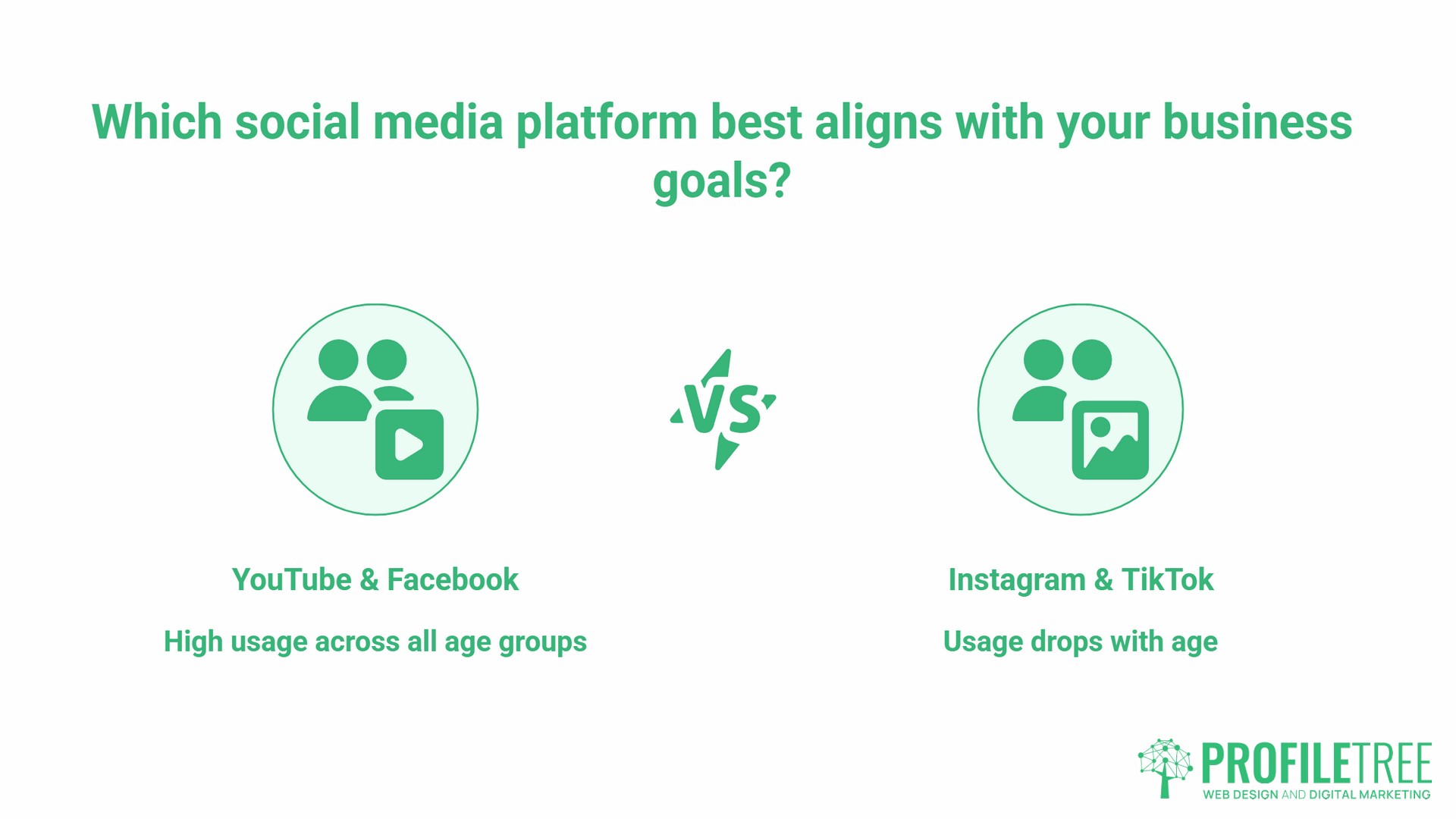
YouTube and Facebook are the only two platforms that the majority of adults across all age groups use, according to Pew Research’s 2025 survey of US adults. For most other platforms, usage drops substantially with age. The table below reflects Pew Research’s findings on platform usage by age group (Pew Research Center, November 2025).
| Age Group | YouTube | TikTok | ||
|---|---|---|---|---|
| 18-29 | 93% | 67% | 80% | ~49% daily users |
| 30-49 | 92% | 80% | 53% | Active users |
| 50-64 | 86% | 73% | 29% | Lower usage |
| 65+ | 65% | 59% | 19% | 5% daily users |
Source: Pew Research Center, “Americans’ Social Media Use 2025,” November 2025.
In the UK specifically, Ofcom’s Online Nation Report 2025 found that WhatsApp has the highest daily reach among UK adults, followed by Facebook at 63% and Instagram at 44%. YouTube entered the UK top five platforms by daily reach in 2025. As of 2025, roughly 55.5 million people in the UK use social media, representing close to 80% of the population (Statista, 2025).
Daily time on social media also varies significantly by age. According to eMarketer data reported by Statista, US adults aged 18 to 24 spent an average of 186 minutes daily on social media in 2024, while those aged 65 and above spent around 102 minutes per day. Globally, the average across all ages stands at approximately 141 minutes per day (DataReportal/Statista, 2025).
Younger audiences spend more time on platforms, but that does not automatically make them more valuable. Time on the platform translates to value only when it aligns with commercial intent. An older audience spending time on LinkedIn or Facebook, actively researching products and services, is often worth more to an SME than a teenage audience spending three hours on TikTok.
Platform-by-Platform Social Media Age Demographics
Facebook Age Demographics
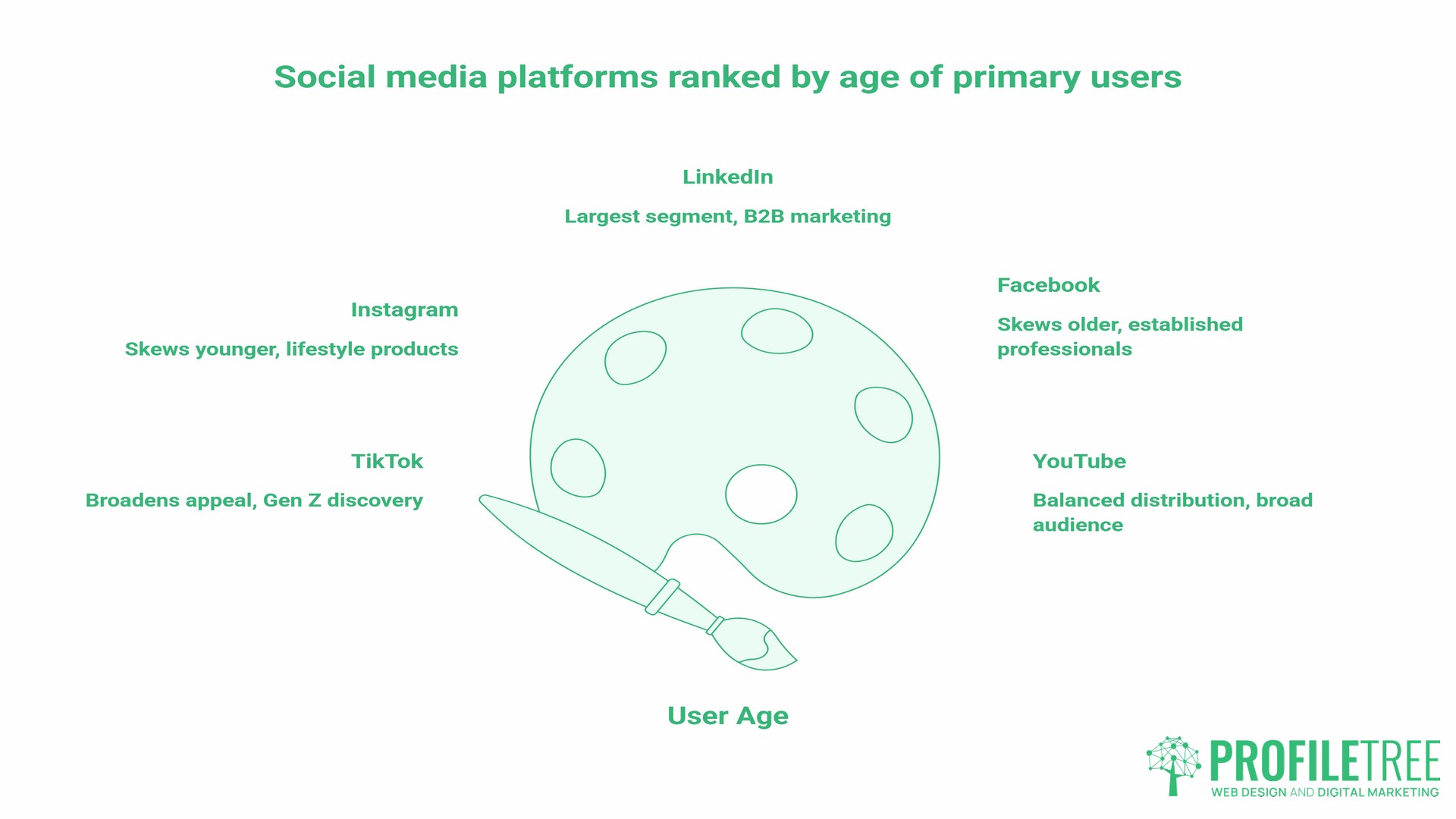
Facebook’s global user base skews older than most other major platforms. Worldwide, the 25 to 34 age group represents the largest single segment, though in the US, Pew Research found that 30 to 49-year-olds are the most frequent Facebook users (80%). Users aged 65 and above represent the lowest US usage at 59%, though this still makes Facebook the platform with the smallest age gap between youngest and oldest users.
| Age Group | Facebook Usage (US Adults) |
|---|---|
| 18-29 | 67% |
| 30-49 | 80% (most frequent users) |
| 50-64 | 73% |
| 65+ | 59% |
Source: Pew Research Center, “Americans’ Social Media Use 2025,” November 2025.
In the UK, Facebook remains deeply embedded in daily life. Ofcom’s Online Nation 2025 data shows Facebook at 63% daily reach among UK online adults, second only to WhatsApp. For SMEs selling to homeowners, parents, established professionals or local communities, Facebook remains a primary channel for reaching the 35-plus audience.
Instagram Age Demographics
Instagram maintains a younger user base than Facebook. According to Pew Research (2025), 80% of US adults aged 18 to 29 use Instagram, compared to 19% of those aged 65 and over — a 61-percentage-point gap that is one of the widest age disparities among major platforms.
| Age Group | Instagram Usage (US Adults) |
|---|---|
| 18-29 | 80% |
| 30-49 | 53% |
| 50-64 | 29% |
| 65+ | 19% |
Source: Pew Research Center, “Americans’ Social Media Use 2025,” November 2025.
Ofcom data for the UK shows Instagram has a 44% daily reach among online adults, with the platform skewing toward the 18 to 34 age bracket. For SMEs offering lifestyle products, hospitality, fashion or professional services targeting younger professionals, Instagram is a primary channel. The 29% of Instagram users who report making purchases on the platform (Piktochart, citing platform data, 2026) also makes it relevant for consumer retail businesses.
TikTok Age Demographics
TikTok’s core demographic remains under 35, though the platform has broadened substantially. According to data from Sprout Social and Backlinko (2026), users aged 50 and above have grown 240% compared to 2023, and 38% of TikTok users globally are now over 30, approximately 418 million people.
In the UK, TikTok has around 26.8 million active users, with ad reach increasing by 12.5% between 2024 and 2025 (Sprout Social, UK demographics report, 2026). UK users aged 18 to 34 spend the most time on TikTok, averaging 88 minutes daily on the platform.
A notable shift for SME marketing strategy: according to Sprout Social’s Q2 2025 Pulse Survey, 41% of Gen Z now turn to social media platforms before traditional search engines when looking for information, with TikTok and Instagram among the primary discovery channels. For businesses targeting younger consumers, being findable on TikTok is increasingly relevant beyond traditional paid advertising.
For businesses targeting younger consumers or looking to build brand awareness at scale, TikTok’s video-first format rewards short, authentic content. ProfileTree’s short-form video content guide covers the practical production side in more detail.
LinkedIn Age Demographics
LinkedIn’s age distribution has shifted. Statista’s October 2025 data — based on DataReportal and We Are Social survey analysis — puts the 25 to 34 bracket at 33.4% of global LinkedIn users, with the 18 to 24 age group at 20.5% and users over 55 at just 1.8%.
| Age Group | % of LinkedIn Users (Global, Oct 2025) |
|---|---|
| 18-24 | 20.5% |
| 25-34 | 33.4% (largest segment) |
| 35-54 | ~26% |
| 55+ | 1.8% |
Source: Statista, citing DataReportal and We Are Social, October 2025.
Sprout Social’s 2026 LinkedIn statistics report notes that the platform’s age distribution is “slowly evening out,” with more career-stage diversity than in previous years. LinkedIn remains the dominant platform for B2B marketing. Pew Research (2025) found that 40% of US adults aged 30 to 49 use LinkedIn, the highest rate among age brackets. In the UK, LinkedIn has approximately 45 million members, with 45% of UK users aged 25 to 34 (Talkwalker, citing platform data, 2025).
For Northern Ireland and Irish SMEs selling to other businesses, LinkedIn is typically the highest-value social channel. For more on how the platform functions in a UK and Irish professional context, see ProfileTree’s analysis of the impact of LinkedIn on UK business.
YouTube Age Demographics
YouTube has the most balanced age distribution of any major platform and the highest usage rates across all adult age groups. Pew Research (2025) found that 93% of US adults aged 18 to 29 use YouTube, closely matched by 92% of those aged 30 to 49, 86% of those aged 50 to 64, and 65% of those aged 65 and older. YouTube and Facebook are the only two platforms where a majority of adults in every age group report being users.
In the UK, YouTube entered the top five most-used platforms by daily reach in 2025 (Ofcom Online Nation Report 2025). UK users aged 18 to 34 spend an average of 88 minutes daily on YouTube, making it the most-used platform for this group by time spent (Sprout Social UK, 2026).
For businesses producing educational content, product demonstrations, tutorials or brand storytelling, YouTube offers the broadest possible audience across age groups. It also functions as a search engine, meaning content optimised for search can generate organic reach well beyond its initial publication date.
How Different Generations Use Social Media
The demographic tables above show the distribution of each age group. This section covers what they actually do when they get there, which matters more for content strategy.
Generation Z (Ages 13-27): Video, Search and Authenticity
Generation Z has grown up with smartphones and social media as default tools. Their platform preferences reflect this: TikTok, Instagram and YouTube dominate, with an emphasis on short-form video and creator-driven content. According to Sprout Social’s 2026 Social Media Content Strategy Report, 80% of Gen Z users are on Facebook and Instagram, 74% on YouTube, and 72% on TikTok.
A significant shift for marketers: Sprout Social’s Q2 2025 Pulse Survey found that social media is now the primary search destination for Gen Z, ahead of traditional search engines. 41% of Gen Z turn to social platforms first when looking for information. For product discovery specifically, data from creator platform Grin found that over half of Gen Z shoppers discover products most often on Instagram (30.4%) or TikTok (23.2%), with only 18.8% listing Google as their top discovery source.
For SMEs, reaching Gen Z means prioritising video content, particularly short-form vertical video, and accepting that consistent, searchable social media profiles matter for discoverability, not just brand awareness.
Millennials (Ages 28-43): Multi-Platform and Commercially Valuable
Millennials use a broader range of platforms than any other generation. Sprout Social’s generational breakdown (2026) shows Millennials spread across YouTube (90%), Facebook (89%), Instagram (81%) and TikTok (69%). They have the highest commercial intent among all adult age groups for social media engagement.
The social media marketing and sales guide on ProfileTree covers how to convert this demographic’s research behaviour into actual enquiries.
Gen X (Ages 44-59): Facebook, LinkedIn and Considered Engagement
Gen X users engage more deliberately than younger demographics. Sprout Social’s generational usage data (2026) shows Facebook as the dominant platform for this group (88%), followed by YouTube. Facebook daily usage is highest among 30 to 49-year-olds in the US (Pew Research, 2025), with 58% of this age group visiting the platform daily. LinkedIn also performs strongly for professional and B2B content targeting this cohort.
For B2B services, professional development content and local business promotion, Gen X is a high-value audience. Content should prioritise depth and practical value over trend-led formats.
Baby Boomers (Ages 60-78): Facebook-First, Growing Everywhere
Sprout Social’s 2026 generational data shows Baby Boomers concentrated on Facebook (88%) and YouTube (69%), with 39% on Instagram and 20% on TikTok. Facebook daily usage among US adults aged 50 to 64 stands at 54%, according to Pew Research (2025).
For businesses in hospitality, healthcare, home services, financial advice or tourism, Baby Boomers represent a high-value audience that is frequently underserved. Content should prioritise clarity and credibility. Facebook Groups and YouTube are the most productive channels for this demographic.
UK and Ireland: Social Media Age Patterns for Local SMEs
Global statistics provide context, but SME strategy in Northern Ireland, Ireland and the UK should be informed by local audience behaviours.
Ofcom’s Online Nation Report 2025 confirms that WhatsApp has the highest penetration across all UK age groups, followed by Facebook, YouTube and Instagram. The main deviation for older users is that those aged 55 and above use Facebook Messenger more than Instagram as a secondary platform (Sprout Social UK, 2026).
Facebook remains significantly embedded in daily UK life across all adult age groups. As of 2025, the UK had roughly 55.5 million active social media users, representing close to 80% of the population, with WhatsApp the most used social media service, followed by Facebook and Instagram. Social media reach among UK Gen Z stands at 98% and among Millennials at 96% (Statista, 2026).
LinkedIn has approximately 45 million members in the UK (DataReportal, January 2025), with 45% of UK users aged 25 to 34. The platform has grown steadily across professional services, manufacturing, agri-food and technology sectors in Northern Ireland and Ireland.
Sprout Social’s UK demographics report notes that for users aged 18 to 34, YouTube is the most used platform in the UK, with an average of 88 minutes spent daily. Facebook and Messenger dominate time spent for users aged 35 to 54, with an average of 50 minutes daily.
For businesses wanting to understand their specific audience mix in this market, ProfileTree’s digital marketing strategy services can map demographic data to platform recommendations.
From Data to Action: Choosing the Right Platform for Your SME
Social media age demographics should directly inform three decisions: which platforms to prioritise, what content format to produce, and how to structure your content calendar.
Platform selection by primary audience age:
| Primary Target Age | Recommended Primary Platform | Secondary Platform |
|---|---|---|
| 13-27 (Gen Z) | TikTok | |
| 28-43 (Millennials) | Facebook or LinkedIn | |
| 44-59 (Gen X) | ||
| 60+ (Boomers) | YouTube | |
| B2B (any age) |
This table is a starting point, not a fixed rule. Your own platform analytics should validate the hypothesis that the demographic data gives you.
Content format by age group:
The social media age breakdown by generation points to clear content format preferences. Short-form vertical video dominates for under-35 audiences across TikTok, Instagram Reels and YouTube Shorts. For Gen Z specifically, Sprout Social’s Content Strategy Report (2026) found they are the only generation to prefer long-form video (over 60 seconds) on YouTube, alongside their preference for short-form on other platforms.
For 35 to 54-year-olds on Facebook and LinkedIn, longer posts and detailed content tend to compete more evenly with short videos than for younger audiences. The 55-plus audience on Facebook and YouTube responds well to clear, informative content with straightforward production values.
For businesses that have the demographic data but need help building a content strategy around it, ProfileTree’s social media content strategy service covers the full planning and production process.
Identifying Your Target Audience Using Social Media Age Data
Demographic data only creates value when you know which part of it applies to your business. Two practical methods for translating social media age statistics into audience clarity:
- Audience research through your existing channels. If you already have social media followers, the platform analytics built into Facebook, Instagram and LinkedIn show you the age breakdown of your current audience. This is more reliable than any industry average because it reflects your actual customers. Use it as a calibration check against the population-level data in this guide.
- Building a buyer persona. A buyer persona is a structured description of your target customer that includes age range, life stage, professional context, platform usage habits and the problems they are trying to solve. For a Belfast-based accountancy firm, the persona might be a business owner aged 38 to 55, primarily active on LinkedIn and Facebook, researching service providers and looking for demonstrated expertise before making contact. That profile points to a LinkedIn-first strategy with case-study content, not a TikTok-heavy approach.
ProfileTree’s digital training programmes include audience research and persona development as part of the social media marketing curriculum.
What Age Group Uses Social Media the Most?
The most active age group on social media is 16- to 24-year-olds, who spend the most time and appear most consistently, using social platforms about 4.6 days each week for roughly 3 hours and 30 minutes per day. The 25 to 34 age group follows closely and remains the single largest demographic across most major platforms globally (Statista, Sprout Social, 2025/2026).
For most SMEs in the UK and Ireland, the commercially most valuable social media age bracket is 25 to 44. This range covers peak earning years, business decision-making authority and active purchasing behaviour across both consumer and B2B categories.
FAQs
Which platform has the oldest average user demographic?
Facebook has the oldest demographic profile of any major platform. Pew Research (2025) found that 30 to 49-year-olds are the most frequent US Facebook users (80%), and users aged 50 to 64 are close behind at 73%. In the UK, Ofcom’s 2025 data shows Facebook at 63% daily reach across online adults. For businesses targeting established professionals, homeowners or the over-55 market, Facebook is the most direct channel.
Is TikTok still primarily a young person’s platform?
TikTok’s core demographic remains under 35, but the platform has broadened significantly. According to Sprout Social and Backlinko (2026), users aged 50 and above have grown by 240% since 2023, and 38% of TikTok users globally are now over 30. In the UK, TikTok has around 26.8 million active users and saw 12.5% growth in ad reach between 2024 and 2025 (Sprout Social UK, 2026). For B2B services or products targeting older customers, TikTok is not typically the best primary channel, but its reach is wider than its reputation suggests.
What is the best social media platform for B2B marketing in the UK?
LinkedIn is the primary platform for B2B marketing in the UK and Ireland. Pew Research (2025) found that 40% of US adults aged 30 to 49 use LinkedIn, the highest rate among age brackets. The UK has approximately 45 million LinkedIn members (DataReportal, 2025). For SMEs offering professional services, technology, manufacturing or business development, LinkedIn should anchor any B2B social strategy. Facebook can complement this for community-building and retargeting.
Which platform should I use to reach Gen X customers in Ireland?
Facebook is the dominant platform for Gen X in the UK and Ireland, with Sprout Social’s generational data (2026) showing 88% of Baby Boomers and high Gen X usage on the platform. LinkedIn is a strong secondary option for professional services contexts. Instagram also has a meaningful Gen X presence, particularly for lifestyle and hospitality brands. Content for this age group performs best when it prioritises practical value and credibility.
Are Baby Boomers active on Instagram?
Yes, though Instagram’s Boomer presence is smaller than on Facebook or YouTube. Sprout Social’s generational usage data (2026) shows 39% of Baby Boomers use Instagram. Pew Research (2025) found 19% of US adults aged 65 and over use Instagram. For businesses that need to reach this demographic on Instagram, content should focus on clarity, straightforward value propositions and formats that do not rely on platform-native trend mechanics.
What is the minimum age for social media in the UK?
The minimum age for most major social media platforms in the UK is 13. TikTok, Instagram and Facebook all require users to be at least 13 to register. The UK’s Online Safety Act 2023 introduced additional obligations on platforms regarding content served to under-18s, and the Age Appropriate Design Code (also known as the Children’s Code) requires platforms to apply higher privacy protections by default for users under 18. Businesses running paid social campaigns targeting younger audiences should ensure their targeting parameters comply with these rules.
How does social media usage by age affect video marketing decisions?
Short-form video dominates for under-35 audiences across TikTok, Instagram and YouTube Shorts. Sprout Social’s 2026 Content Strategy Report found that Gen Z is the only generation to prefer long-form video (over 60 seconds) specifically on YouTube. For the 35-plus bracket, longer explainer or documentary-style content performs well on YouTube and Facebook. For businesses exploring video production as part of a social strategy, ProfileTree’s guide to the rise of short-form video covers the format landscape in detail.