
Content Optimisation: A Practical Guide to Getting Your Content Found
Table of Contents
Most businesses publish content and then wait. They wait for rankings that don’t arrive, for traffic that trickles in but never converts. The problem is rarely the writing. It’s that the content was never optimised.
Content optimisation is the process of making sure what you publish is structured, researched, and positioned in a way that search engines can understand and real readers want to engage with. It covers keyword research, on-page structure, internal linking, and how well your content answers the questions your audience is actually asking.
This guide covers the full process: from identifying the right keywords and structuring your content correctly, through to measuring whether your efforts are producing results.
What Is Content Optimisation?
Content optimisation is the practice of refining existing or new content so that it matches what your target audience is searching for and meets the criteria search engines use to evaluate quality and relevance. It covers everything from the keywords you target and the headings you use, to the internal links you include and the questions your content actually answers.
It’s worth separating this from content creation. Creating new content builds your library. Optimising content makes what already exists work harder. For most SMEs, the second activity delivers a faster return: a page that already sits on page three of Google results is often far cheaper and faster to push to page one than starting a new article from scratch.
The three pillars of modern content optimisation are:
SEO and technical metadata cover title tags, meta descriptions, heading structure, URL slugs, and image alt text. The most common failure point here is either keyword stuffing or keyword absence — titles that are crammed with phrases or that don’t include the primary search term at all.
User experience and readability cover paragraph length, sentence clarity, mobile formatting, and page speed. Dense text blocks, absent subheadings, and slow load times are the main culprits when users arrive but leave immediately.
Editorial authority and E-E-A-T cover original insights, verifiable facts, author credentials, and external citations. Generic content with no unique angle, no named author, and no sources is the fastest way to fall behind competitors who are investing in genuine depth.
Getting all three right simultaneously is what separates content that ranks from content that sits. Most guides focus almost entirely on the first pillar, which is why so many technically optimised articles still fail to attract clicks.
Keyword Research: The Starting Point for Content Optimisation
You cannot optimise content for a keyword you haven’t researched. This sounds obvious, but a significant proportion of SME blog content is written with keyword selection based on gut feel rather than data, which means it targets phrases that either nobody searches for or that are dominated by national or global brands with far greater domain authority.
Keyword research for content optimisation has two distinct goals. First, identify the primary phrase your content should target. Second, mapping out related terms, questions, and secondary keywords that allow a single piece of content to rank for multiple related queries simultaneously.
Understanding search volume and keyword difficulty
Two metrics matter most at the research stage. Search volume tells you how many people search for a phrase per month. Keyword difficulty gives a comparative estimate of how hard it would be to rank on the first page, based on the authority of the pages currently holding those positions.
For SMEs in Northern Ireland, Ireland, and the UK, the practical approach is to prioritise keywords with moderate search volume (typically 200-2,000 monthly searches) and low-to-medium difficulty scores. Highly competitive short phrases like “content marketing” or “SEO tips” are dominated by established publishers with years of domain authority. Longer, more specific phrases, sometimes called secondary keywords, are often far more achievable and bring in searchers with clearer intent.
Tools worth using for keyword research
Semrush offers a full keyword database with search volume, difficulty scores, and related queries. The free tier limits searches to a daily limit; paid plans provide full access to competitive analysis and content gap reports. For UK and Irish content, check that the tool is set to the correct regional database before pulling data.
Ahrefs operates a similar model with a particularly strong backlink analysis component. Its Keywords Explorer feature is well-regarded for identifying clusters of related terms and assessing whether first-page competitors are achievable targets.
Google Search Console is free and often overlooked for keyword research. If your site already has some history, the Performance report shows which queries are generating impressions but few clicks. Those are your best immediate optimisation targets: Google already knows these pages are relevant; the job is to make them compelling enough to actually earn the click. Our guide to common Search Console errors covers how to read and act on this data.
Google’s People Also Ask boxes are a free and underused source of question-based keyword ideas. The questions that appear for your target phrase often map directly to H2 subheadings and FAQ sections in your article.
Search intent: the thing keyword volume doesn’t tell you
A keyword with high search volume is only useful if its intent aligns with what your page delivers. Search intent falls into four broad categories: informational (the user wants to learn), navigational (the user is looking for a specific site), commercial investigation (the user is comparing options), and transactional (the user is ready to act).
Mismatching intent is one of the most common reasons well-written content fails to rank. A service page optimised for an informational query will be outranked by an educational guide. A blog post targeting a transactional phrase will lose to a product or service page. Before writing or optimising any piece of content, check what Google already serves for that query and match your format to it.
On-Page Optimisation: Structuring Content That Ranks
On-page optimisation is the work you do within the content itself to help search engines understand what a page is about and to help users find what they’re looking for quickly. It includes heading structure, title tags, meta descriptions, internal linking, and the distribution of your primary keyword throughout the text.
Title tags and meta descriptions
Your title tag is the clickable headline that appears in search results. It should include your primary keyword naturally, ideally near the start, and stay under 60 characters to avoid truncation. Avoid stuffing multiple keywords into the title; a clear, specific title that tells the searcher exactly what they’ll find performs better than a keyword-heavy one that reads awkwardly.
The meta description doesn’t directly affect rankings, but it does significantly impact click-through rate. It should summarise the page’s value in one or two sentences, include the primary keyword, and give the searcher a clear reason to choose your result. Keep it under 155 characters.
Heading structure
Every page should have a single H1 that includes the primary keyword. H2 headings mark major sections and should be structured around user questions or clear topic statements. H3 headings subdivide sections when the content runs long enough to warrant them.
A consistent heading hierarchy serves two purposes. It makes content more scannable for users, reducing bounce rates. And it helps search engines understand the page’s topical structure, improving the chances that sections will be surfaced as featured snippets or in AI-generated summaries.
Keyword placement and density
Your primary keyword should appear in the H1, in the first 100 words of body text, and naturally throughout the article at a density of roughly 0.5 to 1% of the total body word count. This isn’t about mechanical repetition; it’s about confirming relevance consistently without tipping into keyword stuffing, which Google’s algorithms penalise.
Secondary keywords, related terms, and question-based phrases should be woven in naturally throughout the subheadings and body copy. This is how a single article can rank for dozens of related queries. Our guide to content length and search ranking explores how depth of coverage affects this.
Internal linking
Internal links are one of the most underused elements of on-page optimisation. They distribute authority across your site, help search engines map the relationship between pages, and guide readers toward content that deepens their understanding or moves them closer to a conversion.
Every article should link to at least three to five related pages using descriptive anchor text that tells both users and search engines what the linked page covers. Avoid generic anchors like “click here” or “read more.” A phrase like “our guide to auditing your content library” is more useful than either. Links placed early in an article carry more weight than those buried at the bottom.
Image optimisation
Images slow pages down and add nothing to rankings unless they’re properly handled. Every image should have a descriptive filename (not IMG00023.jpg) and alt text that describes what the image shows, limited to 80 to 120 characters. Use compressed file formats such as WebP or AVIF to reduce load times. Original images consistently outperform stock photography in Google’s quality signals.
Content optimisation tools for on-page work
Rank Math and Yoast SEO are WordPress plugins that score your content against on-page criteria in real time: keyword density, meta length, heading structure, internal links, and readability. They won’t tell you whether the content is good, but they flag structural gaps before publication.
SurferSEO and Clearscope go further by analysing the top-ranking pages for your target keyword and identifying the terms, questions, and topics they cover that your content doesn’t. This type of content gap analysis is particularly useful for articles that already rank but have stalled in position.
Optimising for AI Search and Google’s AI Overviews
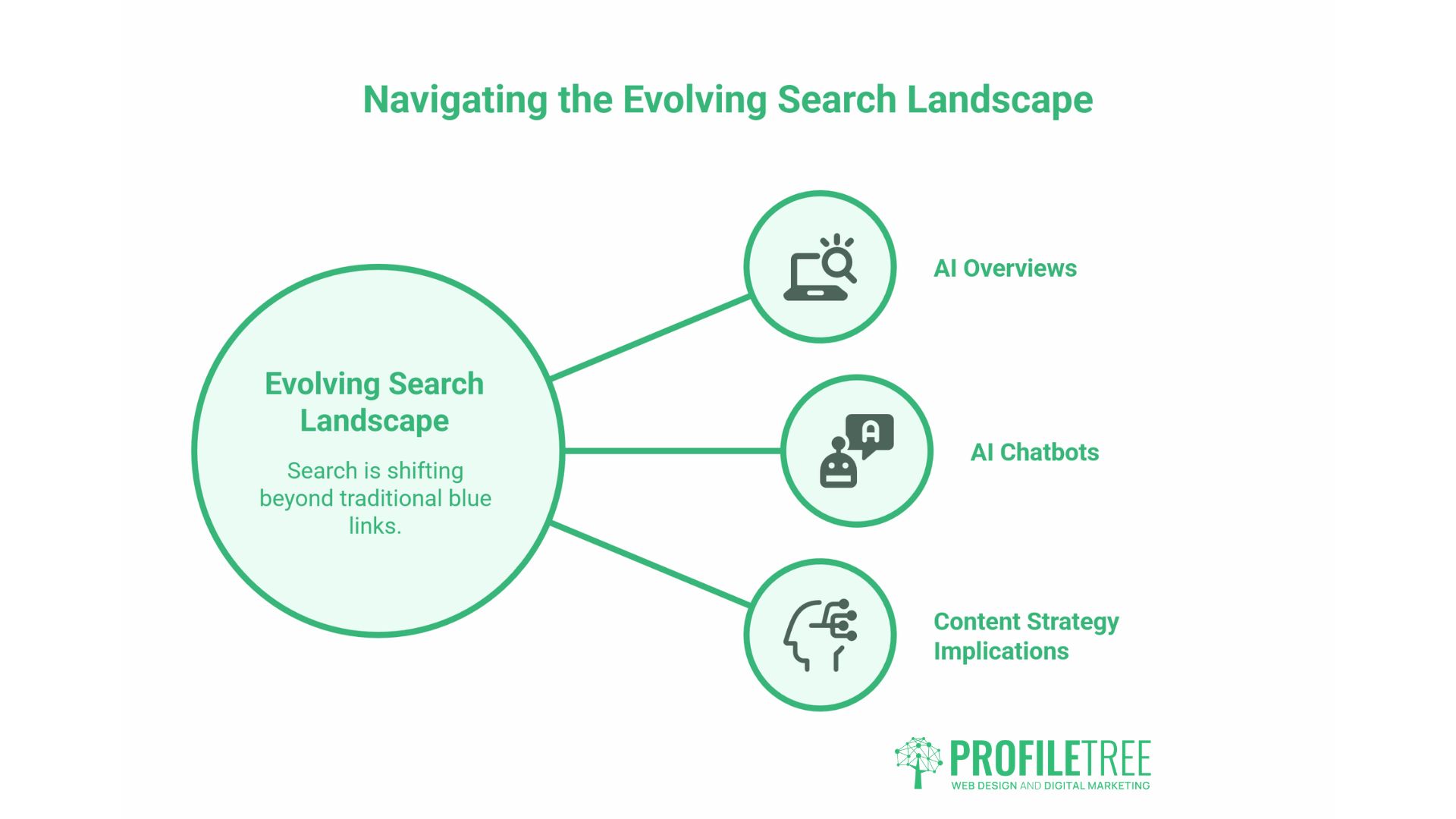
Search is no longer purely a list of ten blue links. Google’s AI Overviews now synthesise answers directly on the results page, drawing from multiple sources. ChatGPT, Perplexity, and similar tools handle an increasing share of informational queries without ever sending users to a website. This shift has real implications for content strategy.
The good news is that the structural principles that help content rank in traditional search also make it more likely to be cited in AI-generated answers. Pages that cover multiple sub-questions within a topic in self-contained, clearly structured sections are significantly more likely to appear in AI Overviews than pages that cover the same ground in long, unbroken paragraphs.
What AI systems look for
AI search tools prioritise content that provides direct, verifiable answers. This means leading each major section with a clear conclusion or answer before supporting it with evidence, keeping section lengths compact enough to extract as standalone responses, using consistent entity language throughout (naming your topic, your location, your services in a way that connects them), and including original data or insights that aren’t available elsewhere.
Our article on AI content detection explains how AI-generated content is identified and why human editorial oversight is essential to maintaining credibility in AI-surfaced results.
The information gain principle
Google’s algorithms now include an Information Gain Score: a measure of how much new or non-redundant information a piece of content adds to the web. If your article covers exactly the same ground as the top ten results for a query, your ranking potential is capped regardless of technical optimisation.
Practical information gain doesn’t require original research studies. It can come from a specific framework you’ve developed for solving a problem, a real project example (anonymised if necessary), a clearly articulated opinion backed by evidence, or content that addresses a sub-question that existing results don’t answer well. The People Also Ask questions for your target keyword are a reliable signal for where information gaps exist.
Structuring content for AI extraction
AI Overviews extract answers from content at the section level, not the page level. This means each H2 section should stand alone as a useful answer to a specific question. The recommended structure for each section is a direct answer or statement in the first one to two sentences, followed by supporting details, examples, and any caveats. This mirrors the BLUF (Bottom Line Up Front) structure that technical writers have used for decades, and that works equally well for both human readers and AI extraction.
The Content Refresh Workflow: Optimising What You Already Have
For most sites, the fastest route to better rankings isn’t publishing new content; it’s fixing what already exists. Content decay, the gradual decline in rankings that affects most pages over time, is a predictable process. Traffic drops steadily as competitors publish fresher material, as search intent shifts, or as the information on the page becomes out of date.
Identifying which pages to prioritise for a refresh starts in Google Search Console. Sort your pages by impressions and filter for those with positions between 8 and 25: these are pages that Google already considers relevant but hasn’t ranked highly enough to generate consistent clicks. They typically need structural improvements, additional coverage of related sub-questions, or better alignment with current search intent rather than a complete rewrite.
Our content audit framework provides a full methodology for categorising pages by their refresh priority. The basic decision logic follows four paths: optimise (good traffic, needs structural improvement), update (declining traffic due to outdated information), consolidate (multiple thin pages covering the same topic), or remove and redirect (pages with no traffic, no links, and no path to recovery).
Why content that isn’t ranking is costing you
Thin or underperforming content has two costs. The direct cost is the traffic and leads it fails to generate. The indirect cost is its effect on the site’s overall authority: Google evaluates site quality at the domain level, and a large proportion of low-quality pages can suppress the rankings of otherwise strong content. Our analysis of why content fails to rank covers both issues in more detail.
For SMEs working with limited time and budget, the most practical approach is to focus optimisation efforts on the ten to twenty pages that already generate some impressions but haven’t yet converted that visibility into clicks. These pages typically respond quickly to targeted improvements.
UK localisation in content optimisation
UK-specific content offers a structural advantage in regional rankings that is frequently overlooked. UK English spelling (optimisation, not optimisation; colour, not colour; behaviour, not behaviour) is a basic signal of geographic relevance. Beyond spelling, genuinely local content includes references to regional market conditions, UK regulatory requirements, GBP pricing, and UK-specific industry bodies or funding schemes where relevant.
For businesses in Northern Ireland, Ireland, and the UK, this localisation applies at multiple levels: city (Belfast), regional (Northern Ireland), national (UK/Ireland), and occasionally sector-specific (manufacturing, hospitality, professional services). Content that specifically addresses the conditions of operating in these markets, rather than recycling generic advice that could apply anywhere, consistently outperforms generic alternatives in regional search results.
Advanced Technical Optimisation
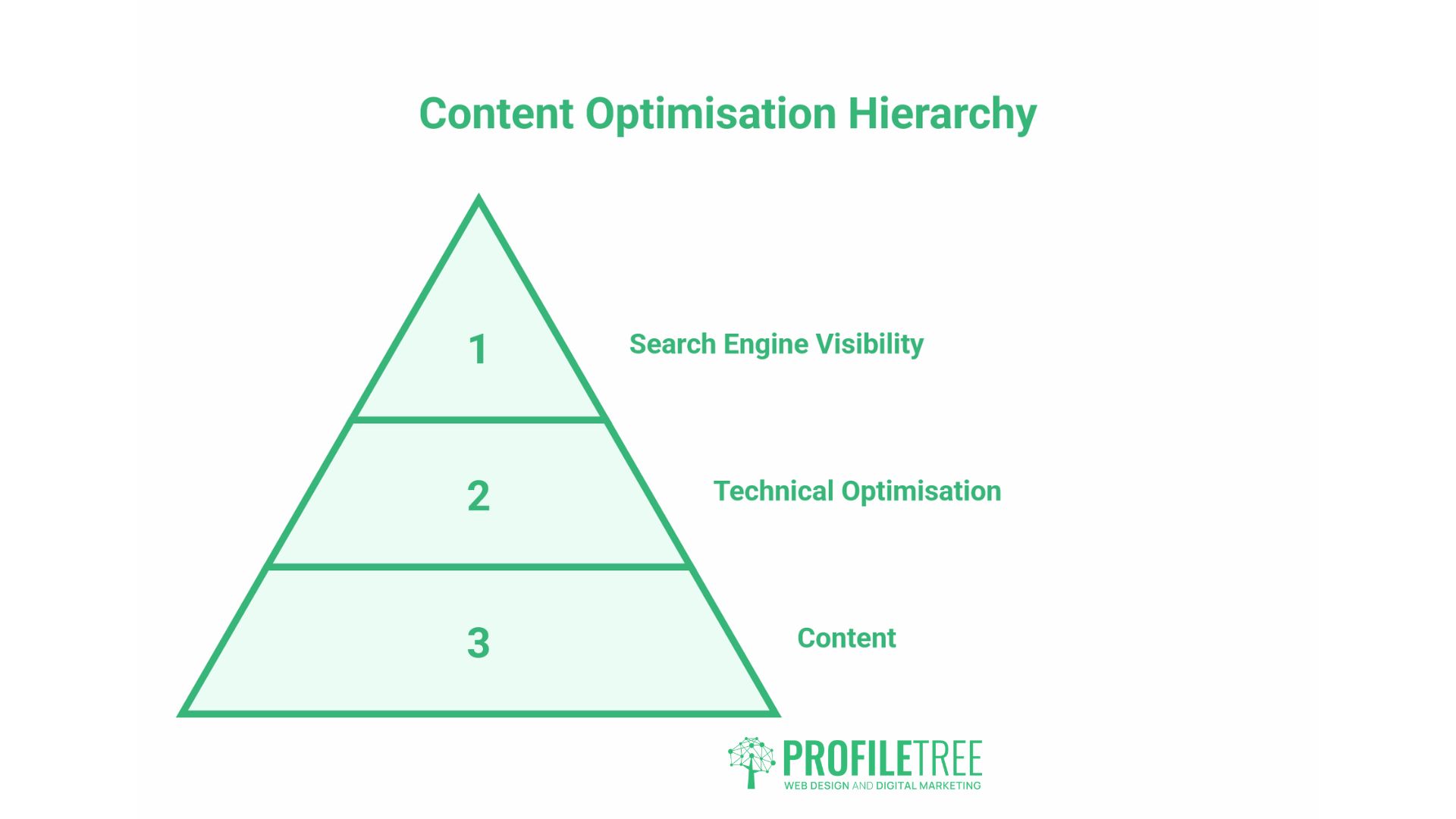
Technical optimisation sits underneath the content itself. It’s the layer that tells search engines what type of page they’re looking at, how it connects to the rest of your site, and how to present it in results. Done well, it amplifies the work you’ve already put into keywords and structure. Left unaddressed, it limits how far even well-written content can go.
Schema markup
Schema markup is structured data added to a page’s code that helps search engines understand what type of content the page contains and how to present it in results. For content-heavy pages, the most useful schema types are Article (for blog posts and guides), FAQPage (for FAQ sections, which can generate expanded results in SERPs), and BreadcrumbList (for navigation context).
Schema doesn’t directly affect rankings, but it does affect how your content appears in search results. The FAQ schema, in particular, can double the visual footprint of a search result, improving click-through rate independent of position. Adding schema is a task for your development team; flag it as a requirement when publishing or refreshing major articles.
Internal linking logic: the hub-and-spoke model
A hub-and-spoke architecture organises content around a central pillar page that broadly covers a topic, supported by cluster articles that address specific sub-topics in depth. Each cluster article links back to the pillar, and the pillar links out to each cluster. This structure concentrates authority on the pages that matter most to your business and gives search engines a clear map of your site’s topical coverage.
For a digital agency, a pillar page on content marketing would link to cluster articles on keyword research, content audit frameworks, using Google Analytics for content marketing, and content strategy. Each of those articles would link back to the pillar and to the agency’s content marketing service page. This is not a complicated architecture, but it does require consistent application across all articles published.
ProfileTree’s content marketing services for SMEs are built around this model, developing content architectures that connect informational articles to commercial service pages to support both rankings and lead generation.
Measuring Success: Content Optimisation Beyond Rankings
Rankings are a useful proxy, but they’re not the goal. The goal is qualified traffic that converts. A page ranking third for a high-volume keyword with a 1% conversion rate may generate fewer leads than a page ranking eighth for a more specific phrase with a 12% conversion rate. Optimisation decisions should be guided by metrics that drive commercial outcomes, not just position data.
The primary metrics for measuring content performance are:
Organic impressions and clicks from Google Search Console: impressions confirm that Google is surfacing the page for relevant queries. Clicks confirm that the title and meta description are compelling enough to earn visits. A high impression-to-click ratio with a low CTR usually indicates a meta title problem rather than a ranking problem.
Time on page and scroll depth from Google Analytics or an equivalent: these metrics indicate whether visitors are actually engaging with the content once they arrive. Low time on page on an article intended to build authority or educate a prospect is a signal of content quality, not a technical issue.
Assisted conversions: most B2B and considered purchases involve multiple touchpoints before a conversion. Attribution modelling in Google Analytics 4 shows which content pieces appear in paths leading to enquiries, even when the content itself isn’t the final click. This is how you demonstrate the commercial value of informational content.
For a structured approach to tracking these metrics, our guide to Google Analytics for content marketing covers the key reports and how to use them.
When to update versus when to redirect
Not every underperforming page warrants a refresh. Pages with zero clicks and fewer than 100 impressions per month, no inbound links, and no clear route to relevance for your commercial services are candidates for removal rather than rehabilitation. Redirecting or deprecating these pages with a 410 (gone) or 301 (redirect to the closest relevant page) response removes a drag on overall site quality.
The threshold for keeping a page is some combination of existing search equity (impressions, positions, or inbound links worth preserving), clear commercial relevance to your services, and a realistic path to improved performance with targeted optimisation.
Content Optimisation and ProfileTree’s Services
For businesses that want support putting this into practice, ProfileTree provides search engine optimisation services for SMEs across Northern Ireland, Ireland, and the UK. This includes full content audits, keyword strategy, and on-page optimisation as part of an ongoing SEO engagement.
For marketing teams that want to build these skills internally, ProfileTree’s digital training programme covers content strategy, keyword research, and SEO fundamentals in a practical, hands-on format. Training can be delivered in-house for teams of two or more and is structured around your actual site and content, not generic case studies.
Ciaran Connolly, founder of ProfileTree, notes that the most common issue he sees with SME content is the gap between publishing and optimising: “Most businesses we work with have a library of articles that were written with good intentions but never revisited. The fastest wins in SEO almost always come from improving that existing content rather than adding new pages.”
Conclusion
Content optimisation is an ongoing discipline, not a one-time task. For most SMEs, the fastest wins are in the existing content library: pages sitting between positions 8 and 25 in Search Console, generating impressions but no clicks, are typically one focused refresh away from real results. Start there.
If you’d like support with a content audit, keyword strategy, or ongoing SEO, ProfileTree works with businesses across the UK and Ireland to build content that ranks and converts. Our digital training programme is available for in-house teams who want to develop these skills themselves.
FAQs
What is the difference between SEO and content optimisation?
SEO covers everything affecting organic performance: technical infrastructure, backlinks, site speed, and content. Content optimisation is the subset focused on the content itself, keywords, headings, internal links, and topical depth.
How often should I optimise existing content?
Every six to twelve months for high-priority pages, more frequently for fast-changing topics. Use data as the trigger: a drop in impressions or clicks, a shift in ranking queries, or stronger competitor content appearing above you.
Does content optimisation help with AI Overviews?
Yes. Content that leads each section with a direct answer, uses consistent entity language, and adds something the competing pages don’t is more likely to be cited. Information gain is the key differentiator.
Which tools are best for UK-based content optimisation?
Semrush and Ahrefs for keyword research, Rank Math for on-page scoring in WordPress, and Google Search Console for performance data. SurferSEO is useful for competitive gap analysis.