
eCommerce Web Design Agency: The UK Complete Guide
Table of Contents
There are over 26 million eCommerce websites worldwide, and for UK businesses, standing out in that crowd requires more than a serviceable-looking shop. The design of your online store directly affects whether visitors buy, bounce, or go elsewhere.
Choosing the right eCommerce web design agency means finding a team that understands conversion, compliance, and the specific expectations of UK consumers, from VAT-inclusive pricing to next-day delivery messaging and GDPR-compliant checkout flows.
This guide covers what effective eCommerce design actually involves, how to choose the right platform for the UK market, what UK-specific regulations your site must address, and what realistic costs look like for businesses at different stages.
What eCommerce Web Design Actually Involves
eCommerce web design is not simply about making a website look attractive. It is the process of building a digital store that guides visitors from their first impression through to a completed purchase, then keeps them coming back. Every element, from how products are displayed to how the checkout behaves on a mobile screen, shapes whether a visitor converts or leaves.
Design as a Conversion Tool
A well-designed eCommerce site treats every page as part of a sales process. Product pages need clear photography, concise descriptions, and obvious calls to action. Category pages need logical groupings that match how shoppers think. The checkout needs to be short, transparent about costs, and free of friction at every step.
Conversion rate optimisation (CRO) sits at the heart of this. Features like one-click purchasing, saved payment details, and wish-list functionality all reduce the steps between intent and purchase. An eCommerce web design agency with real CRO experience will build these features into the architecture from the start, rather than bolting them on later.
Mobile-First Is No Longer Optional
UK consumers are among the most active mobile shoppers in Europe. By 2026, mobile accounts for the majority of eCommerce sessions in the UK, with purchases completed on smartphones during commutes, lunch breaks, and evenings. Designing “mobile-responsive” is no longer sufficient; the site must be designed for the thumb first, with tap targets large enough to use without zooming, menus that collapse intuitively, and product images that load quickly on a 4G or 5G connection.
This distinction between responsive and mobile-first matters when briefing an agency. A site that was built for desktop and then shrunk for mobile will feel awkward on a phone. A site built with mobile as the primary context will feel natural on every device. Learn more about how professional website design approaches this from the ground up.
Navigation and Site Architecture
If shoppers cannot find what they are looking for within a few clicks, they will leave. Good eCommerce navigation uses a clear hierarchy: broad categories at the top level, progressively narrower sub-categories below. Breadcrumb trails, like “Home > Women’s Clothing > Coats,” help users understand where they are and how to backtrack without frustration.
Search functionality matters just as much as navigation menus. For stores with more than a few dozen products, an intelligent search bar that tolerates misspellings, understands synonyms, and filters by attribute (size, colour, price range) will recover sales that poor navigation would otherwise lose.
Upselling and Cross-Selling Features
“You might also like” and “Frequently bought together” banners are now table stakes for any serious eCommerce site. These features increase average order value without requiring additional traffic. The design of these panels matters: they need to feel like helpful suggestions rather than desperate additions, and they should surface genuinely related products rather than random stock.
Choosing the Right Platform for the UK Market
Platform choice has long-term implications for cost, flexibility, and performance. The right choice depends on your business size, technical resources, and growth plans. Each major platform has genuine strengths and genuine constraints, and a good agency will recommend based on your needs rather than their own preference.
Shopify
Shopify is the dominant hosted eCommerce platform and works well for businesses that want to launch quickly, avoid server management, and access a large ecosystem of third-party apps. The interface is genuinely intuitive, which means non-technical staff can manage products, collections, and promotions without developer involvement.
For UK businesses, Shopify supports VAT-inclusive pricing, integrates with Royal Mail, DPD, and Evri shipping carriers, and handles Strong Customer Authentication (SCA) compliance through its payment gateway. Transaction fees apply unless you use Shopify Payments, which is an important cost consideration at higher revenue volumes.
WooCommerce
WooCommerce is an open-source plugin for WordPress and gives businesses full control over their store without per-transaction fees. It is the most flexible option for businesses that need custom functionality, complex pricing rules, or integration with existing systems. Because it runs on WordPress, it also benefits from the world’s largest CMS ecosystem.
The trade-off is that WooCommerce requires more technical management. Hosting, security updates, and plugin compatibility need active attention. For businesses with a development resource or an agency relationship, this is manageable. For businesses expecting a fully hands-off setup, Shopify may be more practical. Explore how website development decisions at the platform level affect long-term performance.
Shopify vs WooCommerce vs BigCommerce: UK Comparison
The table below summarises key considerations for UK businesses choosing between the three most widely used platforms. All prices and figures in this guide are indicative UK examples and correct at the time of writing; use them as a benchmark rather than fixed quotations.
| Factor | Shopify | WooCommerce | BigCommerce |
|---|---|---|---|
| Monthly cost (approx.) | £25–£259+ | Hosting + plugins (£30–£100/mo) | £25–£220+ |
| Transaction fees | 0.5–2% unless using Shopify Payments | None (gateway fees only) | None |
| UK VAT support | Yes (VAT-inclusive pricing) | Yes (with plugins) | Yes |
| SCA / PSD2 compliance | Built into Shopify Payments | Depends on payment gateway | Built in |
| Best for | Fast launch, DTC brands | Bespoke builds, existing WordPress sites | Mid-market & B2B |
| UK carrier integrations | Royal Mail, DPD, Evri (via apps) | Royal Mail, DPD, Evri (via plugins) | Royal Mail, DPD (via apps) |
Wix and Squarespace for Smaller Stores
Wix and Squarespace both offer capable eCommerce features for smaller businesses with limited product catalogues. Wix’s native eCommerce tools have matured considerably and suit businesses that want design flexibility without a large technical budget. Squarespace’s template system produces clean, well-structured results and works well for brands where visual presentation is the primary differentiator.
Neither platform scales as effectively as Shopify or WooCommerce for high-volume stores. If you expect significant growth or complex product configurations, factor that into your platform decision early rather than migrating later at additional cost.
UK Regulations and Compliance in eCommerce Design
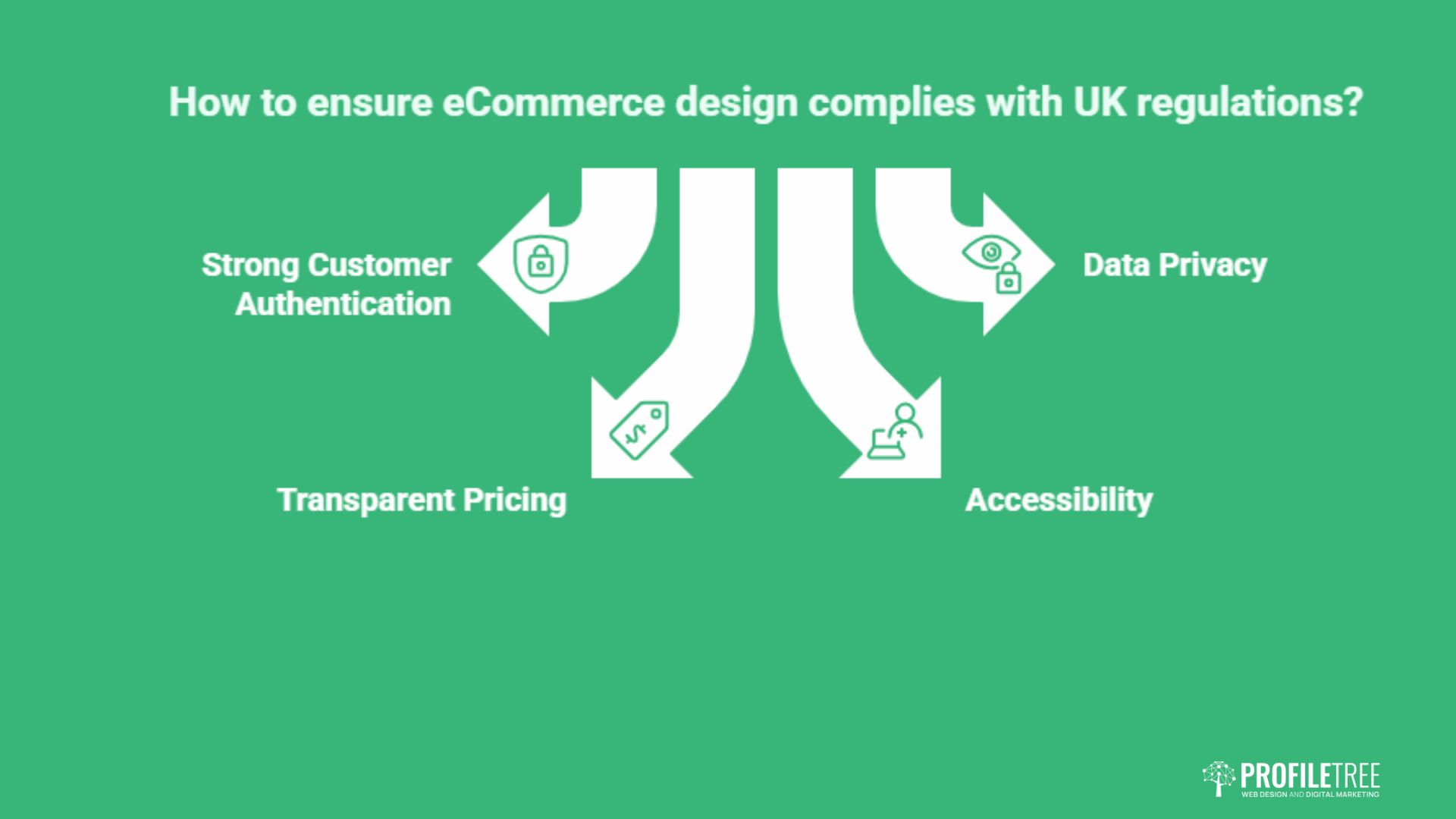
This is the area where UK and US eCommerce guides diverge most sharply. Many global resources gloss over the compliance layer, but for any business selling to UK consumers, getting this right is not optional. Design decisions have direct legal and financial consequences.
Strong Customer Authentication and PSD2
The Payment Services Regulations, which brought PSD2 and Strong Customer Authentication (SCA) requirements into UK law, make multi-factor authentication mandatory for the vast majority of online card transactions. Your checkout must support 3D Secure 2 (3DS2), which prompts customers to verify their identity through their banking app or a one-time passcode. By 2026, most major UK payment gateways handle this automatically, but implementation quality varies, and the UX around authentication still requires deliberate design attention.
Poor implementation of SCA creates friction that causes customers to abandon their baskets. Good design minimises this by using exemptions where permitted (low-value transactions, trusted beneficiaries), communicating clearly when verification is required, and ensuring the authentication step feels like a natural part of the checkout rather than a jarring interruption. Your payment gateway choice determines how much of this is handled automatically, and it is worth raising explicitly with any agency you brief.
GDPR, Cookie Consent, and Data Privacy
UK GDPR (which retained the EU framework post-Brexit with minimal changes) places specific obligations on eCommerce sites. Cookie consent banners must be genuinely opt-in; pre-ticked boxes for non-essential cookies are not compliant. Privacy notices must clearly explain what data is collected, how it is used, and how customers can request its deletion.
From a design perspective, cookie banners and consent flows need to be usable without being obstructive. A poorly designed consent layer that confuses users or obscures the “reject” option risks both ICO enforcement action and reputational damage. The data privacy requirements for eCommerce have tightened considerably, and design needs to reflect that. You can also review the ICO’s guidance at ico.org.uk for the latest requirements.
VAT Display and Transparent Pricing
UK consumer regulations require that prices displayed to retail customers include VAT. Showing ex-VAT prices to consumers and adding tax at checkout is a common source of basket abandonment and, for consumer-facing stores, is not compliant with the Consumer Rights Act pricing obligations.
For B2B stores selling to VAT-registered businesses, ex-VAT pricing with clear tax breakdowns is standard and expected. A well-designed eCommerce site serving both audiences will detect the customer type and display pricing accordingly, or offer a toggle between inclusive and exclusive pricing with clear labelling.
Accessibility and the Equality Act
Under the Equality Act 2010, businesses providing goods and services online have an obligation to make those services accessible to people with disabilities. This includes sufficient colour contrast, keyboard-navigable interfaces, alt text on images, and support for screen readers. Beyond the legal dimension, accessible design typically correlates with better usability for all users, not just those with specific needs.
The Cost of eCommerce Web Design in the UK
Cost is consistently one of the most-searched questions around eCommerce design, and consistently one of the most vaguely answered. The range is genuinely wide, and understanding what drives that range helps you budget more accurately and evaluate proposals more critically.
All prices and figures in this guide are indicative UK examples and correct at the time of writing; use them as a benchmark rather than fixed quotations.
Freelancer vs Boutique Agency vs Full-Service Agency
A freelance developer or designer working alone will typically charge between £1,500 and £8,000 for an eCommerce build, depending on complexity and their level of experience. This works well for straightforward builds on established platforms, but leaves you without a team to call on when something goes wrong post-launch.
A boutique agency with a small team will typically charge between £5,000 and £20,000 for a mid-range eCommerce project. This range covers custom design, platform configuration, payment gateway integration, and some post-launch support. A full-service agency with in-house design, development, SEO, and content capability will typically charge from £15,000 upwards for a serious eCommerce build, with enterprise-grade projects running considerably higher.
Custom Design vs Template-Based Builds
Template-based builds use a pre-designed theme as the starting point and customise it to fit your brand. This is faster and cheaper, often delivering a functional store in four to six weeks at the lower end of the budget ranges above. The limitation is that template-based sites can look similar to competitors using the same theme, and customising templates beyond their intended scope can introduce technical debt.
Custom design builds every visual element from a blank canvas. This produces a stronger brand identity and allows for entirely custom UX flows, but requires a longer timeline (typically ten to sixteen weeks) and a higher budget. For businesses where design differentiation is a genuine competitive advantage, or where complex user journeys require non-standard functionality, custom design delivers ROI that template builds cannot match. Our website design services cover both approaches depending on the brief and budget.
Ongoing Costs to Factor In
The build cost is only part of the picture. Platform subscription fees, hosting (for self-hosted solutions), payment gateway charges, app or plugin subscriptions, and ongoing SEO and content investment all contribute to the total cost of ownership. A realistic budget for a growing eCommerce business should account for £300 to £1,000 per month in ongoing operational costs above and beyond the initial build, depending on the platform and the level of technical support required.
Investing in eCommerce SEO from launch, rather than retrospectively, typically delivers a much better return. Organic search traffic compounds over time in a way that paid advertising does not, and a site built with search architecture in mind will outperform one that treats SEO as an afterthought.
What to Look for When Choosing an eCommerce Web Design Agency
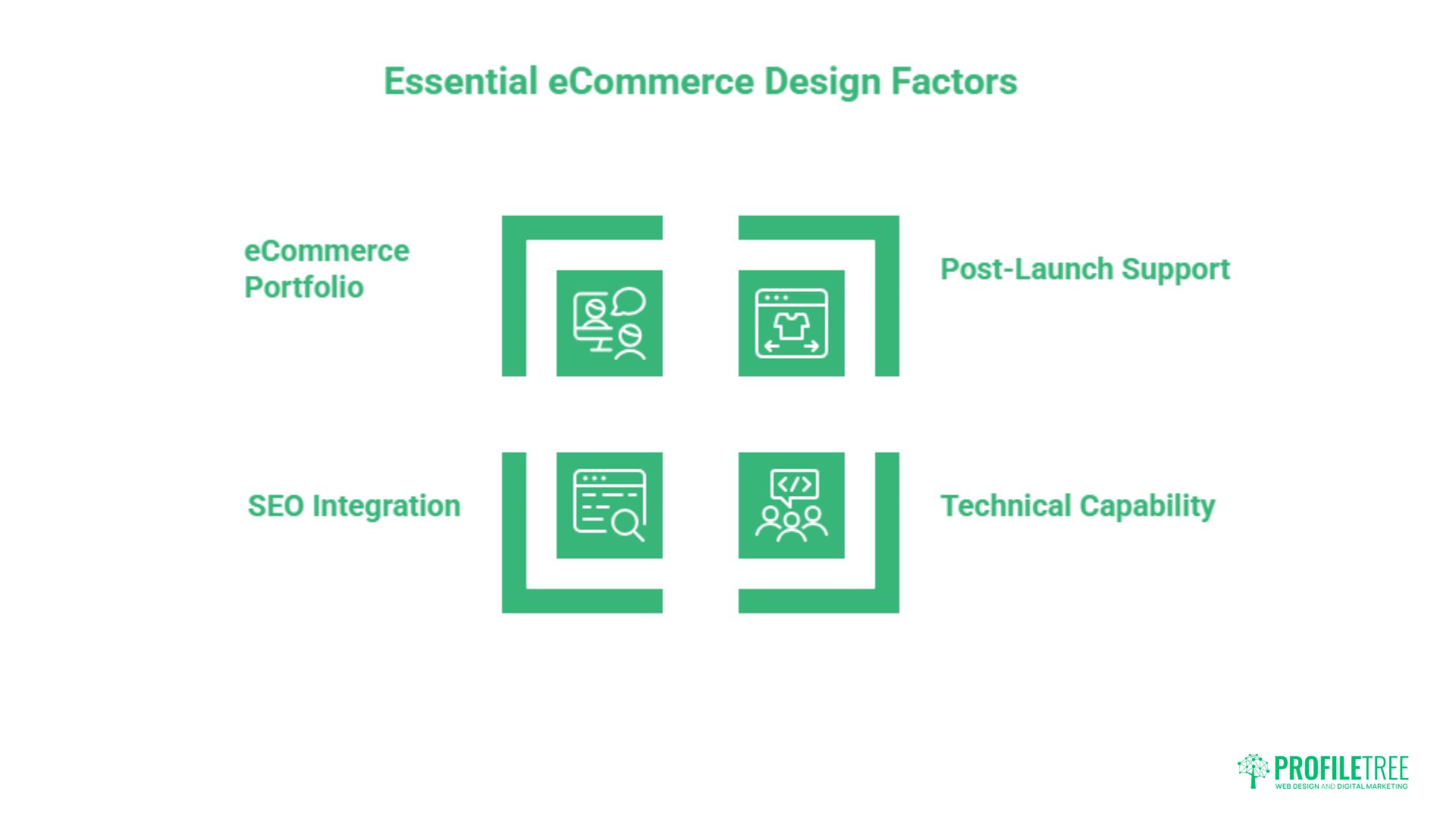
The agency you choose will shape your store’s performance for years. There are practical criteria that separate agencies equipped to deliver a high-performing UK eCommerce site from those that will produce something that looks presentable but underperforms commercially.
eCommerce-Specific Portfolio Work
Ask to see live eCommerce sites the agency has built. Click through the checkout on a mobile device. Check how product pages perform on a slow connection. Look for evidence that the agency understands CRO, not just visual design. A portfolio of visually attractive brochure sites does not demonstrate the ability to build a converting eCommerce store.
Also, ask about post-launch performance. Did the sites they built improve conversion rates after launch? Do they have any data on basket abandonment rates or average order value changes? Agencies that measure commercial outcomes think differently from those that measure design approval.
Technical Capability and Platform Knowledge
The agency should be able to explain its platform recommendation clearly and justify it against your specific requirements. Be cautious of agencies that recommend the same platform to every client, or that cannot explain the trade-offs between options.
Ask specifically about SCA compliance, VAT handling, and UK carrier integrations. If the agency looks blank at any of these, that is a meaningful signal. For businesses expecting to grow, also ask about headless commerce options, where the front-end experience is decoupled from the back-end platform for maximum flexibility. You may also want to consider a digital strategy review before committing to a platform, to confirm the technical choice aligns with your broader commercial goals.
SEO and Content Integration
A beautiful eCommerce store that nobody finds is a poor investment. Ask whether the agency integrates SEO into the build process rather than treating it as a separate service. URL structure, page speed, schema markup, and crawlability should all be addressed during development, not after launch. By 2026, AI-powered search, including Google AI Overviews and Perplexity, will have become a meaningful discovery channel for eCommerce buyers, and product pages will need to be structured to earn AI citations as well as organic rankings. The AI impact on eCommerce now extends well beyond on-site product recommendations.
Support and Maintenance After Launch
eCommerce sites require ongoing attention. Platform updates, plugin conflicts, payment gateway changes, and security patches all need managing. Understand what the agency offers post-launch before signing a contract. A site with no ongoing support arrangement is a liability, not an asset.
Ciaran Connolly, founder of ProfileTree, a Belfast-based digital agency, notes that the agencies that deliver the best long-term results for eCommerce clients are those that treat launch as the beginning of the project rather than the end.
Northern Ireland and the Republic of Ireland have a growing cluster of digital businesses and consumers with specific cross-border commerce considerations. If you are exploring the broader digital environment in the region, Connolly Cove’s guide to Northern Ireland gives useful context on the commercial and cultural environment. ProfileTree works with clients across Belfast, Dublin, and the wider UK, and understanding the local market shapes better eCommerce outcomes. For businesses looking to build their digital skills alongside their store build, digital training services can accelerate how confidently your team manages the platform post-launch.
Conclusion
Building a successful eCommerce store in the UK requires more than a visually appealing design. Platform choice, mobile architecture, compliance with UK payment and privacy regulations, and a clear plan for organic search all determine whether your store converts. The right eCommerce web design agency will address all of these as a connected system rather than separate deliverables. Get in touch with the ProfileTree web design team to discuss your eCommerce project.
FAQs
How much does an eCommerce web design cost in the UK?
Costs vary considerably depending on scope and provider. A freelance build typically ranges from £1,500 to £8,000. A boutique agency project typically falls between £5,000 and £20,000. Full-service agency builds with custom design and complex functionality start from £15,000 and scale upwards. Ongoing costs, including hosting, platform fees, and support, typically add £300 to £1,000 per month. All figures are indicative UK benchmarks; request itemised proposals from any agency you are seriously considering.
Which platform is best for a small UK eCommerce business?
For most small UK businesses launching a new store, Shopify offers the fastest route to a functional, compliant site without requiring significant technical management. It handles SCA compliance through Shopify Payments, supports VAT-inclusive pricing, and integrates with UK shipping carriers. WooCommerce is a strong alternative for businesses already running WordPress or needing greater customisation without transaction fees, provided they have development support available.
What is the most important element of eCommerce design?
Mobile usability and trust signals consistently have the greatest impact on conversion rates for UK eCommerce stores. A site that functions poorly on a smartphone will lose a majority of its potential customers before they reach checkout. Trust signals, including visible security badges, customer reviews, transparent returns policies, and clear contact details, address the hesitation that stops motivated buyers from completing a purchase.
Do I need a custom design or will a template work?
For most small to mid-sized businesses, a well-configured template build delivers a strong result at a realistic cost. Templates have improved significantly and, when customised properly, do not look generic. Custom design is worth the additional investment when your brand identity is a genuine differentiator, when your user journey requires non-standard functionality, or when you are operating in a competitive market where standing out visually drives commercial advantage.
How do I ensure my eCommerce site complies with UK GDPR?
The key requirements are a genuinely opt-in cookie consent mechanism (no pre-ticked boxes for non-essential cookies), a clear and accessible privacy notice, a process for handling subject access requests, and data minimisation in your checkout forms. Your website’s design should make it easy for users to access privacy information and manage their consent preferences without friction.