
E-Commerce Engagement: Turn Social Media Into Revenue for SMEs
Table of Contents
Most small businesses treat social media likes as proof that something is working. They are not. A post can rack up hundreds of reactions and still deliver zero sales if the infrastructure behind it is broken. E-commerce engagement only earns its keep when it drives people into a purchase journey they can actually complete.
This guide is for SME owners and marketing managers who want a practical, joined-up approach: how to build shoppable social content, which platforms suit which products, what to do when social traffic arrives on your website, and how to measure the things that actually connect to revenue rather than vanity.
The core argument is straightforward. Social commerce does not work in isolation. The best shoppable post in the world will underperform if it sends visitors to a slow, mobile-unfriendly product page. Getting e-commerce engagement right means treating web design, content strategy, and social media as a single system rather than three separate activities.
Why Your Engagement Metrics Are Not Telling You the Truth
Engagement rate measures how many people interact with your content. It tells you nothing about whether those interactions led to a purchase, a sign-up, or any other outcome that moves your business forward.
This matters because SMEs with limited budgets and time can spend months optimising for the wrong signal. A clothing brand with 3,000 Instagram followers and a 6% engagement rate might be generating almost no revenue from social if its product pages load slowly on mobile, its checkout asks for too much information, or its product photography does not match what the post shows.
Vanity Metrics vs Revenue-Driving Interactions
Vanity metrics include likes, follower counts, reach, and impressions. They have value for awareness tracking, but they do not predict sales. Revenue-driving interactions are the ones that move a customer toward a transaction: clicking a product tag, adding an item to a basket, starting a checkout, completing a purchase, or returning to buy again.
The shift in thinking about e-commerce engagement starts with asking: what did this post cause someone to do, not how many people saw it?
The Infrastructure Gap: Why Good Content Fails on a Poor Website
One of the most common problems ProfileTree sees, working as a Belfast-based web design and digital marketing agency, is the gap between a business’s social media presence and its website. A shoppable Instagram post might generate strong click-through numbers in a day. If the product page those visitors land on takes five seconds to load on mobile, most of them will leave before the page finishes rendering.
Google’s 2017 research with SOASTA found that as mobile page load time rises from one second to five, the probability of a visitor bouncing increases by 90%. The figure is old, but the mechanism has not changed, and Google’s current Core Web Vitals threshold treats a Largest Contentful Paint above 2.5 seconds as needing improvement.
Fixing this is a technical problem first: page speed, mobile layout, image compression, and a checkout flow designed for small screens. It is also a structural problem. Many SME websites were built years ago, updated piecemeal, and now carry the weight of accumulated changes that slow them down. A web design review often reveals that relatively small technical fixes produce significant gains in the number of visitors who stay long enough to buy.
The Three Pillars of Profitable E-Commerce Engagement
Three things determine whether social traffic turns into sales: where it lands, what brought it there, and whether you can see which parts are working. Weakness in any one caps the return on the other two, which is why businesses that pour money into social while ignoring their product pages tend to conclude that social does not work for them.
Pillar 1: High-Performance Web Design and UX
Your website is where e-commerce engagement converts into revenue. Social media, email, and paid advertising all drive people to it. What happens when they arrive determines whether the business benefits from everything that came before.
For SMEs, the non-negotiables are a mobile-responsive layout, product pages that load quickly, clear and consistent product photography, a checkout that works without forcing customers to create an account, and trust signals such as reviews, security badges, and transparent delivery information near the buy button.
Web design choices that feel cosmetic, such as how images are formatted or how many fields a form contains, have measurable effects on conversion. The Baymard Institute, which conducts large-scale research on e-commerce UX, found in its 2024 US survey that 18% of online shoppers abandoned an order specifically because the checkout was too long or too complicated, and that 26% abandoned because the site forced them to create an account. Baymard estimates that fixing documented checkout usability problems delivers an average 35.26% conversion uplift.
Pillar 2: Content Strategy That Answers Search Intent
The majority of shoppable social content targets people who are already aware of a product or brand. Organic search content reaches people earlier in the journey, when they are still deciding what to buy, which brand to trust, or how to solve a problem. A content strategy that covers both means you are present at more points in the customer journey.
For e-commerce specifically, this means product category pages optimised for the terms people search before they know exactly what they want, comparison content that helps undecided buyers reach a decision, and how-to content that shows products in context rather than just describing their features.
Content that ranks in search builds the kind of sustained, compounding traffic that social content cannot deliver on its own. A useful guide published today can bring relevant visitors for years. A social post has a lifespan measured in hours or days at most.
Pillar 3: Data-Led Digital Marketing
The third pillar is using actual performance data to make decisions rather than assumptions. For most SMEs, this starts with Google Analytics and the analytics provided by each social platform, combined with a clear view of which traffic sources actually generate sales rather than just visits.
Many businesses discover, once they look at the data properly, that one platform or content type is responsible for a disproportionate share of their revenue. Identifying that lets them concentrate effort where it works rather than spreading resources thinly across everything. ProfileTree’s digital marketing strategy services help businesses in Northern Ireland build this kind of data-led approach from the ground up.
Turning Social Media Into a Direct Revenue Channel
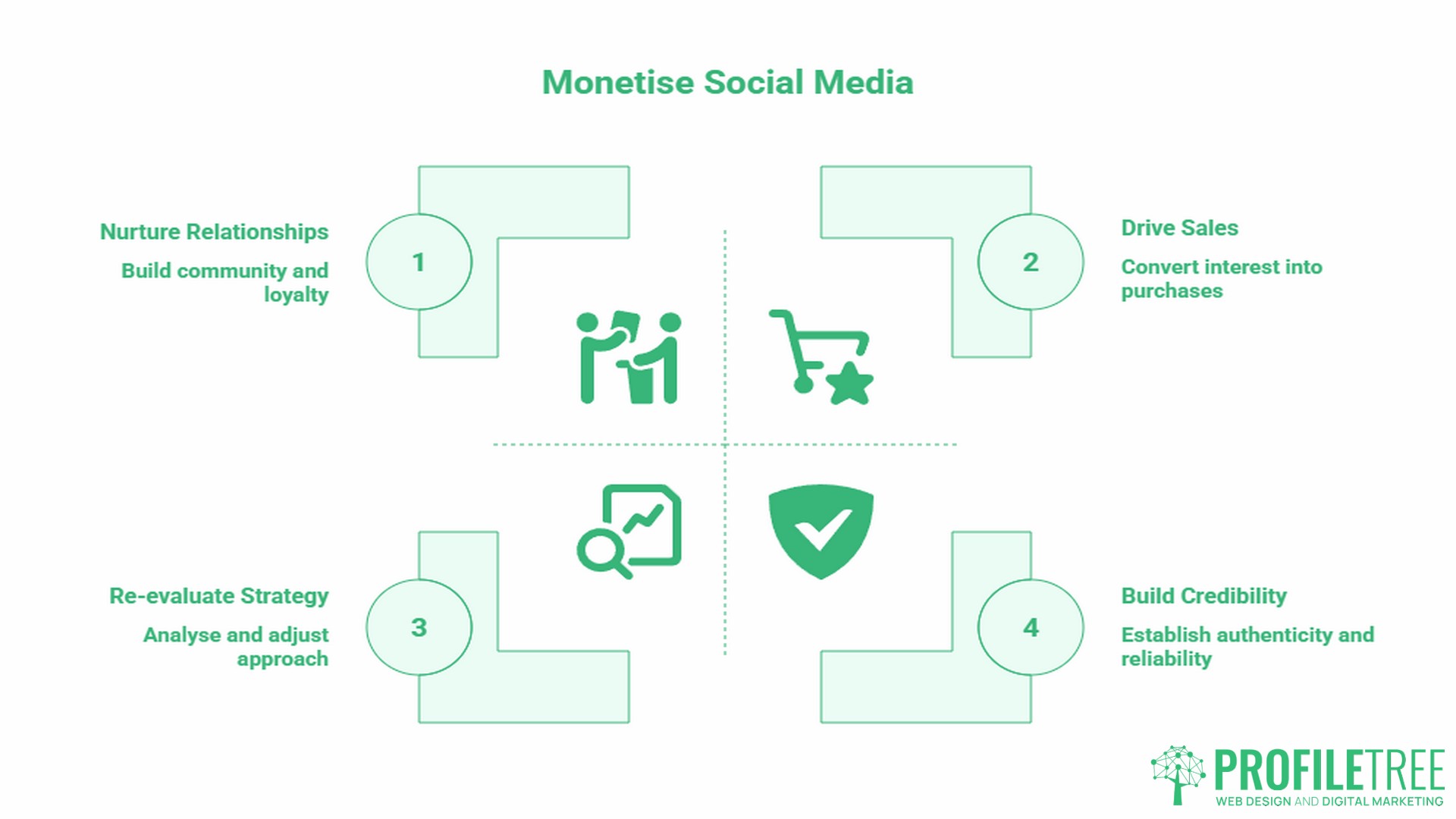
Each major social platform approaches shoppable content differently. The right choice depends on what you sell, who your customers are, and what kind of content you can produce consistently.
| Platform | Best For | Primary Engagement Signal | Shoppable Feature | UK SME Fit |
|---|---|---|---|---|
| Fashion, beauty, lifestyle, food | Saves and product tag taps | Shopping tags, Stories stickers | High for visual product categories | |
| TikTok | Younger audiences, impulse purchases | Shares and comment engagement | TikTok Shop, product links in bio | Growing fast; suits video-native brands |
| Broader age range, local businesses | Shares, comments, Marketplace | Facebook Shop, product catalogue ads | Strong for 35+ demographic | |
| Home, interiors, weddings, DIY | Saves | Product Pins, Shopping Spotlights | High-intent discovery for specific niches | |
| YouTube | Higher-consideration purchases | Watch time, click-through | Shopping cards, product links in description | Suits products needing demonstration |
Shoppable Posts on Instagram, TikTok and Pinterest
Instagram Shopping lets you tag products directly in posts and Stories, so a customer can tap through to price and purchase without leaving the app. Setting it up requires a Facebook Business account, a connected catalogue and Meta commerce approval, and ProfileTree’s guide to Instagram for social commerce covers the full process.
TikTok Shop has grown quickly in the UK market. Short-form video showing a product in use, particularly when it produces a visible before-and-after or solves a clear problem, tends to perform well. The key difference from Instagram is that TikTok’s algorithm distributes content to non-followers, so a new account can reach a large audience quickly if the content is strong.
Pinterest functions more like a search engine than a social feed. People come to it with intent: they are planning a wedding, renovating a room, or looking for a specific style. Product Pins that appear in these searches reach people who are already in a buying mindset, making the path from discovery to purchase more direct than on platforms where users are passively browsing.
The Human Factor: Using UGC to Build UK Consumer Trust
User-generated content (UGC) is content created by your customers rather than your brand: reviews, photos of purchases, unboxing videos, and before-and-after posts. It works because it provides independent social proof. A potential buyer is more likely to trust a genuine customer’s account of a product than a brand’s own marketing.
For UK businesses, the practical approach is to encourage customers to share photos with a specific hashtag after purchase, to repost that content with the customer’s permission, and to make written reviews visible on product pages. A post-purchase email inviting customers to tag the brand costs nothing and can generate a steady stream of authentic content.
UGC also generates further e-commerce engagement on the content itself. When real customers tag products and their followers see it, those followers arrive with an existing endorsement rather than a cold sales pitch.
Social Search: Optimising for In-App Discovery
Both Instagram and TikTok now function as product search platforms. Younger buyers in particular frequently search for products directly within these apps rather than going to Google. This means your captions, hashtags, and product descriptions within a social shop are searchable text, not just contextual framing.
Treat your social product content with the same keyword thinking you would apply to a web page. If someone searches for a specific product type on TikTok or Instagram, is your content using the precise terms they would use? This is an area most SMEs have not yet addressed, which makes it a relatively open opportunity.
7 Tactics to Improve E-Commerce Engagement in Practice
These are ordered deliberately. The first three cost nothing but time and fix problems that make everything else work harder than it should. The last four add capability once the foundations hold. Working through them in order is more useful than picking the ones that sound most interesting.
1. Audit Your Mobile Experience Before Anything Else
Pull up your own website on a mobile phone and go through the product pages you plan to promote on social media. Try adding a product to the basket and completing the checkout. If any part of that journey feels slow, confusing, or requires excessive scrolling, that is what needs fixing before spending money driving traffic to it.
Specific things to check: does the main product image load within two to three seconds, is the add-to-basket button visible without scrolling, does the checkout work without requiring an account, and are delivery costs displayed before the final payment screen?
2. Start on One Platform, Not All of Them
A common mistake is to set up shoppable content across every available platform simultaneously. The result is usually mediocre execution everywhere rather than strong execution anywhere. Pick the one platform where your target customers are most active and where your product category performs best, based on the table above, and build a genuine presence there before expanding.
Consistent, quality content on one platform produces better results than sporadic content spread across five. Once you have a working system and a clear sense of what performs, that learning transfers to the next platform.
3. Use Zero-Party Data for Personalisation Without Cookies
Zero-party data is information your customers give you directly: their size preferences, style choices, the occasions they shop for, or the problems they are trying to solve. Unlike third-party data collected by tracking cookies, which is now largely unavailable due to privacy changes across browsers and Apple’s iOS updates, zero-party data is given willingly and carries no compliance risk.
Practical ways to collect it include style quizzes on your website, preference settings in an account area, and targeted post-purchase surveys. This data allows you to personalise email content and product recommendations in a way that feels relevant rather than intrusive.
4. Build a Post-Purchase Engagement Loop
Most e-commerce engagement strategies focus on acquisition. The post-purchase phase is frequently overlooked, even though a customer who has already bought from you is considerably more likely to buy again than a cold visitor.
A basic post-purchase loop looks like this: a confirmation email that includes a use guide or care instructions, followed by a review request a week later, followed by a personalised product suggestion based on the original purchase three to four weeks on. Each touchpoint keeps the brand in the customer’s mind and provides a reason to return. UGC collected through the review request feeds back into the social content strategy.
5. Produce Video Content Matched to Platform and Purchase Stage
Video drives e-commerce engagement disproportionately compared to static images for most product categories. Short-form video on TikTok and Instagram Reels suits product demonstrations and problem-solution formats. The viewer does not know your brand and needs a reason to stop scrolling within the first two seconds.
YouTube suits longer content: comparisons between two products or a how-to guide that helps someone make a purchase decision. ProfileTree’s video production services work with businesses to produce content matched to the platform and the stage of the purchase journey. A strategy that produces a short-form and a long-form version of the same content covers both ends of the spectrum efficiently.
6. Match Your Loyalty Approach to Your Customer Lifetime Value
Loyalty programmes need to be designed in proportion to the actual value of repeat business in your category. A business selling consumables that people reorder monthly has a strong economic case for a points-based reward system. A business selling wedding stationery has very few repeat customers by nature, and a formal loyalty programme there adds overhead without a matching return.
For most SMEs, the practical approach is referral incentives, early access to new products for past buyers, and regular emails that provide genuinely useful content rather than constant promotions. These require less infrastructure than a formal programme and can deliver comparable retention effects.
7. Use Conversational AI Tools for Real-Time Engagement
AI-powered chat tools on e-commerce websites can handle common questions about delivery timescales, returns policies, and stock availability around the clock. This improves the experience for people who want an immediate answer outside business hours, and it frees up human time for more complex enquiries.
The important distinction is between using AI to handle transactional questions and using it to replace the human tone and judgement that builds trust. A chatbot answering routine policy questions is useful. Replacing your brand voice with generic AI-generated content across all customer touchpoints is more likely to reduce trust than build it. ProfileTree’s AI implementation and transformation service helps businesses in Northern Ireland and across the UK identify where AI tools add genuine efficiency without eroding the human quality of their customer relationships.
Measuring E-Commerce Engagement: The Metrics That Actually Matter
Most e-commerce dashboards show forty numbers and answer none of the questions an owner actually has. The point of measurement is to tell you whether last month’s decisions worked. That takes one headline figure you check often and a handful of supporting ones you check when the headline moves.
Revenue per session is the headline. Total revenue divided by total website sessions over a given period, it folds traffic quality and conversion into a single number. If it rises, either you are attracting better-matched visitors or converting them more effectively. If it falls while sessions climb, you are buying traffic that does not buy.
IRP Commerce publishes this as a UK and Ireland benchmark, which is unusual and useful. Revenue per session across its merchant panel was £1.69 in April 2026, up from £1.54 a year earlier. That gives you something to measure against rather than only tracking your own trend line.
Four supporting metrics explain movement in the headline:
Add-to-basket rate tells you whether your product pages persuade. A low rate points at photography, description, pricing or trust signals rather than at traffic.
Checkout completion rate tells you whether your checkout obstructs. Baymard’s research puts forced account creation at 26% of abandonments and a checkout that is too long or complicated at 18%, both of which are design choices rather than market conditions.
Return customer rate tells you whether the product and the post-purchase experience hold up. Acquiring a new customer costs more than keeping one, so a low figure here quietly inflates every other cost in the business.
Revenue by traffic source tells you where to spend next. This is the one most SMEs never look at, and it frequently overturns assumptions about which platform is earning its keep.
Free Tools for Tracking Engagement Across Channels
Google Analytics 4 tracks on-site behaviour, including the full path from landing page to purchase, broken down by traffic source. This lets you compare how visitors arriving from Instagram perform with those arriving from TikTok, email, or organic search. Setting up e-commerce tracking in GA4 requires some technical configuration, but Shopify, WooCommerce, and most major platforms have documented processes for doing this.
Each social platform provides its own analytics for content performance: reach, saves, profile visits, and link clicks. The limitation is that platform analytics stop at the click. GA4 tells you what happened after the click, which is where the decision-relevant data lives.
“Most businesses start asking ‘how do we get more engagement?’ when the more useful question is ‘why aren’t the people who already engage with us buying?’. Usually the answer is in the website, not the social media.”
Ciaran Connolly, Founder, ProfileTree
E-Commerce Engagement in the UK Market: What Works Differently Here
Most published guides on social commerce are written for a US audience. Several factors in the UK and Irish market are worth addressing separately.
Buy Now Pay Later services such as Klarna and Clearpay are now mainstream in the UK. The FCA’s 2024 Financial Lives Survey found 10.9 million adults, one in five, had used BNPL in the previous twelve months, and lending reached £13.8 billion in 2024.
What changed this year is the regulation. BNPL came under FCA supervision on 15 July 2026 as deferred payment credit. Providers must now run affordability checks, give upfront disclosure of terms, and offer Financial Ombudsman access. For retailers, that means the BNPL option at your checkout carries obligations it did not carry twelve months ago. Check what your provider now requires you to display alongside the option, because the disclosure rules changed with it.
Displaying BNPL prominently can still reduce the perceived upfront commitment on higher-ticket items. Just make sure what you display matches what your provider is now required to say.
Delivery transparency matters more in the UK than in many other markets, partly because of consumer experience with inconsistent carriers. Showing expected delivery dates rather than vague ranges, and being explicit about which carrier you use near the buy button, has a consistent effect on checkout completion for physical products.
VAT-inclusive pricing is legally required in the UK for consumer sales. Businesses that display ex-VAT prices on product pages and add VAT at checkout create a price discrepancy that erodes trust and increases abandonment. All prices shown in social content and on product pages must match the final checkout price.
For businesses in Northern Ireland and Ireland, cross-border considerations around VAT and delivery costs affect both pricing transparency and customer experience. ProfileTree’s SEO and digital marketing services include guidance on structuring product and category pages to serve both markets clearly.
Building an E-Commerce Engagement System That Actually Delivers
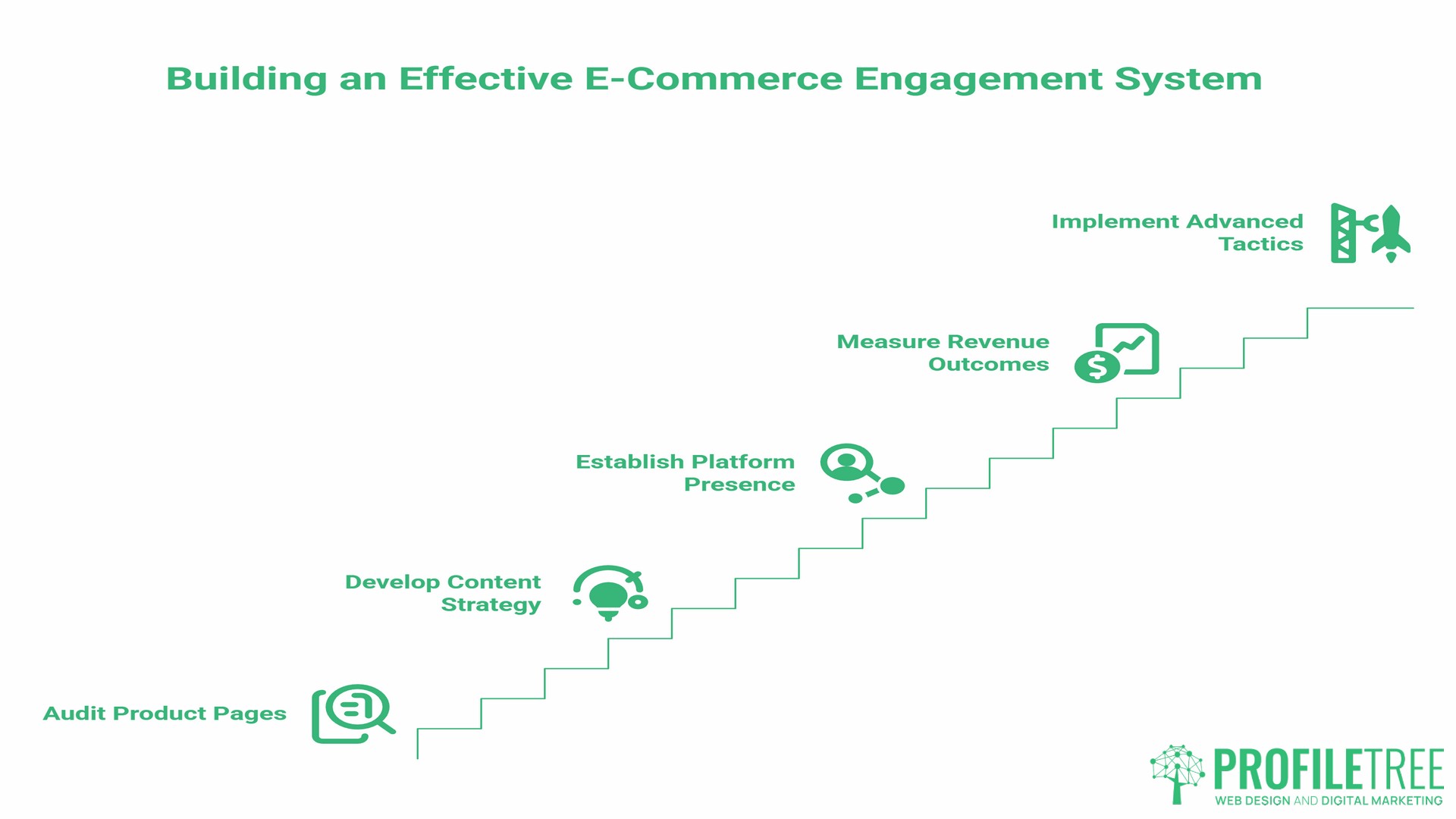
E-commerce engagement is not a social media problem. It is a systems problem. The businesses that get the best returns from shoppable content treat their social presence, website, content strategy, and analytics as a connected whole rather than separate activities managed in isolation.
Start with the foundations. Audit your product pages for mobile performance and checkout friction. Build a content strategy that covers both search intent and social discovery. Measure the outcomes that connect to revenue.
Then, once that system is working, introduce the more advanced tactics: zero-party data collection, post-purchase loops, video content matched to the platform and purchase stage, and AI tools where they genuinely serve the customer.
ProfileTree works with businesses across Northern Ireland, Ireland, and the UK on the full stack of this, from web design and development through to digital marketing strategy, content production, and AI implementation. If you want a practical conversation about where your current e-commerce engagement approach is losing value, get in touch with the ProfileTree team.
Frequently Asked Questions
What is a good engagement rate for a UK e-commerce store?
Lower than most guides suggest, on both measures.
On Instagram, the 2026 Social Media Industry Benchmark Report from Quid, formerly Rival IQ, puts the median engagement rate at 0.30% per post measured against followers, down from 0.36% the year before. Anything at or above 1% now places a business account in the top quartile. If you have been benchmarking against the 3% figures that circulate in older articles, you have been measuring against a standard that no longer exists.
On-site, IRP Commerce publishes monthly benchmarks drawn from live trading data across UK and Irish merchants, which makes it the most relevant reference for an SME here. Session conversion sat at 2.03% in June 2026, up from 1.85% a year earlier, having moved between 1.56% and 1.70% earlier in the year. Note that the 1.89% figure quoted in many articles is IRP’s historical average rather than a current reading.
What matters more than either number is your own rate over time and what causes it to move.
How can I increase e-commerce engagement on a tight budget?
Focus on UGC first, as it costs nothing to collect and provides credible social proof. Ask existing customers to share photos of their purchases in exchange for being featured on your channels or receiving a small discount on their next order. Second, fix the technical basics on your website before spending on driving more traffic to it. Third, use the analytics you already have access to. GA4 and your social platform analytics are free and contain enough information to identify where the biggest opportunities are without additional research spend.
Do shoppable posts actually increase revenue?
They can, but the effect depends heavily on what they link to. Shoppable posts that direct customers to a well-designed, fast-loading product page with clear pricing, visible reviews, and a simple checkout convert at meaningfully higher rates than posts that send people to a homepage or a general category page. When businesses report that shoppable posts did not work, the issue is usually the landing experience rather than the social content itself.
How does mobile speed affect e-commerce engagement?
A great deal. Google’s current Core Web Vitals threshold treats a Largest Contentful Paint above 2.5 seconds as needing improvement, and for e-commerce, where most social traffic in the UK arrives on mobile, every second you cut translates into more visitors who stay long enough to consider a purchase.
What are the four types of e-commerce engagement?
The four types are cognitive (the customer reads, researches, and processes information), emotional (the customer feels a connection to the brand through storytelling or values alignment), behavioural (the customer takes an action such as adding to basket or purchasing), and social (the customer interacts with others through reviews, UGC, and community participation). This framework draws on the customer engagement research published by Brodie, Hollebeek, Jurić and Ilić in the Journal of Service Research in 2011. An effective e-commerce engagement strategy addresses all four, recognising that most purchase journeys move through them in roughly this order.
Is AI or human content better for e-commerce engagement?
They serve different purposes. AI tools are useful for generating product descriptions at scale, personalising email content based on purchase history, and handling routine customer service queries. Human-created content, particularly video showing real people using products and written content reflecting genuine expertise, consistently outperforms AI-generated equivalents on trust signals. Brands using AI for repetitive tasks and human creativity for content requiring authenticity tend to outperform those relying heavily on either alone. ProfileTree’s digital training programmes cover how to find the right balance for your business.