
LinkedIn Ads: A Complete Guide to Targeting Professionals
Table of Contents
LinkedIn Ads give B2B advertisers something no other platform can match: the ability to target by job title, seniority, company size, and industry simultaneously, against a professional network that now counts over one billion members globally. For businesses selling to other businesses, that precision is the difference between paying for attention and paying for pipeline.
The challenge is cost. LinkedIn advertising carries some of the highest cost-per-click figures in paid social, which means every targeting decision, bidding choice, and creative element needs to earn its keep. Campaigns built on guesswork burn through budget fast. Campaigns built on a clear audience framework consistently outperform.
This guide covers LinkedIn’s targeting options in full, including the UK-specific cost benchmarks and GDPR compliance considerations most guides overlook, practical campaign setup, creative best practices, and how to measure results that matter. For broader B2B context, the LinkedIn B2B guide covers organic strategy alongside paid.
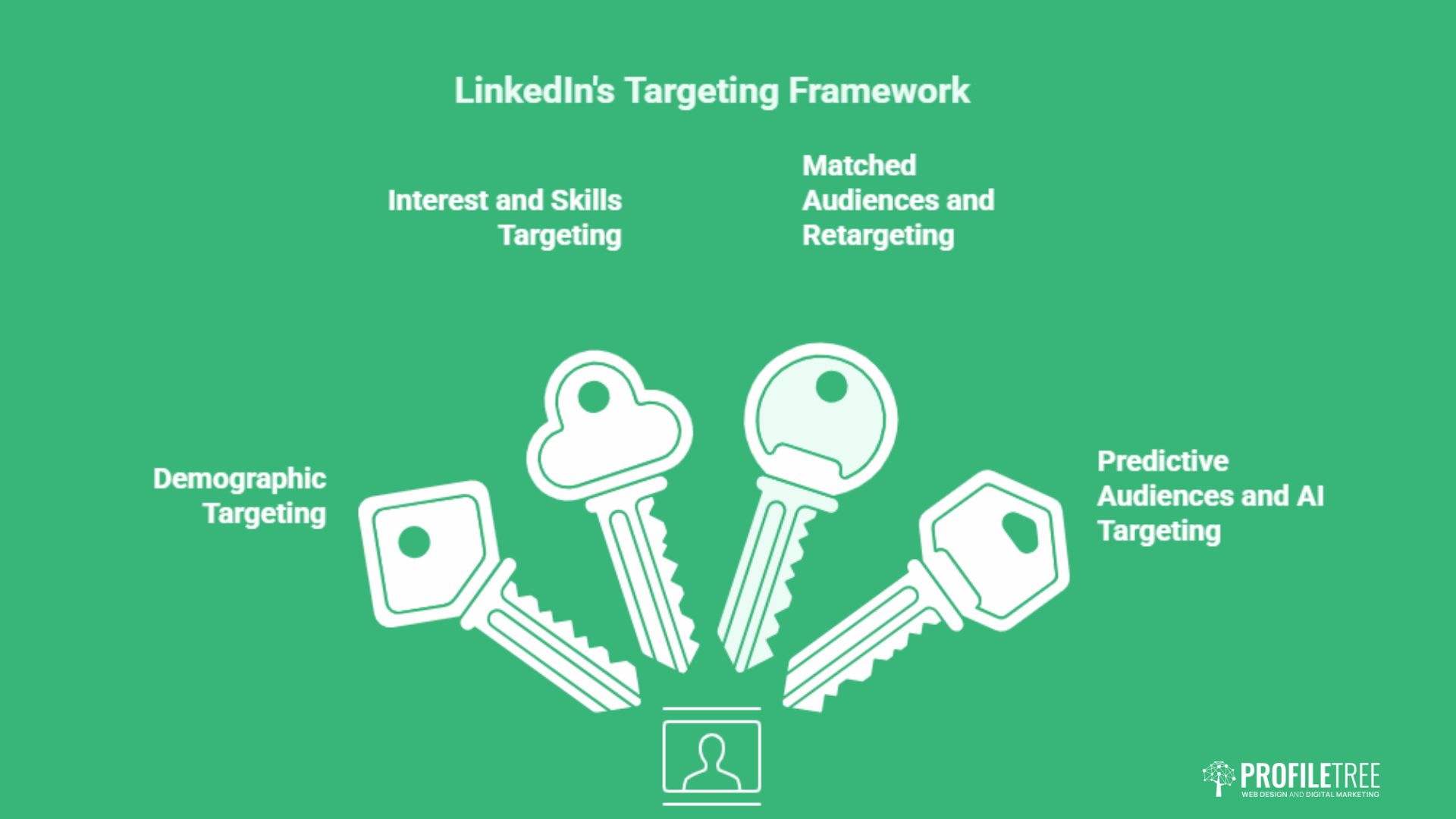
Understanding LinkedIn’s Targeting Options
LinkedIn Ads work differently from Meta or Google because the data underlying them comes from members’ own professional profiles: job titles they’ve chosen, skills they’ve listed, companies they’ve declared. That self-declared data is generally more accurate and stable than behavioural inference. It is also the reason LinkedIn advertising costs more: the audience precision commands a premium.
Demographic Targeting
The demographic layer covers the professional fundamentals: location (by country, region, or city), job title, seniority level, industry, company size, and years of experience. These filters work in combination, so an ad can reach senior-level finance professionals at companies with 200 to 500 employees in Northern Ireland without wasting spend on junior staff or sole traders who fall outside the buying committee.
Job function targeting is worth separating from job title targeting. Job function groups roles into broader categories (marketing, operations, finance), and is useful when you want to reach a department rather than a specific title. Job title targeting is narrower and better for reaching specific decision-makers, but it requires including common variations: “Managing Director,” “MD,” and “CEO” may all describe the same person depending on company culture and size.
Interest and Skills Targeting
Beyond the professional profile, LinkedIn allows targeting based on skills members have listed, groups they belong to, and topics they engage with. Skills targeting is particularly effective in technology and professional services, where a listed skill (cloud infrastructure, financial modelling, employment law) is a reliable proxy for the role a person plays day-to-day.
Group targeting lets advertisers reach members of specific LinkedIn communities, which tends to work well for niche audiences where group membership signals genuine engagement with a subject. A company selling HR software, for example, can target members of CIPD-affiliated groups in the UK without needing to enumerate every possible job title in the HR profession.
For a breakdown of which LinkedIn industry categories generate the most professional engagement in the UK, the LinkedIn Industries data analysis provides useful context for prioritising your targeting selections.
Matched Audiences and Retargeting
Matched Audiences allows advertisers to upload contact lists, retarget website visitors, or sync with CRM tools to reach existing prospects on LinkedIn. Contact list targeting matches email addresses against LinkedIn profiles, which is useful for account-based marketing (ABM) campaigns where you already know the companies and contacts you want to reach.
Website retargeting requires the LinkedIn Insight Tag to be installed on your site. Once active, it builds an audience of recent visitors that you can exclude from cold campaigns (to avoid showing acquisition ads to existing prospects) or target with tailored follow-up messaging. The Insight Tag also provides demographic data about your site visitors (job titles, seniority, and company size), which is genuinely useful for understanding who is already engaging with your content organically.
Predictive Audiences and AI Targeting
LinkedIn’s Predictive Audiences feature, which became available to UK advertisers through 2025 and 2026, uses machine learning to expand targeting beyond your defined criteria by finding similar professionals to those who have already converted. It works best once a campaign has collected at least 300 conversions as a training signal. Before that threshold, the model has insufficient data to make reliable predictions and can dilute targeting precision.
The practical approach is to run tightly defined manual targeting during the learning phase, then introduce Predictive Audiences once conversion volume justifies it. Skipping the manual phase entirely and relying on AI expansion from the outset typically increases impressions while reducing lead quality.
LinkedIn Ad Types and Formats
LinkedIn offers more ad formats than most advertisers realise, and the choice of format significantly affects both cost and conversion behaviour. The format determines where an ad appears, how a member interacts with it, and how the platform charges for delivery. Selecting the wrong format for a campaign objective is one of the most common causes of wasted LinkedIn spend.
ProfileTree’s social media marketing service includes LinkedIn paid campaign management for businesses that want strategic oversight of format selection and budget allocation across platforms.
Sponsored Content
Sponsored Content appears in the LinkedIn feed alongside organic posts. It includes Single Image Ads, Video Ads, Carousel Ads, Document Ads, and Event Ads. Document Ads, which allow members to preview a PDF or whitepaper before downloading, have seen strong engagement in professional services sectors because the format signals content depth rather than a hard sell.
For B2B advertisers, the feed placement of Sponsored Content makes it visible during natural browsing rather than requiring active search intent. The trade-off is that click-through rates are lower than search advertising, so the goal should be driving high-value actions (content downloads, event sign-ups, form completions) rather than maximising clicks.
Thought Leader Ads
Thought Leader Ads allow companies to amplify posts from individual employees or founders rather than the company page. This format has seen consistently higher engagement than standard company-page Sponsored Content, because content from a named individual reads as a personal recommendation rather than a corporate broadcast.
For professional services firms in Northern Ireland and the UK (accountants, solicitors, consultants, and similar), Thought Leader Ads offer a way to position a senior individual as a credible voice in their sector while keeping the campaign within the company’s advertising account. The key requirement is that the individual must have published the original post organically before it can be amplified. You cannot create content directly from the ad interface.
Message Ads and Conversation Ads
Message Ads (formerly InMail) deliver a sponsored message directly to a member’s LinkedIn inbox. They are charged per send rather than per impression, which changes the economics significantly. A well-targeted Message Ad to a small, precisely defined audience of senior decision-makers can be cost-effective; a broad send to thousands of loosely matched profiles is rarely so.
Conversation Ads add branching responses, so a recipient can reply with a button choice that routes them toward different content or calls to action. Both formats require careful attention to LinkedIn’s messaging policies, and deliverability varies: members who are less active on LinkedIn are less likely to see a Message Ad promptly.
Lead Gen Forms
Lead Gen Forms pre-populate with a member’s profile data when they click on an ad, removing the friction of a manual form fill. Conversion rates are typically higher than landing page clicks because the member never leaves LinkedIn. The trade-off is lead quality: the ease of submission means some contacts submit without genuine intent, which increases form completions while sometimes reducing sales-qualified leads.
The right choice between Lead Gen Forms and landing pages depends on your sales process. For high-volume, lower-ticket services where lead quantity matters, forms are usually preferable. For complex B2B sales with long consideration cycles, driving traffic to a detailed landing page that qualifies intent before asking for contact details often produces better downstream results.
UK and Ireland Costs, Benchmarks, and GDPR Compliance
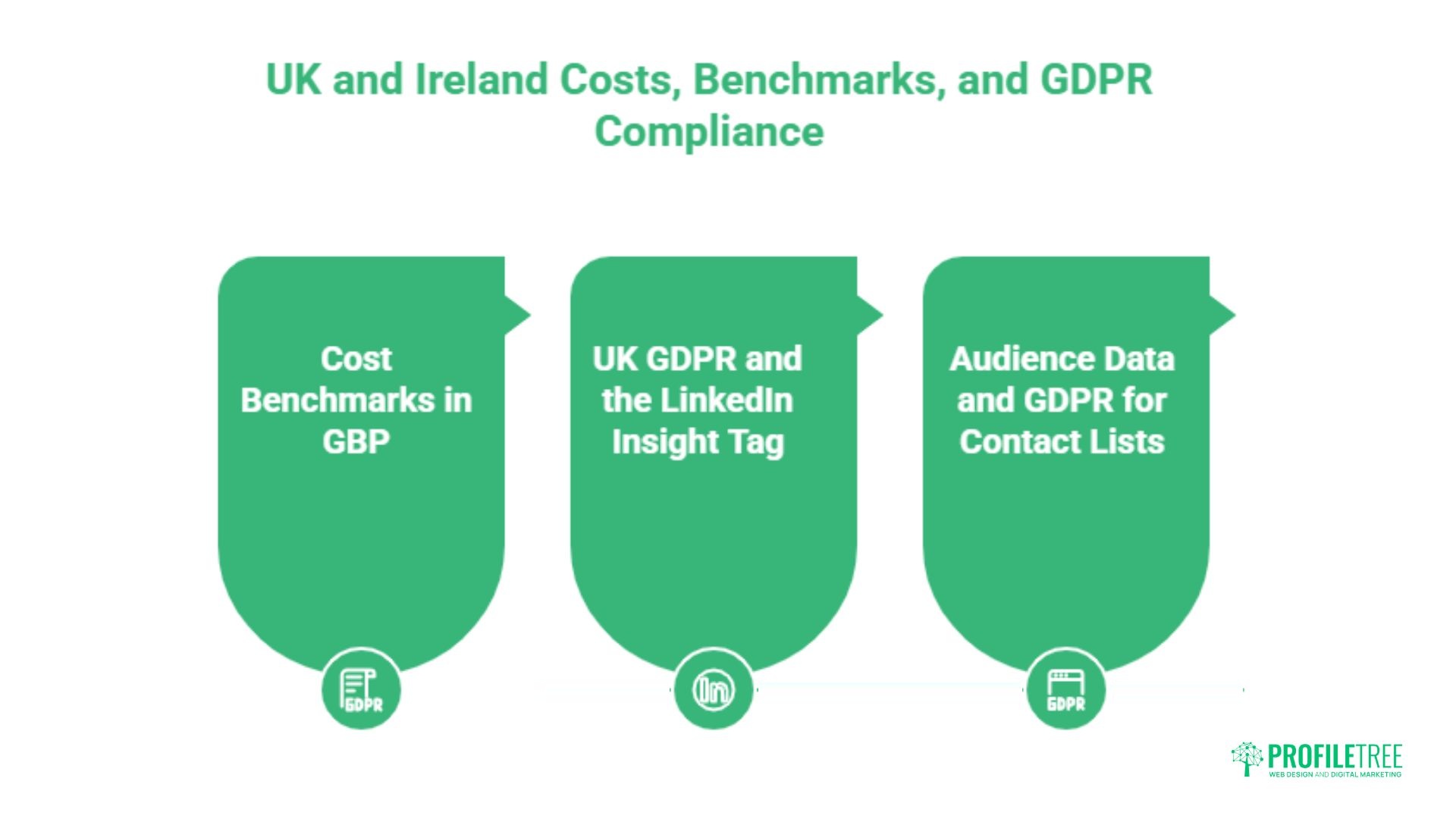
Most LinkedIn advertising guides publish cost figures in US dollars without acknowledging that UK and Irish advertisers operate in a different pricing environment. Currency aside, auction dynamics vary by market: competition for senior professional audiences in London’s financial sector is considerably higher than for similar roles in Belfast or Dublin, and that competition directly affects what you pay per click.
Cost Benchmarks in GBP
All prices and figures in this guide are indicative UK examples and correct at the time of writing; use them as a benchmark rather than fixed quotations.
For UK B2B advertisers in 2025 to 2026, typical cost-per-click (CPC) figures range from £5 to £12 for Sponsored Content targeting mid-level professionals, rising to £15 to £25 or above when targeting C-suite or director-level audiences in competitive sectors such as financial services, SaaS, and legal. Cost per lead through Lead Gen Forms tends to fall between £40 and £150 depending on audience specificity and offer quality.
The minimum daily budget for LinkedIn Ads is approximately £7, but this figure is largely academic. At £7 per day, most campaigns will not gather enough impression data to make meaningful optimisation decisions within a reasonable timeframe. A working minimum for campaigns intended to generate actionable data is £50 per day, with a committed test budget of £1,000 to £2,000 before drawing conclusions about audience and creative performance.
“For professional services firms in Northern Ireland, LinkedIn targeting often delivers the highest quality leads of any paid channel, but only when the targeting is specific enough to reach actual decision-makers rather than broad professional audiences,” says Ciaran Connolly, founder of ProfileTree. “We consistently see businesses underinvest in LinkedIn relative to their deal size. A £15 cost per click is good value when a single converted client is worth £10,000.”
UK GDPR and the LinkedIn Insight Tag
The LinkedIn Insight Tag is a piece of JavaScript that tracks website visitor behaviour and powers both retargeting audiences and conversion tracking. Under UK GDPR, placing the Insight Tag on a UK website requires informed user consent before the tag fires, because it constitutes the processing of personal data (IP addresses, device identifiers, and browsing behaviour).
Practically, this means your cookie consent banner must give visitors a genuine choice to accept or decline analytics and advertising cookies, and the Insight Tag must not load until consent is granted. Pre-ticking consent boxes, or placing the tag on page load without consent, is non-compliant under ICO guidance. Non-compliance risks both ICO enforcement action and invalidated conversion data, since a tag that fires without consent may be recording inaccurate or incomplete signals.
For businesses in Northern Ireland, the cross-border dynamic matters: if your website is accessed by users in Ireland (Republic), EU GDPR requirements apply to those users even if your business is UK-registered. A consent management platform that handles both frameworks is the practical solution rather than building separate consent flows.
Audience Data and GDPR for Contact Lists
Uploading a contact list to LinkedIn’s Matched Audiences feature requires that the contacts were obtained lawfully under UK GDPR. This means they must have consented to their data being used for marketing, or you must have a legitimate interest basis that is documented and defensible. Uploading purchased email lists, or lists of contacts who opted in only to receive a specific newsletter, is unlikely to meet the standard required.
LinkedIn hashes the uploaded data before matching, so raw contact details are not visible to the platform. However, the obligation to have a lawful basis for processing sits with the advertiser, not LinkedIn. The ICO has been active in enforcing marketing data compliance, and direct marketing is one of the areas most frequently subject to complaints and investigations.
Setting Up a Campaign: Framework and Bidding Strategy
LinkedIn Ads are structured in Campaign Manager across a three-tier hierarchy: Campaign Group, Campaign, and Ad. Campaign Groups control budget and scheduling at the top level. Campaigns define the objective, targeting, and bidding. Ads hold the creative. Understanding this structure before building avoids the common mistake of mixing different objectives or audience sizes within the same campaign, which makes optimisation difficult.
Choosing the Right Campaign Objective
LinkedIn structures campaign objectives across three stages: Awareness (brand awareness, video views), Consideration (website visits, engagement, video views), and Conversion (lead generation, website conversions, job applicants). The objective you select changes how the platform’s algorithm optimises delivery, which in turn affects who sees the ad within your defined targeting criteria.
Selecting Lead Generation as an objective when the goal is actually driving traffic to a content page wastes delivery: the algorithm will prioritise showing the ad to people statistically likely to complete a form, not to people likely to read an article. Matching the objective to the actual intended action is not optional; it is the primary lever controlling campaign efficiency.
Manual Bidding vs. Maximum Delivery
LinkedIn offers two main bidding approaches: Maximum Delivery (automated) and Manual Bidding (CPC or CPM). Maximum Delivery hands control to LinkedIn’s algorithm, which optimises for the campaign objective at whatever cost the auction requires. Manual Bidding caps the maximum you’ll pay per click or thousand impressions.
For new campaigns with no performance history, Maximum Delivery is usually the sensible starting point: it gathers data faster and avoids the risk of under-bidding in a competitive auction. Once you have two to four weeks of data and a clear picture of actual CPCs, shifting to Manual Bidding with a cap slightly above the observed average CPC gives you cost control without significantly restricting delivery.
The bidding strategy has a direct relationship with ad relevance. LinkedIn’s auction rewards ads with high click-through and engagement rates by reducing their effective cost. An ad that generates strong interaction from a targeted audience will, over time, cost less per result than a weaker creative targeting the same audience at the same bid. This is why creative quality is not a secondary consideration: it directly affects the economics of the campaign. For further reading on making paid digital channels work alongside organic performance, the guide to LinkedIn ads optimisation covers the key levers in detail.
Account-Based Marketing on LinkedIn
Account-Based Marketing (ABM) on LinkedIn targets specific companies rather than broad audience segments. This is done through Company List targeting, where you upload a list of target company names or domains, and LinkedIn matches them to company pages. The ad then shows only to members who work at those companies, within any additional filters (seniority, job function) you apply.
ABM campaigns typically require a larger budget to work effectively, because the audience is deliberately small. A list of 50 target companies with 10 contacts per company gives a maximum addressable audience of around 500 people. At recommended frequency caps, that audience requires consistent spend to maintain visibility. The payoff is relevance: every impression is reaching someone at a company you have already identified as a viable prospect.
Creative Best Practices and Performance Measurement
LinkedIn Ads face a tougher creative environment than most paid social platforms. Professionals scrolling through a feed of industry news and peer updates apply a higher level of scepticism to sponsored content than consumers on Instagram or TikTok. Creatives that read as self-promotional, vague, or undifferentiated from competitors tend to generate low engagement scores, which feeds back into higher costs.
Writing for a Professional Audience
Effective LinkedIn ad copy addresses a specific professional problem before mentioning a solution. The opening line of a Sponsored Content ad (the text that appears before “See more” is clicked) needs to earn continued reading. Generic openings (“Is your business struggling with…?”) are widely ignored because they signal a pitch rather than useful information.
Specificity consistently outperforms broad claims. An ad opening with a concrete figure, a named challenge, or a specific sector reference gives the reader an immediate signal about whether the content is relevant to them. That filtering effect is a feature, not a bug: a lower click-through rate from a precisely targeted audience that converts is worth more than a high click-through rate from broadly curious professionals who drop off at the landing page.
Social Proof in LinkedIn Creative
LinkedIn members respond to evidence that peers or equivalent businesses have already made a decision. Testimonials from named individuals (with job title and company), case study results expressed as specific figures, and references to named clients (where permitted) all function as social proof that reduces the perceived risk of engaging. This is particularly true in professional services, where buyers are making decisions that reflect on their own professional judgement.
Visually, LinkedIn Sponsored Content performs best with clean, text-light imagery or a short video that communicates one idea quickly. Carousels work well for content that benefits from sequential logic (a step-by-step framework, a before-and-after comparison, or a series of data points), because members can swipe through at their own pace.
Measuring Beyond the Click
LinkedIn’s native reporting covers clicks, impressions, click-through rate, cost per result, and demographic breakdowns of who engaged with an ad. These metrics are necessary but not sufficient for understanding true campaign performance. The critical gap is attribution: a professional who sees a LinkedIn ad on Monday may search for your brand directly on Thursday and convert through Google Analytics as an organic visit, with no LinkedIn attribution recorded.
View-through conversions, which LinkedIn tracks for users who saw an ad but did not click, help to capture some of this delayed attribution. However, view-through windows (typically one to seven days) are an approximation, not a precise measurement. For high-value B2B sales with long consideration cycles, pairing LinkedIn campaign data with CRM pipeline analysis, asking new leads how they first heard about you, is more reliable than relying on last-click attribution alone.
For a practical framework on connecting paid campaign spend to revenue outcomes, the guide to maximising digital ROI covers attribution models and reporting approaches across paid channels.
Testing and Continuous Optimisation
A/B testing on LinkedIn requires patience. Because audiences are smaller than on Meta or Google, campaigns need longer to accumulate statistically meaningful data. As a practical guideline, run each creative variant for at least two weeks or until each version has received 10,000 impressions before drawing conclusions. Testing a single variable at a time (the headline, the image, the call-to-action button) produces clearer signals than changing multiple elements simultaneously.
The variables worth testing, in rough order of impact, are: the opening line of copy (highest impact on click-through), the image or video creative, the call-to-action, and the offer itself. Audience testing (running the same creative against two different targeting segments) is equally valuable and often overlooked. A campaign that performs modestly against a broad professional audience may perform strongly when the same budget is focused on a narrower, better-matched segment.
Northern Ireland businesses exploring tourism marketing investment alongside digital advertising may find relevant context on how Belfast and other cities attract professional visitors in this guide to the top cities in Northern Ireland.
LinkedIn advertising is not a platform to test cheaply and scale later: the minimum viable budget for meaningful data is higher than most paid social channels. It rewards advertisers who invest in precise targeting, strong creative, and a clear understanding of their buyers’ decision process. For organisations that meet those conditions, the quality of the professional audience they provide is genuinely unmatched.
If you’d like strategic support building a LinkedIn campaign that connects to your wider pipeline, digital strategy support from ProfileTree covers paid social, content, and SEO as an integrated programme.
FAQs
What is the minimum budget for LinkedIn Ads in the UK?
LinkedIn sets a minimum daily budget of approximately £7, but this figure is impractical for generating useful data. A realistic minimum for a campaign that can be meaningfully analysed and optimised is £50 per day. That range is generally sufficient to compare two or three audience segments and two creative approaches.
Are LinkedIn Ads worth it for small businesses?
LinkedIn Ads are worth considering for small businesses when the average deal or client value is high enough to justify the cost per lead. A professional services firm where a new client is worth £5,000 to £20,000 can often justify LinkedIn CPCs of £10 to £20. A small retailer or consumer-facing business selling lower-ticket products will rarely see a positive return at LinkedIn’s pricing. The platform is purpose-built for B2B, and it performs best in that context.
How do I lower my LinkedIn CPC?
LinkedIn’s auction rewards relevance. Ads with higher click-through rates cost less per click over time because the platform’s algorithm values content that members engage with. To lower CPC, improve the opening line of your ad copy, test more specific creatives that address a defined professional problem, and narrow your audience to better match the ad to the viewer. Bidding below the suggested range can also reduce costs, but risks limiting delivery in competitive auctions.
Do I need a LinkedIn Company Page to run ads?
Yes. A LinkedIn Company Page is required to run Sponsored Content, Lead Gen Forms, and most other ad formats. Thought Leader Ads additionally require the individual whose post is being amplified to be an admin or employee associated with the advertising account. Setting up a Company Page is straightforward and free; the page does not need to have an established following to run ads.
Are Lead Gen Forms better than landing pages?
Lead Gen Forms typically generate more form completions at a lower cost per lead by removing the friction of leaving LinkedIn. Landing pages typically generate fewer but higher-intent leads, because visitors who navigate to an external page and complete a form there have self-selected more deliberately. For high-volume lead generation at scale, forms usually win on efficiency.