
AI Website Development: A Practical Guide for UK Businesses
Table of Contents
AI website development has moved well beyond chatbots and autocomplete. Today, artificial intelligence is embedded into every stage of the web build process: planning site structure, writing initial code, generating copy drafts, testing performance, and flagging accessibility issues before a site goes live. For a business owner in Belfast, Dublin, or Manchester deciding how to approach their next website project, understanding where AI adds genuine value and where human oversight remains non-negotiable makes the difference between a site that performs and one that simply exists.
This guide covers how AI is being used in professional web development right now, what it means for costs and timelines, and how to evaluate whether a builder tool or a development agency better serves your goals.
What AI Website Development Actually Means
The term covers a range of very different things, and conflating them leads to poor decisions. At one end, “AI website development” refers to consumer-facing builder tools such as Wix ADI, Hostinger’s AI site generator, and Jimdo Dolphin. You answer a few prompts, and the tool produces a functional, if generic, starting point. At the other end, it describes how professional developers use AI-assisted coding tools such as GitHub Copilot to write and review code faster, without sacrificing the bespoke quality that a business’s brand identity requires.
A third category sits between these two: the hybrid model, where an agency uses AI at specific stages of the build (generating initial wireframes, producing content drafts, running automated SEO audits) while human developers and strategists make all consequential decisions. This is the model used in professional website development engagements, and it is the approach that produces the most commercially effective results for SMEs.
AI Builders: What They Do Well
AI-powered website builders have improved considerably. For a sole trader or micro-business that needs a basic web presence quickly and has no plans to scale, a builder tool can produce a usable site within a day. Most include templated SEO fields, mobile responsiveness, and basic e-commerce functionality. Subscription costs typically range from £10 to £60 per month, depending on the platform and feature tier.
Where Builder Tools Fall Short
The limitations become apparent as requirements grow. Builder tools produce structurally similar output: the same heading hierarchies, the same layout patterns, the same generic copy when AI content generation is used. Two businesses in the same industry using Wix ADI will end up with sites that look and function almost identically, which does nothing to differentiate their brands. Performance ceilings are real: Core Web Vitals scores on builder platforms are harder to control than on custom-built WordPress installations, and technical SEO customisation is limited by what the platform exposes to the user.
The Hybrid Development Model
For businesses with genuine commercial goals, the hybrid approach delivers better outcomes at a lower relative cost than either a fully manual build or a self-serve builder. A development team that uses AI at the right stages, specifically for rapid prototyping, code review, and automated testing, can reduce build timelines significantly while still producing a site tailored to the client’s exact requirements. ProfileTree’s approach to website development follows this model: AI accelerates the process, human expertise governs the result.
How AI Is Used at Each Stage of a Professional Web Build
Understanding where AI fits into the workflow helps businesses ask better questions when briefing an agency and clarifies what they are actually paying for.
Planning and Site Architecture
AI tools can analyse a site brief and generate initial sitemap structures based on the business’s service categories, target audience, and competitive context. This is useful for quickly drafting the overall page hierarchy, but the strategic decisions on what the pillar pages are, how services cluster, and how the user journey flows from discovery to contact require a strategist who understands the business and its market. For Northern Ireland SMEs serving both local and national audiences, that kind of contextual judgement cannot be automated.
Design and Prototyping
Tools such as Framer and Vercel v0 enable developers to generate responsive UI components from prompts, producing design prototypes far faster than traditional methods. This speeds up the early discovery phase and gives clients something concrete to react to within days rather than weeks. The AI generates the starting point; the developer refines it for brand alignment, accessibility compliance, and performance.
Code Generation and Review
GitHub Copilot and similar AI coding assistants generate code suggestions inline as developers write. This is not about replacing the developer: it is about removing the repetitive boilerplate that consumes time without requiring skill. A developer using AI assistance can complete certain tasks faster, which reduces the hours billed on a project. Published research from GitHub found that developers using Copilot completed tasks measurably faster than those working without it, though the gains were more pronounced on straightforward tasks than on complex architectural decisions.
Content and Copy
AI content generation tools can quickly produce first drafts for service pages, product descriptions, and metadata. The business case for using them is real: seeding a 20-page site with AI-drafted copy and editing it to brand voice is faster than writing from scratch. The risk is in treating AI output as finished content. AI-generated copy is structurally predictable, often uses phrases that detection tools flag easily, and lacks the specificity that separates high-performing SEO content from noise. For businesses where content quality is a competitive differentiator, editorial oversight is not optional. ProfileTree’s SEO services treat AI as a drafting tool, not a publishing tool.
Testing and Quality Assurance
Automated QA tools can scan a finished build for broken links, missing alt text, slow-loading assets, and WCAG accessibility failures faster than any manual process. This is one of the clearest, lowest-risk applications of AI in web development: it catches the routine errors that a tired human reviewer misses. Running automated QA before handover is standard practice in professional builds; it is rarely available on consumer builder platforms.
AI Website Development Costs in the UK
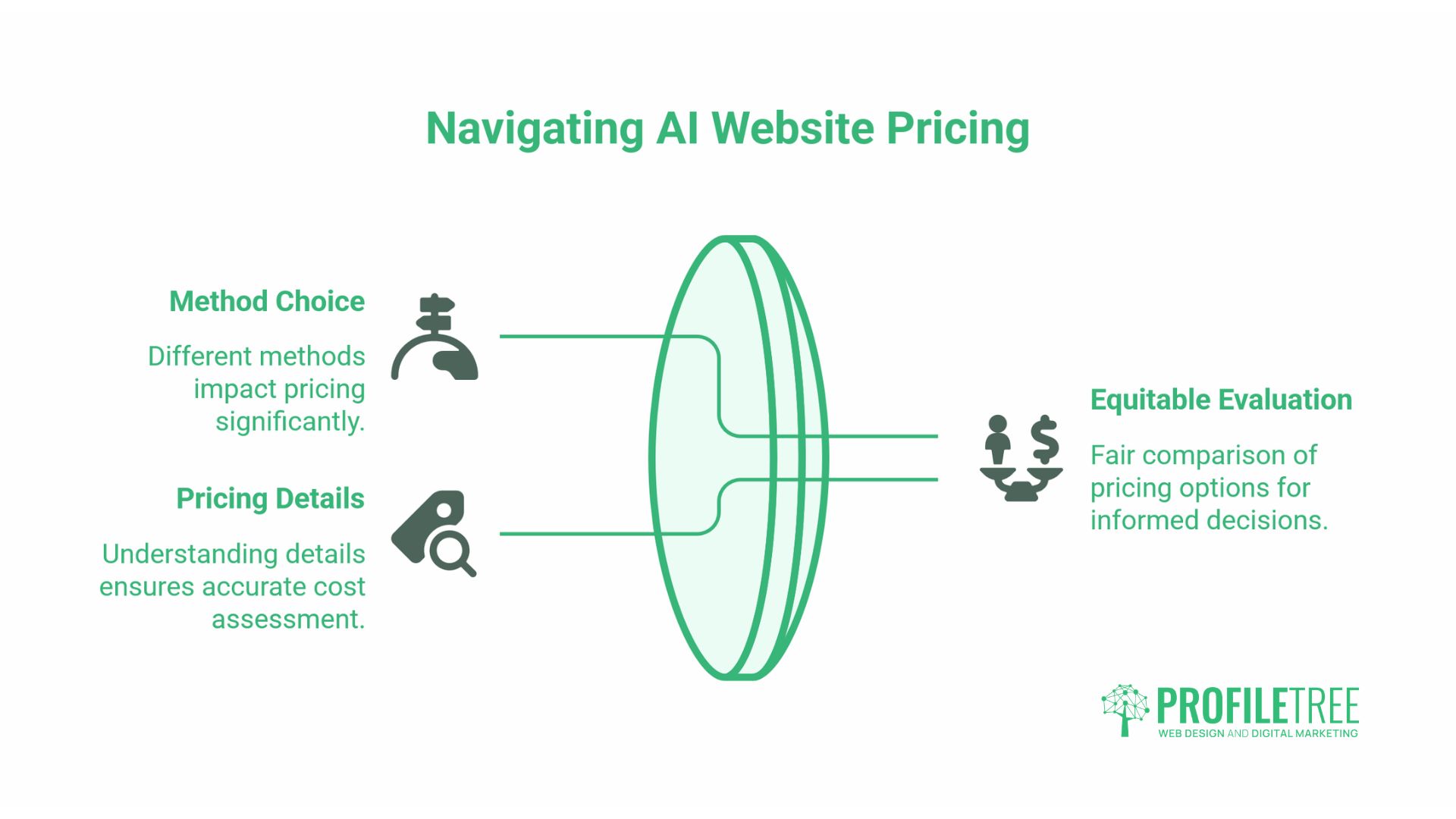
Pricing varies widely depending on the approach, and understanding the breakdown helps businesses compare options fairly.
Builder Platform Subscriptions
Consumer AI builder platforms charge monthly subscriptions. As a general guide, entry-level plans that include a custom domain and remove platform branding typically start at around £10-£15 per month. Mid-tier plans with e-commerce functionality and more storage run from £20 to £40 per month. Premium plans with advanced features can reach £60 or more. These costs recur indefinitely: the site exists only as long as the subscription is active, and migrating away from a proprietary builder is often technically difficult.
Professional Development with AI Assistance
A professionally built WordPress site that uses AI tooling to reduce build time falls into a different cost bracket. Project fees depend on the number of pages, level of custom functionality, and the scope of design work. AI assistance in the build process can reduce the hours required for certain tasks, making professional development more accessible for SMEs than it was five years ago. Unlike a builder subscription, a professionally built site on WordPress or a similar open platform is owned outright and can be transferred or expanded without dependency on a single vendor.
AI Implementation as an Ongoing Service
A separate cost category covers adding AI-powered functionality to an existing site, such as chatbots, personalisation engines, AI-assisted search, or automated content updates. These are implementation projects rather than site builds, and they require development work to configure, test, and integrate with existing systems. For SMEs exploring this area, ProfileTree’s coverage of AI implementation for SMEs covers the practical considerations.
GDPR and Data Compliance for AI-Built Sites
This is the area most overlooked in generic guides, which are almost all written from a US perspective. For businesses in Northern Ireland, the Republic of Ireland, and the wider UK, data compliance has direct implications for which AI tools are safe to use in a web project.
Where AI Tools Store Your Data
Most major AI website builders and AI coding assistants are operated by US companies. When you use an AI generator to produce your site’s copy or generate images, that input data is typically processed on US-based servers. For UK businesses post-Brexit, data transfers to the US are governed by the UK-US data bridge agreement. For Republic of Ireland businesses, GDPR applies directly. Neither framework prohibits the use of these tools, but businesses handling personal data, whether through contact forms, user accounts, or customer data, need their privacy notices to accurately reflect where data is processed and by whom.
Cookie Consent and AI-Powered Features
AI-powered features on a site, such as a chatbot that records conversation history or a personalisation engine that tracks user behaviour, are subject to the same PECR rules (in the UK) and ePrivacy rules (in Ireland and the EU) as any other tracking technology. A cookie banner that covers standard analytics but does not account for AI-powered data collection creates a compliance gap. This is a practical consideration when adding third-party AI tools to an existing site, not just a theoretical concern.
Who Owns AI-Generated Code and Content?
UK copyright law does not currently extend copyright protection to works generated solely by AI, meaning AI-generated code and copy may not be automatically protected. In practice, the final published site will incorporate significant human input, editing, and customisation that establishes authorship. However, if a business uses an AI generator and publishes the output with minimal modification, the ownership position is less clear. A development agency that uses AI tools as part of a professional build and delivers a bespoke end product typically assigns copyright to the client in the contract, which sidesteps this question. Verify this in any agency agreement.
As Ciaran Connolly, founder of Belfast digital agency ProfileTree, puts it: “AI tools have made the technical parts of web development faster and more accessible, but the strategic and legal decisions (what the site should do, how it should perform, and how it handles customer data) still need human judgement. A business that treats an AI-generated site as a finished product rather than a starting point is taking on risk it may not realise it has.”
AI Website Builder vs Professional Development: How to Choose
The right choice depends on what the site needs to do and how much it matters to the business’s commercial performance.
When a Builder Tool Is Sufficient
A builder platform is a reasonable option when the primary need is a simple web presence: contact information, basic service descriptions, and a way for customers to find the business online. For a sole trader or very early-stage startup that needs something functional immediately and has a limited budget, a builder subscription is a practical starting point. It is not a long-term solution if the business expects to use the site to generate leads, rank for competitive keywords, or serve as the primary sales channel.
When Professional Development Is the Better Investment
For established businesses, the site is often the single most valuable marketing asset. A professionally built site gives full control over technical SEO, performance, design, and functionality. It does not cap growth based on platform capabilities or pricing tiers. For businesses where the website directly drives revenue, the return on a professional build, typically a one-off fee rather than a recurring monthly cost, often justifies the investment within the first year.
The Questions Worth Asking
When evaluating options, the practical questions are: Does the site need to rank for competitive search terms? Does it need custom functionality that builder templates cannot accommodate? Will it need to integrate with other business systems (CRM, booking software, inventory)? If the answer to any of these is yes, a professional build is the more appropriate choice. ProfileTree’s website development covers the full range, from WordPress builds for growing SMEs through to custom development for more complex requirements.
Post-Launch: Using AI to Improve Site Performance
AI remains useful even after a site goes live. Some of the most practical applications are in ongoing maintenance and optimisation.
AI-Assisted SEO Auditing
Automated SEO audit tools can crawl a live site and flag issues such as missing metadata, images without alt text, slow-loading resources, internal linking gaps, and duplicate content. Running these audits regularly, rather than once at launch, means issues are caught before they affect rankings. For businesses without in-house SEO capability, working with an agency that runs these tools as part of ongoing management is more cost-effective than periodic manual audits. ProfileTree’s SEO services include ongoing technical monitoring as part of managed packages.
Content Freshness and AI-Generated Updates
AI content tools can help businesses systematically update evergreen pages: refreshing statistics, updating service descriptions when offerings change, and adding new FAQ content based on customer enquiries. The same editorial standards apply to updates as to original content. AI drafts need human review before publication. For SMEs that lack the time to maintain content consistently, structured content programmes that combine AI drafting with editorial oversight make the process manageable.
Performance Monitoring
AI-assisted analytics tools go beyond reporting what happened to suggesting why. Behavioural analysis tools can identify pages where users consistently drop off, sections that receive no engagement, and calls to action that are being missed. Acting on this data is where digital marketing strategy intersects with web development: the insight comes from the data, the improvement comes from changes to the site.
Preparing Your Team for AI in Web Development
For businesses that want to use AI tools directly rather than relying solely on an agency, building internal capability makes a significant difference to outcomes. Understanding what these tools can and cannot do, how to prompt them effectively, and how to review their output critically are skills that apply across AI web tools, AI content tools, and AI-assisted marketing platforms. ProfileTree’s digital training programmes are designed for exactly this: giving business owners and marketing teams the practical knowledge to use AI tools productively, without needing a technical background.
For a deeper grounding in how AI is being adopted across SMEs right now, the article on AI adoption for SMEs covers the practical barriers and how to address them.
Conclusion
AI website development gives UK businesses real options, but the right choice depends entirely on what the site needs to do commercially. Builder tools suit simple web presences; professional development with AI assistance suits businesses where the site is a primary revenue driver. Getting that decision right from the start avoids costly rework later. ProfileTree’s website development team works with SMEs across Northern Ireland, Ireland, and the UK to find the right fit.
FAQs
Can AI build a fully functional website?
Yes, AI builder platforms can produce a functional site quickly for straightforward use cases. However, functional is not the same as optimised. An AI-generated site typically needs human input on SEO, brand voice, and technical performance to work effectively as a business tool.
How much does AI website development cost in the UK?
Builder subscriptions run from roughly £10 to £60 per month, depending on the platform and tier. Professionally built sites are priced as project fees that vary by scope. Adding AI-powered features such as a chatbot to an existing site is a separate implementation cost. Over two to three years, professional builds often compare favourably to recurring subscription costs.
Is AI-generated code SEO-friendly?
The structural output is generally clean. The gaps tend to be in the content and metadata layer: generic page titles, thin copy, and missing schema markup. These are not inherent code problems; they result from using AI without an SEO strategy applied to the output.
Will AI replace web developers?
AI has changed what developers spend their time on, not whether they are needed. Routine tasks are faster with AI assistance. The decisions that determine whether a site succeeds, including architecture, strategy, performance, and compliance, still require experienced human judgement.