
Healthcare Blogging: How Clinics and Practices Build Authority Online
Table of Contents
Healthcare blogging has become a genuine competitive factor for clinics, practices, and health organisations across the UK and Ireland. Patients now turn to search engines before they pick up the phone: around 5% of all Google searches are health-related, and search drives 3 times as many visitors to hospital websites as any other channel. If your practice does not have a consistent, well-structured blog, you are leaving patient trust on the table.
Yet building that trust online is uniquely challenging. Healthcare blogging is not the same as blogging in other sectors; content in this space falls under Google’s “Your Money or Your Life” (YMYL) category. This means it is held to a much higher editorial standard than a lifestyle article or a home improvement guide, and it requires strict medical accuracy and regulatory compliance.
This exact challenge is the pattern ProfileTree encounters repeatedly. As a Belfast-based web design and digital marketing agency, we have built healthcare content strategies for private surgeons, laser eye clinics, and specialist practices across Northern Ireland, Ireland, and the UK. Time and again, providers come with strong clinical credentials but a weak digital presence, creating a significant gap between the care they deliver and the visibility they achieve online.
Closing that gap requires a clear content strategy, an understanding of local regulatory frameworks, and a workflow that keeps clinicians and content teams in sync. This guide covers each of those areas in practical terms, with particular attention to the UK and Irish regulatory environment that most generic blogging guides ignore.
Why Healthcare Blogging Matters for Practices and Providers
A healthcare blog does several things at once, and most practices underestimate how many of them matter commercially.
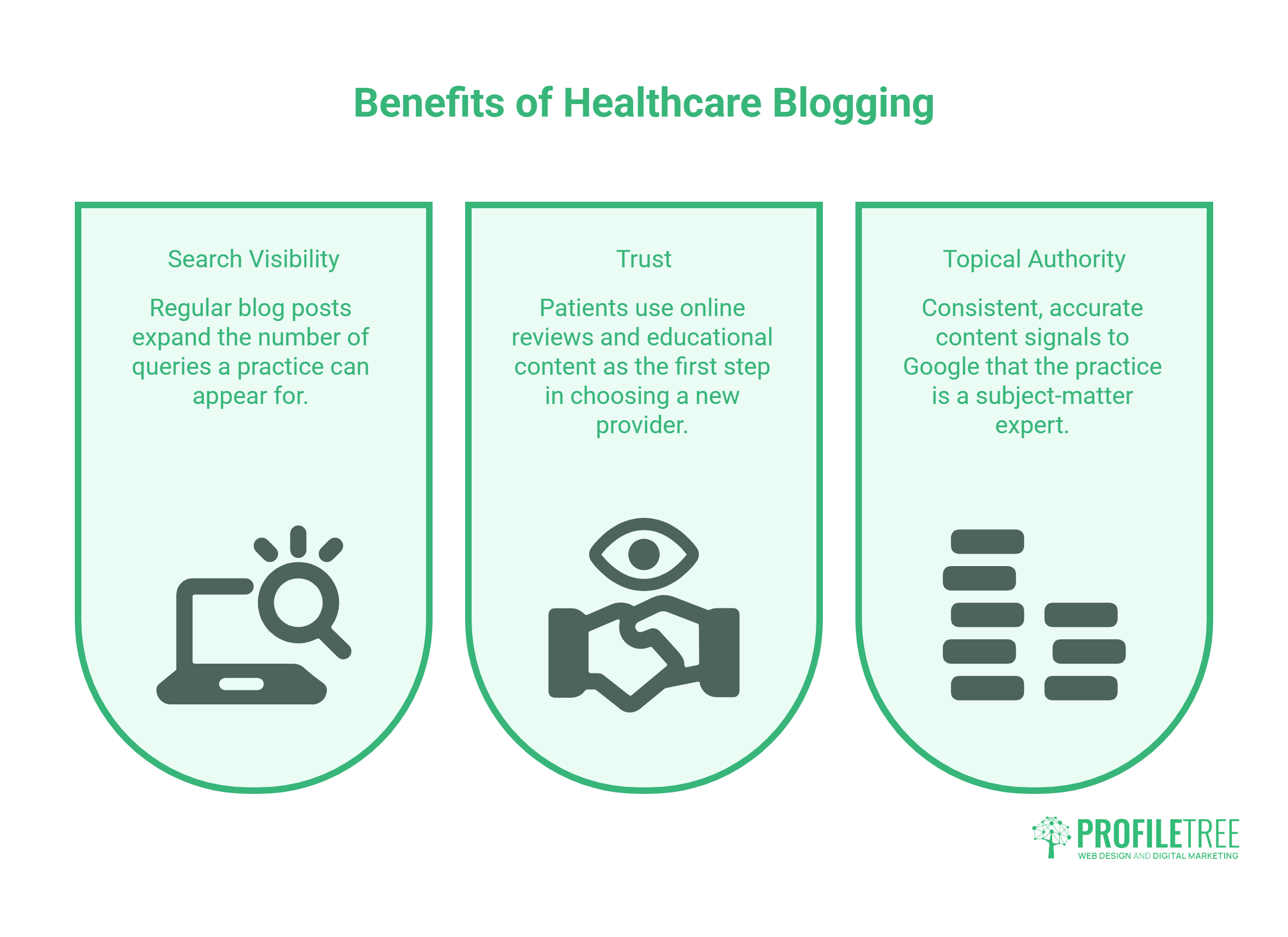
Search visibility is the most obvious benefit. Regular, well-structured blog posts expand the number of queries a practice can appear for. Each post targeting a specific patient question (say, “how long does a knee replacement recovery take”) creates another indexed page, another entry point, another opportunity to reach someone at the moment they need you.
Trust is harder to quantify but arguably more valuable. A patient reading a well-reasoned, clearly sourced article about their condition before a consultation arrives differently from one who has been staring at unverified forum posts. Research consistently shows that a majority of patients use online reviews and educational content as the first step in choosing a new provider.
Healthcare blogs also build what SEOs call topical authority. A practice that publishes consistent, accurate content across a defined set of topics signals to Google that it is a genuine subject-matter expert in that space. That signal reinforces rankings across the whole site, not just the individual article.
Ciaran Connolly, founder of ProfileTree, frames it plainly: “In healthcare blogging, the balance between informative content and regulatory adherence is not just advisable; it is imperative.”
Mastering Google’s E-E-A-T and YMYL Guidelines
That regulatory balance Ciaran describes is not just an editorial principle; it is built directly into how Google evaluates healthcare content. Before looking at compliance frameworks or content workflows, it helps to understand the specific standards Google applies to medical and health information, because they shape every decision that follows.
What YMYL Means for Healthcare Content
Google’s Quality Rater Guidelines identify health and medical content as “Your Money or Your Life” (YMYL) territory, meaning pages that could directly affect a person’s health, safety, or financial well-being. These pages are assessed more carefully than standard content.
For a healthcare blog, this has a direct practical consequence. Articles written by anonymous authors, sourced from unverifiable references, or making unsupported health claims are exactly what Google’s quality systems are trained to deprioritise. It does not matter how well the page is optimised for keywords; if the E-E-A-T signals are weak, the ceiling on what that page can rank for is low.
Building Experience, Expertise, Authoritativeness, and Trust
E-E-A-T stands for Experience, Expertise, Authoritativeness, and Trustworthiness. In healthcare blogging, each element requires active effort:
Experience means demonstrating real-world clinical or professional engagement with the subject. This is best shown through specific details: referencing a process your team follows, describing a challenge that arises in a particular type of consultation, or noting how patient questions on a topic have evolved over time. Vague generalities do not communicate experience.
Expertise is established through author credentials. Since Google updated its Search Quality Rater Guidelines in 2024 to make author credentials a formal ranking input, every healthcare article should carry a named author with verifiable qualifications. Google now crawls LinkedIn profiles, speaker pages, and institutional profiles. A blank author field or a generic “staff writer” credit is a missed opportunity.
Authoritativeness is built through citations. Every non-obvious factual claim should reference a named source: a peer-reviewed journal, official NHS guidance, a published dataset, or a recognised professional body. “Studies show” is not a citation. PubMed, the Cochrane Library, the British Medical Journal, and NICE guidelines are.
Trustworthiness encompasses everything else: transparent authorship, honest disclosure of any commercial relationships, clear contact information, and content that does not overstate what the evidence supports.
The practical implication for healthcare blogging is that you need a named, credentialled author on every post and a reference section that can be checked. Anything less is a structural weakness.
Navigating Regulatory Compliance: UK and Irish Frameworks
Meeting Google’s E-E-A-T standards is one side of the equation. The other is the legal and regulatory environment in which your content operates. This is where almost every generic healthcare blogging guide falls short: the dominant guides are written for US audiences and treat HIPAA as though it were the only framework that matters. For any practice operating in the UK or Ireland, that gap is significant.
Patient Privacy: GDPR vs HIPAA
HIPAA (Health Insurance Portability and Accountability Act) governs the handling of patient health information in the United States. It is not UK or EU law.
In the UK and across the EU and Ireland, patient data is governed by the UK GDPR (retained after Brexit as UK law) and the EU General Data Protection Regulation, respectively. The practical implications for healthcare blogging are meaningful:
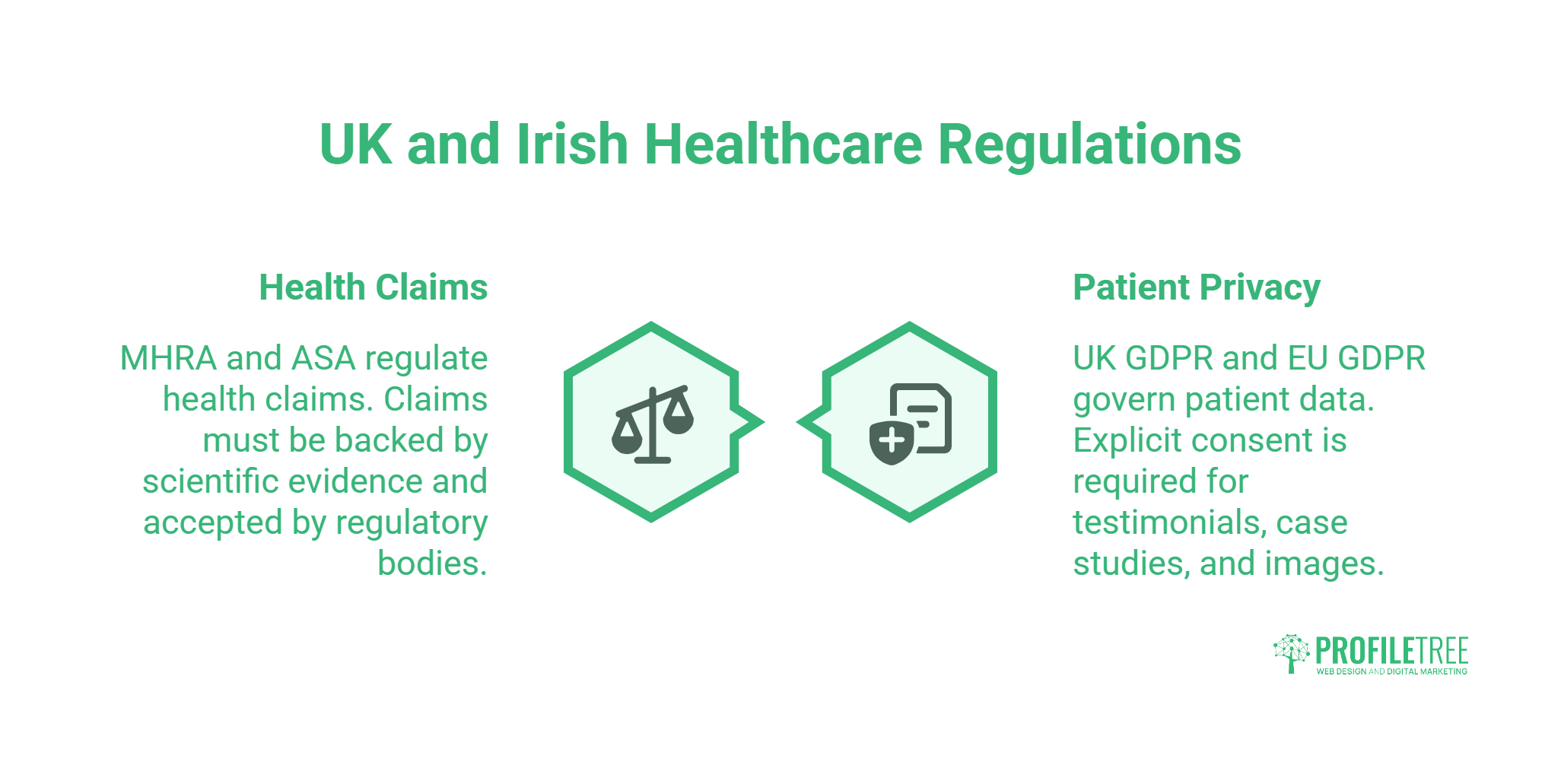
- You cannot publish patient testimonials, case studies, or treatment outcomes without explicit, written, informed consent. Anonymising details is not sufficient on its own; the consent itself must be documented.
- Patient photos and treatment images require specific consent separate from any general terms the patient signed on registration.
- If your blog uses analytics cookies or collects email addresses through a newsletter sign-up, you need a GDPR-compliant privacy policy and consent mechanism.
This matters not just for legal compliance but for editorial credibility. A healthcare blog that uses real patient stories without a clear consent framework is a liability waiting to surface.
Making Valid Health Claims: MHRA and ASA Rules
The Medicines and Healthcare products Regulatory Agency (MHRA) and the Advertising Standards Authority (ASA) both have jurisdiction over health-related claims made in published content, including blog posts.
The core rule is straightforward: do not claim that a treatment, product, or service prevents, treats, or cures a condition unless that claim is backed by strong, peer-reviewed scientific evidence that has been accepted by the relevant regulatory body.
In practice, this means:
- You cannot write that a supplement “treats” arthritis unless that claim is approved.
- A physiotherapy practice cannot claim its approach “cures” lower back pain.
- Dental practices cannot state that a particular treatment “prevents” tooth decay without referencing the evidence base for that claim.
The ASA has issued rulings against health blogs and clinic websites for exactly these violations. The consequence is not just regulatory; a published correction or ruling damages the credibility that your blog is designed to build.
The practical approach is to use what medical communicators call hedged language: “may support,” “evidence suggests,” “some patients report.” These are not weak formulations; they are accurate ones, and they protect you.
| Region | Patient Data Law | Advertising Regulator | Core Blogging Restriction |
| United States | HIPAA | FTC | No false health claims; PHI protection |
| United Kingdom | UK GDPR | ASA / MHRA | No unsupported efficacy claims; explicit patient consent |
| Ireland / EU | EU GDPR | ASAI / HPRA | Same as the UK; stricter consent for sensitive health data |
The Step-by-Step Healthcare Blogging Workflow
Knowing the regulatory frameworks is the foundation. The harder question is how a marketing team, who understand content production, and a clinical team, who hold the medical authority to approve what gets published, actually produce content together that meets those standards without stalling the content calendar. Most guides stop at “write good content and cite your sources,” which is necessary but not sufficient.
Here is a practical workflow that addresses the full process.
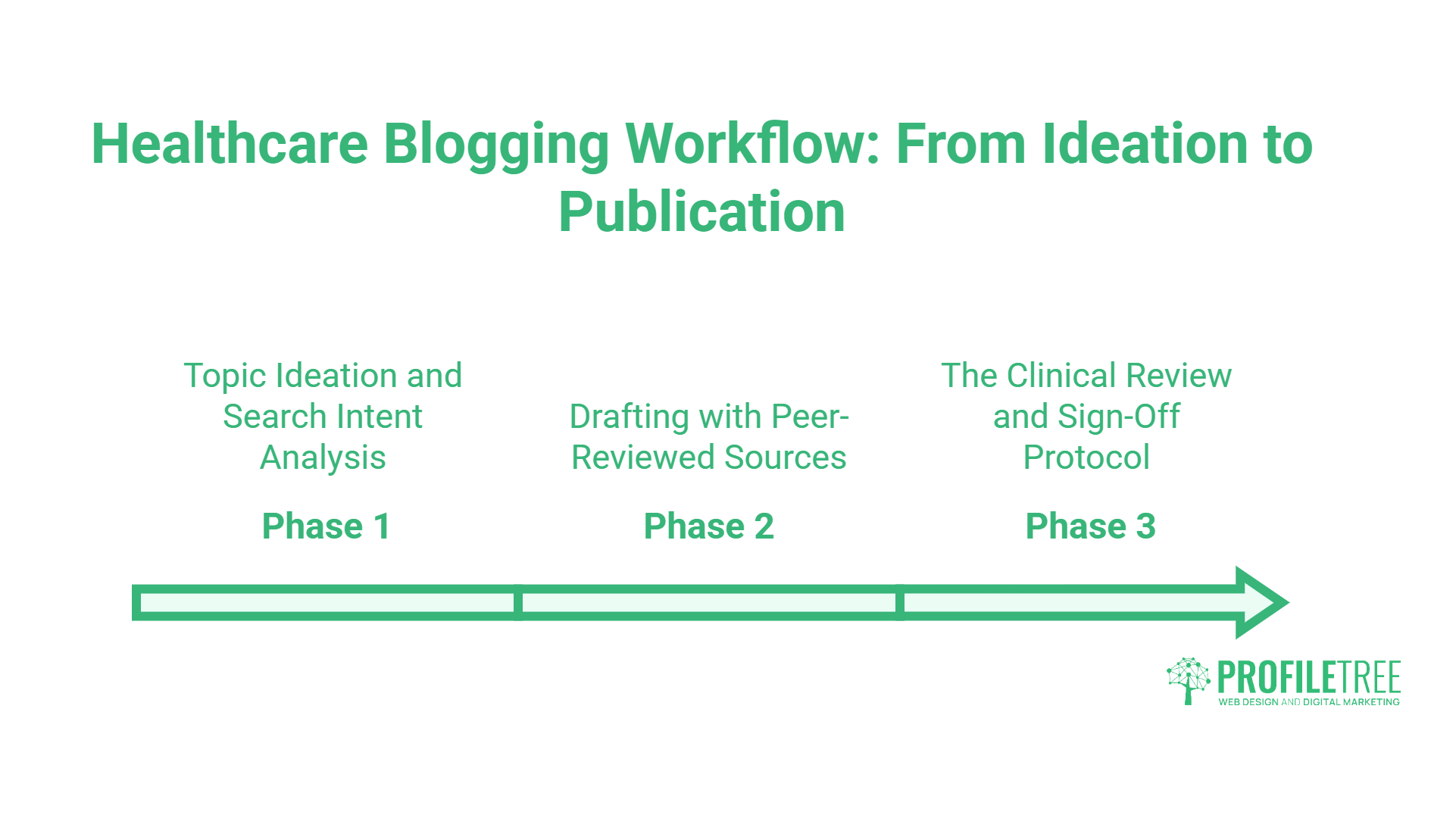
Phase 1: Topic Ideation and Search Intent Analysis
Start with patient questions, not keyword tools. The most effective healthcare blog topics are the ones your reception team and clinicians hear repeatedly. What do patients ask before and after their first appointment? What misconceptions come up in consultations? What do they find confusing about a diagnosis or treatment pathway?
Cross-reference these against search data. Tools like Google Search Console reveal the queries people are actually typing. High-impression, low-click queries often indicate that existing content is not answering the question clearly enough. Those are the gaps your blog can fill.
Classify each topic by search intent:
- Informational intent: The patient wants to understand something (“what is a DEXA scan”).
- Decision intent: The patient is comparing options (“physiotherapy vs surgery for a torn meniscus”).
- Local intent: The patient wants a provider near them (“sports physio Belfast”).
Your content mix should reflect the patient journey. Early-stage informational content builds trust; decision-intent content moves people toward choosing your practice.
Phase 2: Drafting with Peer-Reviewed Sources
Every factual claim in a healthcare blog post needs a traceable source. Before drafting, identify the three to five sources that will underpin the article’s key claims. Acceptable tiers for UK and Irish healthcare content:
| Source Tier | Examples | Use |
| Tier 1 (Primary) | NICE guidelines, NHS clinical guidance, peer-reviewed journals (BMJ, Lancet, NEJM) | Core medical claims |
| Tier 2 (Secondary) | NHS.uk patient information, Cochrane Reviews, WHO guidance | Explanatory and patient-facing claims |
| Tier 3 (Supporting) | Professional body guidance (RCN, BMA, RCSI), public health statistics | Context and framing |
Sources below these tiers (news articles, health influencer content, forum posts) should not be cited as evidence for clinical claims, regardless of how well-known the source is.
Phase 3: The Clinical Review and Sign-Off Protocol
This is the step most marketing guides omit entirely.
For any article that makes clinical claims, the draft should be reviewed by a clinical reviewer before publication. In a large NHS trust or hospital group, this may be a formal process involving a clinical director or medical communications team. In a smaller practice, it may be a five-minute read-through by the relevant clinician.
The key principle is that the person with clinical authority to validate the claims reviews the content before it goes live, not after a complaint has been filed.
A workable sign-off process:
- Content team produces draft with sources cited inline
- Draft sent to clinical reviewer with a specific checklist:
- Are the claims accurate?
- Are any claims overstated?
- Does the language create unrealistic patient expectations?
- Clinical reviewer returns annotated draft or approval confirmation
- Content team incorporates changes and publishes
The most common friction point is turnaround time. Clinicians are not employed to review blog posts; a request that lands in an inbox without context or priority will sit there. A brief, structured sign-off request (one paragraph, the draft attached, three specific questions to answer) is significantly more likely to get a fast response than an open-ended “can you check this?”
Tone, Formatting and Writing for the Patient
Once a draft has cleared clinical review, the next question is whether a patient can actually use it. Healthcare blog content fails at two extremes: too technical to follow, or too vague to be useful. The target is accurate information in plain language.
Translating Jargon into Plain Language
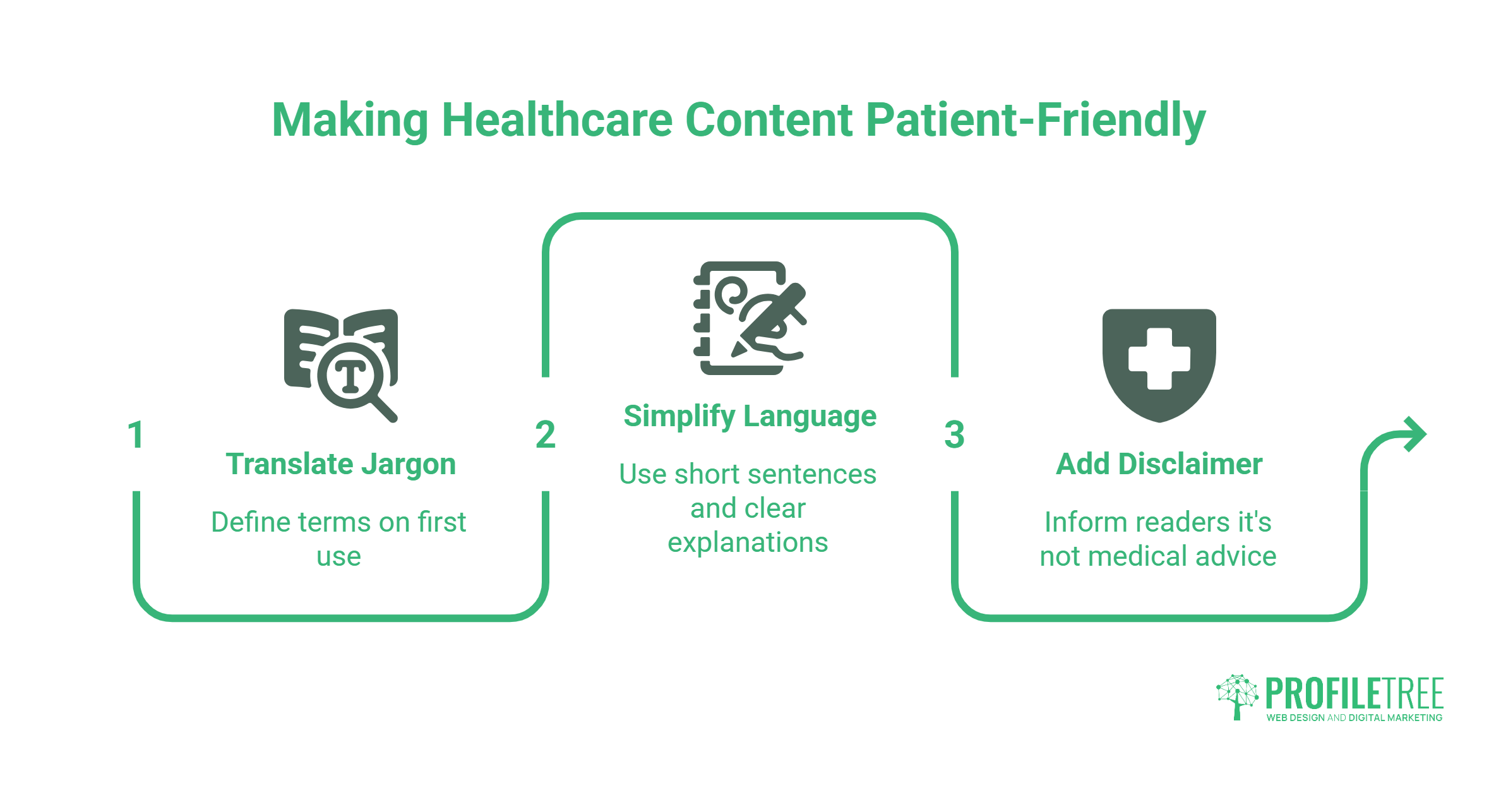
A useful test: if a patient at a first appointment would need the term explained, define it on first use. You do not need to avoid clinical language entirely; introducing correct terminology alongside a plain explanation actually builds health literacy, which is a recognised public health objective.
Example of the problem: “Post-operative haematoma formation is a common sequela of orthopaedic surgery and may require aspiration or conservative management.”
Plain language version: “Bruising and swelling around the wound is common after joint surgery. In most cases it settles on its own, but sometimes a doctor will drain the area if the swelling is significant.”
Both sentences communicate the same clinical reality. Only one of them is useful to someone lying awake, worried about their knee.
Sentence length matters. Short sentences carry more force and are easier to scan. Mix paragraph lengths. Put the key point first, not last.
The Role of Medical Disclaimers
Every healthcare blog post should include a disclaimer stating that the content is for informational purposes only and does not constitute medical advice, and that readers with specific concerns should consult a qualified healthcare professional. This is both a regulatory protection and an honest signal to readers.
Place the disclaimer at the foot of the article, not buried in a footer that readers never see.
Engaging Your Healthcare Blog Audience
Building a readership for a healthcare blog takes longer than in most other sectors, because the trust bar is higher. Patients are not looking to be entertained; they want reliable information from a credible source.
Practical Engagement Tactics
Comment Sections and Questions: Ending posts with a specific, answerable question (not a generic “let us know your thoughts”) encourages genuine responses. Questions like “Have you found it difficult to discuss this with your GP?” or “What information would have been useful before your procedure?” invite the kind of specific feedback that makes your content better.
Multimedia Content: Complex clinical processes are significantly easier to understand with visual support. A short video explaining what to expect during a particular procedure reduces patient anxiety and keeps people on your page longer. For healthcare organisations with access to video production, embedding short explainer videos in blog posts is one of the more durable investments in content quality.
ProfileTree’s content and video production teams work with healthcare organisations to develop exactly this kind of material, from patient-facing explainers to full digital content strategies.
Social Media Distribution: Healthcare content performs well on platforms where professional communities gather: LinkedIn for professional and referral audiences, Facebook for patient communities (especially condition-specific groups). Share specific insights from the article rather than generic “new post” announcements. A post that leads with a concrete statistic or a surprising finding will outperform one that simply names the article.
Incorporating Different Media
A well-structured healthcare blog is not just text. Images, infographics, and short videos improve comprehension and increase the time visitors spend on a page, which is itself a signal of content quality.
For clinical content, original diagrams and practice-specific photography are preferable to stock images. A photo of your actual consultation room carries more authenticity than a generic “doctor with patient” image from a stock library. This matters both for credibility and for SEO: Google’s documentation notes that original images are weighted more positively than stock photography.
SEO for Healthcare Blogs
Clear, well-structured writing serves two audiences simultaneously: the patient reading the page and the search engine deciding whether to surface it. Healthcare blogging and SEO are not separate disciplines; they are the same practice applied to the same goal. A clinically accurate article that nobody finds is not a healthcare asset.
Keyword Research and Intent Matching
The starting point is understanding how patients phrase their questions. The language clinicians use (“haematological malignancy”) is often not what patients search for (“blood cancer symptoms”). Keyword research tools close this gap.
For each article, identify one primary keyword, two to four secondary keywords, and a set of related phrases that reflect how real patients discuss the topic. Integrate these naturally throughout the article. Density is not the goal; relevance is.
For practices targeting a specific geography, local SEO is a parallel priority. An article about physiotherapy for lower back pain has more value for a Belfast practice if it naturally incorporates local context and links out to the practice’s service pages. ProfileTree’s local SEO services work with healthcare clients across Northern Ireland, Ireland, and the UK to make this connection explicit and consistent across content.
On-Page SEO for Healthcare Blog Content
Each article needs:
- A focused H1 containing the primary keyword
- H2 and H3 subheadings that reflect real patient questions
- A meta description of 130 to 152 characters that gives a genuine reason to click
- Internal links to related service pages and other blog posts placed early in the content
- Image alt text that describes the image accurately, with keywords where naturally relevant
- A clear URL that matches the article topic without dates or version numbers
Readability is also an SEO factor. Google’s systems assess content quality in part through signals that correlate with readable, well-structured text: paragraph length, sentence variety, heading frequency, and the presence of structured elements like tables and lists.
Measuring Healthcare Blog Performance

Getting the content strategy, compliance, and SEO right is only part of the work. The other part is knowing whether any of it is actually landing. Producing content without measuring what it does is guesswork; a consistent analytics review tells you which articles attract patients, which drive enquiries, and which are finding audiences you did not anticipate.
The metrics worth tracking for a healthcare blog:
- Organic Search Traffic per Article: Which posts are actually being found?
- Average Time on Page: Are people reading, or bouncing immediately?
- Conversion Events: Are healthcare blog readers booking appointments, filling out contact forms, or subscribing to updates?
- Keyword Rankings: Is the practice appearing for the queries patients actually use?
- AI citation Tracking: Increasingly, appearances in AI-generated overviews (Bing Copilot, Google AI Overviews) are a signal of content credibility
Review performance quarterly. Posts that are attracting good organic traffic but converting poorly may need a clearer call to action. Posts with strong engagement but poor search visibility may need technical SEO attention. Posts that are declining in performance may need a genuine content refresh, adding new information rather than simply updating the publication date.
Sustaining a Healthcare Blog Over Time
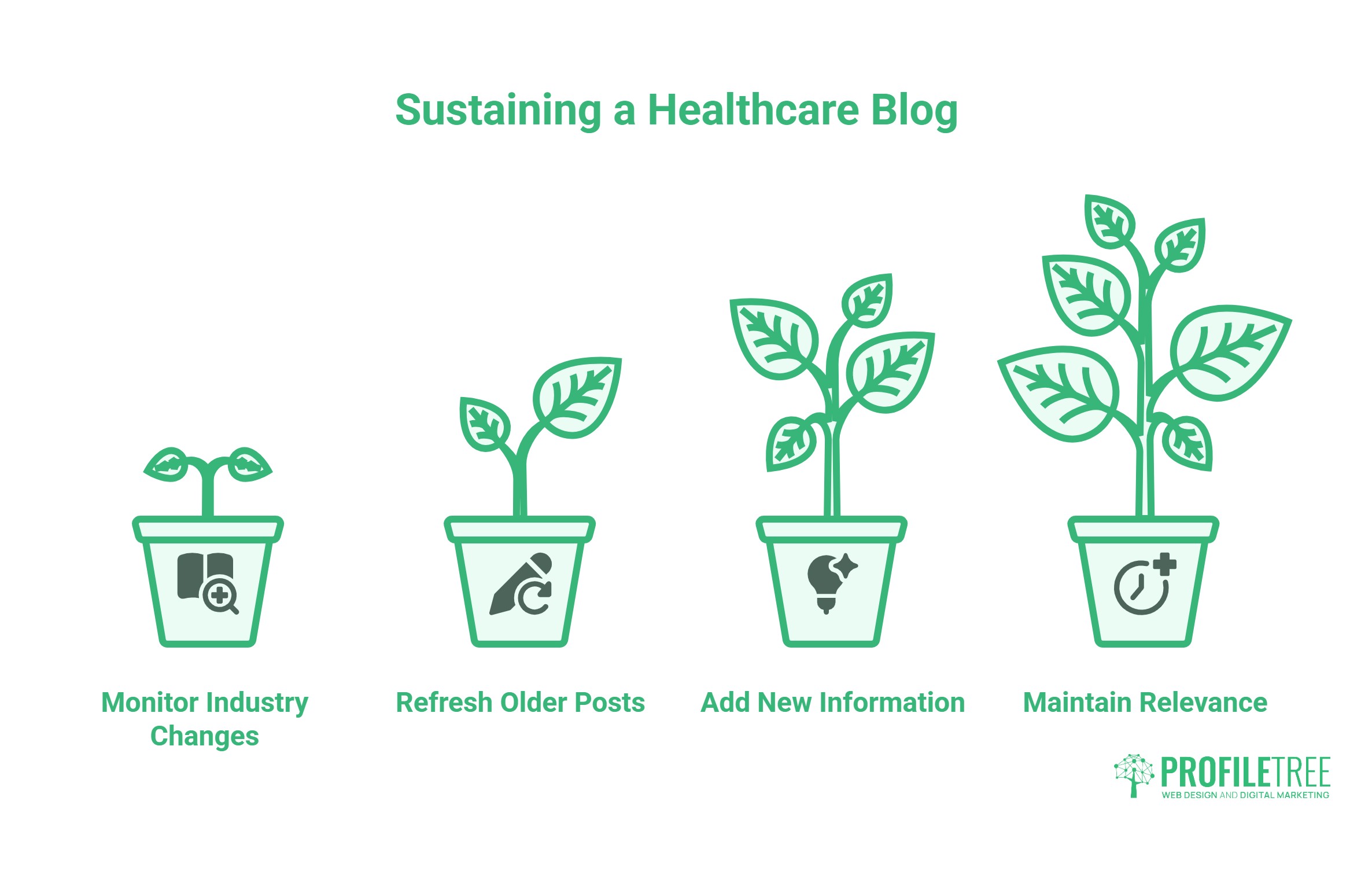
Analytics tell you what is working now. Sustaining that performance over time requires a different kind of discipline. The practices that achieve lasting results from healthcare blogging are those that treat it as an ongoing programme, not a campaign with a start and an end date.
Keep pace with industry changes by monitoring authoritative sources: NICE guidelines updates, MHRA announcements, NHS England publications, and peer-reviewed journals in your speciality. When guidance changes, your published content should reflect that change promptly. Stale medical information is not just an SEO problem; it is a patient safety issue.
Continuous improvement also means revisiting older posts. An article published two years ago may be technically accurate, but structurally weak by current standards. Refreshing it with updated statistics, additional sources, and improved formatting will restore its relevance to both readers and search engines.
The test for whether a refresh is genuine is simple: have you added material new information, or have you just changed the date? AI-powered search systems are increasingly sophisticated at distinguishing between these two things.
Who Should Write Your Healthcare Blog
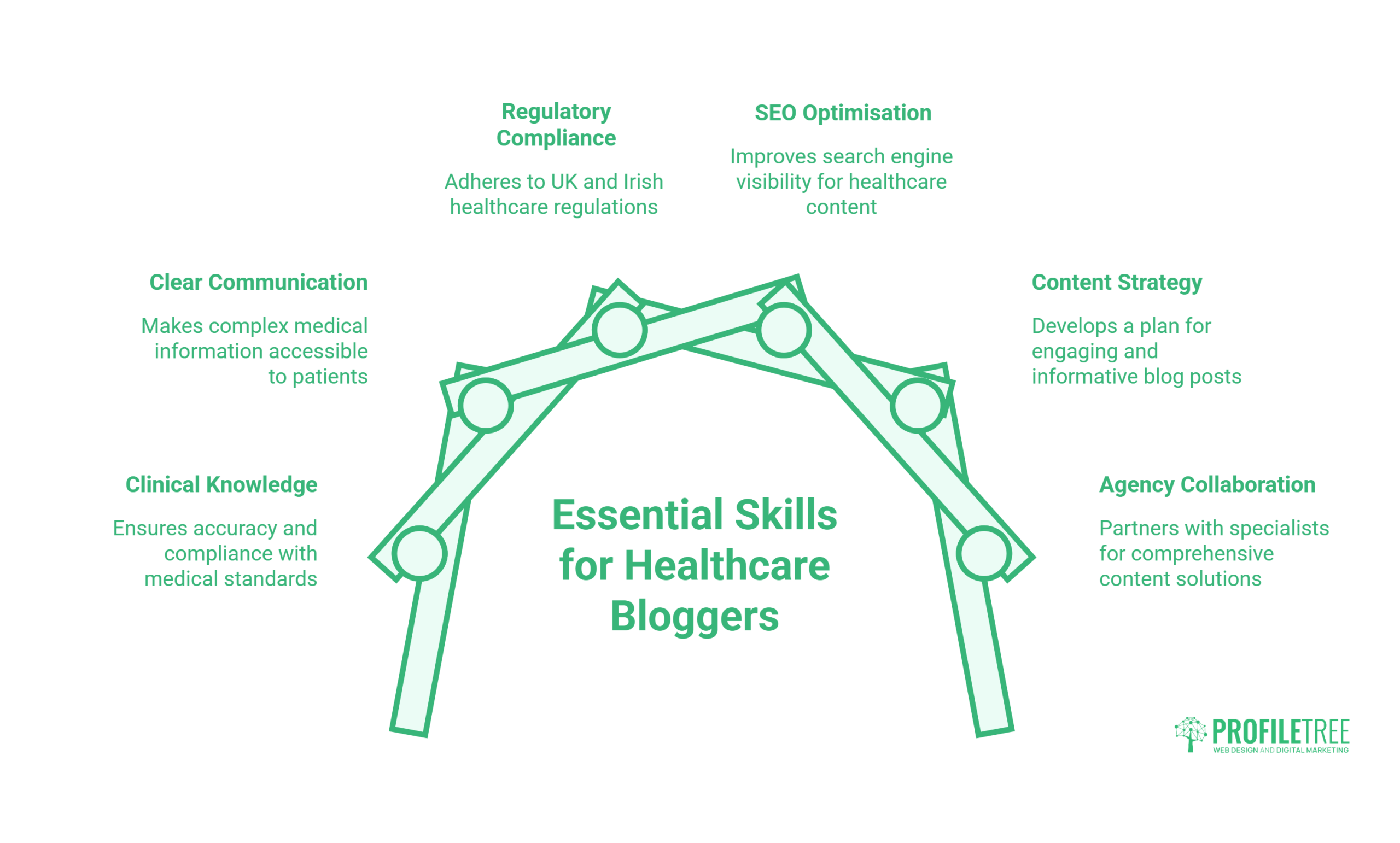
Sustaining a healthcare blog over time raises a practical question that many practices avoid until it becomes a problem: who is actually responsible for producing this content? It requires two distinct skill sets working together, and most practices have only one of them in-house.
Clinical knowledge and accuracy are non-negotiable. Whether the writer is a clinician themselves or a medical communications specialist, the content needs someone with the authority to confirm that what is being claimed is correct, appropriately hedged, and compliant with relevant regulations.
Clear communication is the second requirement. Technical accuracy and readable prose are not the same skill. Many excellent clinicians produce content that is accurate and inaccessible in equal measure. Many skilled writers produce content that is engaging and medically wrong. The goal is both at once.
For practices without in-house content capacity, working with a specialist agency that understands both the editorial standards and the regulatory environment is a practical alternative. ProfileTree has worked with healthcare organisations to develop content that meets clinical accuracy requirements, aligns with UK and Irish regulatory frameworks, and performs in organic search.
Healthcare Blogging in Practice: Two ProfileTree Case Studies
The principles above are not theoretical. Here is how they play out on real projects.
Medical Blogging for a Private Breast Surgeon
Dr Seni is an NHS Consultant Oncoplastic Breast Surgeon operating a private practice across the West Midlands. When he approached ProfileTree, his existing website lacked the structure, credibility, and content depth a specialist at his level needed. Patients researching breast surgery or oncoplastic reconstruction were forming their first impression through a site that did not reflect the quality of his clinical work.
ProfileTree rebuilt the site on WordPress, developed a full content layer for each service, and established a blog section designed to build topical authority in breast surgery. Each article was mapped to the search terms patients actually use when looking for private breast surgery in the UK. The site launched with a 90 on-page SEO score in Rank Math, with correct heading structure, schema markup, internal linking, and mobile responsiveness across all pages. Dr Seni and his team can now publish and update content independently, meaning the blog continues to grow without dependence on the agency.
Laser Eye Clinic Content Marketing
Cathedral Eye Clinic is Belfast’s leading laser eye surgery provider and offers Ireland’s only SMILE laser procedure. Despite those credentials, their digital presence was not converting expertise into patient enquiries. The site lacked mobile responsiveness, treatment-level content, and an organic search strategy.
ProfileTree’s content strategy for the clinic mapped patient intent across the full decision journey, from early queries like “what is SMILE laser eye surgery” through to high-intent searches like “SMILE laser eye surgery cost Belfast.” Dedicated pages were built for each procedure. A blog was structured to address the specific questions that appeared in search data. Video content was produced and embedded site-wide to reduce pre-consultation anxiety and improve engagement signals.
The result was a connected content structure that supports long-term organic growth and positions the clinic for continued visibility across laser eye surgery searches in Ireland and Northern Ireland.
Both projects reflect what effective healthcare blogging actually requires in practice: patient-first content planning, clinical accuracy built into the workflow, and an SEO structure that gives the site a realistic chance of being found by the right people at the right moment.
FAQs About Healthcare Blogging
Can anyone start a healthcare blog?
Technically, yes. But any health content that could affect a reader’s medical decisions sits in Google’s YMYL category and is assessed under elevated E-E-A-T standards. In practice, content that is not authored or reviewed by a qualified professional will struggle to rank for competitive health queries. Non-medical writers can produce healthcare content, but it should be reviewed and co-signed by a credentialled clinician before publication.
Why is blogging important for healthcare providers?
A consistent blog expands the number of patient queries a practice appears for in search, builds topical authority across the site, and communicates clinical credibility before a patient has ever walked through the door. It also provides shareable, citable content for social media and professional networks, extending reach beyond direct search traffic.
What are the UK ASA rules for medical blogging?
The ASA prohibits health or efficacy claims for treatments that are not backed by strong, peer-reviewed scientific evidence accepted by the relevant regulatory body. This means a healthcare blog cannot state that a treatment “cures,” “prevents,” or “treats” a condition unless that specific claim has been substantiated to the ASA’s standard. In practice, this requires using measured language throughout: “may support,” “evidence suggests,” or direct citation of approved clinical guidance.
Is healthcare blogging protected under patient privacy laws?
Publishing patient stories, photos, clinical outcomes, or any identifying details requires explicit written consent under UK GDPR (and EU GDPR for Irish practices). Anonymisation alone is not a substitute for consent. Any blog post that references a real patient case requires documented permission from that patient, regardless of whether their name is used.
How do healthcare blogs make money?
For most clinical practices, the commercial model is indirect: the healthcare blog drives search traffic, which builds patient trust, which converts to bookings. For independent health writers and freelance medical communicators, separate revenue streams include writing for medical communications agencies, producing sponsored content for health technology companies, contributing to peer-reviewed patient education platforms, and clinical affiliate arrangements with medical device or pharmaceutical content programmes.
What makes a successful healthcare blog?
Clinical accuracy, clear writing pitched at the right health literacy level, a consistent publishing schedule, and a structure that helps Google and AI systems understand and cite the content. Success is measured in patient trust as much as in search rankings.
Ready to Build a Healthcare Blog That Works?
A healthcare blog without a strategy is content that costs money and ranks nowhere. One built on the right foundations, accurate, compliant, patient-focused, and technically sound, is one of the most cost-effective ways a practice can build its online presence over time.
ProfileTree works with private practices, specialist clinics, and healthcare organisations across Northern Ireland, Ireland, and the UK on content strategy, medical web design, and healthcare SEO. If your digital presence does not reflect the quality of your clinical work, we can help you change that.
Talk to our team today about healthcare content strategy!