
Social Media for Wellness Brands: A Practical Guide to Building Real Engagement
Table of Contents
Social media is one of the most crowded channels a wellness brand can operate in. Fitness advice, supplement promotions, mindfulness content, and health tips compete for the same feed space, and the brands that cut through aren’t always the ones with the biggest budgets. They’re the ones with a clear point of view, a consistent publishing approach, and a genuine understanding of what their audience actually wants to see.
“Wellness brands often make the mistake of broadcasting at their audience rather than building a relationship with them,” says Ciaran Connolly, founder of ProfileTree, a Belfast-based digital marketing agency. “The brands that grow on social media do it by giving people something worth following, not just something worth buying.”
This guide covers the practical mechanics of social media for wellness brands: how to choose the right platforms, build a content strategy that sustains engagement over time, work with influencers effectively, and measure what’s actually working. Whether you’re running a fitness studio, a supplements business, a mental health app, or a holistic therapy practice, the principles here apply directly.
Choosing the Right Platforms for Your Wellness Brand
The instinct for most wellness brands is to be everywhere. That’s rarely the right call. A stretched presence across five platforms with inconsistent posting produces less business value than a focused presence on two platforms where your audience is most active.
Where Wellness Audiences Actually Spend Their Time
Instagram remains the dominant platform for visual wellness content. It suits product-focused brands, fitness and nutrition businesses, and any category where before/after results, recipes, or workout demonstrations translate well to images and short videos. The Reels format now drives the majority of organic reach on the platform, which means video production capability is no longer optional for brands looking to grow.
YouTube is the platform for depth. Long-form tutorials, practitioner interviews, product breakdowns, and educational series all perform well here, and the search function means content has a longer shelf life than on Instagram or TikTok. For wellness brands with something genuinely educational to say, YouTube is worth the investment in production quality.
TikTok skews younger and rewards speed over production value. Quick tips, relatable moments, and trend-led content perform well. If your audience is under 35 and your brand has a personality that translates to a fast-paced, informal format, TikTok is worth testing. If your wellness brand serves an older demographic or requires considered, trust-building content, it may not be worth the format mismatch.
Facebook retains a strong reach for community-building and paid advertising. Private Facebook groups have become a primary engagement channel for wellness brands running memberships, programmes, or coaching services. The organic feed reach for business pages is limited, but for brands with a community component, Facebook Groups remain underused.
Pinterest drives discovery traffic with unusually long content lifespans. A well-optimised pin can drive clicks for months or years after it was posted. Wellness brands with strong visual assets and searchable content topics (recipes, workout plans, mindfulness practices) should treat Pinterest as a search channel rather than a social channel.
Practical Platform Selection
Before committing resources, answer three questions: Where does your audience already go for content in your category? What format does your content naturally take? What does your production capacity realistically support? The answers will narrow your choices quickly. A physiotherapy practice with strong educational content will almost certainly get more return from YouTube and LinkedIn than from Instagram. A supplement brand targeting fitness enthusiasts aged 20 to 35 will likely see better results on Instagram and TikTok.
Building a Content Strategy That Sustains Engagement
Most wellness brand social media strategies fail not because the content is bad but because the approach is inconsistent. A strong week of posts followed by two weeks of silence trains both the algorithm and your audience to ignore you.
The Content Mix That Works for Wellness Brands
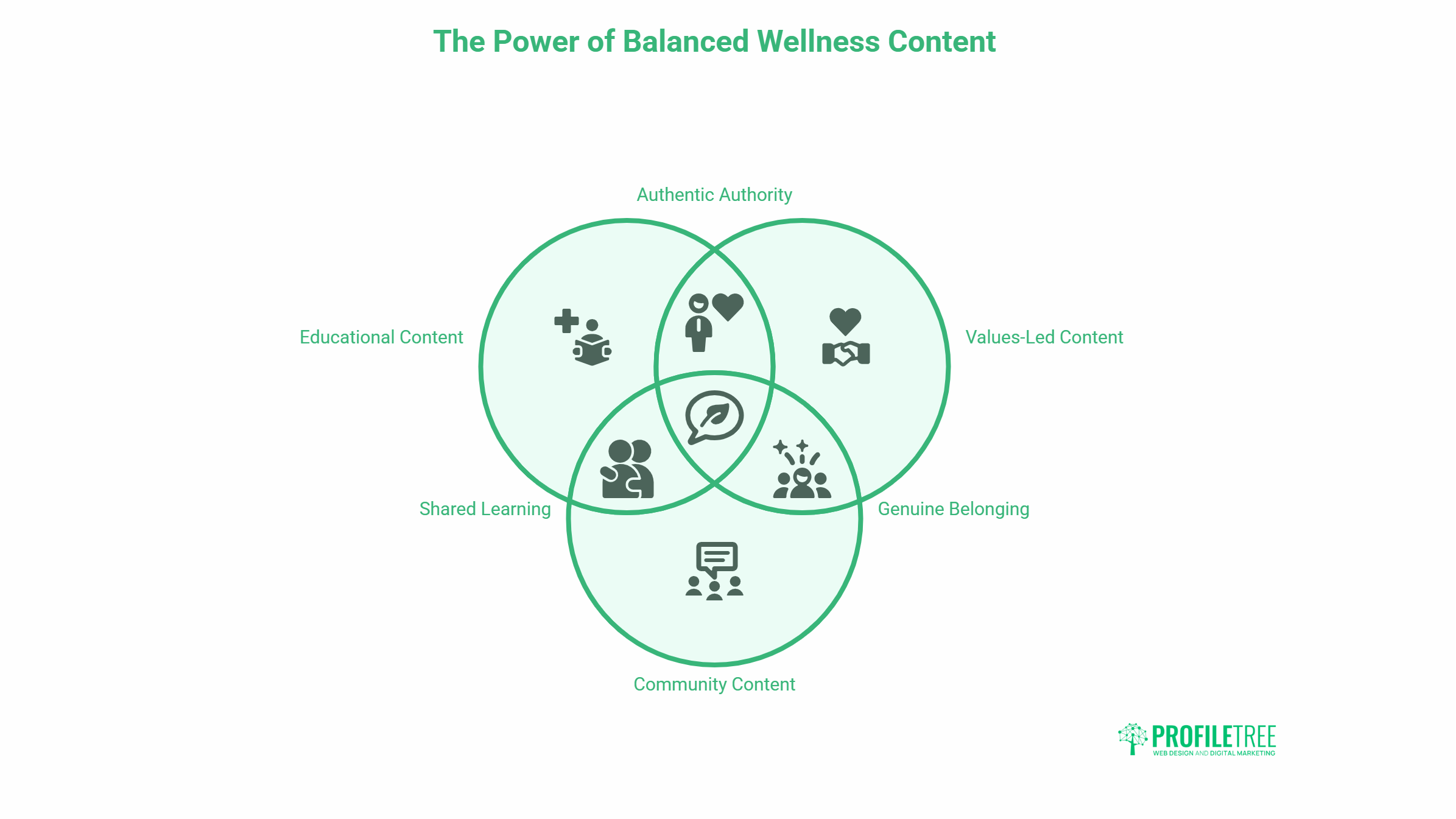
A sustainable content mix for wellness brands typically draws from four types: educational, values-led, community, and commercial. The balance matters. A feed that is 80% promotional will lose followers. A feed with no commercial content won’t generate enquiries.
Educational content is the most shareable category in wellness. Posts that teach something specific, such as how to read a food label, the difference between two training methodologies, or how to assess a supplement claim, give people a reason to save, share, or return to your profile. Educational content also builds authority in a category where trust is hard to establish and easy to lose.
Values-led content reflects what your brand stands for beyond the product. This might be a position on an industry topic, a behind-the-scenes look at how your products are made, or an honest account of a challenge your business faced. Wellness audiences are sensitive to authenticity and will disengage quickly from brands that feel performative.
Community content invites participation. Questions, polls, challenges, and prompts that ask your audience to share their own experiences generate comments and reach while reinforcing the sense that your brand is a space for people with shared interests.
Commercial content should be direct when it appears, but should sit within a feed that earns the right to promote. Product announcements, offers, and service information have their place; they land better when they follow sustained educational and community content that has built goodwill.
Planning and Publishing Consistency
The most effective wellness brands on social media treat content planning the way a media company would: a weekly or fortnightly planning cycle, a clear brief for each piece of content, and a publishing calendar that accounts for seasonal relevance and campaign activity. For brands working with limited in-house resources, ProfileTree’s content marketing services can take the planning, production, and scheduling burden off your team so output remains consistent without diverting attention from running the business.
Format Strategy: Video, Images, and Text
Video now accounts for the majority of organic reach on most social platforms. For wellness brands, video content that demonstrates expertise (a practitioner explaining a concept, a preparation video, a Q&A response) outperforms static imagery across almost all formats. Short-form video (under 60 seconds) suits discovery; longer formats (5 to 15 minutes on YouTube) suit depth and trust-building.
Static images still have a role. Product photography, quote graphics, and infographics that break down data or processes are consistently saved and shared. The key is that the image needs to convey something independently; if you need to read the caption to understand the post, the image isn’t doing its job.
Working With Influencers in the Wellness Space
Influencer marketing in wellness is both one of the most effective growth channels and one of the most easily mishandled. The difference between a partnership that builds brand credibility and one that damages it usually comes down to one question: Does this person actually believe in this category?
Choosing Influencers for Genuine Fit
The follower count metric is the wrong starting point. A micro-influencer with 8,000 followers who posts consistently about plant-based nutrition, has a high engagement rate, and whose audience asks genuine questions about health will produce better results for a wellness brand than a generalist lifestyle creator with 250,000 followers who treats branded posts as an income stream.
Look at the comments on their existing content. Are people asking real questions? Are they sharing their own experiences? Those signals tell you more about audience trust than any reach figure. Review the influencer’s posting history over at least three months. Do they talk about topics related to your category when they’re not being paid to? If a fitness influencer has never mentioned recovery, sleep, or nutrition outside of sponsored content, their endorsement will feel like what it is.
Structuring Influencer Agreements That Work
The most effective influencer partnerships are those where the creator has genuine input into how the product or service is framed. Brief the influencer on your key messages and proof points, then give them room to interpret those in their own voice. Scripted content reads as scripted; wellness audiences are particularly attuned to this.
Set clear expectations for deliverables, timelines, and disclosure requirements. The ASA rules on influencer marketing are clear: paid partnerships must be disclosed, and this applies to gifted products as well as paid placements. Non-disclosure is not a grey area.
Evaluating Partnership Performance
Track the metrics that matter for your goal. If the goal is to reach, track impressions and profile visits. If the goal is conversion, track link clicks, discount code redemptions, or landing page visits during the campaign window. Engagement rate on the partnership post relative to the influencer’s typical engagement rate tells you whether the content actually resonated.
Community Engagement and User-Generated Content
User-generated content (UGC) is the most credible form of social proof a wellness brand can earn. A customer sharing a genuine account of their experience, in their own words, carries more weight with a new audience than any campaign content you produce.
Creating Conditions for UGC
UGC doesn’t happen by default. A specific hashtag gives customers a way to contribute. Reposting UGC (with credit and permission) tells your audience that sharing is noticed and valued. Product packaging, email follow-ups, and post-purchase communications are all places where you can ask customers to share their experience. The request needs to be low-friction: a simple ask with a specific hashtag works; a lengthy submission process doesn’t.
Responding to Your Audience
Response rate and response quality are social signals that most brands underinvest in. Replying to comments, answering questions in DMs, and acknowledging feedback (including critical feedback) tells your audience there’s a real person behind the account. Negative feedback should be addressed promptly and without defensiveness. A brand that handles a critical comment well will often turn the interaction into a demonstration of credibility rather than a reputational risk.
Measuring Performance Through Analytics
Measuring social media performance in a way that informs decisions requires moving past the metrics that feel good and focusing on the ones that connect to business outcomes.
The Metrics That Matter
Reach and impressions tell you how many people are seeing your content. They’re useful for benchmarking brand awareness, but they don’t tell you whether your content is building anything lasting.
Engagement rate (interactions divided by reach) tells you whether the people who see your content care about it. A high-reach, low-engagement ratio signals that content is being served but isn’t landing. For wellness brands, a realistic target engagement rate on Instagram sits between 1 and 3%, lower on Facebook, and higher on TikTok, where the algorithm already pre-selects interested viewers.
Saves and shares are the engagement signals most correlated with content quality in wellness. Saves indicate the content has immediate practical value. Shares indicate it resonates enough to pass on. Both are stronger signals than likes.
Follower growth rate, measured over consistent periods, tells you whether your account is building an audience or treading water. Low net growth despite consistent posting often points to high churn, which in turn points to a mismatch between who you’re attracting and who you’re actually serving.
Conversion metrics (link clicks, website sessions from social, enquiries, purchases attributed to social) are the clearest connection between social activity and business results. These require proper UTM tagging and integration between your social platforms and your website analytics.
Building a Reporting Cycle
| Metric | Why It Matters |
|---|---|
| Engagement rate by content type | Reveals which formats and topics resonate |
| Saves and shares per post | Signals content quality and practical value |
| Follower growth rate | Tracks whether audience is growing or churning |
| Link clicks and website sessions | Connects social to business outcomes |
| Conversion rate from social traffic | Shows whether social visitors act |
A monthly reporting cycle is sufficient for most brands. Each report should end with one or two specific adjustments to the content approach based on what the data shows, not just a summary of what happened.
SEO and Discoverability for Wellness Content
Social media and search are increasingly connected. TikTok’s search behaviour among younger users now rivals Google for certain query types. YouTube is the second-largest search engine in the world. Pinterest is functionally a visual search engine.
Optimising Social Content for Discovery
Use specific, searchable language in captions, titles, and profile descriptions. Vague wellness language (“feeling good”, “holistic living”) is less discoverable than specific terminology (“magnesium glycinate for sleep”, “progressive overload for beginners”, “IBS-friendly meal prep”).
On YouTube, title and description content matter as much as on any webpage. Include the search terms your audience uses in the first 100 characters of your description. On Pinterest, keyword-rich board names and pin descriptions drive search visibility. Treat your Pinterest profile as a set of landing pages: each board is a topic, and the pins within it are the content.
The Connection Between Social Presence and Website Performance
A strong social media presence drives branded search, which contributes to domain credibility signals. When your brand is discussed, shared, and linked from social platforms, it builds the kind of third-party evidence that search engines use as a credibility indicator. For wellness brands building or redesigning their websites to maximise this inbound traffic, ProfileTree’s web design and development services cover the technical and content architecture that turns social visitors into customers.
Building Trust and Credibility as a Wellness Brand
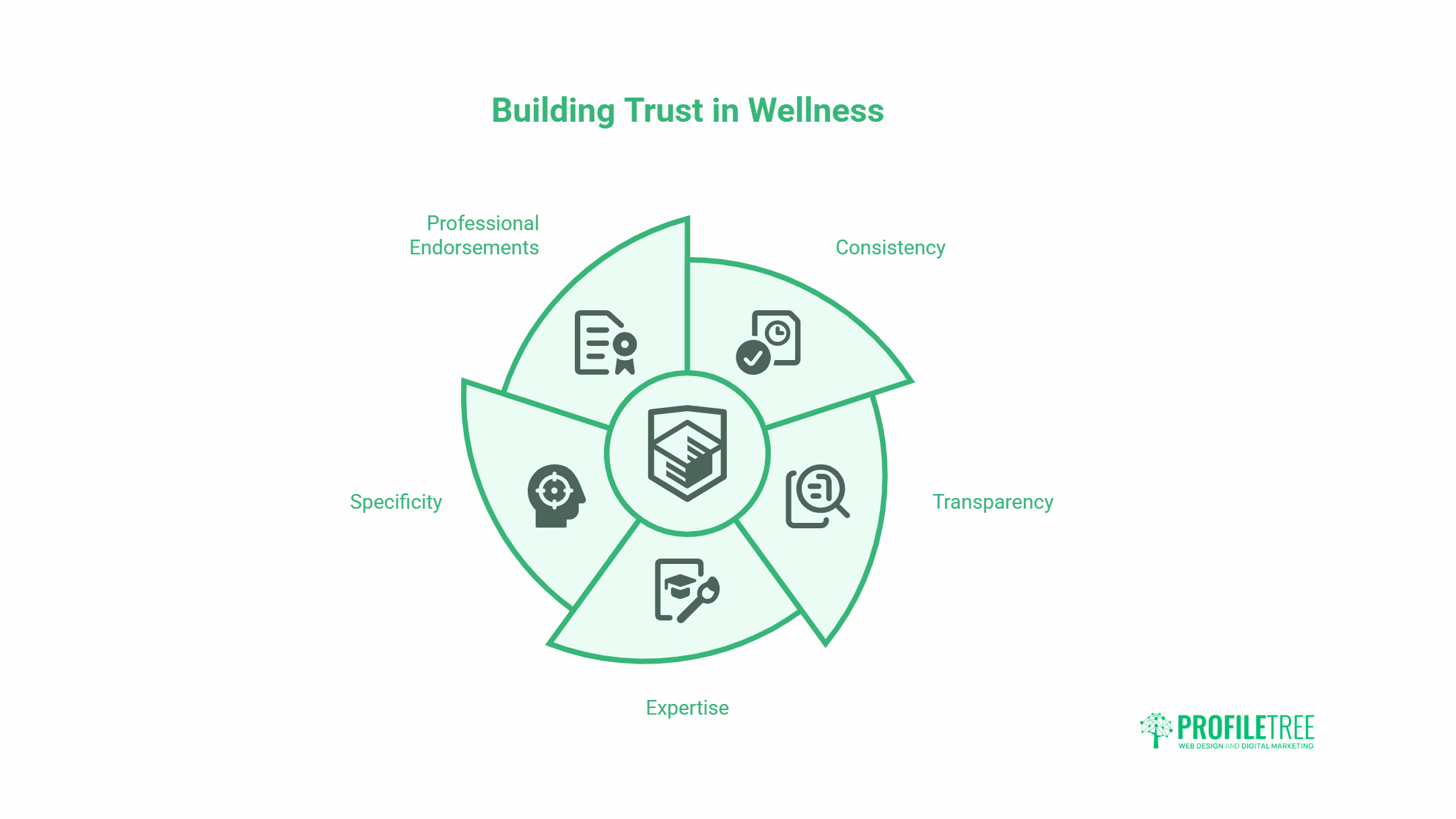
Trust is the currency of the wellness category. Consumers are acutely aware of misleading health claims, and UK regulatory bodies actively enforce rules around health-related marketing. Brands that build trust do so through consistency, transparency, and genuine expertise.
What Credibility Actually Looks Like
Credibility comes from specificity. Vague claims about “supporting wellbeing” or “natural health” carry no weight with a sceptical audience. Specific claims, backed by evidence, with the source identified, are what build authority. Where your brand has genuine expertise, show the reasoning. If you’re recommending a practice, explain why it works. This level of specificity distinguishes professional brands from the noise.
Transparency about your processes and supply chain is valued in wellness in a way it isn’t in most consumer categories. Where your products come from, how they’re made, what testing they’ve been through: audiences who care about health care about these things.
Expertise Signals That Work on Social
Regularly featuring qualified practitioners (nutritionists, physiotherapists, dietitians, psychologists) in your content signals that your brand is grounded in professional expertise. Where you make specific health or nutrition claims, attributing them to a named, qualified professional is both good practice and, in some contexts, a regulatory requirement.
Partnerships with professional bodies, accreditation schemes, and industry associations add institutional credibility signals that audience trust alone can’t replicate.
Frequently Asked Questions
Which social media platforms are most effective for wellness brands?
Instagram and YouTube are the two highest-performing platforms for most wellness brands. Instagram suits visual product content, community building, and short-form video. YouTube suits educational depth, how-to content, and any format where explaining something properly requires more than 60 seconds. Platform choice should ultimately depend on where your specific audience is most active and what content format you can produce consistently.
How often should a wellness brand post on social media?
Consistency matters more than frequency. Posting three to five times per week on Instagram with a clear content mix and genuine engagement follow-up will outperform daily posting with no strategy. On YouTube, one well-produced video per week is a realistic target for most brands and sufficient to build a searchable content library over 12 months.
How do wellness brands use influencer marketing effectively?
The most effective wellness influencer partnerships prioritise audience trust over follower count. Micro-influencers (10,000 to 100,000 followers) with a genuinely engaged audience in your category will typically produce better conversion results than macro-influencers with broad, less-targeted followings. Brief the influencer clearly, disclose all paid relationships as required by ASA guidelines, and track performance against your specific campaign goal rather than generic reach metrics.
What content types perform best for wellness brands on social media?
Educational content consistently outperforms promotional content for engagement and shareability in wellness. Content that teaches a specific, practical point generates saves and shares that promotional content rarely achieves. Values-led content and community content (questions, challenges, prompts) also consistently outperform product promotion.
How should wellness brands handle negative feedback on social media?
Respond promptly, directly, and without defensiveness. Acknowledging a customer’s negative experience, apologising where appropriate, and offering to resolve the issue publicly demonstrates the kind of accountability that wellness audiences value. Deleting or ignoring negative comments is almost always the wrong call.
What metrics should wellness brands track on social media?
Track engagement rate, saves and shares per post, follower growth rate, and conversion metrics (link clicks, website sessions, enquiries attributed to social). Reach and impressions are useful context, but shouldn’t be the primary success measure. A monthly reporting cycle comparing these metrics over three to six months reveals meaningful patterns.
How can wellness brands stay compliant with UK advertising rules on social media?
All paid partnerships, gifted products, and sponsored content must be clearly disclosed in line with ASA and CAP guidelines. Health and nutrition claims on products must comply with Regulation (EC) No 1924/2006 as retained in UK law. Claims about treating or preventing conditions are tightly regulated. The ASA’s CAP Help Note on health and beauty claims is the clearest reference point available.
How does social media support a broader digital marketing strategy for wellness brands?
Social media builds brand awareness and community, but the value multiplies when it connects to the broader digital picture: well-optimised landing pages, email capture, and retargeting produce results that social alone cannot. ProfileTree’s digital marketing services help wellness brands build these connected systems rather than treating social as a standalone activity.
Conclusion
Social media for wellness brands works when the strategy is grounded in what your audience actually needs, not just what you want to communicate. Choose platforms based on genuine audience behaviour, build a content mix that earns the right to promote, work with influencers who have real credibility in your space, and measure the things that connect social activity to business outcomes.
The brands that build lasting wellness audiences do it the same way they build lasting customer relationships: by being genuinely useful, consistently present, and honest about what they do and don’t know.
For wellness brands looking to build or review their social media approach as part of a wider strategy, ProfileTree’s digital marketing services cover the full range of channels from social and content through to SEO and paid. And for brands exploring how AI tools can reduce the production overhead of consistent content creation, ProfileTree’s AI transformation services are worth reviewing.