
Lead Generation Using Content Marketing: A Guide for SMEs
Table of Contents
Most SME owners understand that lead generation using content marketing is supposed to work. Fewer understand why their blog posts, videos, and social updates are not actually doing it. The gap is nearly always the same: content created without a clear connection to the buyer’s decision-making process.
Lead generation using content marketing works when every piece of content is built with a specific audience problem and a specific funnel stage in mind. This guide covers how to do that practically, from mapping content to the buyer journey through to measuring what actually matters for a small or medium-sized business operating in the UK or Ireland.
Why Content Marketing Outperforms Outbound for Lead Generation
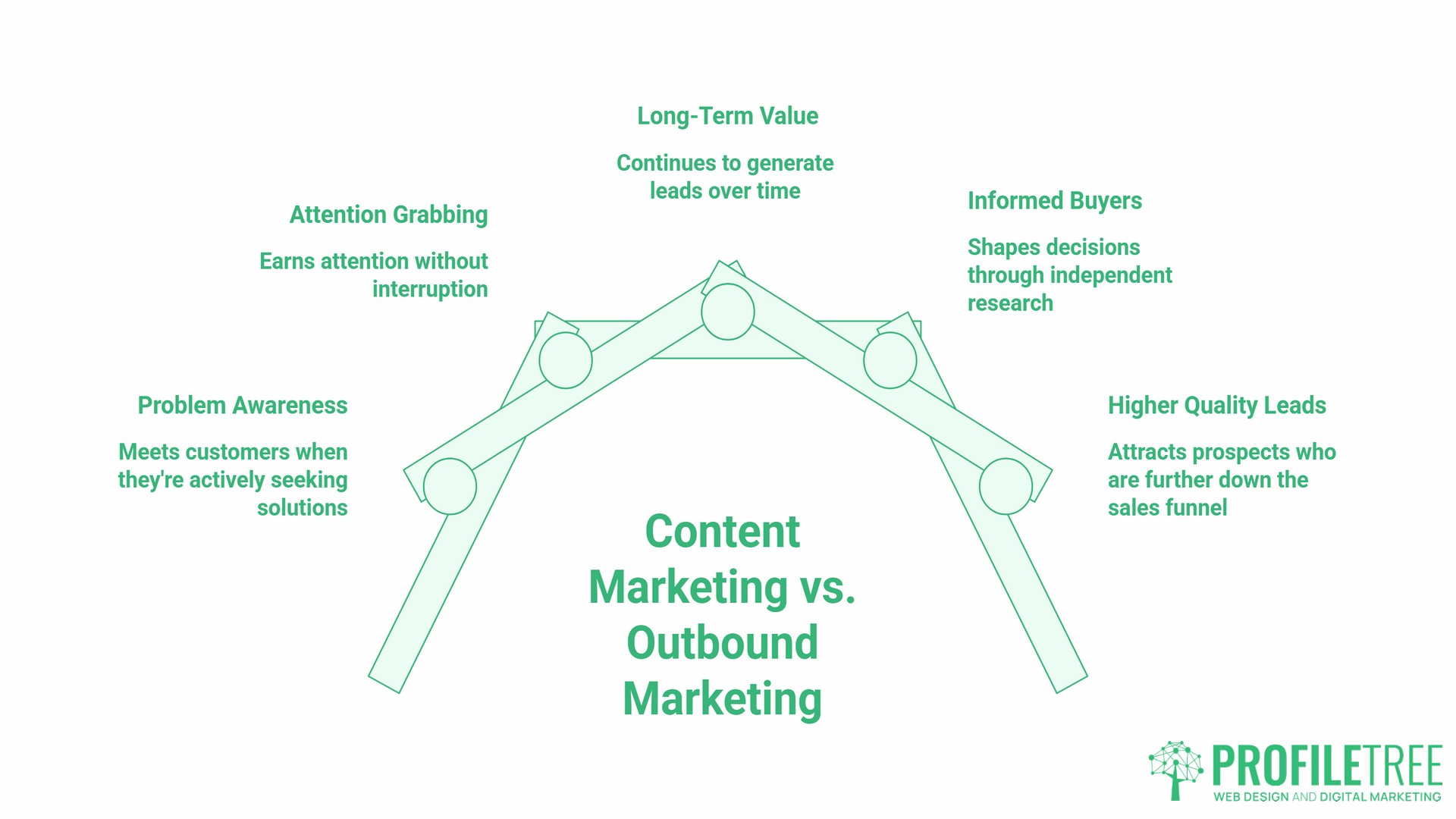
Cold calling and display advertising interrupt people. Lead generation using content marketing meets potential customers at the moment they are already looking for answers.
When a business owner searches “how to improve my website conversion rate” or “what does B2B lead generation look like for a service business,” they are actively problem-aware. A well-written article, a video case study, or a practical checklist that answers their question earns their attention without any interruption. That attention, built over multiple content interactions, is what eventually converts into an enquiry.
The commercial argument is staying power. A paid ad stops generating leads the moment the budget runs out. A piece of content that ranks on Google or gets shared in an industry LinkedIn group keeps working for months or years after publication. According to Gartner, 70% of the B2B buyer’s journey is already complete before a prospect contacts a vendor. That means the buying decision is largely shaped by content consumed independently, not by a sales call.
Lead quality is the other advantage. 76% of B2B buyers say they consumed three or more pieces of content from a vendor’s website before speaking to sales. Someone who has read your guide, watched your video, and explored your service page before contacting you has a shorter sales cycle than a cold outbound prospect. SEO-driven leads close at a rate of 14.6%, compared to 1.7% for outbound leads.
Mapping Content to the B2B Buyer Journey
Effective lead generation using content marketing requires different content types at different stages. The most common mistake SMEs make is producing only one type: usually awareness-level blog posts that attract traffic but never convert it.
Awareness Stage: SEO and Problem-Focused Content
At the top of the funnel, potential customers are identifying a problem. They are searching for information, not solutions. Content at this stage should answer specific questions directly: what something is, why it matters, and how it works.
Blog posts built around informational search terms are the primary vehicle here. The goal is to rank for the questions your target customers are typing into Google, bring them to your site, and establish that you understand their situation. B2B companies with a documented content strategy are 3x more likely to report success than those without one, according to the Content Marketing Institute.
SEO is the infrastructure that makes awareness content findable. Without keyword research, on-page structure, and internal linking, even well-written articles stay invisible. ProfileTree’s SEO services connect content directly to the search queries it should be answering.
Consideration Stage: Case Studies and Video
Once a potential customer knows what their problem is, they start evaluating approaches and providers. This is where trusted content does its work.
Case studies, video testimonials, and detailed how-to guides are the most effective formats at this stage. According to the Demand Gen Report, peer reviews and case studies are the most influential content at the decision stage, with 68% of buyers calling them decisive. A written case study covers part of that ground. A video of a real client explaining an outcome in their own words does it more effectively, because it adds personality, credibility, and the kind of social proof that is harder to fake.
72% of B2B buyers consume video content during the buyer journey, according to Wyzowl and the Demand Gen Report. Yet video remains consistently underused by SMEs in the UK and Ireland, particularly in B2B sectors. ProfileTree’s video marketing work with businesses shows that prospective clients engage longer with video than with any other content format on a service page.
Decision Stage: High-Intent Content and Direct Offers
At the bottom of the funnel, the prospect is comparing options. They want specifics: process transparency, proof points, and reassurance that choosing a provider is a defensible decision.
Content that works here includes detailed service pages, approach comparison guides, FAQ content that addresses objections directly, and anything that removes uncertainty. Free audits, discovery call offers, and resource downloads that help the prospect prepare for a conversation all sit at this stage.
The mistake is treating decision-stage content as purely promotional. The more genuinely useful it is, the more trust it builds before the first conversation.
High-Yield Content Formats for UK and Irish Businesses
Not all formats produce the same return for SMEs running a lead generation using content marketing programme. Budget and time are finite, so the priority should be formats that generate compounding value.
Strategic Blog Content
A blog post written around a high-intent keyword, structured to answer a specific question clearly and completely, will continue generating organic traffic long after publication. The key word is strategic. A post written without keyword research, without a clear structure, and without internal links to related service pages is unlikely to generate leads, regardless of how well it is written.
The discipline required is narrowing the topic. “Digital marketing tips” is too broad. “How to generate B2B leads through content marketing in the UK” is specific enough to rank, attract the right audience, and move them toward a relevant service page. Organic search drives 53% of all website traffic and 40% of B2B revenue, according to BrightEdge, making it the single largest digital acquisition channel.
Video Content
Video outperforms written content at the consideration and decision stages because it communicates trust signals that text cannot. Tone of voice, confidence, specificity, and the willingness to put a face to the advice all matter to a business owner deciding who to work with.
For lead generation, the highest-converting video formats are client testimonials, process explainers, and answers to the questions prospects ask most in sales conversations. Short-form social video works for awareness. A longer video on YouTube or embedded in service pages works for consideration and decision.
LinkedIn and Social Amplification
Organic social media does not replace SEO for lead generation through content marketing, but it extends the reach of content that would otherwise be found only through search. For B2B businesses in Northern Ireland and Ireland, particularly, LinkedIn is where decision-makers spend time. A blog post shared with a clear point of view, a short video clip from a longer piece, or a case study result framed as a practical lesson can generate direct enquiries from an audience that would never have found the content through Google.
The limitation is that social reach is borrowed: the platform controls distribution. Content published on your own site and optimised for search is owned. The right approach uses social to amplify owned content, not to replace it.
GDPR and Data Capture Compliance in the UK and Ireland
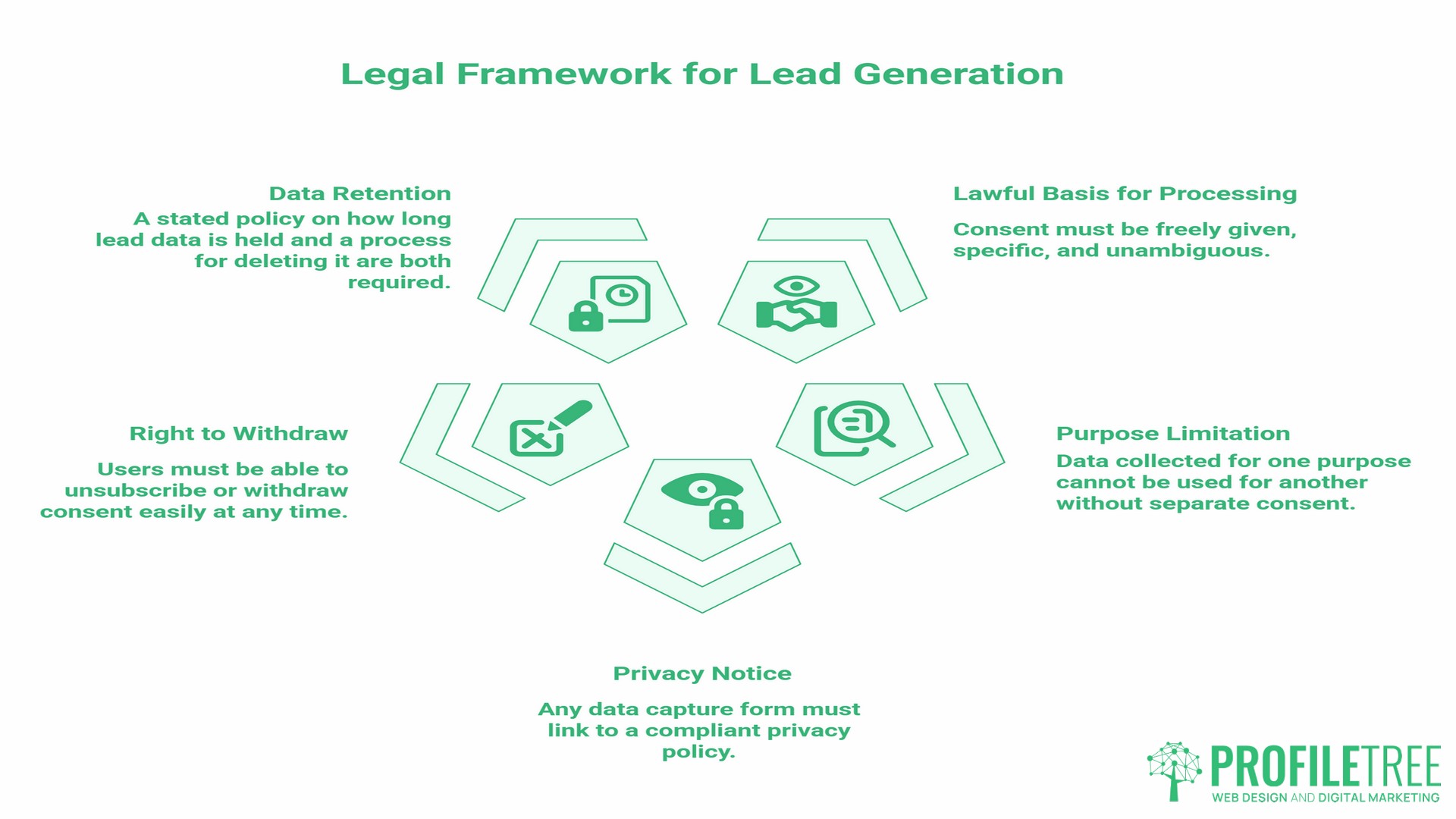
Most lead generation guides are written by US-based platforms and do not address the legal requirements that apply to businesses operating under UK GDPR or the Republic of Ireland’s Data Protection Act 2018, which implements the EU GDPR.
Any content marketing strategy that includes lead magnets, newsletter sign-up forms, or gated resources must meet the following requirements:
| Requirement | What It Means in Practice |
|---|---|
| Lawful basis for processing | Consent must be freely given, specific, and unambiguous. Pre-ticked boxes do not meet the standard. |
| Purpose limitation | Data collected for one purpose (e.g. downloading a guide) cannot be used for another (e.g. cold outreach) without separate consent. |
| Privacy notice | Any data capture form must link to a compliant privacy policy. |
| Right to withdraw | Users must be able to unsubscribe or withdraw consent easily at any time. |
| Data retention | A stated policy on how long lead data is held and a process for deleting it are both required. |
Non-compliance carries real risk, including ICO enforcement in the UK and DPC enforcement in Ireland. The practical implication is that your lead magnets, sign-up forms, and CRM processes need to be built around these requirements from the start. ProfileTree’s guide to GDPR-compliant web forms covers the technical implementation in detail.
The Lead Gen Tech Stack for SMEs
You do not need enterprise software to run lead generation using content marketing effectively. The core requirement is a set of tools that track where leads come from, store contact details compliantly, and trigger follow-up at the right moment.
- CMS: WordPress remains the most practical choice for SMEs running content-led sites. It handles blog publishing, page management, and plugin-based lead capture without custom development costs.
- CRM: A basic CRM (HubSpot’s free tier, Zoho, or similar) allows you to log where leads originate and track them through the pipeline. Recording source data for every enquiry is what makes ROI measurement possible.
- Email automation: Triggered email sequences tied to content downloads or sign-ups can nurture leads automatically. Keep sequences short and practical: three to five emails that deliver genuine value before any commercial message.
- Analytics: Google Analytics 4 and Google Search Console together show which content drives traffic, which pages convert visitors into enquiries, and which search queries are bringing people to your site.
Measuring ROI: KPIs That Actually Matter for Small Businesses
Vanity metrics (page views, social shares, follower counts) tell you nothing about whether your content is generating leads. The measures that matter are simpler and harder to fake.
- Cost per lead (CPL): Total spend on content production and distribution divided by the number of qualified leads generated in the same period. Compare this to your CPL from paid search or paid social to understand relative efficiency. According to Searchlab’s 2026 B2B benchmarks, SEO delivers an average CPL of $33, compared to $124 for LinkedIn Ads and $874 for events and trade shows. The figures are in US dollars as a benchmark reference; actual costs in GBP will vary by sector and campaign.
- Lead-to-close rate by source: SEO-driven leads close at 14.6% versus 1.7% for outbound leads. Tracking this separately by source shows the quality difference between organic inbound leads and cold outreach.
- Content attribution: Which specific articles, videos, or resources appear in the browsing history of leads that convert? Google Analytics 4’s path exploration report shows the content touchpoints before a conversion event.
- Time to conversion: How long does it typically take from a first content interaction to an enquiry? For B2B SMEs, this is often weeks or months. Understanding the typical lag helps set realistic expectations internally and informs how much nurture content is needed between first touch and enquiry.
One point worth stating plainly: lead generation using content marketing has a burn-in period. SEO-led content typically takes three to six months to build meaningful organic rankings. Social amplification can produce faster results but does not compound in the same way. Set expectations accordingly and do not measure a content programme against the week-by-week responsiveness of paid advertising.
A 30-Day Start Plan for SME Lead Generation
If you are starting from a low base, the following sequence is a realistic first month.
- Week 1: Audit what you already have. List every piece of content on your site, identify which pages get traffic, and note which ones have any enquiry-driving call to action. Most SME sites have content that attracts visitors but has no mechanism to capture them.
- Week 2: Identify three to five high-intent search queries your target customers use. Google Search Console (free) shows what queries are already bringing people to your site. Google’s “People Also Ask” boxes reveal what questions surround your main topic. Build a content brief for one article targeting each query.
- Week 3: Publish the first article. Build it around a specific question, answer it directly in the first 100 words, and include at least one internal link to a relevant service page. Add a clear call to action at the end: a free consultation, an audit offer, or a newsletter sign-up that delivers something useful in return.
- Week 4: Distribute it. Share it on LinkedIn with a clear point of view attached, not just a link. Send it to your email list if you have one. Add it to your internal linking structure so that other pages on your site point to it where relevant.
Then repeat. The compounding effect of lead generation using content marketing comes from consistency over six to twelve months, not from a single piece.
“The SMEs that see the best results from lead generation using content marketing are not the ones publishing the most. They are the ones who understand what questions their customers ask at each stage of the decision process and then answer those questions better than anyone else online,” says Ciaran Connolly, founder of ProfileTree.
For businesses in Northern Ireland, Ireland, and the UK looking to build a content strategy that actively generates qualified leads, ProfileTree’s digital training programme covers content strategy, SEO, and lead generation planning in a practical, SME-focused format.
Frequently Asked Questions
What is the best content type for lead generation?
For most B2B SMEs, case studies and video testimonials convert best at the decision stage because they provide social proof in a format prospects trust. At the awareness stage, well-structured blog posts targeting specific search queries generate the most consistent organic traffic. The two work together: blog content attracts the audience; video and case study content convert them.
How long does it take to see leads from content marketing?
SEO-led content typically takes three to six months to build rankings and generate consistent organic traffic. Content amplified through LinkedIn or email can produce results faster, but without the compounding benefit. A twelve-month horizon gives a fair assessment of content ROI.
Is content marketing better than cold calling for lead generation?
They serve different purposes. Cold calling reaches people who are not yet looking for you. Lead generation using content marketing attracts people who are already problem-aware. The practical difference is lead quality: an inbound lead who has read your article and watched your video before contacting you has a shorter sales cycle than a cold outbound prospect.
Do I need a large budget to generate leads through content?
No, but you do need time. The main investment in organic content marketing is research, writing, and distribution. A consistent output of one to two well-researched pieces per month over six to twelve months is more effective than a burst of ten articles published in a single week and then nothing.
How do I track where my leads come from?
At minimum, add a “How did you hear about us?” field to every enquiry form. For more detailed attribution, use UTM parameters on all links you share so that Google Analytics 4 records the source correctly. A CRM that logs contact source at the point of entry makes this data available across your whole pipeline.
What does GDPR mean for lead generation in the UK?
Any data you collect through lead magnets or sign-up forms must have a clear lawful basis, a stated purpose, and a documented retention policy. Consent must be explicit and unambiguous. UK businesses operate under UK GDPR; Republic of Ireland businesses operate under EU GDPR via the Data Protection Act 2018. Both require the same standard of consent and individual rights.