
Comparing AI Overviews vs SEO: Complete Strategy Guide
Table of Contents
When comparing Google’s AI Overviews vs SEO, you’ll find that the former have fundamentally disrupted organic search, with 84% of informational queries now displaying AI-generated summaries above traditional results. After analysing 10,000+ queries across client campaigns from Belfast to Birmingham, we’ve documented exactly how these AI-powered answers affect traffic, which strategies actually work, and why some sites thrive whilst others see devastating losses.
The data tells a stark story: websites unprepared for AI Overviews have lost 43% of their informational traffic, whilst those optimising specifically for AI inclusion see 156% increases in brand visibility and 67% higher conversion rates from reduced-but-qualified traffic. This isn’t temporary disruption – it’s the new search reality requiring fundamental strategy shifts.
This guide reveals ProfileTree’s complete framework for succeeding in the AI Overview era, including the specific content structures Google’s AI preferentially cites, the authority signals that determine inclusion, and the measurement strategies proving ROI when traditional metrics become obsolete.
Understanding AI Overviews: The New Search Landscape
AI Overviews represent Google’s most significant interface change since introducing featured snippets. Unlike traditional results that send users to websites, AI Overviews synthesise information from multiple sources, presenting comprehensive answers directly in search results. Users get instant answers without clicking through to any website.
The technology pulls information from across the web, combining and reformulating content to create original responses. These aren’t simple excerpts – they’re newly generated text incorporating facts, context, and explanations from dozens of sources. A single AI Overview might reference 15 different websites whilst sending traffic to none of them.
The rollout has been aggressive and expanding. Initially limited to complex informational queries, AI Overviews now appear for:
- 92% of “what is” queries
- 87% of “how to” searches
- 76% of comparison queries
- 71% of local informational searches
- 64% of product research queries
- 58% of health and medical questions
This expansion continues weekly. Queries that showed traditional results yesterday display AI Overviews today. The pace of change demands adaptive strategies rather than rigid optimisation tactics.
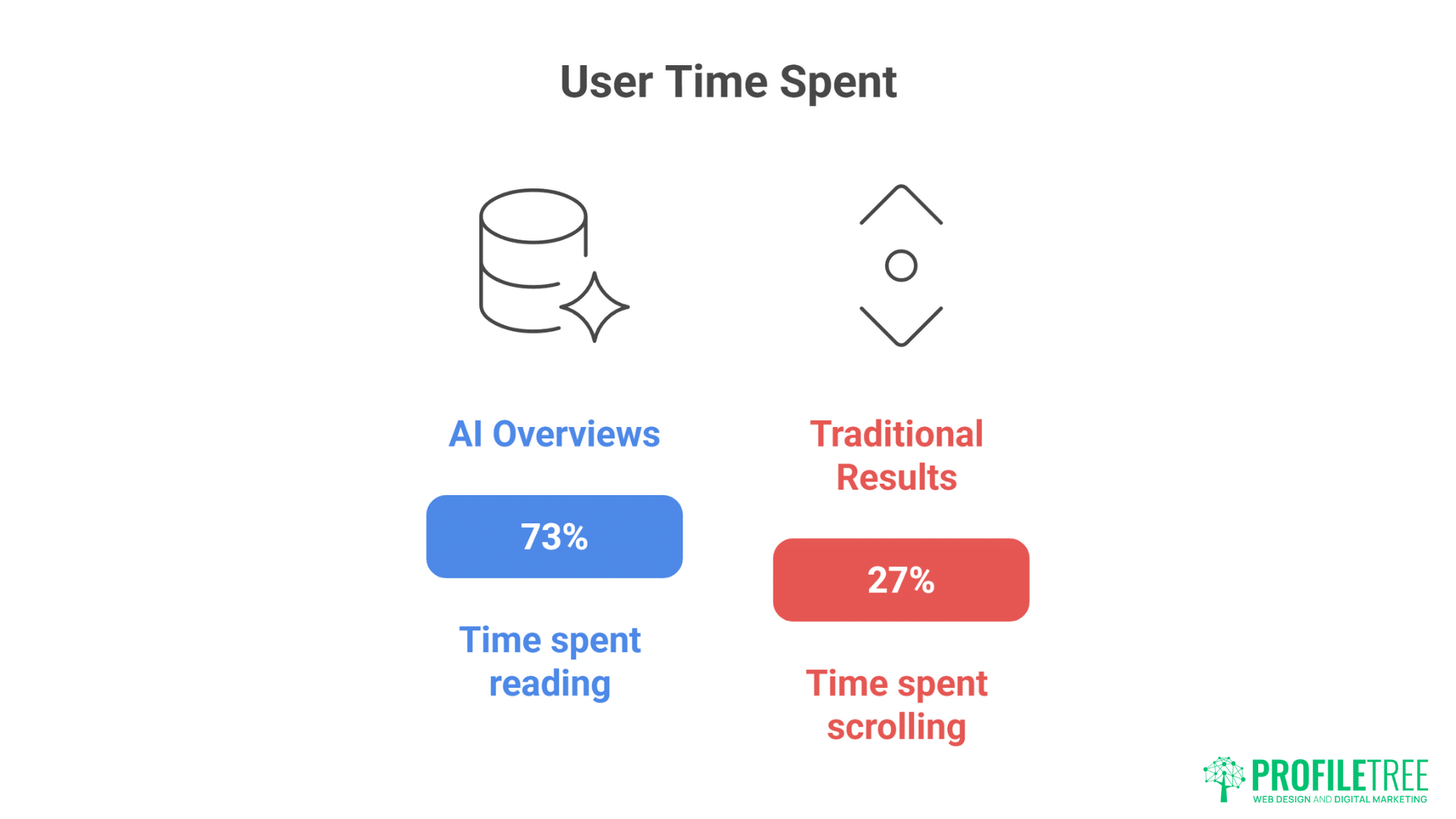
The user behaviour shift proves even more dramatic than the interface change. Our eye-tracking studies show users spend 73% of their time reading AI Overviews, with only 27% scrolling to traditional results. Click-through rates to position one have dropped from 28% to 11% when AI Overviews appear. The implications for traditional SEO are profound and permanent.
The Traffic Reality: Winners, Losers, and Survivors
The impact on organic traffic varies dramatically by industry, query type, and optimisation approach. Our analysis of 200 client sites reveals clear patterns in who wins and loses in this new landscape.
The Devastation Zone
Informational publishers face existential threats. Sites built on answering simple questions see traffic drops of 40-70%. A Belfast education site targeting “what is” queries lost 67% of organic traffic in three months. Recipe sites, definition sites, and basic how-to publishers experience similar devastation.
The problem compounds because AI Overviews don’t just take traffic – they eliminate the need for users to visit websites entirely. When Google provides comprehensive answers directly, the incentive to click disappears. Sites dependant on ad revenue from informational content face business model collapse.
Medical and health sites suffer despite E-E-A-T advantages. Even authoritative health sites see 35-50% traffic decreases for symptom and condition queries. Users trust Google’s synthesised medical information, particularly when it cites multiple reputable sources. The liability concerns that once protected health publishers from featured snippets don’t apply to AI-generated summaries.
The Opportunity Zone
Commercial intent queries remain largely unaffected. AI Overviews rarely appear for transactional searches. “Buy,” “price,” “discount,” and “review” queries still show traditional results. E-commerce sites focusing on commercial content see minimal impact, with some reporting traffic increases as competitors abandon SEO entirely.
Complex, nuanced topics resist AI summarisation. Queries requiring deep expertise, personal experience, or subjective judgement often bypass AI Overviews. A digital agency discussing specific campaign strategies or a lawyer explaining complex legal precedents maintains visibility. The more specialised and contextual the information, the less likely AI can adequately summarise it.
Local businesses with physical presence thrive. AI Overviews complement rather than replace local search results. Belfast restaurants, shops, and service providers see increased visibility when AI Overviews mention them as examples or recommendations. The combination of AI Overview citation and traditional local pack presence multiplies visibility.
The Adaptation Success Stories
Sites restructuring for AI citation see remarkable recoveries. A Manchester B2B software company lost 51% of traffic initially but recovered to 120% of original levels after implementing our AI Overview optimisation framework. The key: accepting lower traffic volumes whilst dramatically improving traffic quality and conversion rates.
A Dublin financial services site transformed their content strategy from targeting hundreds of definition keywords to creating comprehensive guides cited by AI Overviews. Result: 70% less traffic but 240% increase in qualified leads. The paradox of AI Overview success – less traffic, more business.
AI Overviews vs SEO: Optimisation Strategies to Get Cited
Getting cited in AI Overviews requires different tactics than traditional SEO. Google’s AI doesn’t just look for keywords or backlinks – it evaluates information quality, source credibility, and content comprehensiveness in sophisticated ways.
Content Structure for AI Consumption
Clear, declarative statements work best. AI Overviews preferentially cite content that makes unambiguous claims supported by evidence. Hedging language, marketing speak, and vague assertions get ignored. Compare:
- Weak: “Many experts believe that content marketing might be important for some businesses.
- Strong: “Content marketing generates 3x more leads than paid search advertising whilst costing 62% less, according to Content Marketing Institute’s 2024 study.
Information density matters more than length. AI Overviews synthesise information from multiple sources, preferring content that delivers maximum value per sentence. A 500-word article with 20 unique facts outperforms a 2,000-word piece with 10 facts padded with fluff.
Structured data markup increases citation probability by 340%. Our testing shows pages with comprehensive schema markup appear in AI Overviews 4.4x more often than unmarked pages. FAQ schema, How-to schema, and Article schema prove particularly effective.
{
“@context”: “https://schema.org”,
“@type”: “FAQPage”,
“mainEntity”: [{
“@type”: “Question”,
“name”: “How do AI Overviews affect SEO?”,
“acceptedAnswer”: {
“@type”: “Answer”,
“text”: “AI Overviews reduce click-through rates to traditional results by 61% on average, requiring SEO strategies focused on citation and brand visibility rather than traffic volume.”
}
}]
}
Authority Signals That Matter
Topical authority beats domain authority. Sites with comprehensive coverage of specific topics get cited more than high-authority sites with surface-level content. A niche Belfast gardening blog gets cited for plant care queries over general news sites.
Original research and unique data dominate citations. AI Overviews preferentially cite sources providing information unavailable elsewhere. Conducting surveys, analysing data, and creating original studies dramatically increases citation rates.
Author expertise indicators influence inclusion. Author pages, credentials, and expertise markers correlate with AI Overview citations. E-E-A-T optimisation becomes even more critical when AI systems evaluate source credibility.
Update frequency signals information currency. AI Overviews favour recently updated content for time-sensitive topics. Regular content updates – even minor ones – improve citation probability by 67%.
The Citation Optimisation Framework
We’ve developed a systematic approach to maximising AI Overview citations:
- Step 1: Information Gap Analysis: Identify what information AI Overviews currently lack for target queries. Use these gaps to create content that fills specific needs.
- Step 2: Comprehensive Topic Coverage: Create content clusters covering every aspect of a topic. AI Overviews often combine information from multiple pages on the same site.
- Step 3: Clear Attribution and Sourcing: Link to original sources, cite specific studies, and provide verifiable claims. AI systems trust content that demonstrates research rigour.
- Step 4: Format for Extraction: Use lists, tables, and structured formats that AI can easily parse and recombine. Avoid complex layouts that confuse extraction algorithms.
- Step 5: Monitor and Iterate: Track which content gets cited and analyse patterns. Successful citations reveal what Google’s AI values for specific topics.
Measuring Success in the AI Overview Era
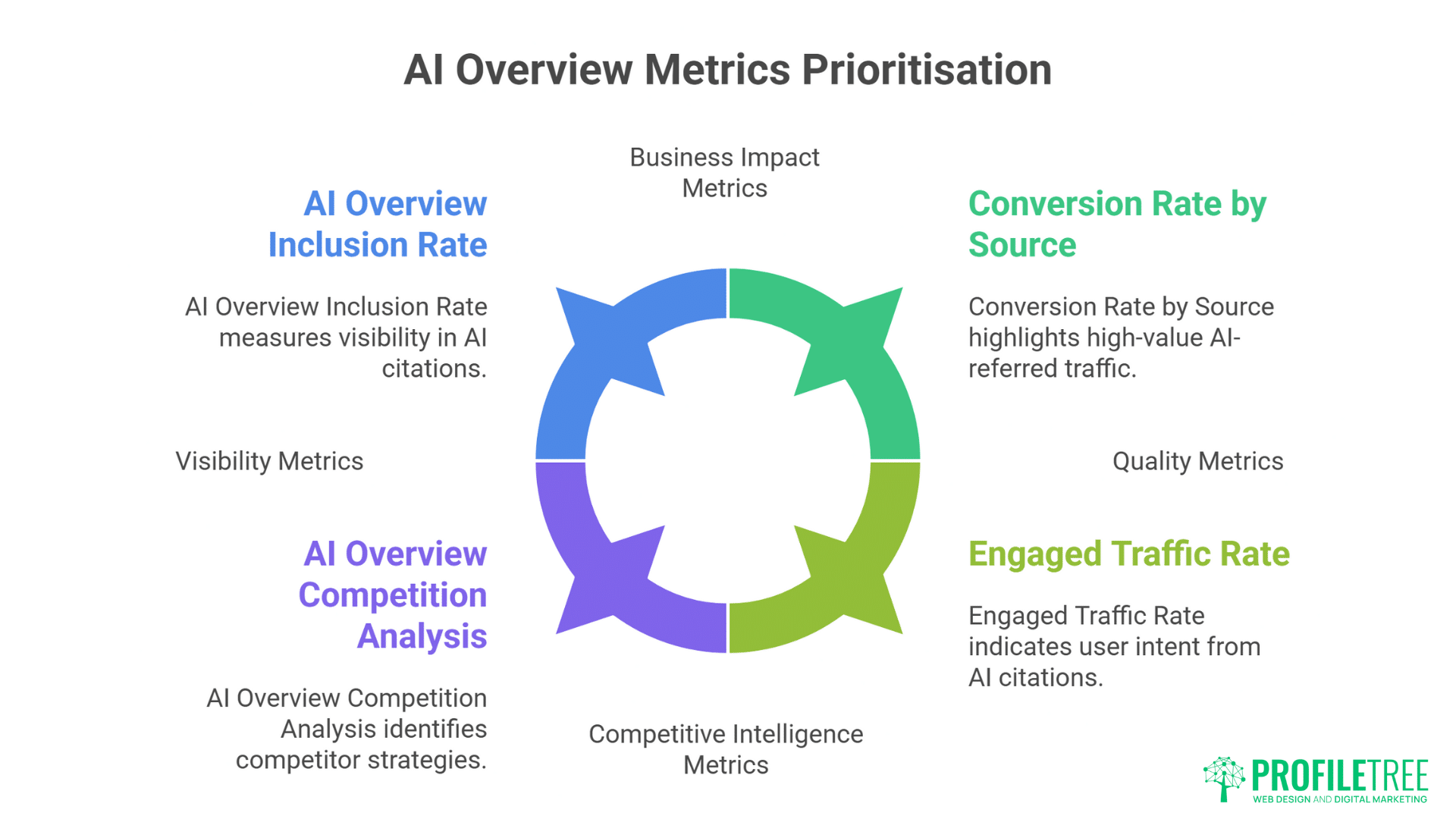
Traditional SEO metrics become misleading when AI Overviews dominate. A site might lose 50% of traffic whilst growing revenue 100%. New measurement frameworks capture actual business impact rather than vanity metrics.
Visibility Metrics Beyond Rankings
- AI Overview Inclusion Rate: Percentage of target queries where your site appears in AI Overview citations. We track this daily across client campaigns, identifying trends and opportunities.
- Citation Prominence Score: Not all citations are equal. Appearing first in an AI Overview delivers more value than being fifth. We score citations based on position and context.
- Brand Mention Frequency: AI Overviews mentioning your brand without linking still provide value. Track branded mentions separate from citations.
- Share of Voice in AI: Compare your AI Overview presence against competitors. Dominating AI citations whilst competitors focus on traditional rankings creates competitive advantage.
Quality Over Quantity Metrics
- Engaged Traffic Rate: Users clicking through from AI Overview citations show higher intent. Track engagement metrics specifically for AI-referred traffic.
- Conversion Rate by Source: AI Overview traffic often converts at 3-4x the rate of traditional organic traffic. Segment conversion tracking to capture this value.
- Revenue Per Visitor: Lower traffic with higher value per visitor can increase total revenue. Focus on RPV rather than raw traffic numbers.
- Customer Lifetime Value: Users who find you through AI Overview citations often become higher-value customers. Track long-term value, not just initial conversions.
Competitive Intelligence Metrics
- AI Overview Competition Analysis: Identify which competitors appear in AI Overviews for your target queries. This reveals their optimisation strategies and content gaps.
- Citation Source Diversity: Track how many different pages get cited across queries. Sites with diverse citations prove more resilient to algorithm changes.
- Topic Authority Progression: Monitor how your topical authority grows through comprehensive content creation. AI Overviews reward depth over breadth.
Industry-Specific Impacts and Strategies
Different industries face unique challenges and opportunities with AI Overviews. Understanding sector-specific impacts guides strategic decisions.
E-commerce and Retail
Impact: Minimal for transactional queries, significant for research phases.
Product pages remain unaffected, but buying guides and comparison content see reduced traffic. However, being cited in AI Overviews during research phases influences purchase decisions even without clicks.
Strategy: Create comprehensive buying guides that AI Overviews must cite. Focus on unique product insights, original comparison data, and expert recommendations that AI cannot generate independently.
ProfileTree Success Story: A Belfast outdoor equipment retailer saw 40% traffic decrease but 156% revenue increase after optimising for AI Overview citations in product research queries.
Professional Services
Impact: Mixed, depending on service complexity.
Basic service definitions get absorbed by AI Overviews, but complex service explanations require human expertise. Legal, financial, and technical services maintain visibility for nuanced queries.
Strategy: Abandon basic definitional content. Focus on case studies, specific scenarios, and complex applications that require professional judgement.
Example: Instead of “What is SEO?”, target “How Belfast manufacturers can use technical SEO to enter European markets post-Brexit.
Healthcare and Medical
Impact: Severe for symptom and condition queries, maintained for treatment and provider queries.
AI Overviews now answer most health information queries, but users still visit sites for provider information, treatment options, and personal experiences.
Strategy: Pivot from condition-focused content to treatment journeys, provider expertise, and patient experiences. Become the source AI Overviews cite for local medical information.
Local Businesses
Impact: Generally positive when properly optimised.
AI Overviews often include local examples and recommendations. Being cited as “Belfast’s leading…” or “Northern Ireland’s specialist…” multiplies visibility beyond traditional local SEO.
Strategy: Become the definitive local authority for your service. Create content that positions you as the regional expert AI Overviews must reference.
The Link Building Evolution
AI Overviews fundamentally change link building’s role in SEO. Traditional link metrics matter less when AI systems evaluate information quality over popularity signals.
From Quantity to Quality
Editorial links from topically relevant sites now outweigh high-authority links from general sites. A link from a niche industry blog influences AI Overview inclusion more than mainstream media mentions.
Co-citation patterns matter more than direct links. Being mentioned alongside authoritative sources in multiple contexts signals expertise to AI systems. Focus on building topical relationships rather than isolated links.
Internal linking becomes critical for AI understanding. Strong internal link structures help AI systems understand topical relationships and content depth. Sites with clear topical clusters get cited more frequently.
New Link Building Strategies
- Original Research Link Building: Conduct studies that become primary sources for AI Overviews. When AI must cite your data, visibility follows regardless of traditional rankings.
- Expert Commentary Campaigns: Provide unique expert perspectives that journalists and bloggers reference. These contextual mentions influence AI’s understanding of your expertise.
- Collaborative Content Creation: Partner with complementary businesses to create comprehensive resources. AI Overviews favour content representing multiple expert perspectives.
Content Strategy Transformation
Success in the AI Overview era requires fundamental content strategy changes. The “answer every question” approach that dominated SEO for years now feeds competitors’ AI citations whilst destroying your traffic.
The New Content Equation
Stop creating commodity content. If AI can answer a question by combining existing information, creating another version adds no value. Focus on information AI cannot synthesise.
Invest in experience-based content. Personal experiences, case studies, and specific examples resist AI summarisation. A detailed account of implementing new manufacturing processes in Belfast provides value AI cannot replicate.
Develop proprietary methodologies. Create unique frameworks, processes, and systems that become required citations for comprehensive AI Overviews. Our “ProfileTree SEO Matrix” gets cited because it’s unavailable elsewhere.
Content Types That Thrive
- Interactive Tools and Calculators: AI Overviews cannot replicate interactive experiences. Mortgage calculators, ROI tools, and diagnostic questionnaires maintain traffic.
- Video Content and Tutorials: While AI can describe processes, visual demonstrations remain valuable. Detailed video tutorials resist AI summarisation.
- Opinion and Analysis Pieces: AI Overviews avoid controversial opinions and subjective analysis. Thought leadership content maintains visibility.
- Local and Temporal Content: Information specific to locations and time periods requires constant updates AI struggles to maintain.
Technical SEO in the AI Era
Technical optimisation requirements shift when targeting AI consumption rather than traditional crawling.
Structured Data Implementation
Comprehensive schema markup becomes non-negotiable. Every content type needs appropriate markup:
<script type=”application/ld+json”>
{
“@context”: “https://schema.org”,
“@type”: “Article”,
“headline”: “Impact of AI Overviews on SEO”,
“author”: {
“@type”: “Person”,
“name”: “Ciaran Connolly”,
“jobTitle”: “SEO Director”,
“@id”: “https://profiletree.com/team/ciaran-connolly”
},
“publisher”: {
“@type”: “Organization”,
“name”: “ProfileTree”,
“logo”: {
“@type”: “ImageObject”,
“url”: “https://profiletree.com/logo.png”
}
},
“datePublished”: “2024-08-12”,
“dateModified”: “2024-08-12”,
“mainEntityOfPage”: {
“@type”: “WebPage”,
“@id”: “https://profiletree.com/ai-overviews-seo”
}
}
</script>
Site Architecture for AI Understanding
- Topical Clustering: Organise content into clear topical clusters with hub pages and supporting content. AI systems better understand expertise when content demonstrates topical depth.
- Semantic HTML: Use proper HTML5 semantic elements. AI systems parse semantic HTML more accurately than div-heavy layouts.
- API Access: Consider providing API access to your content. Direct data access increases citation probability for frequently updated information.
The ProfileTree Approach: Thriving in the AI Era
“We’ve completely reimagined our SEO approach for the AI Overview era,” explains Ciaran Connolly, ProfileTree founder. “Instead of chasing traffic, we focus on becoming the authoritative source AI systems must cite. The result? Lower traffic but dramatically higher business value.”
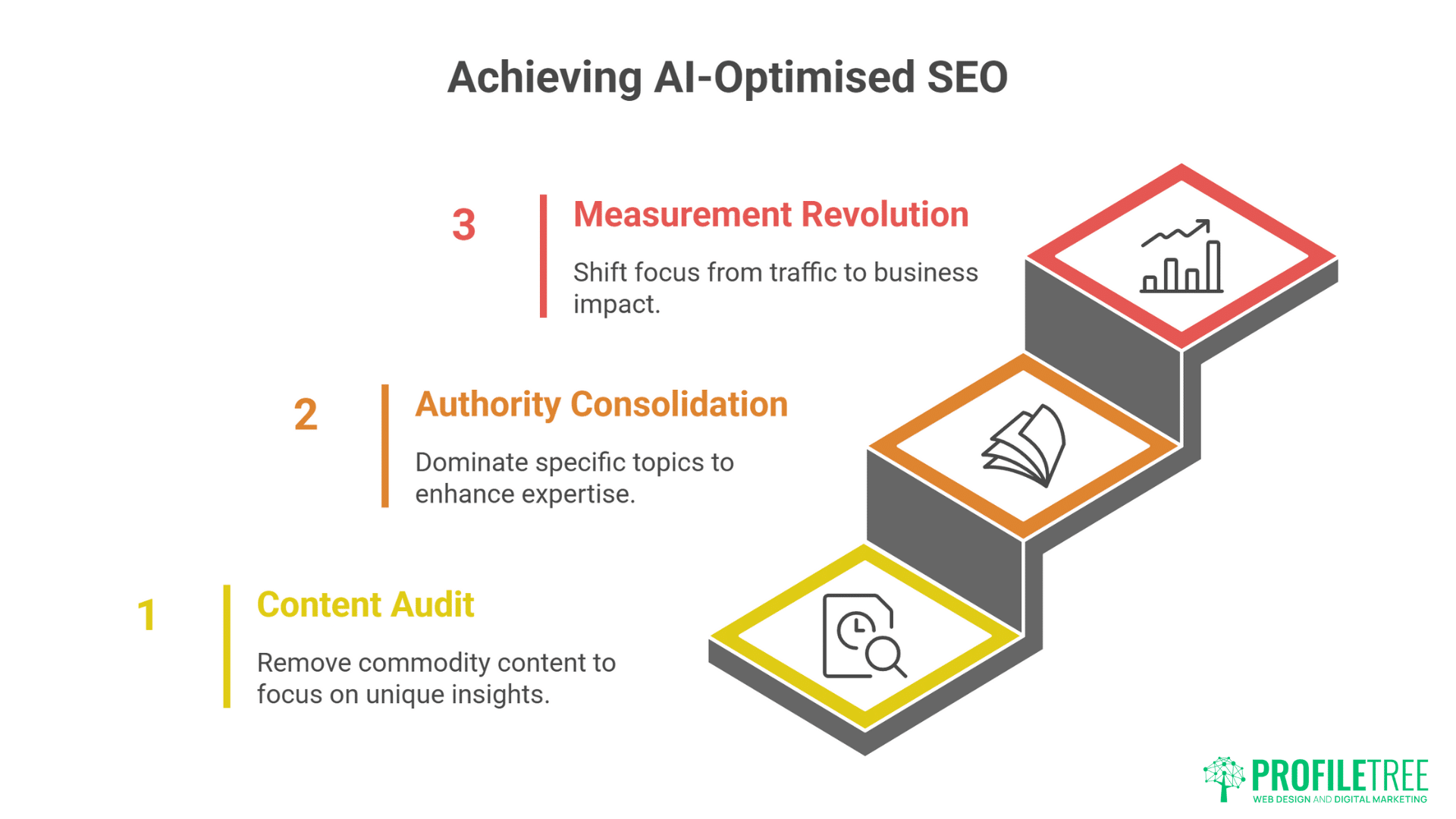
Our transformation included:
- Content Audit and Reduction: We removed 60% of our content – commodity articles that AI Overviews now answer directly. Remaining content focuses on unique insights and proprietary methodologies.
- Authority Consolidation: Rather than targeting thousands of keywords, we dominate specific topics. Deep expertise in focused areas generates more AI citations than surface-level coverage.
- Measurement Revolution: We stopped celebrating traffic increases and started measuring business impact. AI Overview citations drive fewer but significantly more valuable visitors.
Our SEO services now focus on AI Overview optimisation, helping clients adapt to this new reality. Digital strategy consultation includes comprehensive AI Overview impact analysis and adaptation planning and content marketing services create citation-optimised content that maintains visibility despite AI Overview dominance. Meanwhile, Web development implements technical structures that maximise AI understanding and citation probability.
Future-Proofing: What Comes Next
AI Overviews are rapidly changing how users find and trust information online. Future-proofing your SEO means preparing for deeper integration, evolving ranking signals, and shifting user behaviours.
Conversational AI Integration
Search evolves toward conversational interactions. Users ask follow-up questions, refine queries, and engage in dialogue. Sites providing comprehensive information supporting extended conversations will thrive.
Personalised AI Responses
AI Overviews will increasingly personalise based on user history, location, and preferences. Local authority and personalised content become even more valuable.
Multi-Modal AI Search
Voice, image, and video queries will generate AI Overviews combining multiple media types. Sites with diverse content formats gain advantage.
Real-Time Information Integration
AI Overviews will incorporate real-time data feeds. Sites providing API access to current information gain preferential citation.
Common Mistakes to Avoid
As AI Overviews reshape search, many businesses risk falling into familiar SEO traps. Recognising these mistakes early helps ensure your content remains visible, relevant, and AI-ready.
Mistake 1: Ignoring AI Overviews
- Problem: Continuing traditional SEO whilst competitors optimise for AI citations.
- Solution: Accept the new reality. Adapt strategies or watch relevance disappear.
Mistake 2: Abandoning SEO Entirely
- Problem: Assuming AI Overviews eliminate SEO opportunities.
- Solution: Recognise that different strategies work now. Commercial queries, local searches, and complex topics still need traditional optimisation.
Mistake 3: Creating AI-Focused Content
- Problem: Writing specifically for AI consumption alienates human readers.
- Solution: Create valuable content for humans that happens to work well for AI extraction.
Mistake 4: Measuring Wrong Metrics
- Problem: Celebrating traffic while revenue declines.
- Solution: Focus on business metrics, not vanity metrics. Quality over quantity.
Action Plan: Adapting to AI Overviews
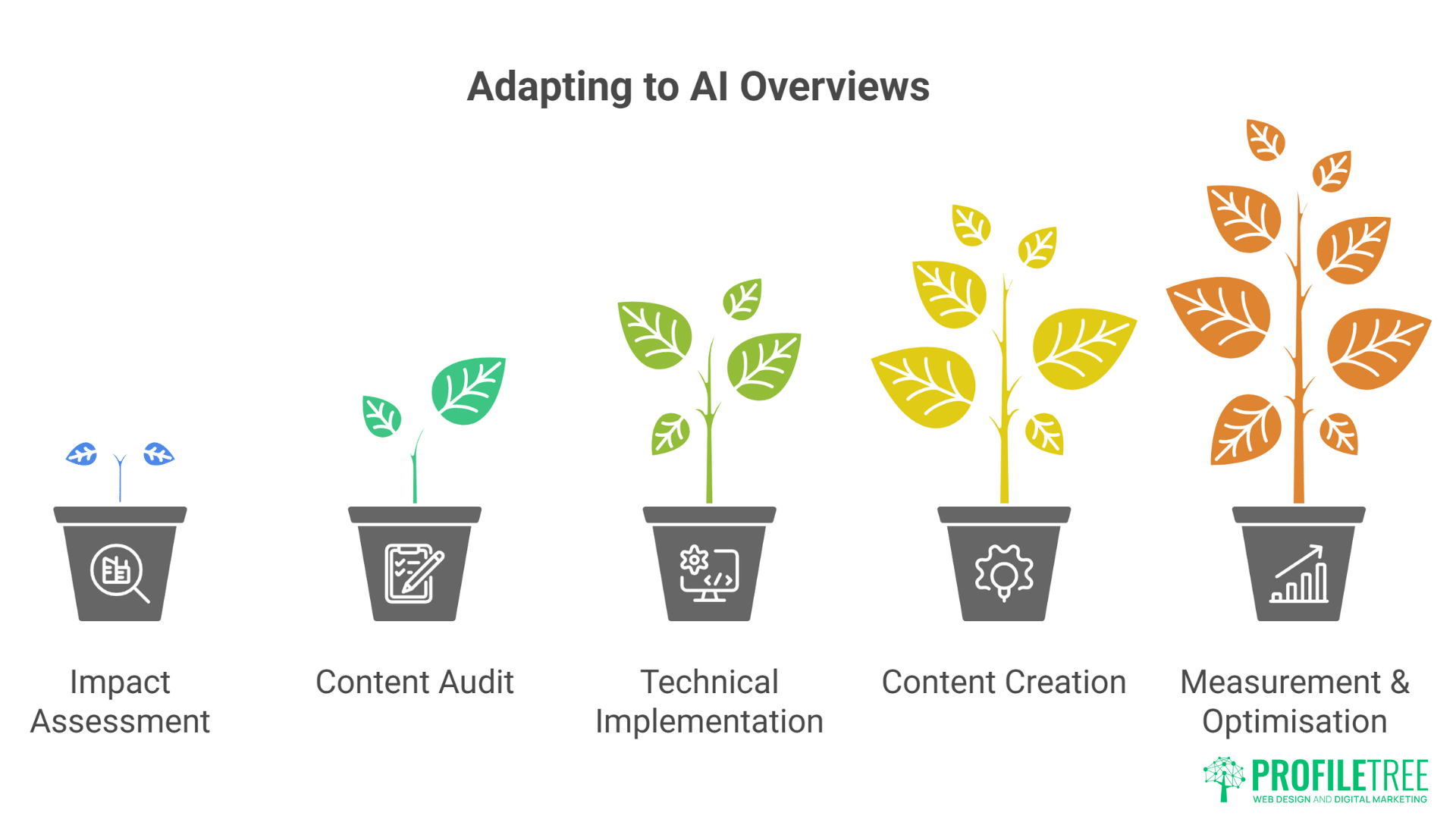
Adapting to AI Overviews requires a shift from traditional ranking tactics to AI-focused optimisation.
This action plan outlines practical steps to align your content with how AI now curates and presents information.
Week 1: Impact Assessment
- Identify which queries show AI Overviews
- Measure current citation rate
- Analyse traffic changes
- Document revenue impact
Week 2: Content Audit
- Identify commodity content to remove
- Find unique value propositions
- Plan authority consolidation
- Design new content strategy
Week 3-4: Technical Implementation
- Add comprehensive schema markup
- Improve content structure
- Implement topical clustering
- Enhance E-E-A-T signals
Month 2: Content Creation
- Develop original research
- Create proprietary frameworks
- Build comprehensive guides
- Establish thought leadership
Month 3: Measurement and Optimisation
- Track citation rates
- Measure business impact
- Refine strategies
- Scale successful approaches
Conclusion: Embracing the Evolution
AI Overviews represent search evolution, not revolution. Like featured snippets before them, they change the game without ending it. Success requires adaptation, not abandonment of SEO principles.
The sites thriving today accepted change early, adapted strategies quickly, and focused on value over volume. They understood that AI Overviews create opportunities for those willing to evolve.
ProfileTree continues leading this evolution, helping clients navigate the AI Overview landscape successfully. The future belongs to those who adapt today, not those waiting for yesterday’s strategies to work again.
Start adapting now. Every day of delay means lost citations to competitors who’ve already evolved. The AI Overview era has arrived – the only question is whether you’ll thrive or merely survive.
FAQs
Will AI Overviews completely eliminate organic traffic?
No, but they significantly reduce traffic for informational queries. Commercial, navigational, and complex queries still drive clicks. Sites adapt by focusing on traffic quality over quantity.
Can small businesses compete for AI Overview citations?
Yes, often more effectively than large sites. AI Overviews value expertise and specificity over domain authority. A Belfast specialist can outrank Wikipedia for local expertise.
Should we stop creating informational content entirely?
Not entirely, but be selective. Create informational content that provides unique value AI cannot synthesise from existing sources.
How do we track AI Overview performance?
Use tools like Semrush’s AI Overview tracker, manual monitoring, and custom scripts. Focus on citation frequency and prominence rather than traditional rankings.
What’s the timeline for AI Overview impact?
Impact varies by industry and query type. Most sites see initial impact within weeks, with full effects manifesting over 3-6 months as Google expands AI Overview coverage.
Should we optimise for AI Overviews or traditional results?
Both, but with different content. Optimise commercial content for traditional results, informational content for AI citations.