
Developing Topical Authority: A Practical Framework for UK SMEs
Table of Contents
Search engines no longer rank pages in isolation. They evaluate whether an entire website can be trusted to speak authoritatively on a subject — and that trust is built through topical authority. For businesses across the UK and Ireland, understanding this shift is what separates websites that grow organically from those that plateau, regardless of how much content they publish.
This guide on developing topical authority covers the full picture: what topical authority actually means in practice, how to map and build it systematically, why the UK market presents specific challenges worth addressing, and how to defend your position as AI-generated content floods every niche.
By the end, you will have a clear framework for turning scattered blog posts into a coherent content architecture that earns rankings, AI citations, and genuine reader trust.
What Topical Authority Is and Why Domain Rating Misses the Point
There is a common misconception that a high domain rating (DR) automatically translates to strong search performance across all topics. It does not. Topical authority operates differently — it rewards depth and coherence over bulk, and it is the reason why a specialist website with a modest DR can consistently outrank a high-authority generalist on specific subjects.
Defining Topical Authority in Plain Terms
Topical authority is the degree to which search engines recognise your website as a credible, comprehensive source on a defined subject area. It is built through the volume, quality, and interconnectedness of content you publish within that subject — not through backlinks alone.
Google’s E-E-A-T framework (Experience, Expertise, Authoritativeness, Trustworthiness) underpins how this is assessed. A site that publishes 40 tightly focused articles on local SEO for UK service businesses signals something very different from a site that publishes one article on local SEO alongside hundreds of unrelated topics. The former is treated as a subject-matter authority; the latter is not.
Topical Authority vs Domain Authority: Key Differences
Understanding the distinction matters for planning. The table below sets out the practical differences:
| Factor | Domain Authority / Rating | Topical Authority |
|---|---|---|
| Primary driver | Backlink volume and quality | Content depth and coverage |
| Metric used | DR, DA (third-party scores) | Rankings, Share of Voice, AI citations |
| Control level | Low (dependent on external sites) | High (entirely within your control) |
| Speed of influence | Slow (months to years) | Faster with consistent publishing |
| New page benefit | Marginal unless linked externally | Significant — each page reinforces the cluster |
A useful way to think about it: domain authority is the reputation of the building, topical authority is the expertise of the people inside. You want both, but for most SMEs in the UK, topical authority is the lever you can actually pull.
Why Google Has Shifted Toward Topical Signals
Google’s Helpful Content System, now integrated permanently into core ranking, evaluates entire sites rather than individual pages. This means a cluster of weak, superficial content on a topic drags down every other page on that subject — including pages that are individually well-written.
The February 2026 core update reinforced author credentials as a first-class ranking input. Sites where the content demonstrably comes from people with real experience in the subject perform measurably better. For UK businesses, this is an opportunity: regional expertise and first-hand knowledge are things AI cannot credibly replicate at scale.
If you want to understand how your current content performs before building out a topic cluster, a structured content audit is the logical starting point.
The Five-Step Framework for Building Topical Authority
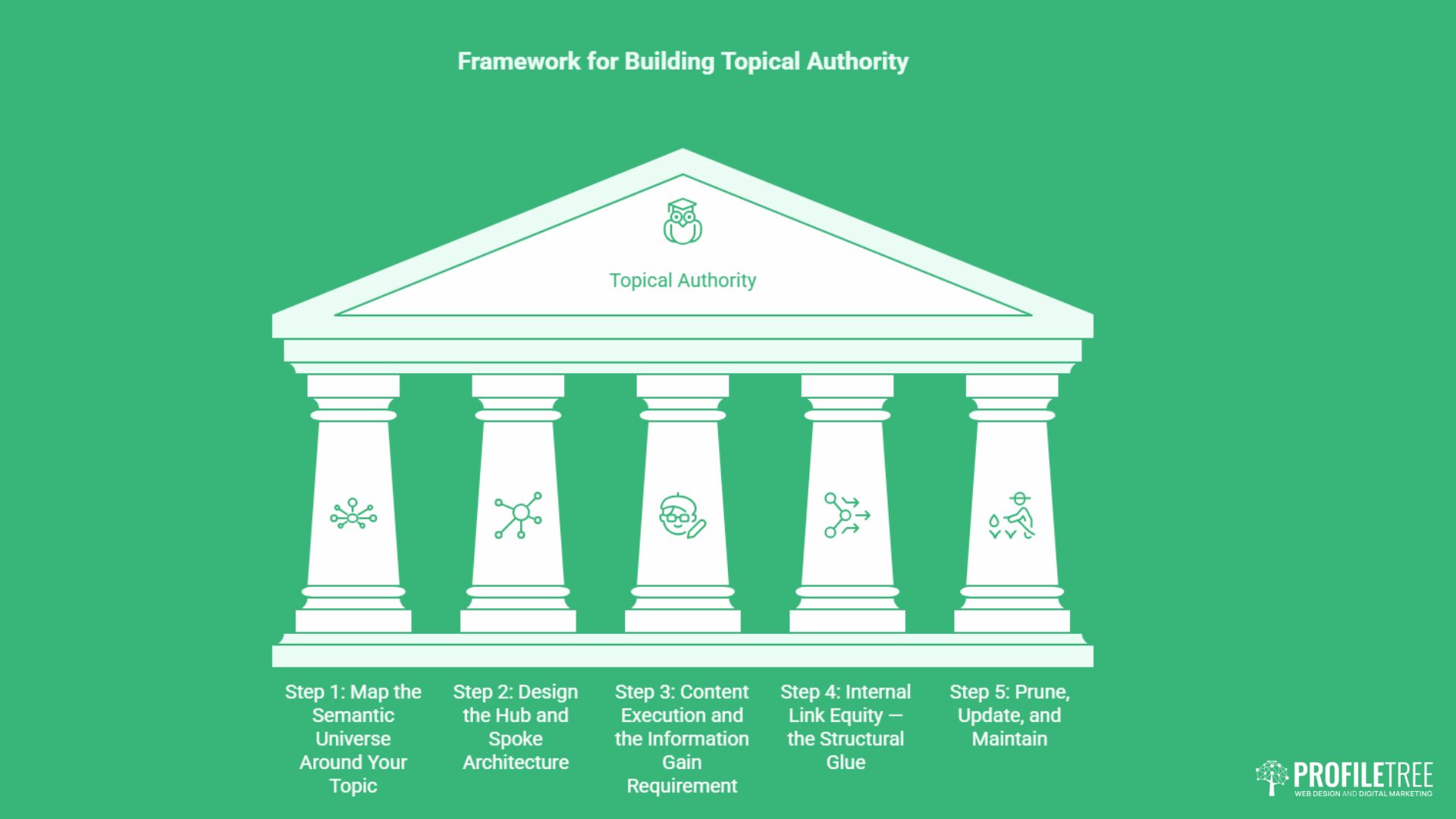
Most guides explain the theory. This section focuses on execution — the practical sequence a UK business or marketing team can follow, starting from scratch or from an existing content base that lacks coherent structure.
Step 1: Map the Semantic Universe Around Your Topic
Before writing a single word, map every question, sub-topic, and adjacent concept that belongs to your subject area. This is not keyword research in the traditional sense — it is semantic mapping. You are identifying the full territory, then deciding which parts to claim.
Start with your primary topic (for example, “local SEO for UK law firms”). Branch out to first-level subtopics: Google Business Profile optimisation, citation building, local pack rankings, and review management. Then branch further: how reviews affect local rankings, schema markup for solicitors, and near-me search behaviour in regional UK cities.
A simple spreadsheet with four columns works well: Topic, Sub-topic, Search Intent (informational or commercial), and Planned Internal Link Target. This becomes your topical map — the blueprint for everything that follows. A thorough competitive analysis at this stage reveals which subtopics competitors have covered superficially, giving you clear gaps to fill with genuine depth.
Step 2: Design the Hub and Spoke Architecture
Once your topical map exists, organise it into a hub-and-spoke structure. The hub (pillar page) covers the broad topic at a high level — typically 3,000 words or more — and links out to every spoke (cluster) article. Each spoke article covers one sub-topic in depth and links back to the pillar.
This architecture does two things simultaneously. It signals to Google the breadth of your coverage (you have content on every relevant subtopic) and the depth of each coverage point (each subtopic has a dedicated, detailed page). Neither breadth nor depth alone is sufficient; the combination is what builds authority.
For a UK digital agency, this might look like: one pillar page on “SEO for UK small businesses” supported by spokes on local SEO, technical SEO audits, content strategy for service businesses, Google Search Console basics, and link building in the UK market.
Step 3: Content Execution and the Information Gain Requirement
This is where most content fails. Publishing a 2,000-word article that covers the same ground as every other article on the topic does not build topical authority — it adds to the noise. Google’s Information Gain Score measures how unique your content is relative to what already ranks. If the score is low, the ranking potential is capped regardless of word count.
Information gain comes from specific sources: original data or first-hand testing, a real example drawn from actual project work, a framework or approach that you have coined and can own, a well-argued position that challenges the existing consensus, or content segmented for an audience that generic guides ignore.
“SEO for UK manufacturers” provides more information than “SEO guide” even if the word count is identical, because it answers questions that generic content does not address. For SMEs and agencies in Northern Ireland and the Republic, regional specificity is a consistent source of information gain that larger competitors routinely ignore.
Ciaran Connolly, founder of ProfileTree, puts it directly: “Volume is a vanity metric. The question is always whether you’ve covered the topic in a way that genuinely serves someone who already knows the basics — because that’s the person Google is trying to help.”
Step 4: Internal Link Equity — the Structural Glue
Internal links are the mechanism through which topical authority is transferred across your content. Without them, even a well-structured hub-and-spoke architecture fails to signal coherently to search engines.
The practical rules are straightforward. Every cluster article should link back to its pillar. The pillar should link out to every cluster article. Related cluster articles within the same topic should cross-link where the connection genuinely serves the reader. Anchor text should be descriptive and varied — never the same phrase used repeatedly across multiple pages.
A common mistake is placing internal links only at the bottom of articles. Links placed early in the content pass more equity and are more likely to be clicked. If you are working through a site with hundreds of existing articles, a structured content audit will surface which pages are orphaned (no internal links pointing to them) and which are over-concentrated with links from only one or two sources.
Step 5: Prune, Update, and Maintain
Topical authority is not a one-time project. Content decays: statistics become outdated, competitor articles improve, and new subtopics emerge. A site with 200 articles, where 60 are thin, outdated, or redundant, is actively harmed by those 60 pages under Google’s sitewide quality assessment.
Pruning decisions follow a four-way framework. Optimise pages with traffic but poor positioning. Reframe pages with impressions but no clicks (intent mismatch). Redirect pages with no traffic and a better existing alternative. Deprecate pages with no traffic, no links, and no salvageable value.
A consistent publishing cadence matters more than volume. Publishing four genuinely useful cluster articles per month, every month, compounds faster than publishing 20 articles in a burst and then going quiet.
Building Topical Authority in UK and Irish Markets
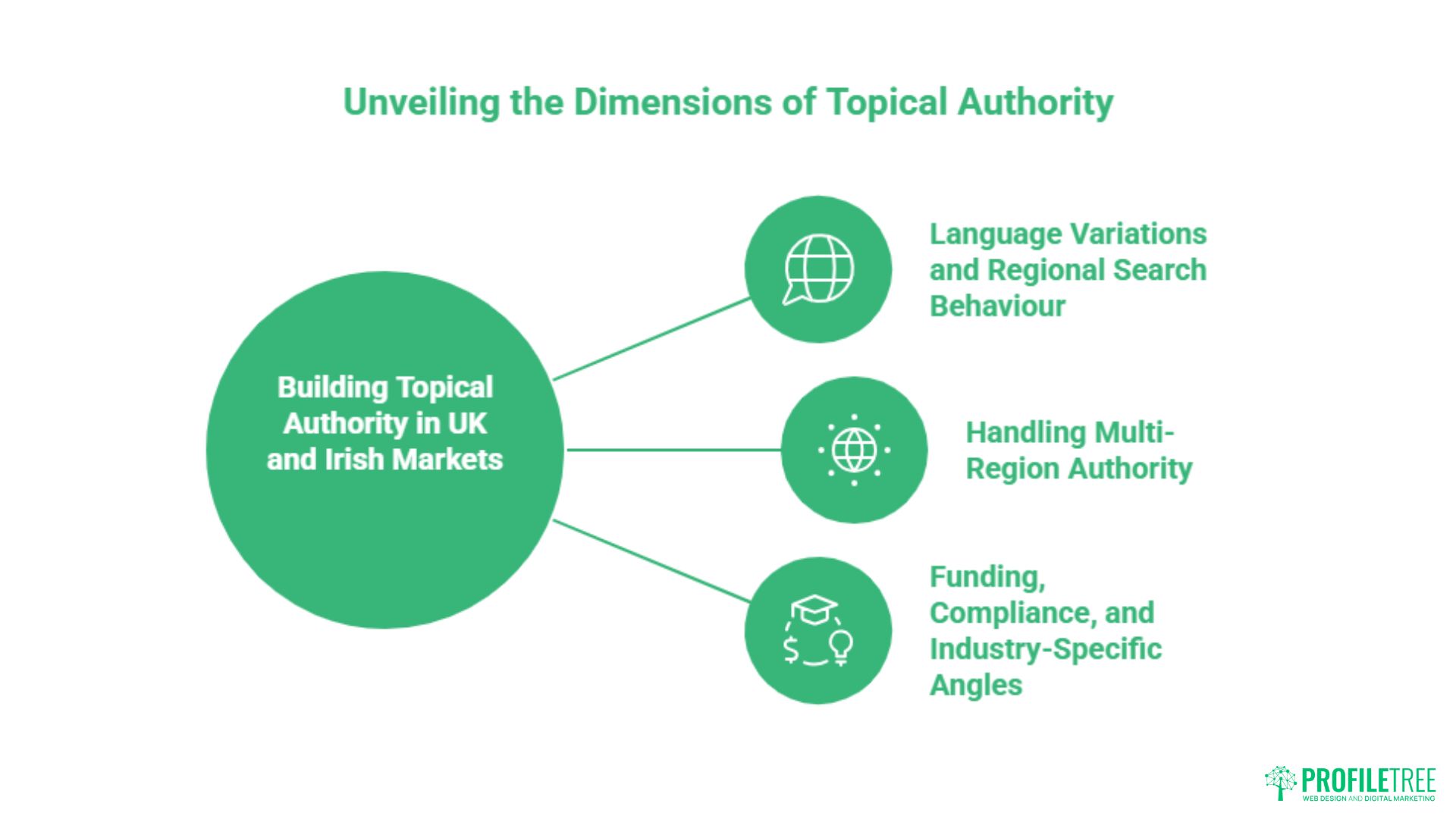
The guidance that dominates the top of Google for “developing topical authority” is almost universally American or, at best, internationally generic. It overlooks specifics that matter considerably if your target market is the UK, Ireland, or Northern Ireland specifically.
Language Variations and Regional Search Behaviour
British English is not simply a spelling preference — it affects how people search and how content is perceived by readers and algorithms. Users in the UK search for “solicitor” not “lawyer”, “estate agent” not “realtor”, “pavement” not “sidewalk”. These are not minor variations; they represent entirely different keyword sets.
For a business building topical authority in UK legal services, for instance, publishing content using American terminology is a structural disadvantage. The semantic relationship between “solicitor” and “conveyancing” or “barrister” is well-established in UK search data. Using “lawyer” throughout disrupts those associations.
The same principle applies at a regional level. Searches in Northern Ireland, Scotland, and Wales have distinct characteristics shaped by devolved legislation, local institutions, and cultural references. A law firm in Belfast competes in a different local SERP from one in Manchester, even for broadly similar queries.
Addressing these distinctions directly in your content is a source of information gain that generic guides cannot match. For inspiration on the regional context that shapes search behaviour across the island, Connolly Cove’s guide to Northern Ireland cities illustrates how regional specificity drives genuine engagement.
Handling Multi-Region Authority Without Diluting Relevance
A common challenge for UK and Irish businesses is building authority across multiple regions without creating thin, templated content that weakens the overall topical signal. Simply swapping “Belfast” for “Dublin” or “London” on the same article template is one of the fastest ways to trigger a sitewide quality downgrade.
The correct approach is to build genuine regional differentiation into each location-specific page: local funding bodies and business support organisations, regional regulatory differences (particularly relevant between Northern Ireland and Great Britain post-Brexit), local case study references, and specific geographic intent signals. Each regional page should have at least 50% unique content — not unique phrasing of the same information, but genuinely different information relevant to that location.
The SEO services ProfileTree provides to businesses across Northern Ireland, Ireland, and the UK are built on this exact principle: authority is earned by being the most genuinely useful source for a defined audience, not by scaling generic content across geographies.
Funding, Compliance, and Industry-Specific Angles
UK and Irish businesses operate within a regulatory and funding environment that is rarely covered by generic SEO guides. Invest NI grants for digital adoption, the UK Shared Prosperity Fund, ICO compliance requirements for UK websites, and GDPR variations post-Brexit — these are subjects where a UK-focused content cluster can achieve topical authority rapidly because the competition from major US-based SEO publications is effectively zero.
If your business operates in a regulated sector (financial services, healthcare, legal, food and drink), there are entire sub-topic territories available that no generic competitor will contest. Your content strategy should map these out explicitly before prioritising more broadly contested topics.
AI-Proofing Your Authority in the Age of Generative Search
Generative AI has fundamentally changed the competitive landscape for content. AI tools can now produce competent, grammatically correct, on-topic articles in seconds. This means the baseline for “acceptable content” has dropped to zero cost — and the value of content that only meets that baseline has dropped with it.
Why Generic Content No Longer Builds Authority
When any competitor can generate a 1,500-word overview of any topic in minutes, content volume ceases to be a differentiator. What cannot be replicated at scale by AI is first-hand experience, proprietary data, original research, and genuine professional judgement shaped by real client work.
Google’s AI-powered search features (AI Overviews, featured snippets, People Also Ask) now synthesise information across multiple sources. Pages that contain only information available in every other article on the topic contribute nothing new to that synthesis — and are therefore less likely to be cited. Pages that contain a data point, framework, or perspective not found elsewhere are disproportionately cited.
The practical implication: every article you publish should contain at least one element that an AI model cannot produce from its training data — a specific measurement from a real project, a position supported by your own testing, or an angle specific to your market that generic guides ignore. For businesses wanting to apply this thinking to their own content workflows, exploring AI SEO prompts can be a useful starting point for structuring AI-assisted research without producing AI-indistinguishable output.
Structuring Content for AI Citation
AI systems — including Google’s AI Overviews, ChatGPT, and Perplexity — extract information most readily from content that is structured for extraction. Self-contained sections of 100 to 300 words that begin with a direct answer (bottom line up front) and follow with supporting detail are consistently cited at higher rates than narrative prose.
Pages covering multiple sub-questions of a topic are 161% more likely to appear in AI Overviews than pages covering only one sub-question (Ahrefs, correlation study). This aligns directly with the hub-and-spoke model: a well-structured pillar page that addresses multiple related questions in discrete sections is architecturally suited to AI citation.
Tables are cited 2.5 times more often than equivalent information in prose. Statistics are cited at rates 40% higher than those for qualitative statements. These are not arbitrary stylistic preferences — they reflect how AI extraction works. Structured, factual, specific content is extracted more reliably than flowing narrative.
Defending Authority Through Original Research
The most defensible form of topical authority in an AI-saturated market is content built on data that only you have access to. This does not require a formal research programme. It can be as simple as: aggregating anonymised outcomes from client projects, surveying your own customer base, analysing publicly available data through a lens specific to your industry or region, or documenting and naming a process or framework you have developed through practice.
ProfileTree’s approach to social media content planning, for instance, is informed by real client outcomes across sectors that generic social media guides simply cannot replicate. That specificity is what earns citations and sustains rankings when competitors publish volume. You can explore how this applies to broader content marketing services if you want to see how original insight is systematically built into a content programme.
Measuring Topical Authority: Metrics That Actually Matter
Topical authority is sometimes treated as an abstract quality that is difficult to measure. In practice, there are concrete signals in Google Search Console and standard SEO tools that tell you clearly whether your authority-building is working — or where it is stalling.
Topic Share of Voice and Ranking Spread
Share of Voice (SOV) for a topic measures how often your pages appear in the top 10 results across all relevant queries within a subject cluster — not just for your primary keyword. If you rank for “local SEO for UK restaurants” but none of the 15 related subtopic queries, your SOV is narrow. As your cluster content matures and internal links bed in, you should see rankings spread across more of those related queries without having to build new backlinks to each individual page.
This spreading effect — ranking for new related keywords without targeted link building — is the clearest signal that topical authority has been established. Track it monthly in Google Search Console by filtering by query topic and monitoring the number of queries generating at least one impression.
Internal Link Health and Orphan Page Rate
A topical authority audit should always include internal link health. Orphan pages (pages with no internal links pointing to them) cannot benefit from the authority of the cluster they notionally belong to. A site with 20% of its pages orphaned is losing a significant portion of the authority signal it has worked to build.
Track orphan rate using a crawl tool (Screaming Frog or equivalent), then use your topical map to determine which pages should be linked from where. The goal is that every page has at least two internal links pointing to it from topically relevant pages, with descriptive anchor text that reflects the target page’s subject matter.
Realistic Time-to-Authority Timelines
One question almost no guide answers honestly is how long this takes. Based on typical patterns across content programmes, a new site in a competitive niche should expect 6 to 12 months before topical authority signals are visible in rankings. An established site with existing content that is restructured into coherent clusters can see measurable improvement in 3 to 6 months. A site with strong existing domain authority moving into a new topic cluster may see results within 8 to 12 weeks.
These are realistic ranges, not guarantees — they assume consistent publishing (three to six cluster articles per month minimum), proper internal linking on every publish, and content that meets a genuine information gain threshold. Sites that publish less frequently, link internally inconsistently, or produce thin content should expect the longer end of these ranges.
For businesses that want hands-on support applying these principles to an existing content base, ProfileTree’s digital marketing services include topical authority audits and content architecture planning for SMEs across the UK and Ireland.
GSC Signals to Track Monthly
Within Google Search Console, four metrics provide the clearest read on topical authority progress:
- Impressions by topic cluster: Filter queries by your cluster’s core terms. Rising impressions across the cluster (not just the pillar) indicate Google is recognising your authority.
- Average position for cluster queries: Track the mean position across all queries in your cluster. Consistent improvement over 90-day periods confirms the strategy is working.
- Click-through rate by page type: Pillar pages should show higher CTR than cluster pages because they target broader, higher-volume queries. Anomalies indicate title tag or meta description issues.
- New query appearances: The “Queries” report, filtered by date comparison, shows which new queries your site has begun ranking for. In a healthy topical authority programme, new related queries should appear each month without dedicated new content targeting them.
An honest SEO guide will tell you that none of these metrics moves in a straight line. Expect fluctuation around core updates, and evaluate trends over 90-day windows rather than week-to-week movements.
Conclusion
Topical authority is earned through depth, coherence, and consistency — not through content volume alone. For UK and Irish businesses, the opportunity lies in the gap between generic international guides and the specific, regional, first-hand expertise that no AI model can credibly replicate at scale. Map your subject area methodically, build your hub-and-spoke architecture, prioritise information gain in every piece you publish, and track the right signals. The authority compounds over time.
Ready to build topical authority for your business?
ProfileTree works with SMEs across Northern Ireland, Ireland, and the UK to develop content strategies grounded in real data and regional expertise. Whether you are starting from scratch or restructuring an existing content base, our team can map your topic clusters, audit your current content, and build the architecture that earns lasting search visibility.
Explore our SEO services or see how our content marketing works to find out where to start.
FAQs
What is the fastest way to build topical authority?
Focus on a tightly defined micro-niche before expanding to broader categories. A new site attempting to build authority across all of digital marketing simultaneously will be outcompeted at every point. A site that builds genuine depth on “local SEO for UK hospitality businesses” can establish authority in that niche within months and then expand outward systematically. Breadth comes after depth, not before it.
Does topical authority replace the need for backlinks?
No, but it makes every backlink you earn significantly more effective. A backlink to a page within a well-structured topical cluster passes more value than the same backlink to an isolated, unclustered page. Think of backlinks as amplifiers: topical authority determines what they amplify. Sites with strong topical authority also tend to attract backlinks more naturally, because comprehensive cluster content gives other publishers more to reference.
How many articles do I need for a topic cluster?
A functional cluster typically requires one pillar page and between 5 and 15 spoke articles, depending on the topic’s complexity and breadth. A narrow niche (e.g., “Instagram marketing for UK florists”) may require fewer spokes. A broad topic (e.g., “SEO for UK businesses”) may require fifteen or more to achieve adequate coverage. Start with the subtopics that have clear search intent and measurable demand, and expand from there.
Can a new website compete with established brands through topical authority?
Yes — and topical authority is one of the few mechanisms by which a newer site can realistically do so. Established brands with broad domain authority are often spread thinly across many topics. A focused new site that covers a specific subject area more thoroughly and specifically than any existing competitor can outrank those brands for queries within that defined territory, even without a comparable backlink profile.
How do I know when I have achieved topical authority?
The clearest signal is when your site begins ranking for related queries you did not specifically target or write about directly. When Google associates your domain with a subject area to the point that new, related queries surface in your Search Console data without additional link-building, topical authority has been established.