
Structured Data and SEO: What It Means for Your Website
Table of Contents
Structured data is one of the most underused SEO tools available to small and medium-sized businesses in Northern Ireland and the UK. Most business owners have heard of it, fewer understand what it actually does, and almost none know how much visibility they’re leaving on the table by ignoring it. This guide explains what structured data is, why it matters for your search rankings, and what you need to do to put it to work on your website.
Structured data is a standardised way of labelling your website’s content so that search engines like Google and Bing can understand exactly what each page is about. Instead of making a search engine guess whether your opening hours are opening hours, or whether a number on your page is a price, a rating, or a date, structured data tells them directly. That clarity translates into richer, more prominent results in search, and increasingly into citations in AI-powered answers.
If you’re working with a web design or SEO agency to improve your website’s performance, structured data and SEO should be part of the conversation from the start.
What Structured Data Actually Does
Search engines are sophisticated, but they still have to interpret content that wasn’t written for machines. Structured data removes the guesswork. By adding a layer of machine-readable labels to your pages, you tell Google not just what your page says, but what it means.
How Schema Markup Works in Practice
The vocabulary used for structured data comes from Schema.org, a shared standard maintained by Google, Bing, Yahoo, and Yandex. When you add schema markup to a page, you’re using that shared vocabulary to describe the content in terms that search engines recognise. A local business can mark up its address, phone number, and opening hours. A product page can mark up its price, availability, and customer rating. A blog post can mark up its author, publication date, and topic category.
The most widely used format is JSON-LD, a block of code placed in the head of a webpage. Google recommends it because it sits separately from the visible content, making it easier to add and maintain without disrupting the page design. You don’t need to see it to benefit from it, but it has to be there, and it has to be accurate.
What Search Engines Do With That Information
Once Google processes your structured data, it can use that information to generate enhanced search results. These are called rich results or rich snippets, and they display additional information directly in the search listing: star ratings, product prices, event dates, FAQs, recipe details, and more. A rich result takes up more space on the page, looks more informative, and consistently attracts more clicks than a standard listing. For businesses competing in crowded local markets, that visual difference in search results can be the deciding factor in whether someone clicks your listing or a competitor’s.
Structured Data and AI Search
The role of structured data has grown considerably as AI-powered search tools have become mainstream. Google’s AI Overviews, ChatGPT, and Perplexity all draw on structured, clearly labelled content when constructing answers. Pages with clean entity signals and accurate schema markup are more likely to be cited in these AI-generated responses. For a Belfast business trying to appear in voice searches and AI answers for local queries, structured data is no longer optional; it’s a direct input into how those systems decide which businesses to mention.
Why This Matters More Than Most Businesses Realise
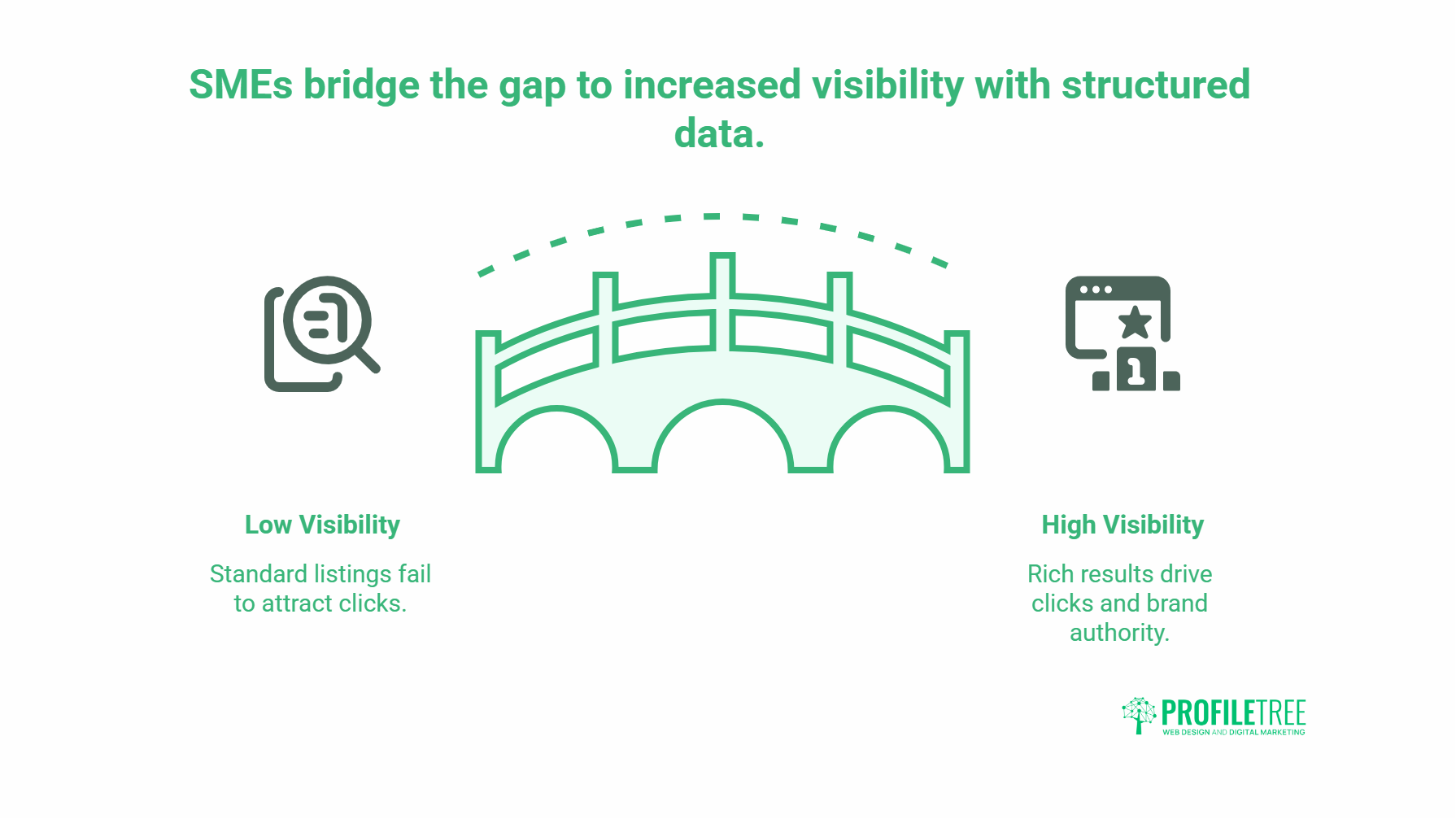
Most SMEs treat their website as a digital brochure and leave the technical details to whoever built it. Structured data falls into that gap: it’s technical enough that business owners assume someone else has handled it, and often no one has.
The Gap Between Rankings and Visibility
A website can rank on page one and still perform poorly if the search listing itself isn’t compelling. A standard listing shows a title, a URL, and a meta description. A rich result shows a title, a star rating, a review count, a price range, and a call to action. Both can appear on the same page of results, and the rich result will typically earn two to three times the clicks. This is not a technical detail. It’s a direct commercial outcome.
The Knowledge Graph Connection
Google’s Knowledge Graph is the database that powers the information panels you see on the right side of search results for businesses, people, and organisations. Structured data is one of the primary inputs into that graph. A business with consistent, accurate schema markup across its website is more likely to be represented correctly in Google’s understanding of what that business is, where it operates, and what it does. For ProfileTree clients working to build brand authority in Northern Ireland and the UK, getting that entity data right is a foundational step.
As Ciaran Connolly, founder of ProfileTree, puts it: “Structured data is the part of SEO that most businesses skip because they can’t see it. But when we audit websites for new clients, missing or broken schema is one of the most common quick wins we find. Fix it properly and you’re not just feeding the algorithm; you’re telling Google exactly who you are and what you do.”
Local Businesses Have the Most to Gain
For a business serving customers in Belfast, Northern Ireland, or across the UK, local structured data is particularly valuable. LocalBusiness schema tells Google your exact trading address, phone number, opening hours, and service areas. When someone searches for a web design agency in Belfast or an SEO consultant in Northern Ireland, Google uses that marked-up data to decide which businesses appear in the map pack and local results. A business without it is invisible to those filters, regardless of how well the rest of the page performs.
The Main Types of Structured Data and SEO for Business Websites
Not all schema types are equally relevant to every business. The ones that matter most depend on what your website is trying to do and what kind of content sits on it.
Local Business and Organisation Schema
This is the baseline for any business with a physical location or a defined service area. It covers your business name, address, phone number, website, opening hours, price range, and the category of business you operate. Every page on a business website should have the Organisation type at minimum; location pages should carry LocalBusiness with full NAP data. This is the schema that feeds directly into Google Maps results and the local knowledge panels that appear for brand searches.
WebPage and Article Schema
Blog posts, guides, and long-form content benefit from the Article or BlogPosting schema. This tells Google when the content was published and last updated, who wrote it, and what organisation it belongs to. Author schema is increasingly important following Google’s February 2026 update, which made author credentials a direct ranking input. Linking a piece of content to a named author with a verified profile is now a signal Google actively weights. If your content marketing strategy involves publishing thought leadership and SEO articles, Article schema with Author markup should be standard practice.
FAQPage Schema
FAQ schema tells Google that a section of your page contains question-and-answer content. When it processes that markup correctly, it can display those questions and answers directly in search results, taking up significantly more space on the page and reducing a user’s need to click elsewhere. For service pages where prospects commonly ask the same questions before making a decision, the FAQ schema is one of the most practical ways to win more real estate in search results.
Product and Offer Schema
For businesses selling products or services with defined pricing, the Product and Offer schema allows Google to display prices, availability, and review ratings directly in search listings. E-commerce businesses using WooCommerce or Shopify can integrate this through their platform’s SEO settings, but getting the configuration right is a separate task from simply installing a plugin. As part of SEO services for e-commerce clients, ProfileTree’s team regularly audits and corrects product schema to make sure it reflects live inventory and pricing accurately.
BreadcrumbList Schema
Breadcrumb schema tells Google how a page sits within the structure of your website. In search results, it replaces the standard URL in the listing with a readable path, such as “Home > Services > Web Design > Belfast.” This small change makes the listing look more structured and trustworthy, and it reinforces your site’s internal hierarchy for Google’s crawlers.
How to Implement Structured Data on Your Website
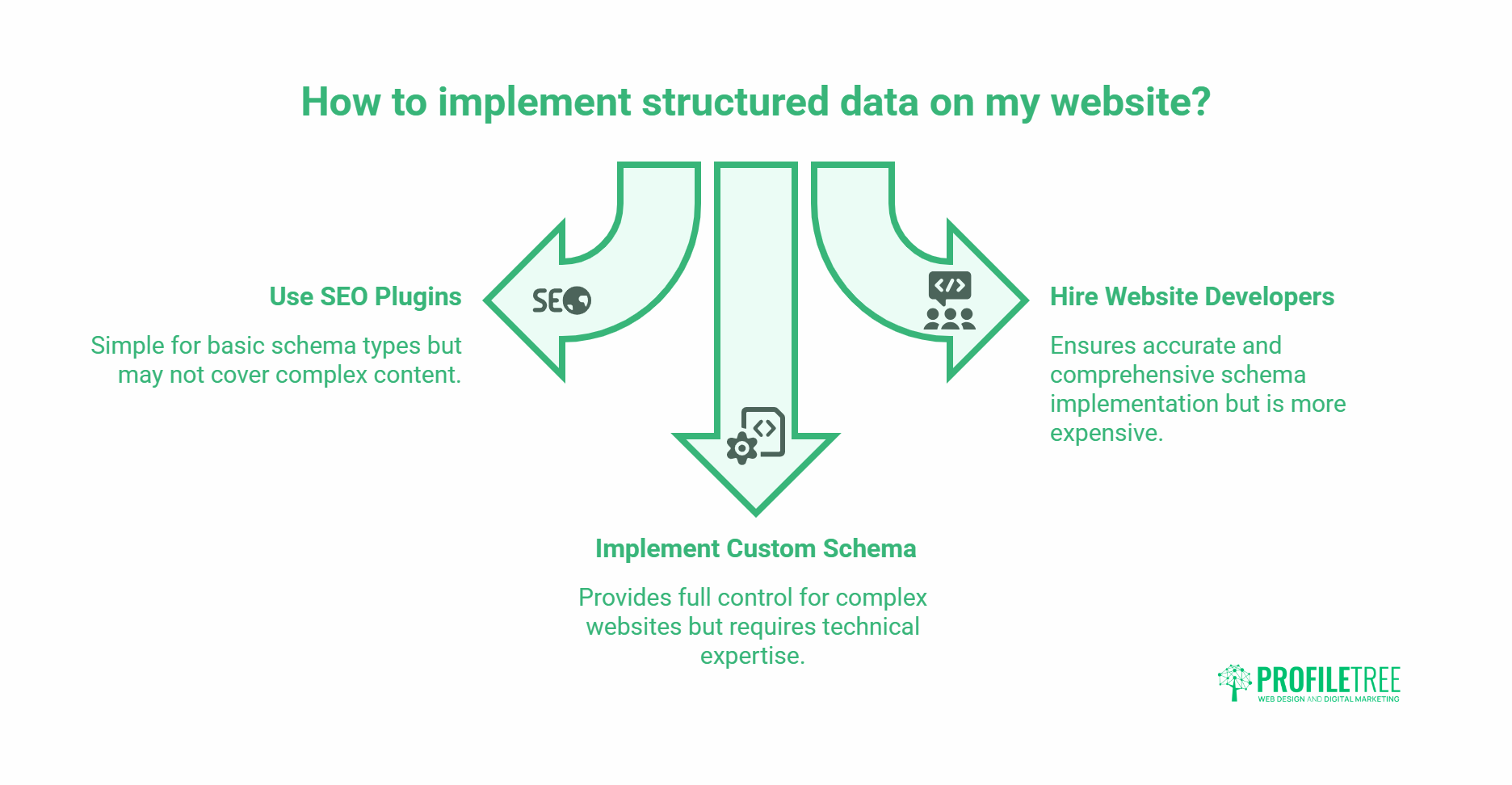
The practical question for most business owners isn’t what structured data is; it’s how to get it onto their website without breaking anything.
WordPress and SEO Plugins
If your website runs on WordPress, the simplest route is through an SEO plugin such as Yoast SEO or Rank Math. Both generate JSON-LD schema automatically for pages, posts, and custom post types based on settings you configure. At a minimum, they will output Organisation or LocalBusiness schema, Article schema for blog content, and BreadcrumbList schema across the site. This is not a complete solution: plugins generate a generic schema and cannot automatically mark up complex service pages, product variants, or FAQ sections. Those require manual configuration or custom development.
For businesses that want their schema properly configured rather than just present, working with a team offering website development services is the right approach. Plugin defaults often contain errors or omit required properties, and a broken schema can be worse than none at all, because it signals inconsistency to Google’s quality systems.
Testing and Validating Your Schema
Google provides a Rich Results Test tool that lets you check any URL and see exactly what structured data it contains and whether it passes validation. Common errors include missing required properties, mismatched data (where the schema says something different from what’s visible on the page), and incorrect nesting of schema types. Every schema implementation should be tested at launch and rechecked whenever the page content changes significantly. A product page with outdated pricing in its schema is not just a technical problem; it’s a trust issue if a customer sees a price in search that doesn’t match the price on the page they land on.
Custom Schema for Complex Websites
Larger websites with multiple service areas, team member profiles, case studies, and events need custom schema solutions rather than plugin defaults. This means either adding JSON-LD manually to page templates or using a structured data plugin with sufficient flexibility to handle the site’s content model. For organisations managing several service lines across different locations, structured data becomes part of the technical architecture of the site, not an afterthought. If your business is planning a website redesign, structured data should be part of the web design brief from day one rather than retrofitted afterwards.
Structured Data as Part of a Broader SEO Strategy
Structured data on its own won’t make a poorly optimised website rank well. It works as a multiplier on the fundamentals: good content, clear page structure, strong internal linking, and legitimate authority signals. The businesses that get the most from schema markup are those that already have those foundations in place and use structured data to communicate their content quality more clearly to search engines.
Combining Schema With Content Strategy
The types of content most likely to earn rich results in search are exactly the types that also perform well in traditional rankings: FAQ content, how-to guides, product pages with real customer reviews, and event listings with accurate details. An SEO strategy that includes structured data implementation alongside content development gets compounding returns: better rankings from the content quality, better click-through rates from the enhanced search listings, and broader AI visibility from the entity signals.
Structured Data and Digital Marketing
Structured data supports digital marketing campaigns by improving the quality of organic traffic before it arrives. A search listing that already shows your star rating, price range, and a clear description of what you do pre-qualifies the click. People who click a rich result already know more about your business than people clicking a standard listing. That typically means lower bounce rates, better on-page engagement, and higher conversion rates, all of which feed back into Google’s quality signals for the page.
Training Your Team to Maintain Schema
Structured data degrades over time. Product pages change. Events end. Opening hours update. A schema implementation that was accurate at launch can become misleading within months if there’s no process for keeping it current. For businesses investing in digital training, understanding how to audit and maintain schema markup is a practical skill that protects the investment made in the initial implementation. ProfileTree’s training programmes for SMEs cover this as part of broader technical SEO awareness, giving in-house teams the knowledge to catch issues before they affect search performance.
Conclusion
Structured data is the clearest signal your website sends to search engines about what your business does and who it serves. Getting it right means more visible search listings, better placement in local results, and stronger representation in AI-generated answers. If your website doesn’t currently have schema markup, or if it was added through a plugin and never properly configured, a structured data audit is one of the most straightforward improvements you can make to your search performance. ProfileTree’s SEO team works with businesses across Northern Ireland and the UK to implement, test, and maintain structured data as part of a complete SEO strategy.
Frequently Asked Questions
What is structured data in SEO?
Structured data is a standardised format for labelling website content so search engines can understand what it means, not just what it says. It uses vocabulary from Schema.org and is typically added as JSON-LD code in the page’s HTML. When implemented correctly, it allows Google to generate rich results in search, including star ratings, FAQ dropdowns, product prices, and event details, directly within the search listing.
Does structured data directly improve search rankings?
Structured data is not a direct ranking factor in the traditional sense. Google has stated that most schema types don’t cause a page to rank higher on their own. What structured data does is help search engines understand your content more accurately, which can improve how the page is represented in results and may support rankings indirectly by increasing click-through rates and reducing bounce rates over time.
Which types of structured data matter most for small businesses?
For most SMEs, the highest-priority schema types are LocalBusiness (for address, hours, and contact details), FAQPage (for service page question sections), and Article or BlogPosting (for content pages with author information). Product schema is essential for any business selling goods online. The right priority depends on your specific business model and the pages on your website that drive the most commercial value.
How do I check if my website already has structured data?
Google provides a free Rich Results Test tool at search.google.com/test/rich-results. Enter any URL from your website and it will show you what structured data is present, whether it’s valid, and whether it qualifies for rich results in search. Bing Webmaster Tools also provides schema validation data if your site is verified there. If you’re unsure how to interpret the results, an SEO audit from a specialist team will give you a clear picture of what’s working and what needs fixing.
Can I add structured data to WordPress without coding?
Yes, to a point. SEO plugins like Yoast SEO and Rank Math generate basic schema automatically based on your page and post settings. They handle Organisation, Article, and BreadcrumbList schema reasonably well for standard configurations. More complex implementations, such as custom service pages, multiple locations, or detailed product data, typically require manual JSON-LD or custom development to get right. Plugin-generated schema should always be tested using Google’s Rich Results Test to confirm it’s valid.
How does structured data help with AI search tools like ChatGPT and Google AI Overviews?
AI search systems, including Google’s AI Overviews and tools like Perplexity, tend to cite content that is clearly structured, factually specific, and easy to extract. Structured data supports this by signalling to those systems what your content is about and who produced it. Pages with clean entity signals, accurate author markup, and well-formed FAQ schema are more likely to appear in AI-generated answers for relevant queries. This is becoming an increasingly important consideration for businesses investing in content and SEO.