
Local SEO for Law Firms: A Practical Guide
Table of Contents
Local SEO for law firms means optimising your online presence so your practice appears when people search for legal services in your area. The key elements are your Google Business Profile, consistent contact details across directories, location-specific website content, and a steady flow of genuine client reviews. Together, these signals tell Google your firm is the relevant local answer.
When someone needs a solicitor, their first move is usually a Google search. “Family lawyer Belfast,” “personal injury solicitor near me,” “employment law firm Dublin.” Local SEO for law firms is what determines whether your practice appears in those results or whether a competitor does. It is not about technical tricks; it is about giving search engines a clear, consistent, and credible picture of who you are, where you are, and what you do.
This guide covers the practical steps law firms can take to improve their visibility in local search, from setting up a well-structured Google Business Profile to building the kind of backlink profile that signals authority to Google. Each section is grounded in what actually moves the needle for professional services businesses.
ProfileTree’s SEO services include local search strategy for professional services firms across Northern Ireland, Ireland, and the UK.
Google Business Profile for Law Firms
Your Google Business Profile (GBP) is the single most visible element of your local SEO. It controls what appears in the map pack, the knowledge panel, and local search results, so getting it right is not optional.
Creating an Accurate and Complete GBP Listing
Start with the basics: your firm’s name, address, phone number, website URL, and business category. Choose the most specific legal category available, such as “Solicitor” or “Law Firm,” rather than a generic option. A vague category tells Google less about who you serve and reduces the chance of appearing in relevant searches.
Your description should explain your main practice areas and the geographic area you serve. Include terms that real clients use when searching, not the formal legal language your firm uses internally. “Family law Belfast” is more valuable in a GBP description than “matrimonial and family proceedings.”
The Importance of Accurate NAP Details
NAP stands for Name, Address, and Phone number. These three pieces of information need to be identical across every platform where your firm is listed: your website, your GBP, legal directories, and general business directories. A discrepancy as small as “St.” versus “Street” in your address can create confusion for search engines and reduce your local ranking confidence.
Add your opening hours, a selection of photos of your office and team, and your firm’s services list. Each of these signals gives Google more to work with when matching your profile to a local search query.
Appearing in the Google Local Pack
The local pack is the three-business block that appears at the top of Google results for location-based searches. For law firms, appearing here is far more valuable than ranking on page one of organic results because it is the first thing most searchers see. The factors that influence local pack placement include proximity to the searcher, relevance of your GBP category and content, and prominence, which is largely determined by reviews and backlinks.
Consistent effort across all three areas, rather than focusing on just one, is what builds and maintains a local pack position over time.
Website Optimisation for Lawyers
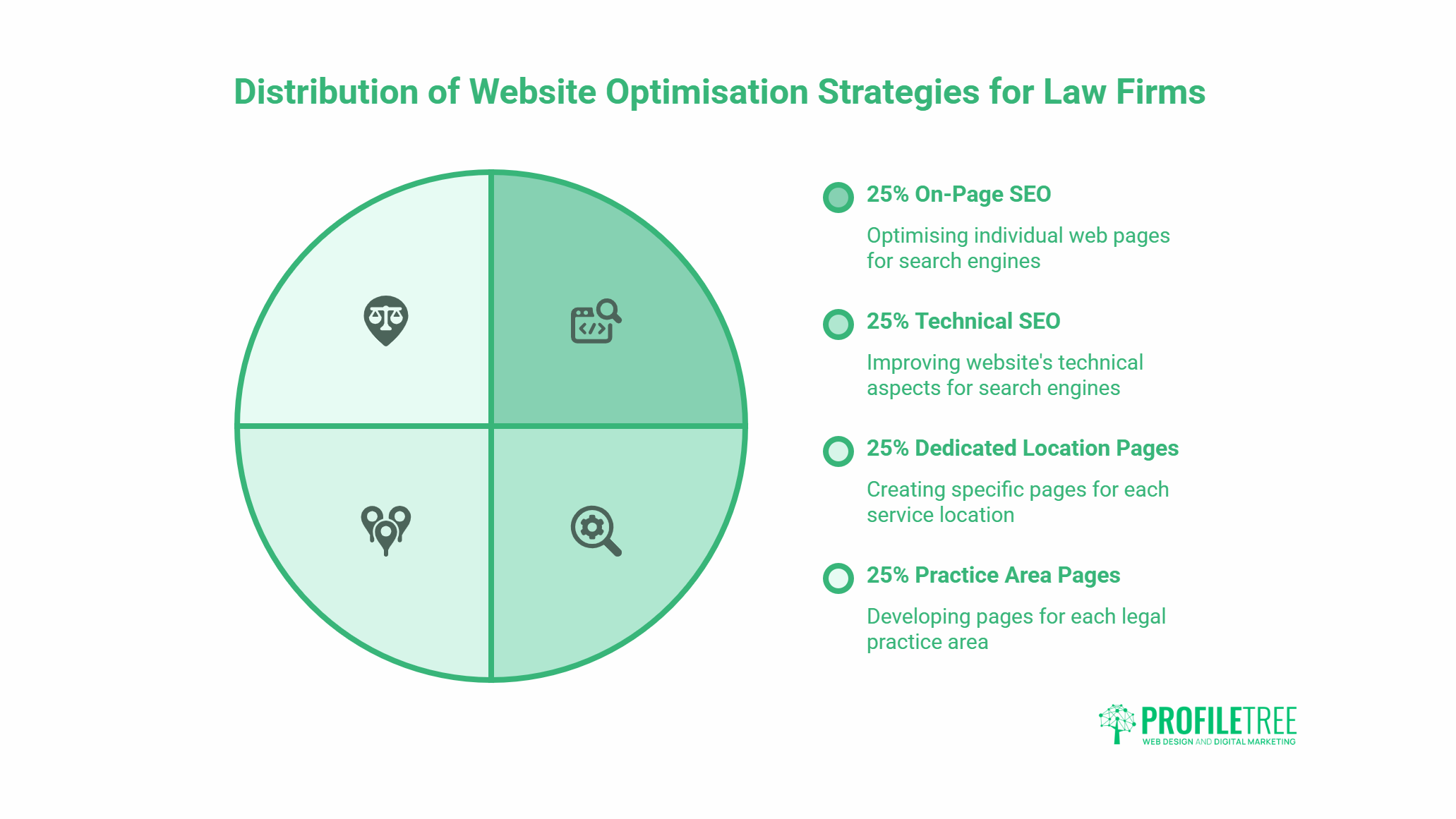
Your GBP gets you into local results. Your website is what converts those visits into enquiries. The two need to work together, and that means your website must also send clear local signals to search engines.
ProfileTree’s website design services include locally optimised site structures built for professional services firms.
On-Page SEO for Law Firm Websites
Every practice area page on your website should target a specific keyword and location. “Employment law solicitors Belfast” and “personal injury lawyers Northern Ireland” are different pages, serving different search intents. Trying to cover both on one generic page means you rank well for neither.
Title tags and meta descriptions should include your practice area and location. Your H1 on each page should match the primary term you want that page to rank for. And the first 100 words of your content should confirm to Google and to the reader what the page is about, without burying the key information in a lengthy preamble.
Technical SEO and Site Structure
A law firm website that loads slowly or breaks on mobile will not rank well, regardless of how good the content is. Google’s mobile-first indexing means your mobile experience is what gets evaluated. Use PageSpeed Insights to identify specific issues rather than relying on a general sense that the site “feels fast.”
Your site structure matters too. A clear hierarchy, where your homepage links to practice area pages, which in turn link to relevant blog content and FAQs, helps both search engines and visitors find what they need. An SSL certificate (HTTPS) is now a basic requirement, not an optional extra.
If your current site has structural or performance issues, ProfileTree’s website development team can audit and rebuild the technical foundations.
Dedicated Location and Practice Area Pages
If your firm serves multiple locations, each location deserves its own page with genuinely local content, not a copy-paste of another location page with the city name swapped. Mention the specific courts you appear in, the local regulatory bodies relevant to your clients, or the types of businesses and individuals typically seeking your services in that area. Google can identify thin location pages, and they do more harm than good.
Content, Citations, and Backlinks
Publishing content that answers real legal questions builds authority with both search engines and potential clients. It also creates the kind of pages that earn backlinks and social shares without you having to ask for them.
Creating Content That Serves Legal Searchers
ProfileTree’s content marketing services help law firms produce the kind of substantive, practice-area content that ranks and converts.
The best legal content is specific. “What happens if I miss a mortgage payment in Northern Ireland?” is more useful and more rankable than “mortgage advice.” Address the questions your clients actually ask during consultations. These are the questions being typed into search engines, and a clear, accessible answer on your website builds trust before a client has even picked up the phone.
Practice area landing pages should go beyond a basic description of your services. Include what clients can expect from the process, how long matters typically take, what information they should bring to an initial consultation, and what outcomes are realistically achievable. This depth of information is what differentiates a useful page from a thin brochure.
Local Citations and Legal Directories
A citation is any mention of your firm’s name, address, and phone number on another website. Google uses citations as a trust signal: if your details appear consistently across reputable directories, it confirms that your firm is legitimate and established at that location.
Legal directories are the priority. Avvo, The Law Society directory, and sector-specific listings relevant to your jurisdiction carry more authority than general directories for a law firm. Submit your details accurately and check existing listings for errors. An incorrect phone number on a directory you have not visited in three years is still a negative signal.
Local business directories, including your local Chamber of Commerce and regional business networks, provide additional citation sources. They also connect you to local community signals that strengthen geographic relevance in search results.
Building a Backlink Profile for Law Firms
Backlinks from authoritative, relevant websites tell Google that other credible sources consider your content worth referencing. For law firms, this means pursuing links from local business organisations, legal professional bodies, law school publications, local press, and community sponsorships.
Writing guest content for local business publications or contributing expert commentary on legal issues to news outlets are both legitimate ways to earn backlinks while raising your firm’s profile. The quality of the linking site matters far more than the volume of links. A single link from a respected regional publication is worth more than dozens of links from low-authority directories.
Reviews, Social Media, and Tools
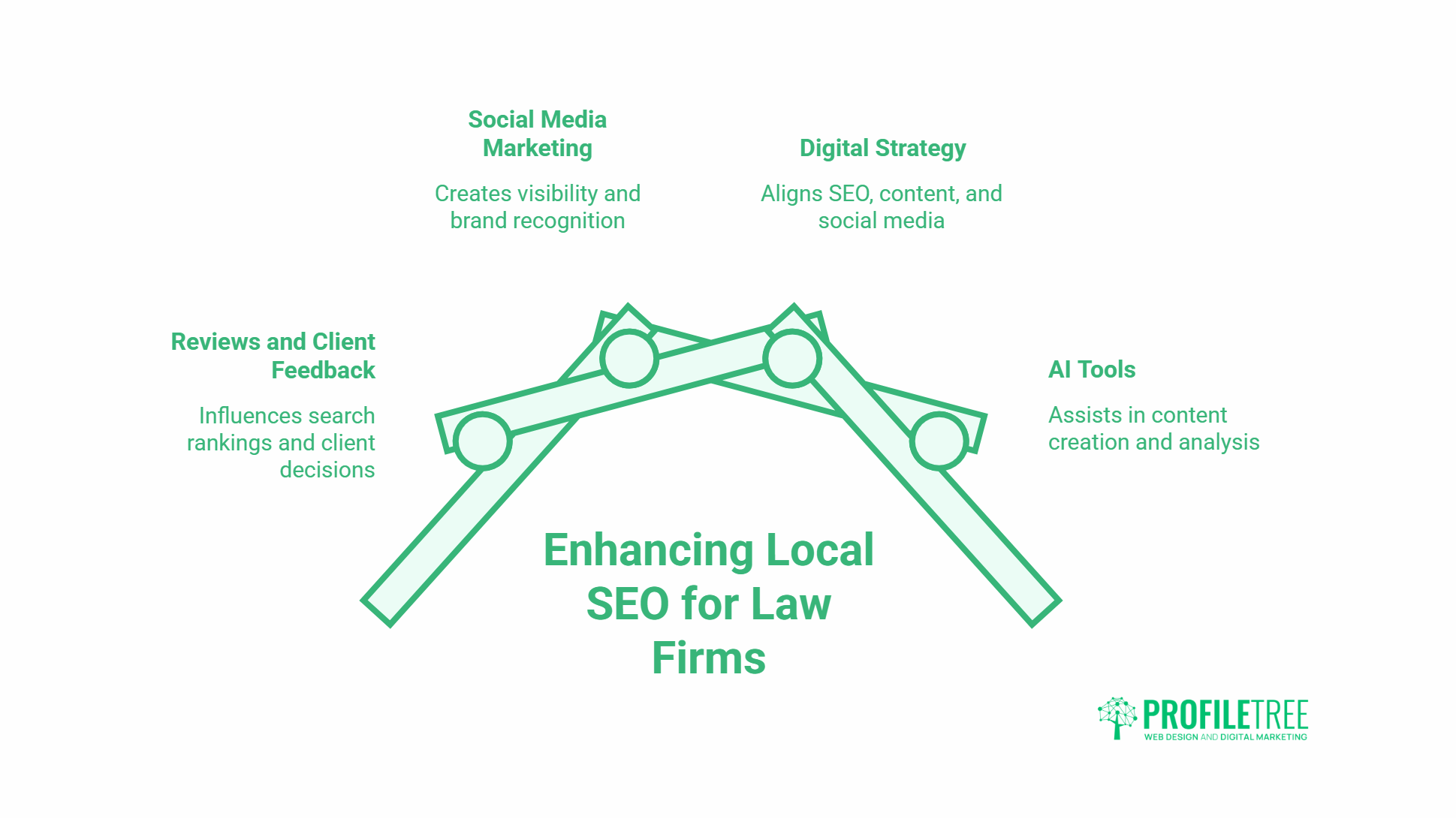
Reviews influence both search rankings and client decisions. Social media creates an additional channel for visibility. And the right tools help you track whether your efforts are producing results.
Managing Reviews and Client Feedback
Google reviews are a direct local ranking factor. The number of reviews, the average rating, and the recency of reviews all contribute to how prominently your firm appears. Ask satisfied clients to leave a review at the natural close of a matter, when the outcome is fresh, and goodwill is high. A follow-up email with a direct link to your Google review page removes friction and increases the likelihood they will follow through.
When a negative review appears, respond promptly and professionally. Acknowledge the concern, offer to discuss it privately, and avoid any specifics that could breach client confidentiality. A measured, constructive response demonstrates professionalism to anyone reading the exchange, not just the person who left the review. Compliance with Solicitors Regulation Authority guidance on client testimonials applies to how you solicit and respond to reviews.
Social Media for Law Firms
ProfileTree’s social media marketing team can help law firms build a consistent, credible presence across the platforms where their clients spend time.
Social media does not directly influence Google rankings, but it supports local SEO indirectly. A firm with an active, professional LinkedIn page, regular posts that demonstrate legal expertise, and genuine engagement with local business content builds brand recognition. When someone encounters your firm in search results after having seen it on social media, the click-through rate improves, and the likelihood of an enquiry goes up.
The platform matters. LinkedIn suits commercial and employment law firms. Facebook can work well for family law and personal injury practices, where potential clients are more likely to seek recommendations through personal networks. Focus on one or two platforms you can maintain consistently rather than spreading thinly across five.
Using Digital Strategy to Connect the Moving Parts
ProfileTree’s digital strategy service helps professional firms align their SEO, content, social media, and web presence into a single, coherent plan rather than a collection of disconnected activities.
Google Analytics shows you where your website visitors are coming from and which pages they spend time on. Google Search Console shows which search queries your pages appear for, which positions they hold, and how many people click through. For law firms new to SEO, these two free tools are sufficient to identify where to focus improvement efforts. Over time, more specialised local SEO software, such as BrightLocal for citation tracking and local rank checking, can add useful detail.
Leveraging AI Tools for Legal Marketing
ProfileTree’s AI transformation services and AI training programmes are helping professional services firms understand where AI fits into their marketing without replacing the human expertise that clients are actually hiring.
AI-powered tools are increasingly relevant to law firm marketing, from drafting initial content for review by a qualified solicitor to analysing which topics are generating traffic from potential clients. The key distinction is that AI produces a starting point; the legal expertise that makes that content credible and compliant still has to come from your team.
Where to Start with Local SEO for Your Law Firm
The firms that see the clearest results from local SEO are not the ones that try everything at once. They start with the foundation: a complete and accurate Google Business Profile, consistent NAP details across directories, a well-structured website with dedicated practice area pages, and a process for collecting reviews after each matter closes. Get those right before adding content marketing or paid campaigns on top. If you want help building that foundation, ProfileTree’s SEO team works with professional services firms across Northern Ireland, Ireland, and the UK.
FAQs: Local SEO for Law Firms
How long does it take for local SEO to produce results for a law firm?
Most law firms see meaningful movement in local search positions within three to six months of consistent effort. A complete Google Business Profile, accurate citations, and a handful of new reviews can improve map pack visibility faster than organic rankings. Organic ranking improvements for competitive terms like “solicitor Belfast” or “personal injury lawyer Dublin” typically take six to twelve months of sustained content and link-building activity. The timeline depends heavily on the current state of your online presence and the competitiveness of your local market.
What is the most important factor in local SEO for solicitors?
Your Google Business Profile is the single most important starting point. An incomplete or inaccurate profile is the most common reason law firms fail to appear in local search results despite having a decent website. After the GBP, consistent NAP details across directories and a genuine review strategy are the next most impactful factors. These three elements, done well, will outperform a more complex strategy that neglects the basics.
How do client reviews affect local search rankings?
Reviews influence local search rankings directly through the number, recency, and average rating of your Google reviews. Google treats a high volume of recent, positive reviews as a trust signal that your firm is active, legitimate, and well-regarded. They also influence click-through rates from search results: a firm with 4.8 stars and 60 reviews will get more clicks than a competitor with no reviews, even if both appear at the same position. Soliciting reviews at the natural close of each matter, rather than in bulk, produces the most consistent and credible result.
Should a law firm have separate pages for each practice area?
Yes. Each major practice area should have its own dedicated page targeting a specific keyword and location. Combining family law, employment law, and personal injury onto a single “services” page means none of those terms ranks as strongly as they would on a focused, individual page. The same applies to locations: if your firm serves Belfast and Derry, each deserves its own page with genuinely location-specific content, not just a swapped city name.
How do legal directories factor into local SEO?
Legal directories are among the most authoritative citation sources for law firm SEO. Directory listings provide backlinks, add citation volume, and specifically reach people actively searching for legal help. The priority directories for UK and Irish firms include The Law Society of Northern Ireland directory, The Law Society of Ireland directory, and sector-specific listings relevant to your practice areas. General business directories add supporting citation signals. Check existing listings regularly for accuracy, as outdated information on a directory you submitted years ago can undermine your local SEO efforts.
Does social media help with local SEO for law firms?
Social media does not directly influence Google’s ranking algorithm, but it contributes to local SEO indirectly. An active, professional social presence increases brand awareness, which improves click-through rates when your firm appears in search results. Social profiles on LinkedIn and Facebook also appear in search results for your firm’s name, giving you more control over what potential clients see when they research you.