
Content Marketing for Tech Startups: A UK and Ireland Strategy Guide
Table of Contents
Tech startups face a particular content challenge. You need to build brand credibility, generate organic traffic, and convert visitors into users or investors, often with a lean team and a limited budget. Generic advice about “posting valuable content consistently” does not get you there.
This guide covers how content marketing for tech startups actually works in the UK and Ireland: the strategic decisions that matter, the formats that earn traction, the SEO foundations that support everything else, and the regional advantages that most competitors overlook. ProfileTree works with digital businesses across Northern Ireland, Ireland, and the UK on content marketing services built around exactly this kind of long-term, problem-first approach.
Why Content Marketing Hits Differently for Tech Startups
Content marketing for a tech startup is not the same discipline as content marketing for a retailer, a consultancy, or an established SaaS business. The starting conditions are different, and the strategy needs to reflect that.
Most content marketing guides are written for businesses with existing audiences. Tech startups operate in a different context. You may be explaining a product category that lacks widespread recognition. You may be competing with companies that have ten times your domain authority. You may need content to serve three different audiences simultaneously: potential customers, early-stage investors, and the technical talent you want to recruit.
That tension shapes every strategic decision. A B2C fintech startup in Belfast has different content needs from a B2B SaaS company targeting enterprise clients in London. The principles overlap, but the execution diverges.
“For startups, content marketing works best as a long-term investment, not a quick acquisition channel,” says Ciaran Connolly, founder of ProfileTree. “The startups that build genuine topical authority early are the ones that find organic traffic compounding in their favour twelve to eighteen months later.”
What both have in common is this: content marketing is not optional for tech startups. For companies that cannot afford sustained paid advertising and need to build trust in a product people cannot yet see or touch, organic content creation for tech companies is one of the most cost-effective ways to build lasting commercial visibility.
Building a Content Strategy That Fits a Startup’s Reality
Getting content strategy right from the start saves significant time and budget. The mistakes startups make at this stage, trying to speak to everyone, writing about the product rather than the problem, chasing the wrong keywords, are costly to undo once a content archive starts to grow.
Start With a Single Audience, Not Three
Early-stage startups often try to use content to speak to investors, customers, and recruits at once. The result is content that serves none of them particularly well. It’s more productive to pick the audience that represents your most pressing commercial need and build a content strategy around them first.
For most early-stage tech startups, that means potential customers. Once you have content that clearly explains what you do, who it helps, and why it works, you can adapt it for investor decks and recruitment pages rather than building three separate content tracks. If investor-facing visibility is a near-term priority, ProfileTree’s guide to using digital marketing strategy to attract investors covers how the two efforts can run in parallel without diluting either.
Define the Problem Before the Product
The most effective content for tech startups addresses the problem the product solves, not the product itself. People searching for solutions to a specific business problem are at exactly the right stage of awareness for content marketing to work.
A startup building AI-driven inventory management software for UK retailers will find more traction writing about stock forecasting accuracy, the cost of stockouts, or supply chain planning for small retailers than writing about their own platform. The content attracts people with the problem; the product page closes them out.
This is the foundation of keyword research for tech startups. You are not looking for keywords that describe your product. You are looking for keywords that describe the problem your product solves, the questions your ideal customer asks, and the comparisons they make when evaluating options.
Keyword Research for Startup Content
Keyword research for a tech startup differs from keyword research for an established brand. You are unlikely to rank for short, high-volume terms in the early stages. The realistic opportunity lies in longer, more specific queries where search intent is clearer and competition is lower.
When ProfileTree works with early-stage digital businesses on digital marketing strategy, the keyword approach typically starts with problem-focused long-tail phrases, location-qualified terms (particularly relevant for UK and Irish startups targeting local B2B clients), and question-based queries that map to the buyer’s research process. A content plan built on twenty well-chosen long-tail keywords will consistently outperform a strategy targeting five high-volume terms that a startup has no realistic chance of ranking for in the near term. It’s also worth grounding your assumptions in current data; ProfileTree’s UK small-business statistics breakdown is a useful reference point when you’re building the business case for a content programme internally.
Content Formats That Work for Tech Startups
Not every content format produces the same return for a startup. Some are high-effort and slow to pay back; others build authority quickly when applied to the right topic.
Long-Form Blog Content and SEO
Long-form content remains the primary vehicle for organic search visibility. Pages that cover more than 2,000 words and address multiple related questions within a topic tend to perform better in AI-generated search overviews and featured snippets, which matters for startups trying to build early visibility.
The format that tends to work best is the comprehensive guide: a single, authoritative page that covers a topic thoroughly enough to be genuinely useful, structured so readers can navigate to the sections most relevant to them. This earns links, ranks for multiple related queries, and builds topical authority faster than publishing a high volume of shorter posts.
One practical discipline that separates effective startup content from ineffective content is the information-gain test. Before publishing anything, ask what this piece offers that isn’t already available in the top five results for the target query. If the answer is “nothing particularly,” the piece is unlikely to rank. If the answer is a genuine insight, a regional angle, original data, or a specific worked example, it has a realistic chance.
Video Content
For tech startups, video serves a purpose that written content cannot fully replicate: it makes the product and the people behind it visible. Explainer videos, product demos, and founder commentary all address a central question that investors and early customers have: whether they can trust these people to deliver something real.
Video also performs well in distribution. A well-produced explainer can sit across your product page, feature in email campaigns, and appear in YouTube search results for relevant queries. ProfileTree’s video production work with digital businesses has consistently shown that even short, clearly structured videos generate meaningful engagement when placed at the right points in the content journey.
SEO Foundations for Tech Startups
SEO is where content marketing and technical performance meet. Startups that get the foundations right early avoid the expensive rework of rebuilding site structure and content architecture after launch. The good news is that this foundational work is not complicated; it is just consistently skipped.
On-Page Optimisation
On-page SEO for a tech startup begins with the basics: every page needs a clear, specific title that reflects the actual content, a meta description that gives searchers a reason to click, and a heading structure that makes the page easy to read. These are not advanced tactics. They are the minimum entry point for organic visibility, and a surprising number of startup websites launch without them.
Beyond the basics, on-page SEO for tech startups should focus on two areas that generic guides underemphasise. First, website development needs to build a URL structure around the content hierarchy, using descriptive phrases rather than meaningless slugs. Second, the internal linking structure should actively pass authority from your highest-traffic pages to your most commercially important ones. ProfileTree’s own SEO services are built around this same principle, whether the client is a Belfast trades business or a tech startup targeting UK-wide search terms.
SEO for SaaS and Software Products Specifically
Software and SaaS companies face SEO challenges that general startup advice does not fully cover: pricing pages, comparison and alternatives content, integration pages, and documentation all need to work as search assets, not just as functional pages. ProfileTree’s dedicated guides to SEO for SaaS companies and SEO strategies for software companies go into more depth on keyword mapping and content structure in this specific context, and are worth reading alongside this guide if your startup sells software rather than a physical product or service.
Technical SEO Basics
Site speed, mobile performance, and crawlability matter more for startups than for established brands, not less. An established brand with thousands of inbound links can absorb slow page speed; a startup building domain authority from scratch cannot afford unnecessary friction. Tools like Google Search Console are free, and reviewing them regularly for crawl errors, indexing issues, and performance data is a basic operational discipline for any startup with a content programme. A periodic SEO audit catches the technical issues that content alone cannot fix, and a modest, well-targeted link-building effort compounds the authority that good content earns.
The UK and Ireland Regional Advantage
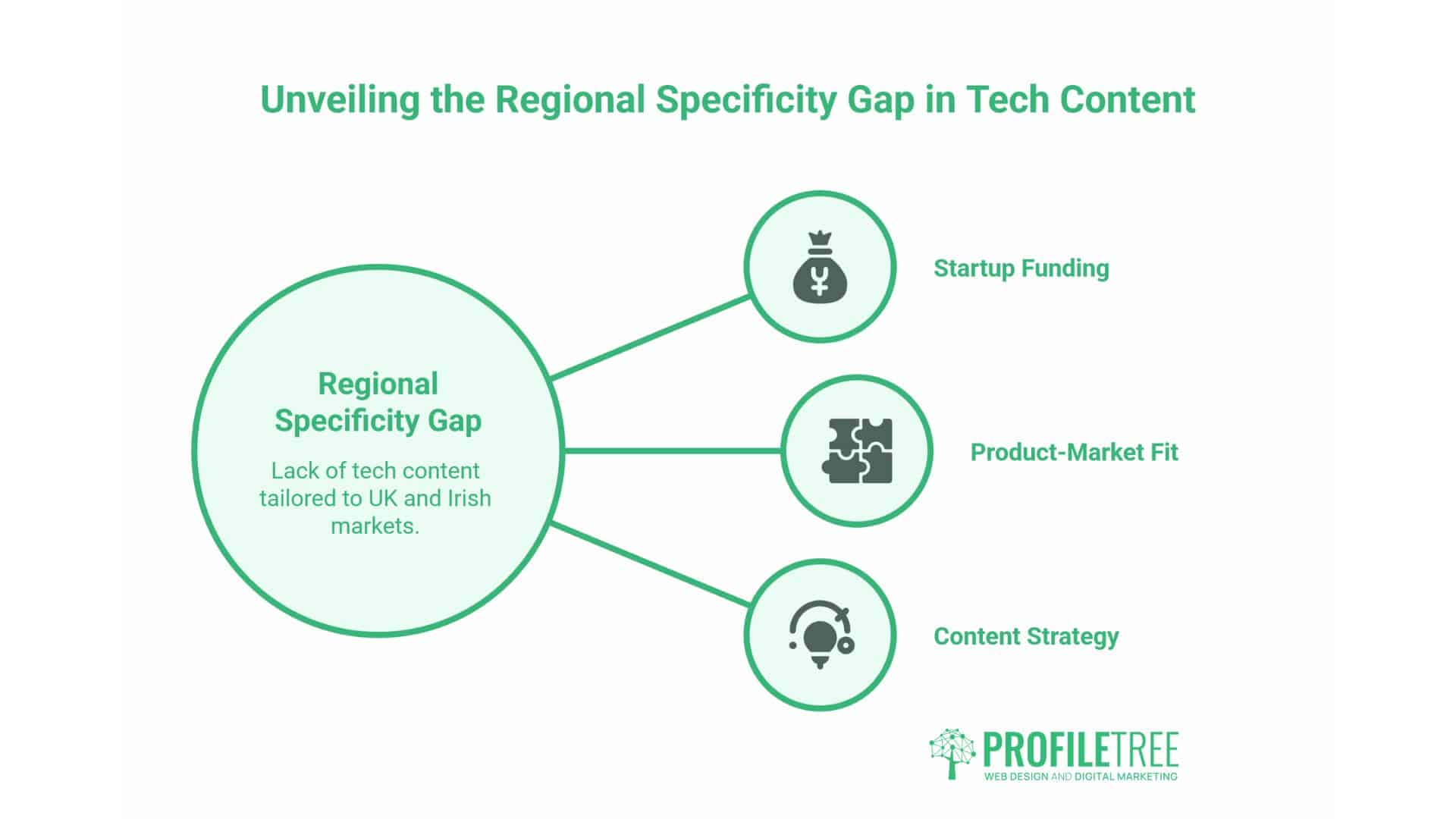
One of the clearest competitive opportunities for UK and Irish tech startups is the regional specificity gap. Most high-ranking content on topics like startup funding, product-market fit, or content strategy is written from a London or a US perspective, with London-centric or US regulatory context and funding examples. There is a consistent gap for content that addresses the same topics from the perspective of a company operating in Belfast, Derry, Dublin, or the wider Northern Ireland and Ireland market.
That gap is worth taking seriously. Coverage of the Belfast-Dublin corridor specifically, including the practical realities of operating across two tax jurisdictions, the support available through bodies like Invest Northern Ireland, and R&D tax relief schemes on both sides of the border, is thin compared to the volume of London-focused content. Startups that write from genuine experience of this market, rather than adapting a generic UK template, earn a level of trust and specificity that larger competitors cannot easily replicate.
ProfileTree is a Belfast-based digital agency, and the same regional specificity that helps our clients rank locally applies directly to a tech startup’s content strategy: naming the actual funding bodies, referencing the actual talent pipeline (Ulster University, Queen’s Belfast, and the wider Northern Ireland tech scene), and writing with the market’s specific constraints and advantages in mind, rather than treating Belfast as an afterthought to a London-first guide.
Content Distribution and Social Media
Publishing strong content is only half the work. Without a distribution strategy, even well-written, well-optimised content reaches a fraction of the audience it could.
Choosing Platforms Strategically
Tech startups often make the mistake of trying to maintain a presence on every social platform at once. The result is a thin, inconsistent presence that builds nothing. A more productive approach is to identify one or two platforms where your target audience is actually active and build a genuine presence there before expanding.
| Startup type | Strongest platform | Why |
|---|---|---|
| B2B SaaS targeting enterprise buyers | Reaches decision-makers directly, supports long-form thought leadership | |
| B2C fintech or consumer app | Instagram or TikTok | Visual, high engagement, fits younger demographic research habits |
| Developer tools and technical products | X and technical communities | Reaches practitioners where they already discuss tools |
| Regional B2B services | LinkedIn plus local search | Combines professional reach with local SEO |
The decision should follow the audience, not the platform’s general reputation.
Organic Versus Paid Distribution
Early-stage startups with limited budgets often ask whether to invest in paid content distribution or focus on organic. Both serve different purposes, and neither replaces the other. Organic content builds long-term search authority and generates traffic without ongoing spend. Paid distribution amplifies content quickly and can validate which topics resonate before investing in deeper coverage.
A practical approach is to use paid distribution selectively to amplify content that is already performing well organically, extending the reach of proven pieces rather than allocating paid budget to content that has not earned organic traction.
Brand Voice and Content Consistency
Brand voice is one of the most underrated competitive advantages available to a tech startup. In a market where dozens of companies may be addressing similar problems, how you write is often what makes your content memorable and keeps people coming back.
A consistent brand voice matters for a specific reason: Two articles covering the same topic in the same format will be differentiated primarily by their writing. A distinctive, confident, specific voice is a genuine competitive asset, and establishing it early, before you have a large content archive to be consistent with, is considerably easier than retrofitting it onto existing content later.
A content calendar does not need to be complicated. At its most basic, it is a shared document that shows what is being published, when, on which channel, and who is responsible. For a lean startup team, publishing two substantive long-form pieces per month and distributing them consistently across relevant channels will outperform publishing ten short pieces without a distribution strategy.
Using Data to Improve Content Performance
Content that is published without review leaves significant value on the table. For tech startups, where every hour of content effort needs to justify itself commercially, the discipline of reviewing what is working and acting on that data is what separates programmes that plateau from those that keep growing.
Traffic is the most visible metric, but not always the most useful one for early-stage startups. The metrics that deserve more attention are organic click-through rate by page, which reveals whether your titles and meta descriptions are compelling; time on page, which indicates whether your content holds attention; and conversion events tied to content pages, which connect content investment to commercial outcomes. Google Search Console shows which queries drive impressions and clicks to each page. For a startup with a modest content archive, reviewing this data quarterly and using it to identify which topics are gaining traction gives clear guidance on where to invest more content effort.
Publishing an article and moving on means leaving value on the table. Articles that rank for a handful of queries but underperform often need relatively modest improvements: a better title, an additional section covering a related question, or clearer internal links to related content. Building a habit of reviewing and updating existing content every six months typically produces faster improvements in organic performance than publishing an equivalent number of new pieces. ProfileTree’s own approach to this, the ProfileTree methodology, sets out how ongoing review fits into a wider content and SEO programme.
Thought Leadership and Community
Beyond SEO and distribution, content marketing for tech startups has a longer-term function: building the kind of recognised authority that attracts press coverage, investor attention, and partnership opportunities. Thought leadership content is the vehicle for that, but it only works when grounded in specific, verifiable experience rather than broad industry commentary.
Thought leadership content is most effective when rooted in specific experience. Publishing a post arguing that “AI is transforming X industry” without supporting evidence carries little weight. Publishing a post explaining precisely what changed when you tested a specific approach on a specific problem, with clear before-and-after comparisons, builds credibility quickly.
The bar for thought leadership is not brilliance. It is specificity. A founder who writes clearly about the precise problem their product solves, what they tried that did not work, and why the approach they landed on was different will build more genuine authority than one who publishes polished commentary on industry trends.
For consumer-facing tech startups in particular, community can be one of the highest-return distribution channels available. Early adopters who feel invested in a product’s development become its most effective advocates. Content that invites participation, asks real questions, shares genuine challenges, and acknowledges what is not yet solved tends to generate more meaningful engagement than polished promotional material.
Building Content That Compounds
Content marketing for tech startups works when it is built around a clear understanding of the audience, the problems they are trying to solve, and the specific queries that reflect their research process. The UK and Ireland startup ecosystem offers real opportunities for regional specificity that most competitors ignore, and that gap closes a little further every time a generic, London-first guide gets published instead of one that actually understands Belfast, Derry, or Dublin.
ProfileTree works with digital businesses across Northern Ireland, Ireland, and the UK on content marketing, SEO, video production, and digital training. For a fuller picture of why founders choose to work with an agency rather than build this capability in-house from scratch, see “Why Choose ProfileTree sets out the practical trade-offs. If you want a second pair of eyes on your own startup’s content approach, get in touch to talk it through.
FAQs
How much should a tech startup budget for content marketing?
Start with a realistic monthly cadence, such as two substantive pieces, and measure what that produces before committing to more.
Should a pre-launch startup start content marketing before the product is ready?
Yes, provided the content addresses the problem rather than the product. It builds search visibility and trust before launch.
How is content marketing for a tech startup different from content marketing for a SaaS company?
A pre-revenue startup often serves investors and recruits alongside customers. A mature SaaS company can focus almost entirely on customer acquisition, using formats like comparison and pricing pages.
What is the fastest way for a tech startup to get content ranking on Google?
There is no genuine shortcut. Long-tail, problem-focused keywords with low competition, backed by solid technical SEO, is the fastest realistic path.