
Social Media Search Tool: Free and Paid Options for UK Businesses
Table of Contents
Native search on Facebook, Instagram, X, LinkedIn, and TikTok only shows what’s happening on that platform, so tracking a brand across all of them requires a dedicated social media search tool. The right one depends on budget and use case: Social Searcher covers free, occasional lookups; Mention and Hootsuite suit ongoing brand monitoring; Brandwatch and Keyhole suit agencies and larger campaigns. This guide breaks down what each tool actually delivers in 2026, what’s changed since the last major platform API shake-up, and how to search social media properly without paying for anything at all.
Every business that does any kind of monitoring or research on social media quickly hits the same wall: each platform’s native search only looks at its own data. If you want to track brand mentions across Facebook, Instagram, X (formerly Twitter), LinkedIn, and TikTok simultaneously, you need a tool that works across all of them. That’s the core job of social media marketing for businesses: knowing what’s being said before deciding how to respond. This guide covers the most useful options, what they’re actually good for, and how to get more out of social search without spending a fortune.
X’s API pricing has changed twice more since the 2023 shake-up that first pushed several tools onto limited or scraped data. On 6 February 2026, X scrapped its subscription tiers altogether and moved every new developer onto pay-per-use credits, charging roughly $0.005 per post read and up to $0.20 per post published with a link, with a monthly cap of 2 million reads (source: SocialCrawl’s 2026 X API pricing breakdown).
The old $200-a-month Basic and $5,000-a-month Pro tiers are closed to new sign-ups. That matters because it’s reshaped which monitoring tools still offer meaningful X coverage and which have quietly reduced it. Below, the options are grouped by what they genuinely deliver, not what their marketing pages claim.
Why Native Platform Search Falls Short
Built-in search on social platforms is useful for finding content within that network, but it wasn’t designed for business intelligence. The limitations matter more once you understand them.
- Each platform shows you only its own content. Instagram’s search returns Instagram posts. LinkedIn’s search returns LinkedIn activity. There’s no native way to get a unified view of what people are saying about your brand, competitors, or industry across all platforms at once. For any business running social media marketing across multiple channels, this creates blind spots.
- Algorithms filter what you see. Platform algorithms are built to show you content they predict you’ll engage with, not the full picture of what’s being said. A brand complaint with limited engagement may never surface in a standard search, even though it’s publicly visible. Search tools that query the data directly, rather than through a personalised feed, give a more accurate view.
- Date and format filtering are inconsistent. Instagram has no built-in date filter for standard search results. X has advanced date operators, but they’re buried. Facebook’s filters have improved, but still lack granularity for historical research. A third-party tool with proper date-range filtering is far more practical for research, crisis tracking, or competitor analysis across a list of social platforms.
The Best Social Media Search Tools by Use Case
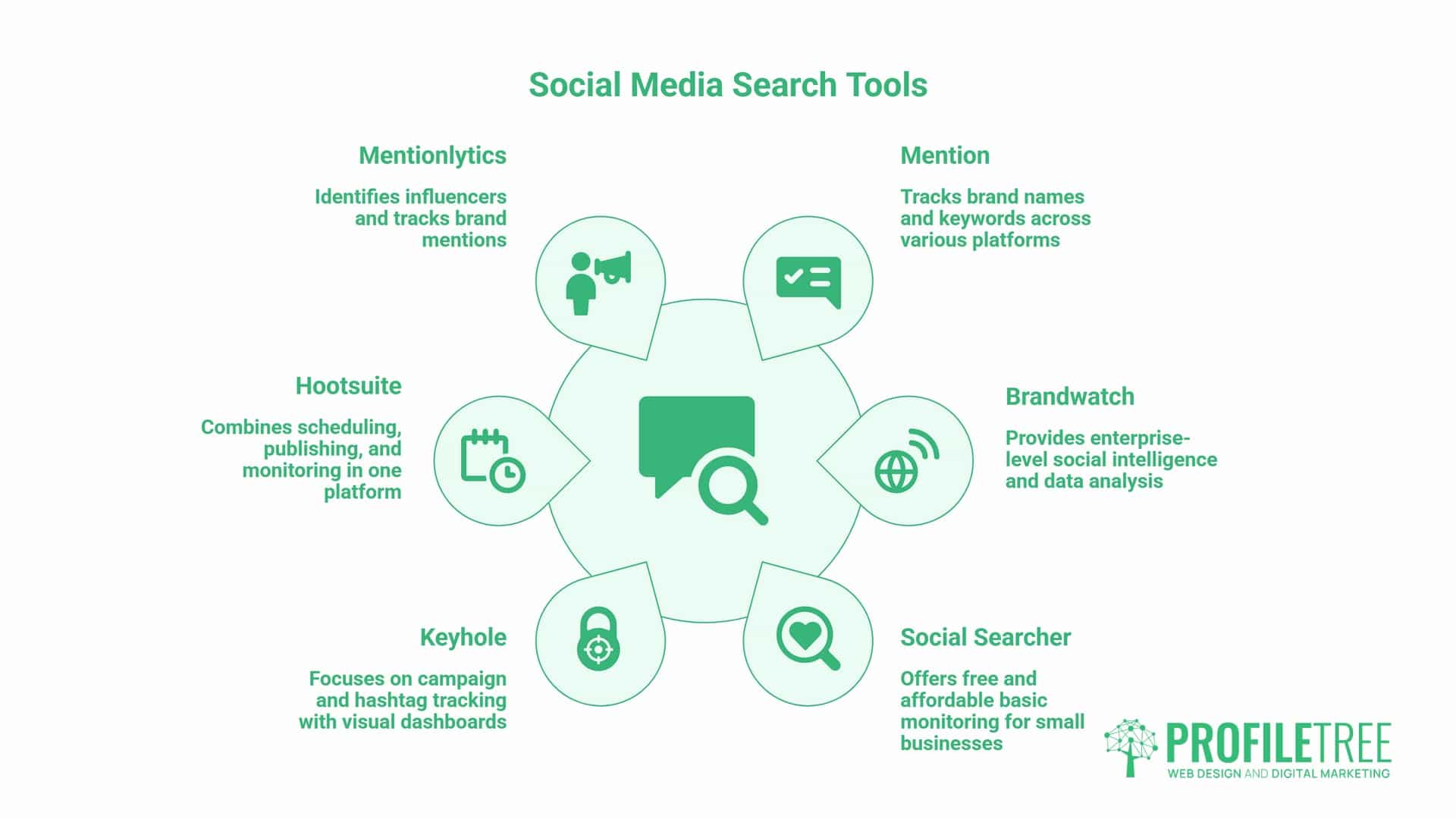
The right tool depends on what you’re trying to do. Brand monitoring for a business of 20 employees looks different to OSINT research or influencer discovery for a campaign. These categories reflect real differences in functionality, not just marketing positioning.
- For brand monitoring and reputation management: Mention tracks brand names, keywords, and competitor names across social networks, news sites, blogs, and forums in real time using Boolean search logic, so you can set up precise queries that exclude irrelevant results from the start. Mention has moved away from its old self-serve tiers.
- As of 2026, its pricing page shows a single demo-gated “Company” plan, with published entry pricing of around $599 per month in G2’s comparison listings, and API access and historical data now sold as paid add-ons rather than bundled in (source: Octolens’s 2026 social listening tools comparison). The Publish and Respond features have also been folded into its sister product, Agorapulse. If your business relied on Mention’s old £41-a-month Solo plan, that tier no longer exists, and it’s worth re-checking whether Mention still fits your budget before renewing.
- For enterprise intelligence: Brandwatch sits at the top end of the market in terms of both capability and cost. It monitors billions of public data points, offers image analysis to detect logo mentions in photos, and provides audience segmentation that goes well beyond what mid-market tools offer. Its historical data archive dates back further than most competitors’, which is useful for trend analysis, and it remains one of the few platforms with official API partner access to X.
- Pricing is not published publicly and requires a sales conversation. For most SMEs, the cost is hard to justify unless social intelligence is a core business function. For agencies managing multiple large-brand clients, the depth of data and the quality of reporting can justify the investment.
- For small businesses and free monitoring: Social Searcher is the most accessible entry point for businesses not ready to pay for a dedicated monitoring platform. The free plan allows up to two saved email alerts and basic searches across Facebook, X, Instagram, TikTok, YouTube, and a handful of others. Results appear quickly, and the interface is straightforward.
- Paid plans now start at around €3.49 a month for basic tracking, rising to roughly €19.49 a month for fuller analytics access (source: Social Searcher’s own pricing page, checked 2026), which keeps it genuinely affordable for small businesses. The limitations are real: no sentiment scoring on the free plan, no in-depth historical data, and X/Twitter coverage has stayed inconsistent since the API changes. For basic monitoring and one-off searches, it still works well.
- For campaign tracking and hashtag research: Keyhole is built around campaign and event tracking rather than broad monitoring. It produces visual dashboards that show hashtag performance, top posts, and audience demographics across platforms, making it practical for measuring campaign reach, tracking an event hashtag, or benchmarking a product launch across networks.
- Keyhole was acquired by Muck Rack in 2024 and folded into its PR and communications platform. Pricing has moved up accordingly: the Professional plan now starts at roughly $179 per month for three trackers, with Corporate and Enterprise tiers running at $539 and $999 per month (source: Keyhole’s published 2026 pricing, via SocialRails). There’s no permanent free plan, only a 14-day trial. For businesses running regular campaign activity, visual reporting still saves real time, but it’s meaningfully more expensive than it was.
- For all-in-one management and monitoring: Hootsuite Hootsuite combines scheduling, publishing, and monitoring in a single platform, making it a practical choice for teams that want to manage their social presence and track conversations in one place. The Streams feature lets you set up persistent searches for keywords, mentions, and hashtags across connected accounts.
- It’s not a specialist monitoring tool: for deep sentiment analysis or competitor intelligence, platforms built specifically for listening give better results. Hootsuite has also dropped its permanent free plan; pricing in 2026 starts at $99 a month for the Professional tier (one user, ten social accounts), rising to $249 for Team and $739 for Business, with a 30-day trial in place of a free tier (source: Hootsuite’s published 2026 pricing). For a small business team that needs scheduling and monitoring without managing two separate tools, it’s still workable, but budget for the higher entry price.
- For influencer research: Mentionlytics covers brand mentions and keyword tracking, but its standout feature for many marketing teams is influencer identification. After running a search, the platform surfaces the top influencers discussing your topic or brand, along with reach and engagement data, making it significantly faster to identify relevant creators than manual searches across platforms.
- Pricing in 2026 starts at around $69 per month for the Basic plan, then moves through Essential, Advanced, and Pro, up to $999 per month for Enterprise (source: Mentionlytics’ 2026 pricing via Capterra). There’s still no permanent free tier, though a free trial is available. The platform suits businesses with an active influencer or PR strategy more than those doing occasional monitoring.
Tool Comparison: Quick Reference
| Tool | Best For | Free Plan? | Approx. Starting Price (2026) | X Data Access |
|---|---|---|---|---|
| Social Searcher | Free monitoring, quick searches | Yes (limited) | ~€3.49/month | Limited, post-API changes |
| Mention | Brand monitoring, sentiment tracking | Demo-gated only | ~$599/month (Company plan) | Add-on |
| Keyhole | Campaign and hashtag tracking | No (14-day trial) | ~$179/month | Enterprise tier only |
| Hootsuite | All-in-one management and monitoring | No (30-day trial) | ~$99/month | Limited |
| Mentionlytics | Brand and influencer discovery | No (free trial only) | ~$69/month | Limited |
| Brandwatch | Enterprise intelligence | No | Contact for pricing | Official partner access |
How to Search Social Media Without Paying for a Tool
A paid monitoring platform isn’t always necessary, particularly for one-off research tasks. Google’s advanced search operators and platform-native search tactics can cover a lot of ground for free. The key is knowing which operators to use and where.
- Google search operators for social media content: Google indexes a large share of public social media content, and its advanced search syntax lets you filter results by platform, date, and keyword combination. A few practical examples:
- Search a specific platform:
site:instagram.com "your brand name"returns public Instagram posts mentioning the term. Combine platforms in one search:[brand name] (site:facebook.com OR site:linkedin.com)pulls results from both networks simultaneously. Date-range filtering: addafter:2026-01-01 before:2026-06-30to limit results to a specific period, useful for tracking coverage around a campaign or event. Exclude irrelevant results: add a minus sign before any term to remove results containing it, e.g.site:twitter.com "brand name" -jobto filter out job postings. - These techniques work best for research rather than ongoing monitoring. For businesses that continuously track their social media interactions, manual Google searches don’t scale. But for a competitor audit or a one-off brand health check, they’re surprisingly thorough.
- Search a specific platform:
- Using Boolean search within platforms: Boolean logic (AND, OR, NOT) is natively supported by some platforms. LinkedIn’s search is the most capable; it accepts full Boolean strings in the search bar, allowing you to filter by company, job title, location, and keywords. X’s advanced search supports AND/OR operators and date ranges. For businesses researching prospects, tracking industry discussions, or auditing their own X handle mentions, these built-in options are worth using before paying for third-party access.
- TikTok native search: TikTok’s search has become a genuinely useful tool in its own right, particularly for trend research and insight into younger audiences. With TikTok in the UK now one of the dominant platforms for discovery, businesses that ignore TikTok’s search data are missing out on real audience intelligence. The platform allows keyword and hashtag searches across videos, accounts, and sounds. Results can be filtered by date, making it practical for tracking the emergence of trends over time.
Using Free Social Media Analytics Alongside Search Tools
Search tools tell you what’s being said. Analytics tools tell you how your own content is performing. The two work best together. Free social media analytics platforms, including Meta Business Suite, LinkedIn Analytics, and TikTok’s native creator tools, provide reach, engagement rates, and audience demographics at no additional cost.
Ciaran Connolly, founder of ProfileTree, puts it directly: “Most SMEs don’t need enterprise monitoring software. What they need is a clear process: check mentions manually each morning using a saved search, review their own analytics weekly, and run a deeper competitor search quarterly. That combination catches nearly everything that matters without any subscription cost.”
The paid tools earn their keep when volume reaches a point where manual checking becomes impractical, or when you need historical data, sentiment scoring, or multi-user team access. For early-stage businesses or those with limited digital marketing budgets, the free-plus-manual approach is a sensible starting point.
UK and EU Legal Considerations for Social Media Searching
Using social media search tools to monitor individuals, scrape user data, or build audience profiles without a lawful basis exposes you to UK GDPR and the Data Protection Act 2018. Most monitoring activities focused on publicly available brand mentions, hashtags, and keyword searches fall within legitimate business interest, but the boundary becomes less clear when you’re searching for individuals by name, using tools that access private or semi-private data, or building detailed profiles of specific people.
The UK Online Safety Act, which came into force progressively from 2024, introduced additional obligations for platforms and has implications for how businesses use third-party tools that interface with platform data.
Specifically for HR and recruitment purposes, using social media search tools to research candidates introduces risks related to protected characteristics. Seeing information about someone’s ethnicity, religion, or health status during a search (even incidentally) creates a paper trail that employment law treats carefully. Businesses using search tools for hiring should seek advice on their specific process and document how they handle the data they find.
The broader point is that social media monitoring is not a legal grey area: it sits within existing data protection law and the digital marketing ethics framework that applies to all online business activity in the UK. The key distinction is public interest and proportionality: monitoring public posts about your brand is lawful; building detailed dossiers on private individuals is not.
It’s also worth noting that social media security risks extend to the tools themselves. Third-party monitoring platforms require API access to the accounts you connect. Always audit which tools have access to your social accounts, and revoke permissions for any platform you no longer use.
Building a Practical Search Schedule
The volume of content produced across social platforms every day is enough to overwhelm any monitoring system without a clear process. A structured search schedule is more practical than trying to monitor everything in real time.
- Daily checks (10 to 15 minutes): Run a saved keyword search for your brand name, common misspellings, and your most important product or service names. Check any direct mentions across the platforms you’re active on. Flag anything requiring a response for your customer service or PR team.
- Weekly review (30 to 45 minutes): Run a broader search covering your primary industry keywords and competitor names. Note emerging topics or conversations that could inform your content calendar and wider digital strategy. Check which of your own posts are generating the most shares and comments; these give signals about what your audience actually wants to discuss.
- Monthly competitor audit: Use Boolean search operators or a monitoring tool to review what your competitors are posting, what engagement they’re getting, and what their audience is saying about them. Cross-reference this with your own social media results and platform-native data to identify gaps in your positioning.
- Quarterly keyword refresh: Search trends shift over time. Terms that were central to your industry six months ago may have been replaced by new language, new platforms, or new audience concerns. Review and update your saved search queries quarterly to make sure you’re capturing what’s actually being discussed, not just what was relevant when you first set up the tool.
How ProfileTree Can Help
ProfileTree is a Belfast-based digital agency working with SMEs across Northern Ireland, Ireland, and the UK. The team builds social media strategies grounded in audience research, content planning, and performance data. Monitoring is only useful if it feeds into action; for a closer look at how structured social media activity turns into enquiries and revenue, see how social media marketing increases sales. For support with social search or content strategy, get in touch.
FAQs
What is the best free social media search tool?
Social Searcher remains the most capable free option, covering Facebook, X, Instagram, TikTok, and YouTube with up to two saved email alerts on the free plan. Google Alerts, paired with platform-native search, is a viable alternative for basic brand monitoring.
Which social media search tools still work after the X API changes?
Brandwatch retains official API partner access to X. Keyhole offers X data mainly on its higher-tier Enterprise plan following its 2024 acquisition by Muck Rack. Most other tools, including Mention, Hootsuite, and Mentionlytics, now offer partial or reduced X coverage since X moved to pay-per-use pricing in February 2026, so confirm current access with any tool before subscribing.
Is it legal to use social media search tools to monitor competitors?
Monitoring publicly available posts, mentions, and hashtag performance is legal and standard practice. UK GDPR applies if you collect personal data in the course of your activities, so avoid building profiles of private individuals.
What is Boolean search, and how does it apply to social media?
Boolean search uses AND, OR, and NOT operators to narrow results. LinkedIn and X both support Boolean queries natively; most paid monitoring platforms build this logic into their search interfaces.
Do social media search tools track private accounts?
No legitimate tool indexes private content. Search tools access only publicly available posts and profiles; private posts, direct messages, and restricted content are not accessible through any commercial platform.
How do I search social media posts by date?
On X, use since:YYYY-MM-DD until:YYYY-MM-DD in the search bar. On Google, add after:YYYY-MM-DD before:YYYY-MM-DD alongside a site: operator. Instagram has no native date filter; a third-party tool is the most reliable workaround.
Can I search all social media at once?
Paid platforms like Hootsuite, Mention, and Brandwatch pull data from multiple networks into one dashboard. For free, Google’s site: operator lets you query several platforms simultaneously: [keyword] (site:instagram.com OR site:facebook.com OR site:linkedin.com).