
Structured Data in SEO: What It Is and Why It Matters
Table of Contents
Structured data gives search engines a clear, machine-readable description of your content. Without it, Google has to guess what your page is about. With it, you hand over the answer directly, and that precision is what unlocks rich results, better visibility, and stronger performance in AI-powered search.
This guide covers what structured data actually is, the schema types most relevant to SMEs, how to implement it without a developer on call, and what to realistically expect in return. If you run a website and care about how it performs in search, this is worth reading carefully.
What Is Structured Data?
Structured data is a standardised format for labelling the content on a web page so that search engines can interpret it accurately. Instead of reading through your text and inferring meaning, Google reads the structured data and knows immediately: this is a product, this is a review, this is a local business with these opening hours.
The most widely used vocabulary for this is Schema.org, a collaborative project backed by Google, Microsoft, Yahoo, and Yandex. Schema.org provides a shared language of types and properties, hundreds of them, covering everything from recipes and events to job postings and software applications.
The Three Main Formats
Schema markup can be written in three formats. JSON-LD is the format Google recommends, and the one most developers prefer. It sits in a script tag in the page’s head section, separate from the visible content, which makes it easier to add and update without touching the page layout.
Microdata embeds markup directly into the HTML of a page using attributes. It works, but it becomes harder to maintain as pages get more complex. RDFa does something similar and is still used on some sites, but for most SMEs implementing schema from scratch today, JSON-LD is the practical choice.
What Search Engines Do with It
When Googlebot crawls a page, it reads both the visible content and any structured data present. If the two match, if your schema markup describes the same content that’s actually on the page, Google can use that information to generate rich results. The markup doesn’t replace your content; it annotates it.
Google is also explicit that structured data helps its AI systems understand relationships between entities. A page that clearly identifies itself as a local business, names its services, and provides consistent contact details gives Google far more to work with than plain text alone.
Why Structured Data Matters for SEO
Structured data is not a direct ranking factor in the traditional sense; adding schema markup won’t push you from position 8 to position 3 overnight. What it does is make your content eligible for features that change how your listing appears in search results, which in turn affects how many people click on it.
Rich Results and Enhanced Listings
Rich results are the visual enhancements that appear in Google search alongside or instead of standard blue links. Star ratings under a review page, a price and availability block under a product, a date and location under an event listing, all of these come from structured data.
Pages that display rich results consistently earn higher click-through rates than comparable pages without them. This is partly because the listing looks more informative and partly because richer listings take up more visual space on the results page. Both effects compound over time as your pages accumulate clicks and engagement signals.
AI Overviews and Answer Visibility
Google’s AI Overviews and other AI-powered search features draw heavily on structured, well-labelled content. Pages that use schema markup to clearly identify key facts, especially in self-contained sections, are better positioned to be cited in these features. Research from Ahrefs found that pages covering multiple sub-questions within a topic are 161% more likely to appear in AI Overviews, and clear entity labelling through structured data is part of what enables that.
This matters because AI-generated answers are increasingly the first thing users see. Being cited there is a different kind of visibility from a traditional organic ranking; it’s a recommendation, not just a link.
Local Business Visibility
For SMEs with a physical location or a defined service area, the LocalBusiness schema is one of the most immediately impactful types to implement. It tells Google your business name, address, phone number, opening hours, and service areas in a structured format that feeds directly into Maps results and local knowledge panels.
“Structured data is one of the most consistently underused tools we see when auditing SME websites,” says Ciaran Connolly, founder of ProfileTree. “Most businesses assume it’s too technical to bother with, but the basics, LocalBusiness, Article, FAQ schema, can be added in an afternoon, and the impact on how your site appears in search is immediate.”
ProfileTree’s digital marketing work with clients across Northern Ireland, Ireland, and the UK consistently shows that local businesses with complete structured data outperform competitors in map pack results, even when the competitors have higher domain authority.
The Schema Types That Actually Matter for SMEs
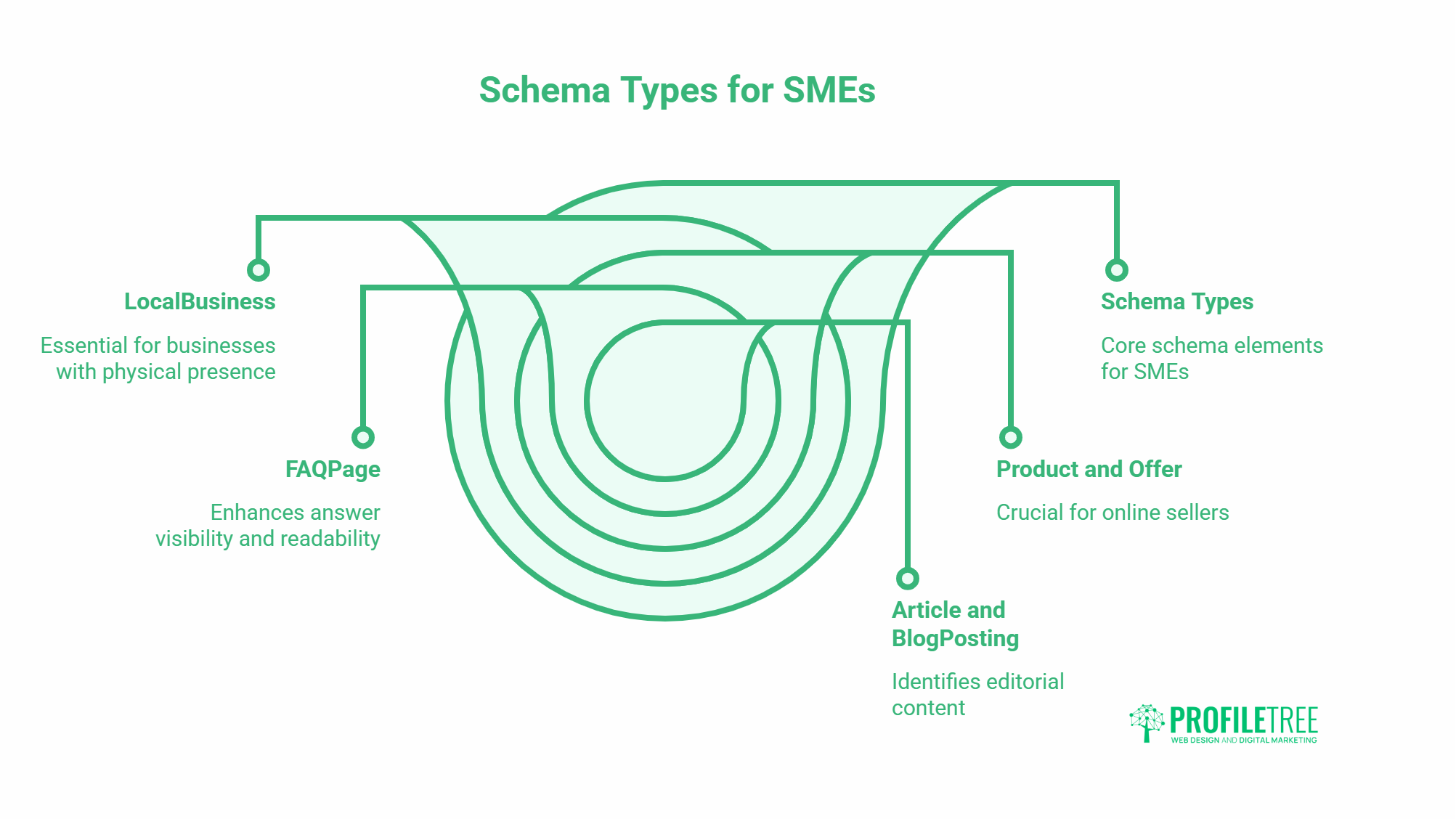
There are hundreds of schema types, but most small and medium businesses need to focus on a small handful. Getting these right is more valuable than implementing a dozen types badly.
Article and BlogPosting
For content-heavy sites, the Article schema identifies your posts as editorial content and passes key metadata, author, publication date, headline, and featured image to Google in a format it can act on. This is particularly relevant if you’re investing in content marketing, where author credentials and publication freshness both influence how Google treats your content.
The February 2026 core update made author credentials a first-class ranking input. Marking up your author information with structured data is no longer optional if you want your content to be treated as authoritative.
FAQPage
FAQ schema can trigger accordion-style rich results that display questions and answers directly in Google search. Even when they don’t generate the accordion feature, they make your content more legible to AI systems that extract answers to common questions. Every article on ProfileTree that includes a structured FAQ section should have the FAQPage schema applied by the development team.
Product and Offer
If you sell products online, Product schema is non-negotiable. It enables price, availability, and review data to appear directly in search results, which directly reduces friction for buyers comparing options on Google. WooCommerce and Shopify both have plugins and built-in features to automate this, but the output should always be validated before going live. Structured data that contradicts your visible page content can trigger manual actions from Google.
LocalBusiness
As covered above, the LocalBusiness schema is the highest priority for any business with a physical presence or defined service area. It feeds into Google Business Profile integration, local pack results, and the knowledge panel that appears when someone searches for your business by name.
BreadcrumbList
Breadcrumb schema tells Google the navigational hierarchy of your site, which helps it understand how your pages relate to each other. It also displays the breadcrumb path in search results instead of (or alongside) the raw URL, which makes listings look cleaner and more structured. This is especially useful for sites with deep content architectures, multiple categories, subcategories, and detailed topic pages.
How Structured Data Works in Practice
Implementation varies depending on how your site is built. For WordPress sites, which account for a large share of SME websites in Northern Ireland and the UK, there are plugins that handle much of the heavy lifting. Yoast SEO and Rank Math both generate JSON-LD automatically for posts, pages, and products based on content you enter in their settings panels.
Implementing Schema on WordPress
The basics are largely automated in a well-configured WordPress setup. Site-wide LocalBusiness and Organisation schema can be set in the SEO plugin’s site identity settings. Article schema is applied automatically to posts. Product schema is handled by WooCommerce with the right plugin configuration.
Where plugins fall short is in more specific schema types: FAQPage, HowTo, Event, and custom types for specialist sectors. These typically need to be added manually as JSON-LD in a custom HTML block or via the theme’s functions file. For most SMEs, this is a one-time task per template that a web design team can handle in a single session.
Validating Your Markup
Before any structured data goes live, it must be validated. Google provides the Rich Results Test for this purpose, paste a URL or a code snippet, and it will tell you exactly which rich result types the page is eligible for and flag any errors in your markup.
Common validation errors include missing required properties (a Product schema without a name, for example), inconsistencies between the markup and the visible page content, and markup applied to content that doesn’t exist on the page. All three will prevent rich results from displaying, and the third can attract a manual action from Google’s spam team.
Keeping Markup Up to Date
Structured data isn’t a one-time task. Schema.org updates its vocabulary regularly, Google adjusts which types it uses for rich results, and your own page content changes over time. A product page with markup showing an old price, or an event page with a date that has passed, creates the exact inconsistency that undermines trust in your structured data. Build a review of key schema types into your regular site maintenance cycle; quarterly is a reasonable cadence for most SMEs.
Structured Data, E-Commerce, and Content Performance
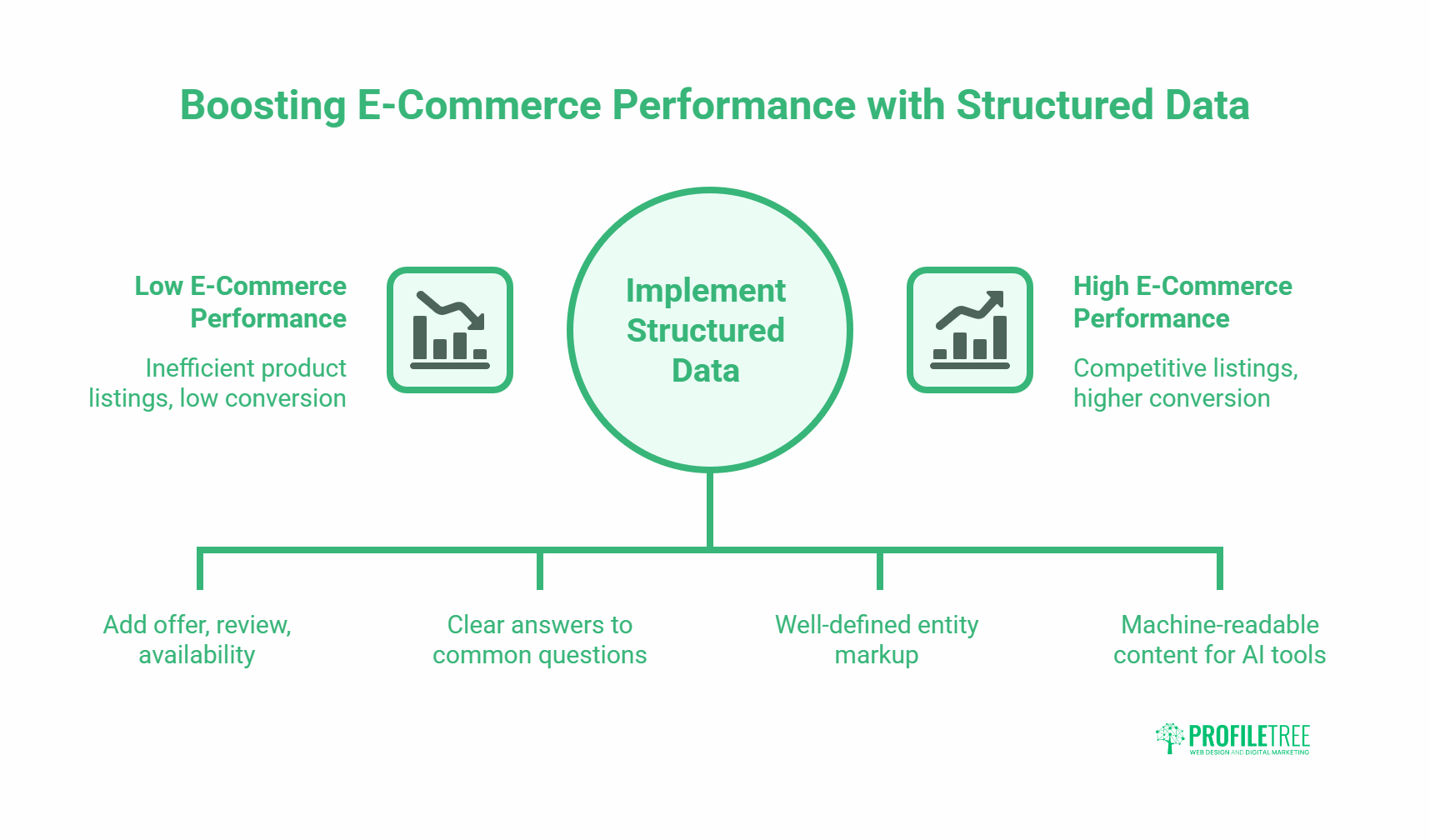
For e-commerce sites, the relationship between structured data and revenue is direct. Product schema with complete offer, review, and availability properties makes your listings more competitive in Google Shopping and in standard organic results. Shoppers who see ratings and pricing before they click are making a more informed decision to visit your site, which means a higher proportion of those clicks convert.
Measuring the Impact
Google Search Console’s Performance report breaks down clicks and impressions for pages with rich results separately from standard results. This is the most reliable way to measure what your structured data is doing for you. Look at CTR for pages where you’ve implemented schema versus comparable pages where you haven’t. The difference is usually visible within six to eight weeks of implementation.
Alongside CTR, track position changes on the queries driving traffic to schema-marked pages. Rich results don’t change your ranking position directly, but the engagement signals generated by higher CTR can influence position over time. This is one of the more compelling arguments for investing in schema as part of a broader digital marketing strategy rather than treating it as a one-off technical task.
Structured Data and Voice Search
Voice search queries are typically answered from featured snippets and structured content. Pages with clear FAQ schema, well-defined entity markup, and short, direct answers to common questions are the ones most likely to be read aloud by Google Assistant and similar systems. If voice search SEO is part of your strategy, structured data is a prerequisite, not an enhancement.
The Role of AI Implementation
Businesses investing in AI services and automation need structured data to function at a higher level, too. When AI tools crawl and process your website for any purpose, whether that’s your own internal knowledge base, lead generation automation, or third-party AI assistants recommending local services, structured data is what makes your content machine-readable without manual interpretation. The same markup that helps Google helps any AI system that processes your site.
Common Mistakes That Undermine Structured Data
The structured data errors that cause the most damage are the ones that look fine until you check the Rich Results Test. Knowing the failure modes in advance saves time and avoids SEO risks that can be difficult to unpick later.
Marking Up Content That Isn’t Visible
Every property in your structured data must correspond to something visible on the page. You cannot add a review rating to a page that shows no reviews, or list a price that doesn’t appear in the page content. Google’s guidelines are explicit on this, and violations can result in the rich result being suppressed or, in serious cases, a manual action.
Using Outdated or Incorrect Schema Types
Schema.org evolves. Types that were recommended three years ago may have been deprecated or superseded. Before implementing a new schema type, check the current Schema.org documentation and Google’s own guidance rather than relying on older tutorials. The gap between what a blog post recommends and what Google actually supports is often wider than it looks.
Inconsistency Across the Site
If your homepage Organisation schema lists your business name as “ProfileTree” but your contact page uses “ProfileTree Web Design Limited”, search engines see two different entities. Consistency in how you name and describe your business across every piece of structured data, and across your visible content, is what builds a coherent entity signal. Inconsistency erodes it.
Frequently Asked Questions
Does structured data directly improve search rankings?
Structured data is not a direct ranking factor in Google’s algorithm; adding schema markup to a page doesn’t move it up the results automatically. What it does is make your content eligible for rich results, which typically improves click-through rates, and it helps Google understand your content more precisely, which can influence how your pages are evaluated for relevance. The ranking benefit is indirect but real over time.
Which schema type should I implement first?
Start with the type that matches your highest-priority pages. For local businesses, that’s LocalBusiness. For content publishers, it’s Article combined with FAQPage on any posts that include a FAQ section. For e-commerce, the product schema on your product pages should be the first priority. Implement each type correctly and validate it before moving on, rather than rushing to cover everything at once.
Can I add structured data without a developer?
Yes, to a degree. On WordPress, SEO plugins like Yoast SEO and Rank Math generate the most common schema types automatically. For custom types, FAQPage, HowTo, and Event, you can write JSON-LD manually and paste it into a custom HTML block. The Rich Results Test will tell you immediately if the markup is valid. More complex implementations, such as site-wide schema templates or dynamic schema for large product catalogues, do require developer support.
How long does it take to see results from structured data?
Google typically crawls and processes updated schema within days of implementation. Rich results, if your markup is valid and your page qualifies, usually appear within one to four weeks. CTR and engagement improvements are measurable within six to eight weeks in Google Search Console. The full compounding effect of better structured data on your search visibility typically plays out over three to six months.
Does structured data help with AI search and Google AI Overviews?
Yes. Structured data makes your content more legible to AI systems by clearly identifying what entities are present on a page and how they relate to each other. Pages with well-structured schema, clear entity labelling, and self-contained answer sections are better positioned for inclusion in AI Overviews. As AI-generated answers become a larger part of how people find information, structured data becomes more important, not less.
What happens if my structured data has errors?
Errors in structured data typically mean the page won’t qualify for the rich result type you’ve targeted, and Google will ignore the markup rather than display incorrect information. More serious violations, such as marking up content that isn’t visible on the page, can result in manual actions that suppress rich results across your entire site. Validate all markup before publishing using Google’s Rich Results Test and address any errors before going live.
Putting Structured Data to Work
Structured data in SEO rewards the businesses that treat it as infrastructure rather than an optional add-on. The basics are not technically demanding, the tools for validating your work are free, and the payoff in richer search listings and AI visibility is measurable. Start with the schema types that match your highest-value pages, validate everything before publishing, and build a regular review into your site maintenance routine.
If you want support auditing your current structured data or implementing schema across a new or existing site, ProfileTree’s team works with SMEs across Northern Ireland, Ireland, and the UK on exactly this kind of technical SEO work. Get in touch to talk through what your site needs.