
Product Video Production for E-Commerce and Retail in Ireland
Table of Contents
A product video earns its place when it answers the questions a photograph cannot: how big is it, how does it move, how is it made, and what does it look like in use. For e-commerce and retail businesses across Ireland, Northern Ireland and the UK, that answer is the difference between a browser who hesitates and a customer who buys. ProfileTree, a Belfast-based digital agency, produces product video for online stores and retail brands that need footage built for conversion, not just for show.
This page covers the formats worth filming, how the production process works for a remote SME client, the technical specs each platform demands, what the work costs, and the logistics of getting products filmed when your business sits two hours from the nearest studio. If you already know you need a production partner, the video marketing services page is the place to start a conversation.
Types of Product Video: Choosing the Right Format
Different formats do different jobs. A 360-degree spin removes sizing doubt; a lifestyle film sells a feeling; an unboxing controls the first impression. Picking the wrong format wastes the budget, so start from the buying question you need to answer rather than the format that looks impressive.
360-Degree Product Spins
An interactive spin lets a customer rotate a product and inspect it from every side. This works hardest for items where construction and detail drive the decision: handbags, footwear, furniture, jewellery, and electronics where port placement and size matter. Seeing how a clasp closes or how a chair joint is finished answers the questions that send people back to a search bar.
Lifestyle and In-Context Films
Lifestyle video shows a product in the setting where it will be used. A Donegal knitwear maker filming a jumper worn on a coastal walk gives a customer something a flat studio shot never can: scale, drape, and context. These films suit brands selling on identity and craft, where the story around the product carries as much weight as the product itself.
Unboxing and Explainer Videos
An unboxing film sets the tone before a customer has bought anything, which is why brands increasingly produce their own rather than leaving it to reviewers. Explainer and assembly videos do quieter but valuable work: they cut the support queries and returns that come from customers who could not work out how something fits together.
Social-First Video for Retail Brands
Reels, TikTok and Shorts reward fast, vertical, sound-off-friendly footage with the hook in the first three seconds. A single shoot can produce this alongside the longer site footage, and the same assets feed an organic posting plan. Where that content needs a distribution strategy, ProfileTree’s video marketing service and YouTube work pick up where production ends.
How the Production Process Works
Most SME clients never set foot in the studio. A ship-and-shoot model works for the majority of product video: you send the items, the shoot runs to an agreed brief, and you review cuts remotely. That keeps a Galway or Limerick retailer on equal footing with a Dublin one.
Production runs in three stages. Pre-production agrees the shot list, formats and platform deliverables before anything is filmed, so there are no surprises at sign-off. The shoot captures the planned footage plus B-roll for later re-edits. Post-production handles the edit, colour, captions and the platform-specific versions. ProfileTree has written up the full sequence in the video production process explained for anyone who wants the detail before committing.
Filming once and editing many times is where the budget stretches furthest. One well-planned session can yield the hero film, the social cut-downs, and the spin, rather than three separate bookings.
Technical Specs by Platform
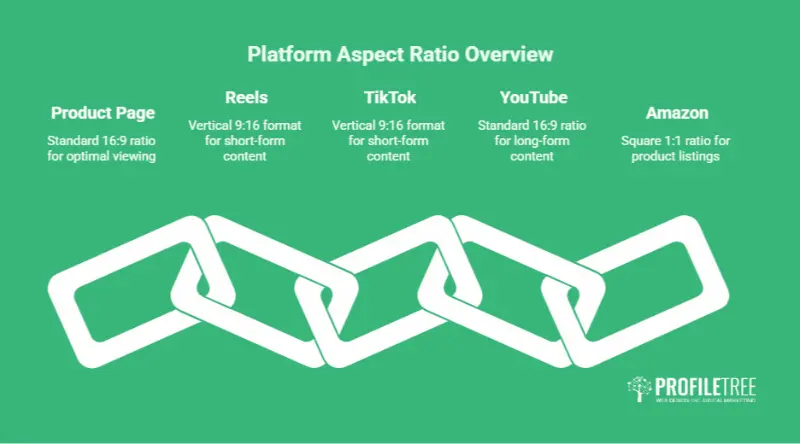
Each platform wants a different shape and length, and getting this wrong means footage that crops badly or loads slowly. Plan the deliverables before the shoot so the framing leaves room for every aspect ratio you need.
| Platform | Aspect ratio | Recommended length | Best use |
|---|---|---|---|
| Product page (site) | 16:9 or 1:1 | 30 to 90 seconds | Demonstration, 360 spin |
| Instagram Reels / Stories | 9:16 | 15 to 60 seconds | Social-first, lifestyle |
| TikTok | 9:16 | 15 to 60 seconds | Behind the scenes, hook-led |
| YouTube | 16:9 | 1 minute and up | Reviews, tutorials, search |
| Amazon listing | 16:9 or 1:1 | Under 60 seconds | Feature demonstration |
Video and Site Speed
Video can drag a page-load time down hard enough to cost rankings and conversions, so how it is embedded matters as much as how it is shot. Hosting through YouTube or Vimeo and embedding the player keeps the file off your own server and protects Core Web Vitals; native self-hosted files give more control but need lazy-loading and proper compression to avoid slowing the page. This is a build decision as much as a creative one, which is where ProfileTree’s web development team and the production side need to agree the approach early. Adding VideoObject schema and a transcript also helps the footage surface in search, a point worth raising with whoever handles your e-commerce conversion work.
What Product Video Costs in Ireland
Cost depends on three things: the number of products, the level of production, and how much post-production each clip needs. A straightforward studio shoot of several SKUs in one session sits at the lower end; a lifestyle film on location with talent, original sound and complex editing sits much higher. The honest guidance most retailers need is that one strong, well-planned video usually outperforms ten rushed phone clips for a premium brand, but volume catalogue work is a different job with different economics.
Batch shooting is the single biggest lever on cost per video. Filming twenty products in one booked session spreads the crew, lighting and studio setup across the whole run rather than paying to rebuild it each time. For high-SKU retailers, that is usually the deciding factor between video being affordable and being a luxury.
“A product video is not a creative extra, it is part of the buying decision. The job is to answer the question a customer would otherwise email you about, before they have to ask it,” says Ciaran Connolly, founder of ProfileTree.
Production Logistics Across Ireland and the UK
Geography should not decide whether a retailer can commission good video. Secure product collection and return, insured handling for fragile or high-value items, and remote review all make distance a non-issue, whether the products are coming from Cork, the west, or across the border. Cross-border transit between Northern Ireland and the Republic adds a paperwork layer that a production partner used to it can plan around rather than be caught by.
Frequently Asked Questions
How much does a product video cost in Ireland?
Cost is driven by product count, production level and editing complexity rather than a single fixed rate. A multi-SKU studio session is the most economical route for catalogue work, while a location lifestyle film with talent and original sound costs considerably more. The most useful way to budget is per session for batch work and per video for hero pieces. A scoped quote against your actual product list and platform needs will always beat a headline figure, so share the brief and ask for a breakdown of what drives the cost.
Do I need to be at the studio during filming?
No. Most retailers across Ireland and the UK use a ship-and-shoot model: products are sent in, the shoot runs to an agreed brief, and cuts are reviewed remotely. This keeps businesses outside Dublin and Belfast on the same footing as those next door to a studio and avoids travel time and cost.
What is the ideal length for a product video on a Shopify or WooCommerce store?
For a product page, aim for 30 to 90 seconds: long enough to demonstrate the product, short enough to hold attention next to the add-to-cart button. Social cut-downs should run 15 to 60 seconds in a vertical 9:16 frame. Filming with both in mind from the start means one session covers the site and the social channels.
Can you handle high-volume SKU production?
Yes, and batch shooting is the right approach for it. Filming many products in a single planned session spreads the fixed setup costs across the run and brings the cost per video down sharply. For retailers with large catalogues, this is usually the difference between video being viable at scale and being reserved for a handful of hero products.
Who owns the footage once it is produced?
Ownership terms should be agreed in writing before the shoot. Clarify whether you receive full commercial rights to the finished video and the raw footage, and confirm usage across the platforms you intend to publish on, so there are no limits on how you use what you have paid for.
How is shipping handled for fragile or high-value products?
Insured, tracked transit and careful handling on site are standard for items that cannot simply be posted in a jiffy bag. Agree collection, insurance cover and return arrangements in the pre-production stage, and flag anything especially fragile or valuable so handling can be planned around it rather than improvised on the day.
Getting Started
The practical first step is a short list: the products you want filmed, the platforms they need to appear on, and the question each video has to answer for a customer. With that in hand, a production partner can scope the formats, the session structure and the cost honestly. For e-commerce businesses weighing where video fits in a wider plan, ProfileTree’s work on e-commerce in Ireland sets the commercial context.